In process vs in progress can be confusing because both expressions can describe something that has started but is not finished. However, they do not always emphasize exactly the same idea.
In everyday English, in progress is the more natural choice when you mean that something is currently happening, continuing, or being worked on.
Cambridge defines in progress as something “happening or being done now,” with examples involving repairs, games, meetings, and audits.
In process, meanwhile, can be used when the focus is on a process, procedure, or stage of handling something. It also appears in specialized contexts such as manufacturing and accounting.
So, which one should you use?
The easiest rule is:
In progress = something is happening or underway.
In process = something is within a process or procedure.
Below, we will explore the difference, grammar, common mistakes, and more than 20 practical examples.
Also Read: Repore or Rapport: Which Spelling Is Correct? Meaning, Examples & Grammar Guide (2026)
In Process vs In Progress: What Is the Difference?
The simplest distinction is focus.
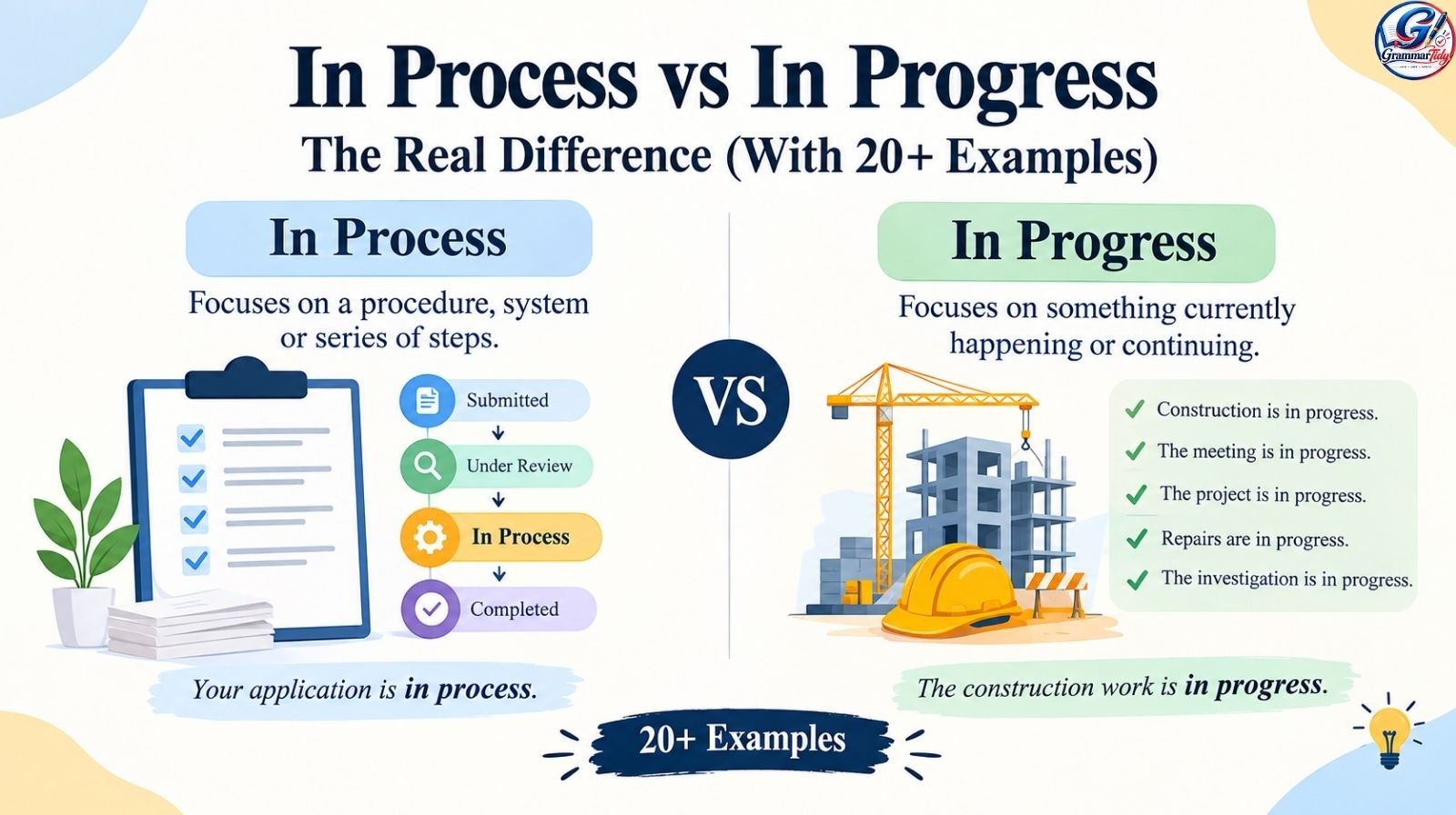
In progress focuses on the fact that an activity, event, task, or project is currently happening.
In process focuses more on something being handled within a particular process, system, or series of steps.
In Progress Meaning
In progress means something has started and is still happening or has not yet been completed.
Cambridge gives examples such as repair work being in progress and an audit still being in progress. Collins similarly defines the expression as something that has started and is continuing.
Examples:
- The construction is in progress.
- The meeting is in progress.
- The investigation is in progress.
- The project is in progress.
- Repairs are in progress.
In Process Meaning
In process can mean that something is currently moving through a process or being handled as part of a defined procedure.
For example:
- The application is in process.
- The request is in process.
- The order is in process.
- The documents are in process.
However, there is an important point: in process is not simply a universal replacement for in progress.
For many ordinary activities, in progress sounds more natural.
A Simple Memory Trick
Think of the two words this way:
Progress → movement toward completion
Process → a series of steps
So:
The renovation is in progress.
The application is in process.
The first sentence emphasizes ongoing work. The second can emphasize movement through an administrative procedure.
When to Use “In Progress”
Use in progress when something is actively happening, continuing, or being completed.
In Progress for Projects and Tasks
This is probably the most common use.
- The website redesign is in progress.
- Our marketing project is in progress.
- The report is in progress.
- The software update is in progress.
- The building renovation is in progress.
If someone asks, “What is happening with the project?” you can naturally answer:
“The project is still in progress.”
In Progress for Events and Activities
The phrase can also describe events that are happening right now.
- The meeting is in progress.
- The conference is in progress.
- The examination is in progress.
- The game was already in progress when we arrived.
- The ceremony is currently in progress.
Cambridge specifically uses in progress for meetings, games, repair work, and audits, showing how broadly the expression works in normal English.
In Progress for Construction and Repairs
This is another very natural context.
- Road repairs are in progress.
- Construction is in progress.
- The renovation is in progress.
- Maintenance work is in progress.
- The repairs are still in progress.
Quick tip: If you can replace the phrase with “underway” or “currently happening,” in progress will often be the natural choice.
Also Read: Unaffected vs Uneffected: Which Word To Use Correctly?
When to Use “In Process”
In process is less straightforward because it is more context-dependent.
It can be appropriate when something is being handled through a particular procedure or system.
In Process for Administrative Workflows
Consider an application moving through several stages:
- Application received
- Documents checked
- Information verified
- Approval considered
- Final decision
In this type of context, someone may describe the application as in process.
Examples:
- Your application is in process.
- The refund request is in process.
- The paperwork is in process.
- Your order is in process.
- The request is currently in process.
That said, many organizations have their own preferred status terminology. In general-purpose English, alternatives such as being processed, under review, or in progress may sound clearer.
In Process in Manufacturing
The word process has a particularly important technical meaning in manufacturing.
Cambridge recognizes work in process as a U.S. term associated with work in progress, particularly in business and accounting contexts.
Professional project-management terminology also uses in-progress activity for an activity that has started but has not been completed. The Association for the Advancement of Cost Engineering’s terminology defines an “in-progress activity” this way.
So technical fields may use process and progress in specialized ways that differ slightly from everyday conversation.
In Process vs. “In the Process Of”
Do not confuse in process with the much more common expression in the process of.
For example:
I am in the process of writing a report.
Here, in the process of is followed by an -ing verb.
Compare:
The report is in progress.
The first sentence focuses on the activity someone is carrying out. The second describes the status of the report.
In Process vs In Progress: 20+ Real Examples
The fastest way to understand this difference is to see the phrases in context.
Examples With “In Progress”
- The construction work is in progress.
- The meeting is in progress.
- The investigation is in progress.
- The website redesign is in progress.
- The repairs are in progress.
- The software update is in progress.
- The negotiations are in progress.
- The research project is in progress.
- The examination is in progress.
- The renovation is still in progress.
- The application review is in progress.
- The training session is currently in progress.
Examples With “In Process”
- Your application is in process.
- The refund request is in process.
- The order is in process.
- The paperwork is in process.
- The request is currently in process.
- The documents are in process.
- The payment is in process within the company’s system.
- The approval procedure is in process.
- The records are in process through the verification system.
- The claim is in process with the relevant department.
Also Read: Offerred or Offered: Which Spelling Is Correct & Why In 2026?
Better Alternatives in Some Cases
Sometimes neither expression is the clearest choice.
Instead of:
Your application is in process.
You might write:
Your application is being processed.
Instead of:
The documents are in process.
You might write:
The documents are under review.
Instead of:
The project is in process.
You would normally write:
The project is in progress.
This is why context matters more than simply memorizing one phrase.
Quick Comparison: In Process vs In Progress
| Feature | In Process | In Progress |
|---|---|---|
| Main idea | Within a process or procedure | Happening or continuing |
| Everyday English | Less common | Very common |
| Projects | Sometimes possible, but often awkward | Natural |
| Meetings | Usually unnatural | Natural |
| Construction | Less natural | Natural |
| Applications | Can occur in administrative contexts | Also possible and often clear |
| Manufacturing | Can be technical terminology | Also widely used |
| Events | Usually not preferred | Natural |
| Meaning of “underway” | Sometimes | Usually |
| Best general choice | Context-dependent | Often the safer everyday choice |
Cambridge’s dictionary treatment supports the broad everyday meaning of in progress, while its Business English material also recognizes work in process as a U.S. variant of work in progress.
Also Read: Oversite vs Oversight: What’s The Difference And Which Word Should You Use?
A Practical Case Study: Choosing the Right Phrase in a Business Email
Imagine that Sarah works for a software company. A customer emails her because a website redesign has not yet been completed.
The customer asks:
“Can you tell me whether the website project is in process?”
Sarah understands the question, but she wants to write a natural professional reply.
She could write:
“The website project is in progress, and our development team expects to complete the next stage this week.”
Here, in progress works naturally because the sentence describes an active project that the development team is currently working on.
Now imagine a different situation. The customer has submitted a refund request through the company’s automated support system. The request passes through several internal stages: submission, verification, approval, and payment.
In that context, the company might use:
“Your refund request is currently in process.”
However, Sarah could make the message even clearer by writing:
“Your refund request is currently being processed.”
The difference is subtle but useful. In progress naturally describes the ongoing activity itself, while in process can emphasize the fact that an item is moving through a defined workflow. Being processed is often the clearest choice when a company is handling a request through a system.
This case also shows why blindly replacing one phrase with the other is not a good strategy. The correct wording depends on what the writer wants the reader to understand.
A project being actively developed is naturally described as in progress. A request moving through a company’s internal procedure may be described as in process, although being processed may be clearer.
2025–2026 Usage and Data Snapshot
Current English-language reference material continues to show in progress as a well-established expression for ongoing activities.
Cambridge currently defines in progress as “happening or being done now” and provides examples involving repair work, games, meetings, and audits.
Collins likewise describes it as something that has started and is continuing. Its current American English entry also includes examples such as recruitment being in progress and a divorce being in progress.
There is also evidence of continuing specialized use of process. Cambridge’s current Business English dictionary lists work in process as a U.S. term that points to work in progress, while specifically documenting manufacturing and accounting usage.
Also Read: Acception vs Exception: Which One Is Actually Correct? (2026)
A 2026 research publication also demonstrates that in process remains an active expression in specialized educational terminology: a 68-person study published in International Journal of Instruction used “In process” as one of its achievement categories and reported 12 of 68 participants (17.6%) at that level in one pretest and 18 of 68 (26.5%) in the posttest.
This is not a general-English frequency statistic; it simply demonstrates current specialized usage.
Important: There is no single authoritative 2025–2026 statistic that gives a universal percentage for how often English speakers use in process versus in progress.
Search frequency, corpus frequency, and workplace terminology measure different things. Therefore, it is more accurate to use current dictionary and professional-language evidence rather than inventing a precise modern percentage.
Common Mistakes With “In Process” and “In Progress”
Mistake 1: Using “In Process” for Every Ongoing Project
A common sentence is:
The project is in process.
It may be understandable, but in progress is generally more natural when you simply mean that work on the project is continuing.
Better:
The project is in progress.
Mistake 2: Assuming “In Process” Is Always Wrong
This is also a mistake.
In process does exist in English, particularly in specialized, administrative, manufacturing, and business contexts.
For example:
The order is in process.
The exact acceptability and naturalness can depend on the organization’s terminology and the intended meaning.
Also Read: Humorous vs Humerous: Which Spelling Is Correct? 2026 Guide
Mistake 3: Confusing “In Process” With “In the Process Of”
These are not identical constructions.
Correct:
I am in the process of preparing the report.
Also correct:
The report is in progress.
The first emphasizes the person’s activity. The second emphasizes the report’s current status.
Mistake 4: Using “On Process”
English learners sometimes write:
The project is on process.
In standard English, this is generally not the expression you want.
Use:
The project is in progress.
Or, where appropriate:
The request is in process.
How to Choose Between “In Process” and “In Progress”
Use this simple three-step check.
Step 1: Is Something Happening Right Now?
If yes, in progress is usually the natural choice.
The meeting is in progress.
Step 2: Is Something Moving Through a Defined Procedure?
If yes, in process may fit, especially in specialized or organizational language.
The application is in process.
Step 3: Would Another Phrase Be Clearer?
Sometimes the best option is:
- being processed
- under review
- underway
- ongoing
- being developed
- in the process of
For example:
Your request is being processed.
This can be clearer than either in process or in progress.
Also Read: Tying vs Tieing: Correct Spelling & Easy Rule To Remember
Mini Quiz: In Process vs In Progress
Test yourself with these quick, easy questions and see how well you know the difference!
1. Which phrase means something is currently happening?
A) In progress
B) In process
Answer: A) In progress
2. Pick the natural sentence.
A) The meeting is in progress.
B) The meeting is in process.
Answer: A) The meeting is in progress.
3. Which phrase can describe something moving through a procedure?
A) In progress
B) In process
Answer: B) In process
4. Fill in the blank: “The construction work is ___.”
A) in progress
B) in process
Answer: A) in progress
5. Is “in progress” commonly used for ongoing projects?
A) Yes
B) No
Answer: A) Yes
6. Which sentence sounds more natural for an active website project?
A) The website project is in progress.
B) The website project is in process.
Answer: A) The website project is in progress.
7. Choose the better phrase: “Your application is currently ___.”
A) in process
B) in progress
Answer: A) in process
8. What does “in progress” mainly emphasize?
A) Something is ongoing
B) Something has been canceled
Answer: A) Something is ongoing
9. Which phrase is associated with steps or a procedure?
A) In process
B) In progress
Answer: A) In process
10. Spot the better sentence!
A) The game is in progress.
B) The game is in process.
Answer: A) The game is in progress.
11. What is the better choice for ongoing road repairs?
A) Road repairs are in progress.
B) Road repairs are in process.
Answer: A) Road repairs are in progress.
12. Complete the sentence: “I am in the process of ___ the report.”
A) writing
B) write
Answer: A) writing
13. Which expression can sometimes be clearer for a company handling a request?
A) Being processed
B) Being progressed
Answer: A) Being processed
14. True or False: “In process” and “in progress” always have exactly the same usage.
Answer: False.
They can overlap, but in progress commonly describes something ongoing, while in process can emphasize a procedure or workflow.
15. The Easy Memory Trick: Which one matches “ongoing”?
A) In progress
B) In process
Answer: A) In progress think progress = moving toward completion.
Also Read: Transferring or Transfering: Correct Usage In Business, Technology & Everyday English In 2026
FAQs
1. Is “in process” or “in progress” correct?
Both can be correct, but they are not equally natural in every situation. In progress is the standard everyday choice for something currently happening or being worked on. In process can be appropriate when the focus is on a defined process or workflow.
2. Is “in progress” more common in everyday English?
Yes. Major dictionaries treat in progress as an established expression meaning that something is happening or continuing. Cambridge and Collins both provide this meaning.
3. Which is correct: “The project is in process” or “The project is in progress”?
For an ordinary project that people are actively working on, “The project is in progress” is generally the more natural choice.
4. Can I say “the application is in process”?
Yes, particularly when referring to an application moving through an administrative or organizational procedure. However, “the application is being processed” or “the application is in progress” may be clearer depending on what you mean.
5. What does “in the process of” mean?
In the process of describes an activity that someone is currently carrying out.
For example:
I am in the process of changing my job.
It is different from:
The project is in progress.
6. Is “work in process” correct?
Yes. Cambridge recognizes work in process as a U.S. term pointing to work in progress, particularly in business and accounting contexts.
7. What is the easiest way to remember the difference?
Remember:
Progress = ongoing movement.
Process = steps or procedure.
If something is simply happening, in progress is usually the safer choice.
Conclusion:
The difference between in process vs in progress becomes much easier once you focus on the idea behind each phrase.
Use in progress when an activity, project, event, repair, investigation, or task is currently happening or continuing.
Use in process when you want to emphasize that something is within a particular process, procedure, or workflow, especially in specialized or organizational contexts.
When you’re unsure, ask yourself:
Is it happening? → In progress.
Is it moving through a process? → In process may fit.
And remember that in the process of, being processed, under review, and underway can sometimes communicate the intended meaning even more precisely.
If you regularly write emails, reports, academic content, or professional documents, keeping this distinction in mind will make your English clearer and more natural.
Discover More Article
- Amount or Ammount: Which Word Is Correct? (2026)
- Discard or Disgard: Which Spelling Is Correct?
- Continuous vs Continous: What’s The Difference? 2026
- Brite vs Bright: 7 Easy Ways To Know The Difference
Keep learning with more easy grammar lessons on GrammarTidy.com

Hi, I’m Noor Fatima, the author and creator of Grammar Tidy. I’m passionate about grammar, writing, and making language learning simple and enjoyable. Through Grammar Tidy, I share helpful tips, clear explanations, and practical guidance to help readers improve their writing, avoid common mistakes, and communicate with confidence. My goal is to make better grammar easy, useful, and accessible for everyone.