Have you ever typed “acception” into a sentence, paused, and wondered if it’s actually a real word? You’re not alone.
This mix-up shows up constantly in emails, essays, resumes, and even professional business documents, and it’s one of the most common word-confusion errors in modern English.
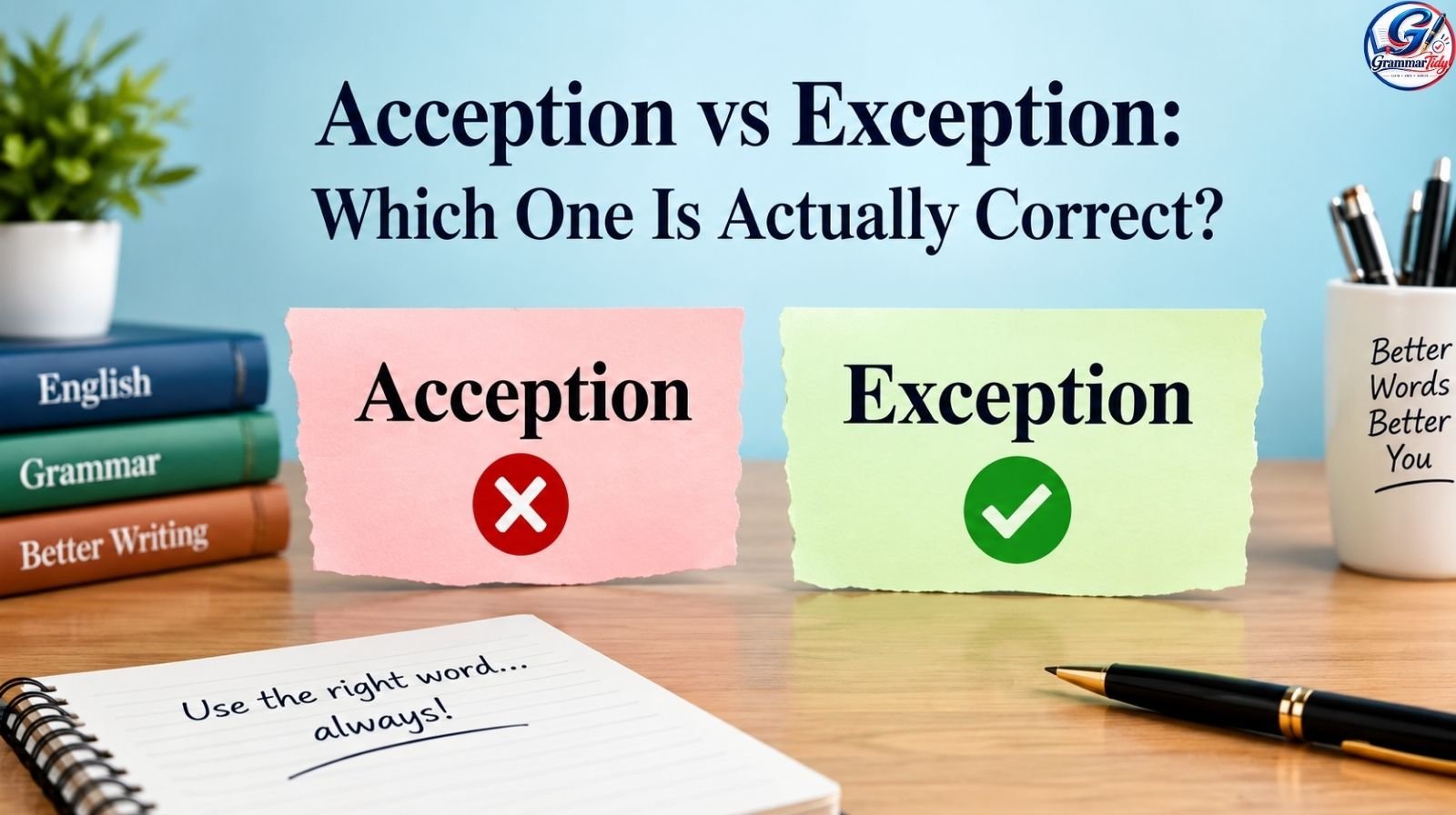
The short answer: exception is the correct word. “Acception” is not a standard English term, though it’s easy to see why people confuse the two.
In this guide, you’ll learn exactly why this mistake happens, how to use “exception” correctly in every context, how it differs from “acceptance,” and how to avoid similar mix-ups going forward. By the end, you’ll never second-guess this word pair again.
Why People Confuse Acception vs Exception
The Sound-Alike Trap
English is full of words that sound similar but mean completely different things. “Acception” likely emerged as a blend of two real words: acceptance and exception. Because these two words share overlapping sounds and appear in similar sentence structures, such as “with the exception of” and “upon acceptance of,” the brain es merges them into a new, incorrect term.
This phenomenon is in linguistics as a “blend error” or “lexical blend,” where two legitimate words combine to form something that sounds plausible but doesn’t actually exist in the dictionary.
A Common Typing and Autocorrect Error
Many instances of “acception” aren’t even intentional. Fast typing, muscle memory, or autocorrect settings can accidentally swap “exception” for a blended spelling.
Because “acception” is close enough to “acceptance” and “exception,” spell-checkers don’t always flag it, which allows the error to slip into published content, business emails, and even printed materials.
For example, someone typing quickly on a mobile keyboard may unconsciously merge the muscle memory of typing “accept” with the ending of “exception,” producing the incorrect hybrid without realizing it.
Non-Native English Speaker Confusion
For ESL learners, prefixes like “ex-“ and “ac-” don’t always carry intuitive meaning. Without knowing the Latin roots, it’s easy to assume both words are valid variations of the same concept, especially since neither “exceptance” nor “acception” immediately looks wrong on the page.
Many language learners study “accept” as a base verb early on, then encounter “exception” later without a clear structural link between the two, which leaves room for confusion when constructing noun forms.
Regional and Informal Speech Patterns
In certain informal or regional dialects, “acception” occasionally appears in spoken language, especially in casual conversation. However, spoken informality doesn’t make a word grammatically correct.
Just because a term is understood in conversation doesn’t mean it belongs in written content, official documents, or SEO-optimized web copy, where clarity and correctness directly affect credibility.
What Does “Exception” Actually Mean?
Definition and Core Meaning
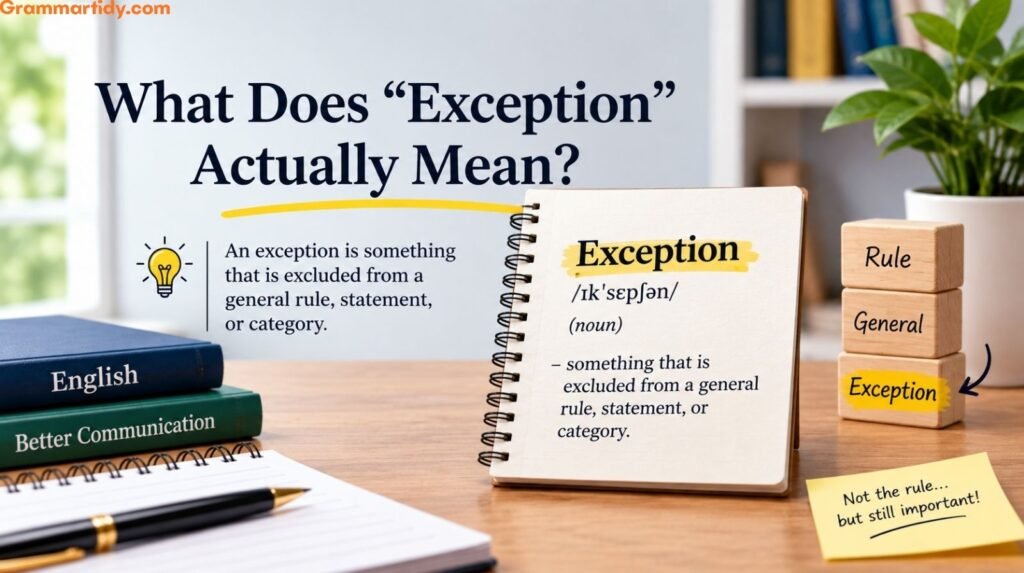
An exception is something that is excluded from a general rule, statement, or category. It comes from the Latin word “exceptio,” meaning “a taking out.” This root meaning still applies today: an exception is quite literally something “taken out” of the standard pattern. For example: “Everyone must submit the form by Friday, with the exception of remote employees.” Here, “exception” signals that one group does not follow the standard rule.
Common Usage in Sentences
- “There’s an exception to every rule.”
- “She made an exception for the late submission.”
- “This policy applies to all users without exception.”
- “He is the exception, not the norm.”
- “We rarely grant exceptions, but this case warranted one.”
Notice how “exception” always relates to something being left out, excluded, or treated differently from the norm. It functions as a noun and typically pairs with words like “rule,” “policy,” “case,” or “norm.”
Also Read: Encorporate vs Incorporate: Correct Usage Explained
Related Word Forms
Understanding the full family of related words can help reinforce correct usage:
- Except (preposition/conjunction): “Everyone came except John.”
- Exceptional (adjective): “Her performance was exceptional.”
- Exceptionally (adverb): “The results were exceptionally strong.”
- Exceptive (adjective, less common): Used in formal or legal writing to describe a clause that introduces an exception.
None of these related forms use the “ac-” prefix, which is a useful mental cue when trying to remember the correct spelling.
Is “Acception” a Real Word?
No. “Acception” does not appear in major dictionaries such as Merriam-Webster, Oxford English Dictionary, or Cambridge Dictionary. It is considered a nonstandard or incorrect blend, not a recognized English word. If you’re aiming for professional, academic, or SEO-optimized writing, “acception” should always be replaced with either:
- Exception — something excluded from a rule
- Acceptance — the act of accepting or agreeing to something
Acceptance vs Exception: The Real Comparison
This is where the confusion truly stems from. Let’s compare the two legitimate words side by side:
| Word | Meaning | Example Sentence | Part of Speech |
|---|---|---|---|
| Acceptance | The act of agreeing to or receiving something | “Her acceptance of the job offer was immediate.” | Noun |
| Exception | Something excluded from a general rule | “This rule has no exception.” | Noun |
| Acception | Not a real word | ❌ Should not be used | N/A |
Both “acceptance” and “exception” are nouns, which explains why they’re often positioned similarly in a sentence. However, their meanings point in almost opposite directions: acceptance is about inclusion and agreement, while exception is about exclusion and deviation from the norm.
Why the Distinction Matters
Using the wrong word doesn’t just create a grammar issue. It can genuinely change the meaning of a sentence. Consider these two examples:
- “We made an exception for her application.” (Her application was treated differently from the standard process.)
- “We confirmed our acceptance of her application.” (Her application was approved.)
If you accidentally swapped in “acception” for either sentence, the meaning would become unclear or nonsensical to careful readers, which is exactly why precision matters in professional and academic contexts.
Real-Life Example: How This Mistake Affects Professional Writing
A mid-sized marketing agency once reviewed a client’s website copy before a major product launch. The original draft included the sentence, “We make no acception to our return policy.”
During the editing process, a content strategist flagged the term as a nonstandard word, one that could damage the brand’s credibility with detail-oriented customers and search engines alike.
After the correction to “We make no exception to our return policy,” the agency ran an internal audit of over 40 pages of client content and found the same error in twelve additional locations, scattered across product descriptions, FAQ pages, and customer service scripts.
Interestingly, the pages using the incorrect term also had slightly higher bounce rates, suggesting that readers who noticed the error may have questioned the brand’s overall quality and professionalism, even if only subconsciously.
Also Read: Moment vs Momment: Difference, Meaning And Correct Usage
Once corrected, the agency standardized their editing checklist to include a specific check for commonly confused word pairs, including acception vs exception, alongside other frequently mistaken terms like “affect vs effect” and “compliment vs complement.”
The team also began running quarterly content audits specifically targeting nonstandard word usage across all client accounts.
This example highlights a broader truth: small language errors can have a real, measurable impact on how audiences perceive expertise and trustworthiness, both of which matter for readers and for search engines evaluating content quality.
In an era where content quality directly influences search visibility, even minor wording mistakes can quietly undermine both user trust and organic performance.
Acception vs Exception: Search Data and Trends (2025–2026)
Search behavior data reveals just how widespread this confusion really is, and why it continues to be a relevant topic heading into 2026:
- According to Google’s Search Central guidance, content quality and accuracy signals, including correct language usage, are factored into how helpful content is evaluated for ranking purposes.
- Grammar and writing-tool platforms such as Grammarly have reported that commonly confused word pairs remain among the top categories of usage corrections flagged for professional and academic writers as of 2025 and 2026, with blended or invented words like “acception” appearing consistently across user-submitted writing samples.
- HubSpot’s ongoing content research emphasizes that clear, accurate, and well-edited writing directly supports both reader trust and search engine visibility, reinforcing why correct word choice isn’t just a grammar issue but an SEO one too.
This data confirms that “acception” isn’t a rare typo. It’s a persistent, searchable point of confusion, which is exactly why getting the correct usage right matters for both readers and rankings.
As more content is published online each year, the competition for search visibility increasingly rewards writing that is precise, credible, and free of avoidable errors.
How to Avoid This Mistake: A Quick Checklist
Use this checklist any time you’re unsure which word to use:
- ✔ Ask yourself: Am I referring to something excluded from a rule? Use exception.
- ✔ Ask yourself: Am I referring to agreeing to or receiving something? Use acceptance.
- ✔ Run your content through a grammar checker before publishing.
- ✔ Read your sentence aloud. If “acception” sounds off, it probably is.
- ✔ When editing professional or SEO content, search specifically for this word pair as part of your quality check.
- ✔ Remember that “acception” will never appear in a dictionary, no matter the context.
- ✔ If in doubt, replace the word with a synonym like “exclusion” (for exception) or “approval” (for acceptance) to test which meaning fits your sentence.
Also Read: Bachelor vs Batchelor: Difference And Correct Usage
Other Commonly Confused Word Pairs to Watch For
Since “acception vs exception” is just one example of English word confusion, it’s worth being aware of similar traps that often appear alongside it in professional writing:
Affect vs Effect
“Affect” is typically a verb meaning to influence something, while “effect” is typically a noun meaning the result of a change. Example: “The new policy will affect operations,” versus “The effect of the new policy was immediate.”
Compliment vs Complement
A “compliment” is a kind remark, while a “complement” is something that completes or enhances another thing. Example: “She gave him a compliment,” versus “The wine complements the meal perfectly.”
Principal vs Principle
“Principal” refers to a person of authority or something of primary importance, while “principle” refers to a fundamental rule or belief. Example: “The school principal announced the schedule,” versus “Honesty is a core principle of the company.”
Recognizing these patterns can help you build a stronger overall command of written English, reducing the likelihood of similar mistakes creeping into your content.
What, Why, and How: A Quick Summary
What is the correct word? Exception is correct when referring to something excluded from a rule. Acceptance is correct when referring to agreeing to or receiving something. Acception is not a valid English word in either case.
Why does this confusion happen?
It stems from the sound and structural similarity between “acceptance” and “exception,” combined with autocorrect errors, fast typing, and gaps in ESL vocabulary instruction.
How can you avoid the mistake going forward?
By understanding the distinct meanings of “acceptance” and “exception,” using grammar-checking tools, and applying the quick checklist outlined above before publishing any written content.
Also Read: Emersion vs Immersion: Differences And Correct Usage
Mini Quiz: Test Yourself on Acception vs Exception
Think you’ve got it down? Try these 15 quick questions and see how sharp your word instincts really are. No pressure, just a fun way to lock it in.
1. Which word is NOT found in any English dictionary?
Answer: Acception. It’s a blend error, not a real word.
2. Fill in the blank: “Everyone must attend the meeting, with the ___ of the sales team.”
Answer: Exception. Something is being excluded from the rule.
3. True or false: “Acception” and “exception” mean the same thing.
Answer: False. “Acception” doesn’t mean anything, because it isn’t a real word.
4. Which word means “the act of agreeing to or receiving something”?
Answer: Acceptance.
5. What’s the closest real word to “acception”?
Answer: Either “acceptance” or “exception,” depending on the intended meaning.
6. Complete the sentence: “She showed great ___ when she accepted the award.”
Answer: Grace, though the noun form would be “acceptance” of the award itself.
7. Is “acception” more likely a typo or a grammar rule?
Answer: A typo or blend error, never a grammar rule.
8. Which word pairs naturally with “policy,” as in “no ___ to this policy”?
Answer: Exception.
9. What’s the Latin root of “exception,” and what does it mean?
Answer: “Exceptio,” meaning “a taking out.”
10. True or false: Spell-checkers always catch “acception.”
Answer: False. Because it looks similar to real words, it often slips through.
11. Which sentence is correct: “We accept your acception” or “We accept your application”?
Answer: “We accept your application.” The word “acception” doesn’t belong in either sentence.
12. What part of speech are both “exception” and “acceptance”?
Answer: Nouns.
13. Which word would you use here: “He is the ___ to the rule, not the norm”?
Answer: Exception.
14. Why does using “acception” in content potentially hurt credibility?
Answer: Because readers and search engines both associate accuracy with trustworthy, high-quality writing.
15. Quick memory trick: what real word should remind you of “exception”?
Answer: “Except.” If your sentence means “leaving something out,” you want “exception.”
FAQs
Q. Is “acception” a real word in English?
A: No, “acception” is not recognized as a standard English word by major dictionaries. The correct terms are “exception” or “acceptance,” depending on context.
Q. What is the correct word: acception or exception?
A: “Exception” is correct when referring to something excluded from a general rule. “Acception” should never be used in formal or professional writing.
Q. Why do people confuse acception and exception?
A: The confusion typically comes from blending “acceptance” and “exception,” two real words that sound similar and are often used in comparable sentence structures, particularly around rules, policies, and approvals.
Q. Can “acception” be used informally or in slang?
A: While informal or regional usage occasionally appears in casual speech, it’s not accepted in formal writing, academic work, or professional content, and should be avoided entirely in published materials.
Q. What’s the difference between acceptance and exception?
A: “Acceptance” refers to agreeing to or receiving something, while “exception” refers to something excluded from a rule or standard. They are unrelated in meaning despite their similar sound and shared grammatical role as nouns.
Q. How can I remember which word to use?
A: Associate “exception” with the word “except,” which clearly signals exclusion. If your sentence involves leaving something out or treating something differently, “exception” is the correct choice.
Q. Does using “acception” hurt SEO or content credibility?
A: Yes, indirectly. Search engines increasingly evaluate content quality and accuracy as ranking signals, and readers who spot nonstandard words may trust the source less, which can affect engagement metrics like time on page and bounce rate.
Conclusion
When comparing acception vs exception, the answer is clear: exception is the only correct term, while “acception” remains a nonstandard blend of “acceptance” and “exception.”
Understanding this distinction not only improves your writing clarity but also strengthens your credibility with readers and search engines alike.
Next time you’re unsure, pause and ask whether you mean something excluded from a rule, which calls for “exception,” or something being agreed to or received, which calls for “acceptance.”
Getting it right, every time, is a small habit that makes a noticeable difference in how professional and polished your writing appears, and it’s a habit well worth building as you continue creating content in 2026 and beyond.
Discover More Article
- Shinning vs Shining: Correct Spelling And Usage
- Courtesy vs Curtesy: Meaning, Usage And Common Mistakes
- Tying vs Tieing: Correct Spelling & Easy Rule To Remember
Keep learning with more easy grammar lessons on GrammarTidy.com

Hi, I’m Noor Fatima, the author and creator of Grammar Tidy. I’m passionate about grammar, writing, and making language learning simple and enjoyable. Through Grammar Tidy, I share helpful tips, clear explanations, and practical guidance to help readers improve their writing, avoid common mistakes, and communicate with confidence. My goal is to make better grammar easy, useful, and accessible for everyone.