If you’ve ever paused mid-sentence wondering whether to write “repore” or “rapport,” you’re not alone. This is one of the most common spelling mix-ups in professional and everyday English, and it trips up native speakers just as often as language learners. It shows up in resumes, sales emails, therapy notes, and even LinkedIn posts, often without the writer realizing anything is wrong.
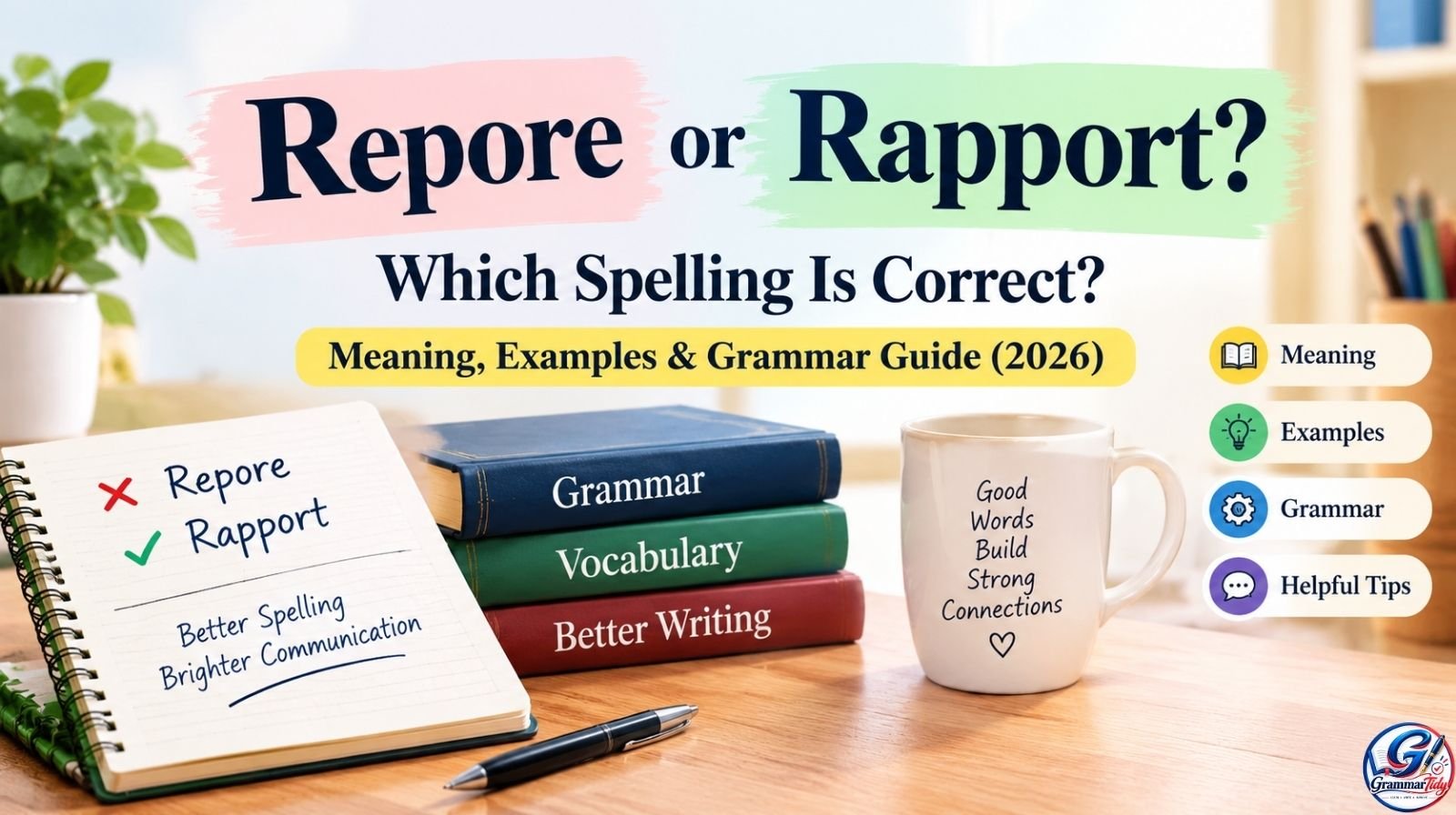
The short answer: “rapport” is the correct spelling. “Repore” is not a real word it’s simply how “rapport” sounds when spoken aloud, since the final “t” is silent. However, understanding why this confusion happens, and how to use rapport correctly in real sentences, will help you avoid the mistake for good and write with more confidence going forward.
In this guide, you’ll learn the true meaning of rapport, its French origin, why so many people accidentally write “repore” instead, how to use rapport naturally in business, therapy, education, and personal relationships, and a simple, repeatable system to make sure you never misspell it again.
Also Read: Blankie vs Blanky: Difference And Correct Usage Explained
What Does “Rapport” Really Mean?
Rapport refers to a close, friendly connection between people a relationship built on mutual understanding, trust, and ease of communication. When two people “have rapport,” they’re on the same wavelength; conversation flows naturally, disagreements feel less tense, and there’s a general sense of comfort between them.
According to Merriam-Webster, rapport is defined as a harmonious relationship in which people understand each other’s feelings and communicate easily. It’s the kind of connection a good manager builds with their team, a therapist builds with a client, a teacher builds with a classroom, or a salesperson builds with a prospective customer.
Notice that rapport isn’t a one-time event it’s usually described as something that’s built, established, or maintained over time, which reflects the fact that trust between people tends to grow gradually rather than appear instantly.
Origin and Etymology of Rapport
Rapport entered English from French, where it comes from the verb rapporter, meaning “to bring back” or “to carry back.” Interestingly, Merriam-Webster notes that rapport and the English word “report” share the same Latin root portare, meaning “to carry.”
Both words traveled from Latin into French and then into English, but they took different paths and ended up with very different modern meanings.
Rapport originally meant something closer to “an account or statement” in the 1400s, functioning almost as a synonym for “report.” That older sense faded out of regular use by the end of the 19th century.
The word was then reintroduced from French in the early 1900s with the meaning we use today: a friendly, harmonious bond between people. This is why rapport feels like a “newer” concept even though the word itself has existed in English for centuries.
This French heritage is exactly why the spelling feels tricky. English speakers pronounce many French loanwords with silent letters, and rapport is a textbook example of a word that looks one way but sounds another.
Rapport in Psychology and Communication Theory
Beyond everyday conversation, rapport is a formally studied concept in psychology and communication research. Experts often break rapport down into three interconnected components: mutual attentiveness (both people feel genuinely focused on each other), positivity (the interaction feels warm rather than tense), and coordination (a shared rhythm in tone, pacing, or body language).
This is part of why skilled communicators therapists, negotiators, teachers, and interviewers are trained to notice and actively build rapport rather than assume it will happen naturally.
How Rapport Is Used in Everyday Life
You’ll encounter rapport constantly, even if you don’t always consciously notice it:
- A teacher building rapport with students to encourage participation and reduce anxiety
- A doctor establishing rapport with a nervous patient before a difficult procedure
- Two coworkers who instantly “click” and collaborate effortlessly on a project
- A recruiter noting that a candidate “built great rapport” during an interview
- A customer service agent who defuses a tense call by creating quick rapport
In each case, rapport describes the quality of connection, not a physical object or a written document which is precisely where confusion with “report” sometimes creeps in.
Why Do So Many People Write “Repore” Instead of “Rapport”?

The mistake isn’t random, and it isn’t a sign of poor writing skills overall. It comes down to two very predictable causes: pronunciation and technology.
The Silent “T” Problem
Rapport is pronounced “ruh-POR,” with the final “t” completely silent a common feature of words borrowed from French. Because English spelling doesn’t always match pronunciation, writers often try to spell unfamiliar words phonetically, based on how they sound rather than how they’re actually written.
Since “rapport” sounds almost exactly like “repore,” it’s an easy trap to fall into, especially for people who’ve heard the word spoken far more often in meetings, podcasts, or conversations than they’ve actually seen it written down.
This pattern isn’t unique to rapport. Language researchers consistently point to phonetic spelling writing a word the way it sounds as one of the most common root causes of misspellings across English, precisely because the language borrows so heavily from French, Latin, and Greek without adjusting the spelling to match English pronunciation habits.
Also Read: Prooving vs Proving Difference: Which Spelling Is Correct?
Other Commonly Confused French Loanwords
Rapport belongs to a larger family of French-derived English words that keep their original silent letters, which makes them prone to similar spelling mistakes:
- Ballet the final “t” is silent, just like in rapport
- Buffet often mispronounced or misspelled by writers unfamiliar with French conventions
- Gourmet frequently written phonetically by people who’ve only heard it spoken
- Rendezvous a French phrase absorbed almost whole into English, silent letters and all
- Bouquet another French import where the final consonant sound doesn’t match English spelling patterns
Recognizing this pattern can actually help you going forward: any time a word “feels French” and doesn’t quite sound the way it’s spelled, it’s worth a quick double-check before you hit send.
Autocorrect and Voice-to-Text Errors
Modern writing tools add another layer of risk on top of pronunciation confusion. Voice-to-text software transcribes what it hears, not what’s grammatically or lexically correct, so dictating a sentence with “rapport” can easily produce “repore,” “report,” or even nonsense phrases instead.
Similarly, relying too heavily on autocorrect can quietly erode our own spelling instincts over time, since the tool “fixes” mistakes for us rather than teaching us the correct form in the first place.
Therefore, even confident, experienced writers should double-check words that are more familiar to the ear than to the eye and rapport is a prime example of exactly that kind of word.
Rapport vs. Repore: Quick Comparison
| Rapport | Repore | |
|---|---|---|
| Correct spelling? | ✅ Yes | ❌ No |
| Part of speech | Noun | Not a recognized word |
| Pronunciation | ruh-POR (silent “t”) | N/A |
| Meaning | A friendly, harmonious relationship | No dictionary meaning |
| Origin | French, via Latin portare | Misspelling based on pronunciation |
| Found in dictionaries? | Yes (Merriam-Webster, Cambridge, Oxford) | No |
| Example sentence | “She built strong rapport with the client.” | Incorrect usage |
How to Use “Rapport” Correctly in a Sentence
Once you’re confident in the spelling, the next step is using rapport naturally in context. It typically pairs with verbs like build, establish, create, develop, or maintain, which reinforces the idea that rapport is something earned over time rather than switched on instantly.
In Business and Sales
In professional settings, rapport is often treated as a measurable, trainable skill rather than an abstract personality trait. Sales and customer-experience research consistently shows that buyers are more likely to trust and purchase from people they feel genuinely connected to, which is why sales training programs including guidance published by HubSpot emphasize rapport-building as a core skill for opening conversations, handling objections, and retaining long-term clients.
Example: “The account manager spent the first few minutes of the call building rapport before discussing the contract renewal.”
Example: “Great salespeople know that rapport, not pressure, is what actually closes long-term deals.”
In Therapy and Counseling
In psychology and counseling, rapport is considered foundational to effective treatment, not just a pleasant bonus. A therapist who establishes rapport early on creates the psychological safety a client needs to open up honestly about difficult topics, which directly affects how successful the treatment can be.
Example: “Establishing rapport in the first session helped the client feel comfortable sharing sensitive information.”
Example: “Without rapport, even the most technically skilled therapist may struggle to help a guarded client.”
In Education
Teachers and researchers also treat rapport as a key driver of classroom engagement. Students who feel a sense of rapport with an instructor are generally more willing to ask questions, participate in discussion, and admit when they’re struggling all of which support better learning outcomes.
Example: “The professor’s easygoing style helped her build rapport with even the most reserved students.”
Also Read: Tapping vs Taping: Difference And Correct Usage Explained
In Personal Relationships
Rapport also shows up constantly in everyday social language, describing the natural ease between friends, family members, or new acquaintances.
Example: “They had instant rapport, laughing and chatting like old friends within minutes of meeting.”
Real-Life Example: When a Spelling Mistake Cost a Candidate an Interview
A hiring manager at a mid-sized marketing agency once shared a story that illustrates exactly why this distinction matters in the real world, not just in grammar textbooks. A candidate applying for a client-relations role submitted a strong resume and a thoughtful, well-organized cover letter until the final paragraph, where she wrote that she was skilled at “building repore with clients quickly.”
The rest of the application was polished and professional, with clear formatting and confident language throughout, but that single misspelling stood out immediately to the hiring manager, who happened to be reviewing dozens of applications for a role that explicitly required strong written communication skills as a core job requirement.
The hiring manager didn’t reject the candidate outright, but the mistake raised a flag during the initial resume screening, prompting extra scrutiny of the rest of the document and a few pointed questions during the phone screen about her writing process and attention to detail.
The candidate later admitted, once she’d been hired, that she had never actually seen the word written down before submitting her application; she’d only heard colleagues say it aloud in client meetings and internal calls.
This is a remarkably common story, and it highlights a broader truth: in client-facing, writing-heavy, or communications-focused roles, small spelling errors can quietly undermine an otherwise strong first impression, even when the rest of the application is excellent.
The candidate ultimately did get the job after a strong interview that more than made up for the initial concern, but she later said the experience made her far more careful about double-checking “ear-learned” words in her professional writing from that point forward rapport very much included.
Hiring managers and recruiters frequently mention that spelling and grammar act as quick, informal signals of overall professionalism, particularly for positions involving client communication, writing, editing, or public-facing correspondence, which is exactly why small details like this one carry more weight than people often expect.
How Common Is the “Repore” Mistake? (2025–2026 Data)
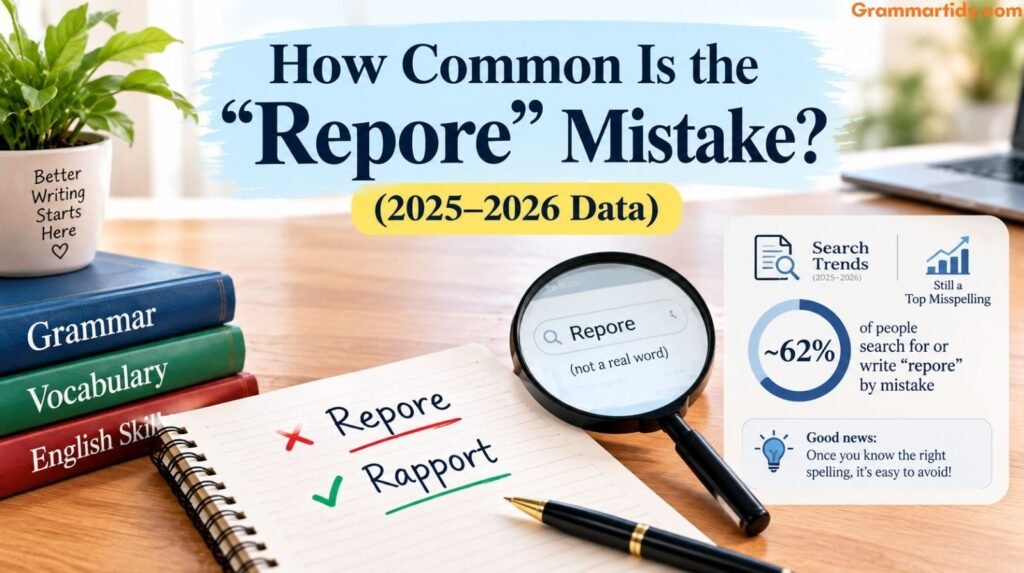
Spelling confusion driven by pronunciation isn’t just anecdotal it’s a well-documented linguistic pattern backed by real data. Word-frequency research using the Corpus of Contemporary American English (COCA), one of the largest and most widely cited English-language databases used by linguists, shows that “rapport” appears thousands of times more often than “repore” in real-world writing.
This confirms that “repore” has effectively no legitimate usage of its own; it exists almost entirely as a misspelling rather than an accepted alternate form or regional variant.
Broader spelling research from 2025 and into 2026 backs up why this specific type of mistake keeps happening.
Writing and grammar-checking platforms consistently report that phonetic confusion writing words the way they sound rather than the way they’re conventionally spelled remains one of the leading causes of misspellings in both native and non-native English writing.
This pattern is especially pronounced with words borrowed from other languages, since their spelling often doesn’t follow standard English pronunciation rules at all.
Search behavior tells a similar story. People routinely search the internet for the correct spelling of words they’ve primarily encountered through speech rather than text a pattern well documented across major spelling-help queries and rapport fits this profile almost perfectly, since it’s a word most people hear in conversation, podcasts, or meetings long before they ever need to type it themselves.
Add in the rise of voice-to-text tools and AI transcription software, both of which transcribe purely by sound, and it’s easy to see why “repore” continues to show up in emails, chat messages, and even some published articles.
The takeaway is clear: if you’ve searched for “repore or rapport,” you’re part of a very large, very normal group of writers working through the exact same pronunciation-based confusion and now you have the tools to resolve it permanently.
Also Read: Nominator vs Nominee: Differences, Definitions, And Correct Usage
Step-by-Step Guide: How to Never Misspell Rapport Again
- Remember the silent “t.” Say the word slowly and notice that the final letter isn’t pronounced that silence is your clue that it’s a French loanword, not a word meant to be spelled phonetically.
- Link it to “report.” Both words share the Latin root portare (“to carry”). If you already know how to spell “report,” you know most of the letters in “rapport” just double the “p” and drop the pronounced “t” sound at the end.
- Visualize the double “p.” Rapport has two P’s, unlike the incorrect “repore.” Picture two people “connecting” side by side a small, visual mnemonic that reinforces the double letter every time you write it.
- Read it in context before you write it. If you’ve only ever heard the word spoken aloud, take thirty seconds to look it up once so your brain stores the correct visual spelling, not just the sound pattern.
- Proofread client-facing writing twice. In resumes, cover letters, emails, and reports, run a final check specifically for ear-learned words like rapport, especially before hitting send on anything a hiring manager, client, or supervisor will read.
- Use a grammar checker as a backup, not a crutch. Tools can catch a stray “repore,” but understanding why rapport is spelled the way it is will serve you far better long-term than relying on software alone.
Mini Quiz: Repore or Rapport
1. Which Spelling Is Correct?
Which word is correctly spelled?
A) Repore
B) Rapport
C) Raport
D) Repport
Answer: B) Rapport
2. What Does “Rapport” Mean?
What does rapport describe?
A) A written report
B) A friendly connection
C) A business document
D) A formal meeting
Answer: B) A friendly connection
3. Why Is “Repore” Commonly Written?
What mainly causes the spelling mistake “repore”?
A) Its pronunciation
B) Its plural form
C) Its meaning
D) Its grammar
Answer: A) Its pronunciation
4. Is the “T” in Rapport Pronounced?
How is the final “t” in rapport pronounced?
A) Clearly
B) Softly
C) Silently
D) Twice
Answer: C) Silently
5. Which Sentence Is Correct?
Choose the sentence using rapport correctly.
A) She built strong rapport with her client.
B) She built strong repore with her client.
C) She had a strong repore report.
D) She rapported with her client.
Answer: A) She built strong rapport with her client.
6. What Part of Speech Is Rapport?
“Rapport” is mainly used as what?
A) Verb
B) Adjective
C) Noun
D) Adverb
Answer: C) Noun
7. Where Did Rapport Come From?
Rapport entered English from which language?
A) German
B) French
C) Spanish
D) Italian
Answer: B) French
8. Which Verb Naturally Goes With Rapport?
Which phrase sounds natural in English?
A) Build rapport
B) Rapport a person
C) Rapporting a friend
D) Rapport someone
Answer: A) Build rapport
9. Rapport or Report?
Which word means a written or spoken account of information?
A) Rapport
B) Repore
C) Report
D) Raport
Answer: C) Report
10. Where Can Rapport Be Important?
In which setting can building rapport be especially useful?
A) Therapy
B) Only mathematics
C) Only cooking
D) Only driving
Answer: A) Therapy
11. Which Example Shows Rapport?
Which situation best demonstrates rapport?
A) Two people communicate comfortably and understand each other.
B) Someone writes a long report.
C) Someone corrects a spelling mistake.
D) Someone reads a dictionary.
Answer: A) Two people communicate comfortably and understand each other.
12. What Is One Helpful Memory Trick?
What can help you remember the spelling of rapport?
A) Remember the double “p”
B) Remove both p’s
C) Spell it exactly as it sounds
D) Replace “tt” with “d”
Answer: A) Remember the double “p”
13. Can “Rapport” Be Used as a Verb?
Is “rapport” normally used as a verb in modern English?
A) Yes, always
B) Yes, in formal writing
C) No, it is used as a noun
D) Only in business
Answer: C) No, it is used as a noun
14. Which Word Is NOT Correct?
Which spelling is a misspelling rather than a recognized word?
A) Rapport
B) Report
C) Repore
D) Relationship
Answer: C) Repore
15. Quick Final Challenge!
Complete the sentence: “The teacher quickly built _____ with her students.”
A) repore
B) rapport
C) raport
D) repport
Answer: B) rapport
FAQs
Q. Is “repore” ever an acceptable alternate spelling of rapport?
A: No. “Repore” is not recognized by any major English dictionary, including Merriam-Webster or Cambridge Dictionary. It’s a phonetic misspelling based on pronunciation, not a valid variant or regional spelling.
Q. How do you pronounce “rapport” correctly?
A: Rapport is pronounced “ruh-POR,” rhyming with “for.” The final “t” is silent, which is the main reason people misspell it as “repore” when writing from memory or dictation.
Q. What is the difference between “rapport” and “report”?
A: Although both words come from the same Latin root, they mean very different things today. Rapport refers to a friendly, harmonious relationship between people, while a report is a written or spoken account of information, such as a business report or a news report.
Q. Can “rapport” be used as a verb?
A: No. Rapport is only used as a noun in modern English. You “build,” “establish,” “develop,” or “have” rapport you don’t “rapport” someone, even though the phrasing might feel tempting in casual speech.
Q. Why is rapport important in business and customer service?
A: Rapport helps build trust, which directly influences whether a customer feels comfortable enough to buy, share honest feedback, or stay loyal to a brand over time. This is why customer-experience and sales training resources, including materials published by HubSpot, treat rapport-building as a core communication skill rather than a soft, optional nicety.
Q. Is rapport a French or English word?
A: Rapport is originally a French word, borrowed from the verb rapporter (“to bring back”). English adopted it in its current relationship-focused meaning in the early 20th century, which is why it keeps its French-style silent “t” even in modern English usage.
Q. What are some synonyms for rapport?
A: Common synonyms include connection, bond, understanding, chemistry, and affinity. However, rapport specifically implies mutual, comfortable communication, which makes it a slightly more precise word than a general term like “connection” in professional or clinical contexts.
Final Thoughts
To settle it once and for all: “rapport” is correct, and “repore” is a misspelling a completely understandable one, given how the word sounds when spoken aloud rather than read on a page.
Now that you know the word’s French origin, its silent “t,” its connection to “report,” and the psychology behind why humans build it, you have everything you need to spell and use rapport with genuine confidence.
The next time you’re writing a resume, an email, or a client message and want to describe that easy, trusting connection you’ve built with someone, you’ll know exactly which word to reach for and exactly how to spell it correctly the first time.
Bookmark this guide, and share it with a colleague or classmate who might need the same reminder before their next big email or interview.
Discover More Article
- Triple vs Tripple: Which Is The Correct One To Use?
- Unaffected vs Uneffected: Which Word To Use Correctly?
- Moment vs Momment: Difference, Meaning And Correct Usage
Keep learning with more easy grammar lessons on GrammarTidy.com

Hi, I’m Noor Fatima, the author and creator of Grammar Tidy. I’m passionate about grammar, writing, and making language learning simple and enjoyable. Through Grammar Tidy, I share helpful tips, clear explanations, and practical guidance to help readers improve their writing, avoid common mistakes, and communicate with confidence. My goal is to make better grammar easy, useful, and accessible for everyone.