Have you ever wondered whether eaten or aten is the correct spelling? If you have heard someone say “eaten” quickly, the word can sound like “aten,” making the spelling surprisingly easy to question.
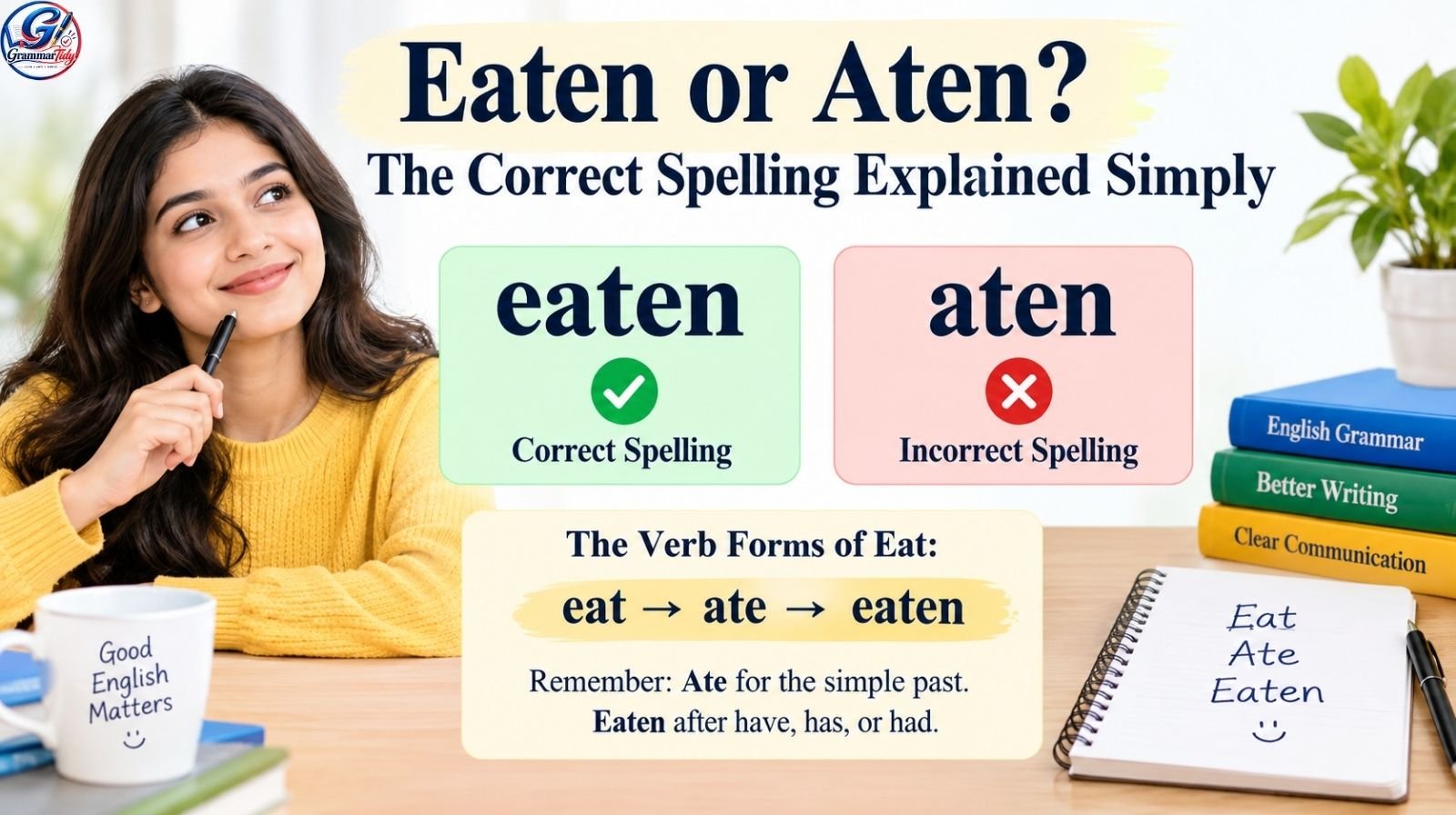
The answer is simple: eaten is the correct spelling in standard English. Aten is not the past participle of “eat.” The correct verb forms are eat → ate → eaten. Cambridge Dictionary identifies ate as the simple past of eat and eaten as its past participle.
In this guide, you’ll learn exactly when to use eaten, why aten causes confusion, how ate differs from eaten, and several easy examples that will help you remember the correct form.
Also Read: Transferring or Transfering: Correct Usage In Business, Technology & Everyday English In 2026
Quick Answer: Eaten or Aten?
Eaten is correct. Aten is incorrect when you mean the past participle of “eat.”
| Form | Correct? | Example |
|---|---|---|
| eat | ✅ Yes | I eat breakfast every morning. |
| ate | ✅ Yes | I ate breakfast earlier. |
| eaten | ✅ Yes | I have eaten breakfast already. |
| aten | ❌ No | I have aten breakfast. |
The easiest rule is:
Use “ate” for the simple past and “eaten” after have, has, or had.
For example:
- I ate lunch at noon.
- I have eaten lunch already.
- She had eaten before we arrived.
Eaten or Aten: Which Spelling Is Correct?
The correct spelling is eaten.
What Does “Eaten” Mean?
Eaten is the past participle of the verb eat. It describes the action of consuming food and is normally used with an auxiliary or helping verb in perfect constructions.
Examples:
- I have eaten breakfast.
- She has eaten the whole sandwich.
- We had eaten before the movie began.
- The children have eaten all the cookies.
Cambridge Dictionary directly defines eaten as the past participle of eat.
Is “Aten” Correct English?
Not as the past participle of eat.
If you are writing a sentence such as:
I have ___ lunch.
The correct answer is:
I have eaten lunch. ✅
Not:
I have aten lunch. ❌
So, when you mean the past participle of eat, always choose eaten.
The Verb Forms of Eat: Eat, Ate, and Eaten
Understanding the three principal forms makes the spelling much easier to remember.
Eat — Present or Base Form
Eat is the base form of the verb.
Examples:
- I eat breakfast every morning.
- They eat dinner at seven.
- We should eat something before leaving.
Ate — Simple Past Form
Ate is the simple past tense of eat. Cambridge Dictionary identifies ate as the past simple form of eat.
Examples:
- I ate breakfast at eight.
- She ate the last cookie.
- We ate at a restaurant yesterday.
Notice that ate can stand as the main past-tense verb:
I ate lunch.
Eaten — Past Participle
Eaten is the past participle.
It commonly appears with have, has, or had:
- I have eaten.
- She has eaten already.
- They had eaten before the guests arrived.
This gives you an easy pattern:
eat → ate → eaten
There is no standard English verb pattern:
eat → ate → aten
Eaten vs Ate: What Is the Difference?
This is where many English learners become confused. Both ate and eaten describe a completed eating action, but they perform different grammatical jobs.
When to Use “Ate”
Use ate for the simple past when you are talking about a completed action in the past.
Examples:
- I ate breakfast this morning.
- Tom ate pizza last night.
- We ate dinner at 8 p.m.
- Sarah ate the apple yesterday.
A specific past time often works naturally with ate:
I ate lunch at noon.
When to Use “Eaten”
Use eaten as the past participle, especially after have, has, or had.
Examples:
- I have eaten lunch.
- She has eaten already.
- They had eaten before the meeting.
- Have you eaten yet?
The difference becomes very clear when you compare these sentences:
Also Read: Genious or Genius: Which Word Is Correct? Common Mistakes Explained (2026)
| Sentence | Why? |
|---|---|
| I ate breakfast at 7. | Simple past |
| I have eaten breakfast. | Present perfect |
| She ate the cake yesterday. | Simple past |
| She has eaten the cake. | Present perfect |
| We ate before class. | Simple past |
| We had eaten before class started. | Past perfect |
A Simple Memory Trick
Think of it this way:
Yesterday → ate
Have/has/had → eaten
For example:
Yesterday, I ate pizza.
But:
I have eaten pizza before.
This is not an absolute substitute for understanding the grammar, but it is a useful quick reminder.
Why Does “Eaten” Sound Like “Aten”?
One major reason people write aten is pronunciation.
Spoken English Can Be Misleading
In natural, fast speech, sounds can become shorter or less distinct. As a result, eaten may sound closer to “ee-tən” or, to some listeners, something like “aten.”
However, pronunciation does not change the standard spelling.
For example, you might hear:
“I’ve eaten already.”
When spoken quickly, the middle vowel may not sound as strong as it does when the word is pronounced carefully.
Pronunciation vs Spelling
This distinction is important for English learners:
What you hear: may sound approximately like “ee-tən” or “aten”
What you write: eaten
The spelling remains eaten, regardless of how quickly someone says it.
Eaten in Everyday English
You will commonly see eaten in sentences such as:
- Have you eaten yet?
- I’ve already eaten.
- She hasn’t eaten anything.
- The food has been eaten.
- We had eaten before they arrived.
Therefore, don’t let fast pronunciation persuade you that aten is the correct spelling.
Also Read: Important or Inportant: The Correct Spelling Explained (2026 Guide)
Common Mistakes With Eaten and Aten
Knowing the correct spelling is only half the solution. You also need to avoid common grammar mistakes.
Mistake 1: Writing “Aten”
Incorrect:
I have aten lunch. ❌
Correct:
I have eaten lunch. ✅
The problem is the spelling of the past participle.
Mistake 2: Using “Ate” After “Have”
Incorrect:
I have ate breakfast. ❌
Correct:
I have eaten breakfast. ✅
Because have + past participle requires eaten, not ate.
Mistake 3: Using “Eaten” Without the Appropriate Helping Verb
In standard perfect constructions, avoid:
I eaten breakfast. ❌
Instead:
I ate breakfast. ✅
or:
I have eaten breakfast. ✅
Mistake 4: Assuming Every Past Form Ends in “-ed”
English contains many irregular verbs. Eat is one of them.
You do not say:
I eated breakfast. ❌
And you do not say:
I aten breakfast. ❌
The correct forms are:
eat → ate → eaten
Also Read: Writing or Writting: Which Spelling Is Actually Correct? (2026 Guide)
2025–2026 Usage and Grammar Snapshot
Recent educational material continues to teach eaten and aten as an example of a troublesome verb-form distinction.
For example, a 2025/2026 Grade 5 language-arts curriculum lists “eaten, aten” among troublesome verb forms that students are expected to distinguish correctly.
A 2026 Grade 6 curriculum from the same educational publisher likewise includes eaten, aten in its treatment of irregular verb forms.
What the Data Tells Us
This gives us a useful 2025–2026 educational snapshot:
| 2025–2026 curriculum evidence | Result |
|---|---|
| Grade 5 curriculum mentions eaten/aten | Included as a troublesome verb pair |
| Grade 6 curriculum mentions eaten/aten | Included as an irregular-form issue |
| Standard dictionary form | eaten |
| Simple past form | ate |
| Standard past participle | eaten |
The important point is that the spelling problem is not simply about vocabulary. It is also connected to learning the irregular principal parts of the verb.
A Real-Life Writing Case Study
Imagine a student writing an email to a teacher after missing a morning class.
The student wants to explain that they did not need breakfast because they had already eaten before leaving home. They write:
“I had aten breakfast before I left.”
The sentence is understandable, but aten is the wrong spelling.
The corrected version is:
“I had eaten breakfast before I left.”
Why is eaten necessary? The sentence uses had, which forms the past perfect construction. After had, English requires the past participle of the verb. For eat, that past participle is eaten.
Now compare it with a different sentence:
“I ate breakfast before I left.”
Here, ate is correct because the sentence simply describes a completed past action using the simple past tense.
This small distinction matters in practical writing. In school assignments, emails, reports, applications, and everyday messages, a single incorrect verb form can make otherwise clear writing look less polished.
The good news is that the solution is easy: remember eat → ate → eaten, and check whether your sentence requires the simple past or past participle.
Also Read: Humorous vs Humerous: Which Spelling Is Correct? 2026 Guide
How to Remember the Correct Spelling of Eaten
If eaten or aten keeps confusing you, use a simple three-step method.
Remember the Three Forms
Write this sequence down:
EAT → ATE → EATEN
Say it aloud a few times:
Eat, ate, eaten.
Then create one sentence for each form:
- I eat breakfast every day.
- I ate breakfast yesterday.
- I have eaten breakfast already.
Look for the Helping Verb
When you see have, has, or had, check whether you need eaten.
Examples:
- I have eaten.
- She has eaten.
- We had eaten.
This quick check can prevent the common errors have ate and have aten.
Use the “Ate Alone, Eaten With Help” Reminder
A helpful beginner-friendly memory line is:
Ate can stand alone; eaten usually needs a helper.
Compare:
I ate. ✅
I have eaten. ✅
This isn’t a complete explanation of every grammatical use of participles, but it is an excellent shortcut for everyday writing.
Eaten or Aten: Quick Comparison Checklist
Before publishing or submitting your writing, use this checklist:
- Is the intended word the past participle of eat?
- If yes, spell it eaten.
- Is the sentence in the simple past? Use ate.
- Does the sentence use have, has, or had? Check for eaten.
- Never use aten as the standard English past participle.
- Remember the sequence eat → ate → eaten.
Three Fast Examples
Present:
I eat fruit every morning.
Simple past:
I ate fruit this morning.
Past participle:
I have eaten fruit already.
Once you can identify these three patterns, the confusion becomes much easier to avoid.
Also Read: Lieing or Lying: Correct Spelling Guide 2026
Mini Quiz: Eaten or Aten?
1. Quick Pick: Which One Is Correct?
I have ___ breakfast already.
A) Aten
B) Eaten
Answer: B) Eaten ✅
2. Fill the Gap!
Yesterday, I ___ pizza with my friends.
A) Ate
B) Eaten
Answer: A) Ate ✅
3. Spot the Correct Spelling!
Which spelling is correct?
A) Aten
B) Eaten
Answer: B) Eaten ✅
4. Grammar Check!
Which sentence is correct?
A) I have ate lunch.
B) I have eaten lunch.
Answer: B) I have eaten lunch. ✅
5. Can You Catch the Mistake?
Which sentence has the spelling mistake?
A) She has eaten the cake.
B) She has aten the cake.
Answer: B) She has aten the cake. ❌
6. Ate or Eaten?
Choose the best word:
“I ___ dinner at 8 p.m. yesterday.”
A) Ate
B) Eaten
Answer: A) Ate ✅
7. What Comes After “Have”?
I have ___ already.
A) Ate
B) Eaten
Answer: B) Eaten ✅
8. Remember the Verb Forms!
Which sequence is correct?
A) Eat → Ate → Eaten
B) Eat → Aten → Ate
Answer: A) Eat → Ate → Eaten ✅
9. Find the Correct Sentence!
Which sentence sounds right in standard English?
A) Have you eaten yet?
B) Have you aten yet?
Answer: A) Have you eaten yet? ✅
10. Yesterday Test!
Which word fits naturally?
“Tom ___ breakfast yesterday.”
A) Ate
B) Eaten
Answer: A) Ate ✅
11. Have, Has, or Had?
“She has ___ the whole sandwich.”
A) Ate
B) Eaten
Answer: B) Eaten ✅
12. True or False?
“Eaten” is the past participle of “eat.”
Answer: True ✅
13. True or False?
“Aten” is the standard past participle of “eat.”
Answer: False ❌
The correct past participle is eaten.
14. Final Grammar Challenge!
Which sentence is correct?
A) We had eaten before they arrived.
B) We had ate before they arrived.
Answer: A) We had eaten before they arrived. ✅
15. The Memory Test!
Complete this correctly:
Eat → ___ → Eaten
A) Aten
B) Ate
Answer: B) Ate ✅
Easy reminder: Eat → Ate → Eaten. Never use aten as the standard past participle of eat.
Also Read: Plandid or Candid: Which Is Correct? Meaning, Examples & Usage Guide (2026)
FAQs
1. Is “eaten” or “aten” correct?
Eaten is correct when you mean the past participle of eat. Aten is not the standard English form.
2. What is the past participle of “eat”?
The past participle of eat is eaten. The three main forms are eat, ate, eaten.
3. Is “ate” the same as “eaten”?
No. Ate is the simple past form, while eaten is the past participle.
- I ate lunch.
- I have eaten lunch.
4. Can I say “I have ate”?
No. In standard English, use:
I have eaten. ✅
The construction have + past participle requires eaten, not ate.
5. Why do people spell “eaten” as “aten”?
The confusion can come from pronunciation. In quick speech, the sounds in eaten can become less distinct, making the word seem like “aten.” However, the standard spelling remains eaten.
6. Is “aten” ever a word?
Aten can appear in other contexts as a proper name, including references to the ancient Egyptian deity Aten. However, it is not the standard past participle of the English verb eat.
7. How do you remember “eaten”?
Remember the sequence:
Eat → Ate → Eaten
Then use this shortcut:
Ate = simple past. Eaten = past participle.
Conclusion:
When choosing between eaten or aten, the correct spelling is eaten when you mean the past participle of eat. The standard forms are:
eat → ate → eaten
Use ate for a simple past action:
I ate dinner at seven.
Use eaten with constructions such as have, has, or had:
I have eaten dinner.
The spelling aten is not the standard past participle of eat. If pronunciation makes the word sound confusing, remember that spoken English and written English do not always match perfectly.
So the next time you wonder about eaten or aten, go back to the three-word pattern: eat, ate, eaten. That simple sequence will help you choose the correct form in emails, schoolwork, articles, and everyday writing.
Discover More Article
- Continuous vs Continous: What’s The Difference? 2026
- Discard or Disgard: Which Spelling Is Correct?
- Brite vs Bright: 7 Easy Ways To Know The Difference
- In Process vs In Progress: The Real Difference With 20+ Examples
Keep learning with more easy grammar lessons on GrammarTidy.com

Hi, I’m Noor Fatima, the author and creator of Grammar Tidy. I’m passionate about grammar, writing, and making language learning simple and enjoyable. Through Grammar Tidy, I share helpful tips, clear explanations, and practical guidance to help readers improve their writing, avoid common mistakes, and communicate with confidence. My goal is to make better grammar easy, useful, and accessible for everyone.