Have you ever typed “uneffected” and wondered whether it should actually be “unaffected”? This is an easy mistake to make because affect and effect are two commonly confused English words.
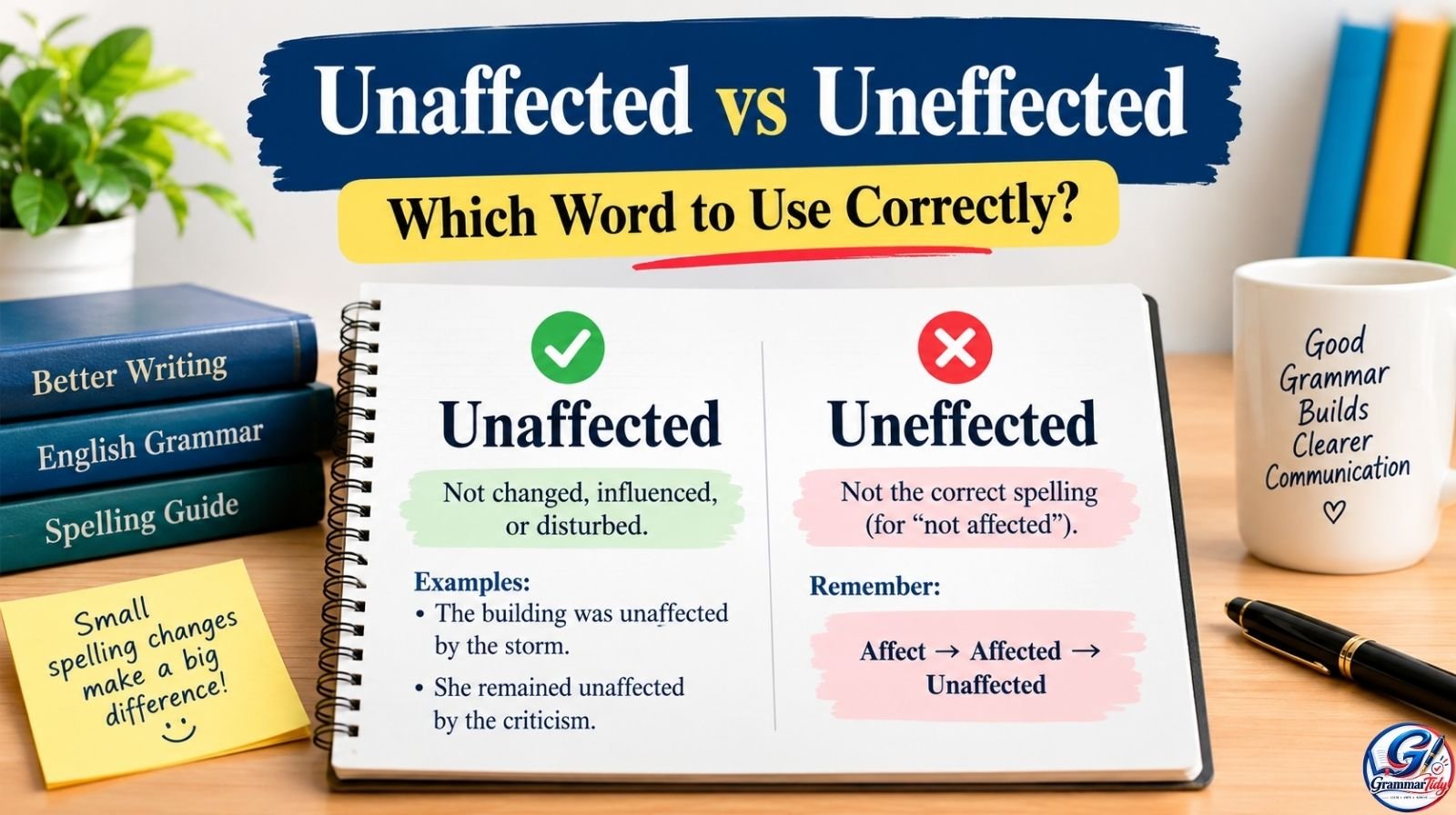
When comparing unaffected vs uneffected, the answer is straightforward: unaffected is the standard and correct word when you mean “not affected,” “not changed,” or “not influenced.” Cambridge Dictionary defines unaffected as something that is not influenced, harmed, or interrupted, while Merriam-Webster gives similar meanings.
So, if you want to say that something remained unchanged after an event, use “unaffected.”
In this guide, you’ll learn exactly what unaffected means, why uneffected causes confusion, how to use the correct word in real sentences, and a simple trick to remember the spelling.
Unaffected vs Uneffected: Which Is Correct?
The correct spelling in ordinary modern English is unaffected.
“Uneffected” is generally not the word you want when you mean “not affected.” The confusion usually comes from mixing up the related-looking words affect and effect.
What Does Unaffected Mean?
Unaffected is an adjective meaning not changed, influenced, harmed, or disturbed by something.
For example:
- The building remained unaffected by the storm.
- Her decision was unaffected by the criticism.
- Most flights were unaffected by the weather.
- His performance remained unaffected by the pressure.
Cambridge specifically defines unaffected as “not influenced, harmed, or interrupted in any way.” It can also describe someone whose behavior appears natural and sincere rather than artificial.
Is Uneffected Correct?
For the meaning “not affected,” use “unaffected,” not “uneffected.”
For example:
❌ The new policy left several employees uneffected.
✅ The new policy left several employees unaffected.
The second sentence is the standard form.
There is a linguistic reason for this: unaffected is formed from un- + affected, where affected comes from the verb affect.
What Does Unaffected Mean?
Understanding the meaning makes the spelling much easier to remember.
Unaffected Means “Not Changed”
The most common meaning is that something experienced no significant change or influence.
Consider:
The garden was largely unaffected by the heavy rain.
This means the rain did not significantly damage or alter the garden.
Other examples include:
- The company’s profits remained unaffected by the change.
- The medicine left the patient’s appetite unaffected.
- The northern region was unaffected by the earthquake.
- His plans were unaffected by the announcement.
Merriam-Webster similarly defines unaffected as something not influenced or changed mentally, physically, or chemically.
Also Read: Triple vs Tripple: Which Is The Correct One To Use?
Unaffected Can Also Describe Behavior
There is another legitimate meaning of unaffected.
It can describe someone who behaves naturally and sincerely rather than trying to impress others.
For example:
Despite her success, she remained friendly and unaffected.
Here, unaffected does not mean “unchanged by something.” Instead, it means natural, genuine, or unpretentious.
Merriam-Webster lists “genuine” as a synonym in this sense, while Cambridge also recognizes unaffected as meaning natural and sincere.
Why Do People Confuse Unaffected and Uneffected?
The main reason is the notorious affect vs effect confusion.
Affect vs Effect Creates the Problem
In many everyday situations:
- Affect is commonly used as a verb meaning to influence or change something.
- Effect is commonly used as a noun meaning a result or consequence.
For example:
The heat affected the crops.
The heat influenced the crops.
Now make that negative:
The crops were unaffected by the heat.
The crops were not influenced by the heat.
That’s why unaffected is the natural form.
The Spelling Pattern to Remember
Think of the word family like this:
affect → affected → unaffected
Not:
effect → effected → uneffected
This simple pattern can prevent the spelling mistake in most everyday situations.
However, effected is itself a legitimate word in certain contexts, particularly when effect is being used as a verb meaning “to bring about” or “cause.” That is a different construction and should not be confused with affected.
Unaffected vs Uneffected in Real Sentences
Seeing the words in context makes the distinction much clearer.
Correct Examples With Unaffected
Here are some natural examples:
- The house was unaffected by the flooding.
- Her confidence remained unaffected by the negative comments.
- The company’s operations were largely unaffected by the outage.
- He appeared completely unaffected by the criticism.
- The price remained unaffected by the sudden increase in demand.
In every example, unaffected indicates that something did not experience a meaningful change or influence.
Also Read: Commit vs Comit: Correct Spelling And Usage
Incorrect Examples With Uneffected
These sentences use the commonly mistaken spelling:
❌ The school was uneffected by the new rules.
❌ She seemed uneffected by the criticism.
❌ The computer system remained uneffected after the update.
The standard versions are:
✅ The school was unaffected by the new rules.
✅ She seemed unaffected by the criticism.
✅ The computer system remained unaffected after the update.
Quick Comparison
| Word | Standard everyday usage? | Meaning |
|---|---|---|
| Unaffected | ✅ Yes | Not changed or influenced |
| Uneffected | ❌ Generally no | Usually a misspelling of unaffected |
Easy rule: If you mean “not affected,” write “unaffected.”
Unaffected vs Uneffected: A Real-Life Writing Case Study
Imagine a manager writing an email to employees after a major software update.
The manager wants to say that some departments experienced no disruption. While typing the email, they write:
“The accounting department was uneffected by the update.”
At first glance, the sentence may look reasonable. The writer has probably remembered the prefix un- and attached it to what they think is the correct form of the word. However, the problem is the base word.
The intended meaning is “not affected by the update.”
The correct sentence is:
“The accounting department was unaffected by the update.”
Now consider a second example. A student writes:
“Sarah seemed uneffected by the disappointing result.”
Again, the intended meaning is clear: Sarah did not appear emotionally influenced by the result. The correct form is:
“Sarah seemed unaffected by the disappointing result.”
This distinction matters in professional and academic writing because a spelling error can make otherwise polished content look careless. It can also become especially confusing when discussing affect and effect, two words that already have different grammatical roles.
The easiest solution is to pause and identify the intended phrase. If you could replace the word with “not affected,” then unaffected is the form you need.
2025–2026 Usage and Dictionary Data
Current reference sources provide strong evidence for how writers should handle this distinction.
What Current Dictionaries Show
As of 2026, Cambridge Dictionary provides a current entry for unaffected, defining it as not influenced, harmed, or interrupted. It also recognizes the word in the sense of being natural and sincere.
Merriam-Webster likewise has an established entry for unaffected, with meanings including “not influenced or changed” and “free from affectation.” Its entry was updated in February 2026.
This gives us an important practical takeaway:
For standard contemporary English writing in 2025–2026, “unaffected” is the dependable choice when you mean “not affected.”
What About Frequency Data?
Google’s Ngram Viewer is useful for studying word and phrase occurrences in its book corpus. Its current documentation explains that Ngram charts show how expressions occur across books over time and that the data are normalized by the number of books published in each year.
However, Ngram data should not be presented as 2025–2026 web-search volume: its documented book data do not provide a simple substitute for current Google search-volume statistics.
Therefore, the strongest 2025–2026 evidence for this spelling question is the current dictionary treatment and modern standard usage, rather than an invented search-volume figure.
How to Remember the Correct Spelling of Unaffected
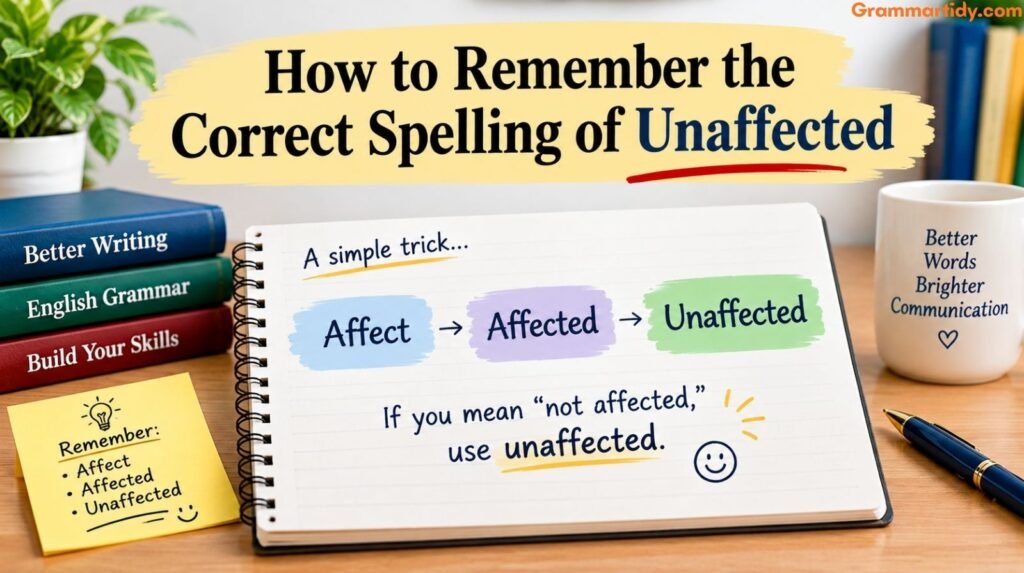
A simple memory trick can make this almost impossible to forget.
Use the “Affect” Shortcut
Remember:
Affect → affected → unaffected
If your sentence means “not affected,” simply put un- before affected.
Affected → Unaffected
For example:
The storm affected the village.
becomes:
The village was unaffected by the storm.
Don’t Build the Word From “Effect”
Avoid thinking:
effect → effected → uneffected
That pathway leads you toward the common spelling mistake.
Instead, ask yourself:
“Was it affected?”
If the answer is “no,” the word is:
unaffected.
Also Read: Accross vs Across: Which Is The Correct Spelling?
A Simple Checklist for Choosing Unaffected
Before publishing an email, article, assignment, or report, use this quick checklist.
Step-by-Step Spelling Check
Step 1: Identify the intended meaning.
Do you mean not changed or influenced?
Step 2: Think of the base phrase.
Can you say “not affected”?
Step 3: Use the correct spelling.
Write unaffected.
Step 4: Check the sentence.
The results were unaffected by the change.
Step 5: Watch for the extra “e.”
If you have written uneffected to mean “not affected,” correct it to unaffected.
This five-second check can prevent a surprisingly common spelling mistake.
Mini Quiz: Unaffected vs Uneffected
1. Which spelling is correct?
A) Uneffected
B) Unaffected
C) Unaffectted
D) Uneffectted
Answer: B) Unaffected
2. What does “unaffected” usually mean?
A) Completely changed
B) Not changed or influenced
C) Slightly damaged
D) Strongly affected
Answer: B) Not changed or influenced
3. Pick the correct sentence.
A) The storm left the village uneffected.
B) The storm left the village unaffected.
C) The storm left the village uneffectted.
D) The storm left the village unaffectted.
Answer: B) The storm left the village unaffected.
4. Complete the sentence:
“Her confidence remained ______ by the criticism.”
A) uneffected
B) unaffected
C) uneffect
D) unaffect
Answer: B) unaffected
5. Which word is the correct base for “unaffected”?
A) Effect
B) Affect
C) Effective
D) Effects
Answer: B) Affect
6. What is the easiest way to remember “unaffected”?
A) Effect → Effected → Uneffected
B) Affect → Affected → Unaffected
C) Affect → Effect → Unaffected
D) Effect → Affect → Unaffected
Answer: B) Affect → Affected → Unaffected
7. Spot the mistake!
“The company was uneffected by the price increase.”
Which word should replace uneffected?
A) Effective
B) Effected
C) Unaffected
D) Affecting
Answer: C) Unaffected
8. Which sentence uses “unaffected” correctly?
A) She was unaffected by the bad news.
B) She was unaffected the bad news.
C) She unaffected by the bad news.
D) She was uneffected by the bad news.
Answer: A) She was unaffected by the bad news.
9. True meaning check: If something is “unaffected,” it is usually…
A) Influenced
B) Changed
C) Not influenced
D) Destroyed
Answer: C) Not influenced
10. Choose the correct spelling for formal writing.
A) Uneffected
B) Unaffected
C) Uneffect
D) Unaffectted
Answer: B) Unaffected
11. Which sentence sounds correct?
A) The new rule left our plans unaffected.
B) The new rule left our plans uneffected.
C) The new rule left our plans unaffect.
D) The new rule left our plans unaffectedly.
Answer: A) The new rule left our plans unaffected.
12. What common word pair causes confusion here?
A) Accept and Except
B) Affect and Effect
C) Advice and Advise
D) Then and Than
Answer: B) Affect and Effect
13. Fill in the blank:
“The computer system remained ______ after the update.”
A) uneffected
B) unaffected
C) unaffect
D) uneffect
Answer: B) unaffected
14. Which form should you use when you mean “not affected”?
A) Uneffected
B) Uneffect
C) Unaffected
D) Unaffecting
Answer: C) Unaffected
15. Quick final challenge! Which sentence is completely correct?
A) The workers were uneffected by the changes.
B) The workers was unaffected by the changes.
C) The workers were unaffected by the changes.
D) The workers were unaffect by the changes.
Answer: C) The workers were unaffected by the changes.
FAQs
Q. Is Unaffected the Correct Spelling?
A: Yes. Unaffected is the standard spelling when you mean not changed, influenced, harmed, or disturbed. Cambridge and Merriam-Webster both recognize it as a standard English adjective.
Q. Is Uneffected a Word?
A: Uneffected is not the standard spelling to use when you mean “not affected.” In normal modern writing, use unaffected instead.
Q. What Is the Difference Between Affected and Unaffected?
A: Affected means influenced or changed by something.
Unaffected means not influenced or changed by something.
For example:
The storm affected the town.
The nearby village was unaffected by the storm.
Q. Can Unaffected Describe a Person?
A: Yes. You can say that someone is unaffected by an event when the event does not appear to influence or upset them.
Example:
She seemed unaffected by the criticism.
It can also describe someone as natural or unpretentious.
Q. Is Unaffected an Adjective?
A: Yes. Unaffected is an adjective.
Example:
The equipment remained unaffected by the power outage.
Q. How Can I Remember Unaffected?
A: Remember the sequence:
affect → affected → unaffected
If you mean “not affected,” use unaffected.
Q. Which Is Correct: Unaffected or Uneffected?
A: Unaffected is correct for the ordinary meaning “not affected.” If you are writing an essay, email, article, report, or other formal text, choose unaffected.
Conclusion:
When it comes to unaffected vs uneffected, the choice is simple: use “unaffected” when you mean not affected, changed, influenced, or disturbed.
The confusion usually comes from mixing up affect and effect, but the spelling becomes easier when you remember the correct word family:
affect → affected → unaffected
For example:
The new policy left our plans unaffected.
That’s the standard, natural form.
So the next time you’re unsure whether to write unaffected or uneffected, remember one simple question: Do I mean “not affected”? If yes, choose unaffected.
Use this rule in your emails, assignments, blog posts, reports, and everyday writing to keep your English accurate and professional.
Discover More Article
- Quantify vs Qualify: Differences And Correct Usage
- Submission vs Submittion: Learn The Difference
- Courtesy vs Curtesy: Meaning, Usage And Common Mistakes
Keep learning with more easy grammar lessons on GrammarTidy.com

Hi, I’m Noor Fatima, the author and creator of Grammar Tidy. I’m passionate about grammar, writing, and making language learning simple and enjoyable. Through Grammar Tidy, I share helpful tips, clear explanations, and practical guidance to help readers improve their writing, avoid common mistakes, and communicate with confidence. My goal is to make better grammar easy, useful, and accessible for everyone.