Have you ever written “brite” when you meant “bright”? You are not alone. Because Brite and Bright are pronounced the same in many contexts, the spelling can be surprisingly easy to mix up.
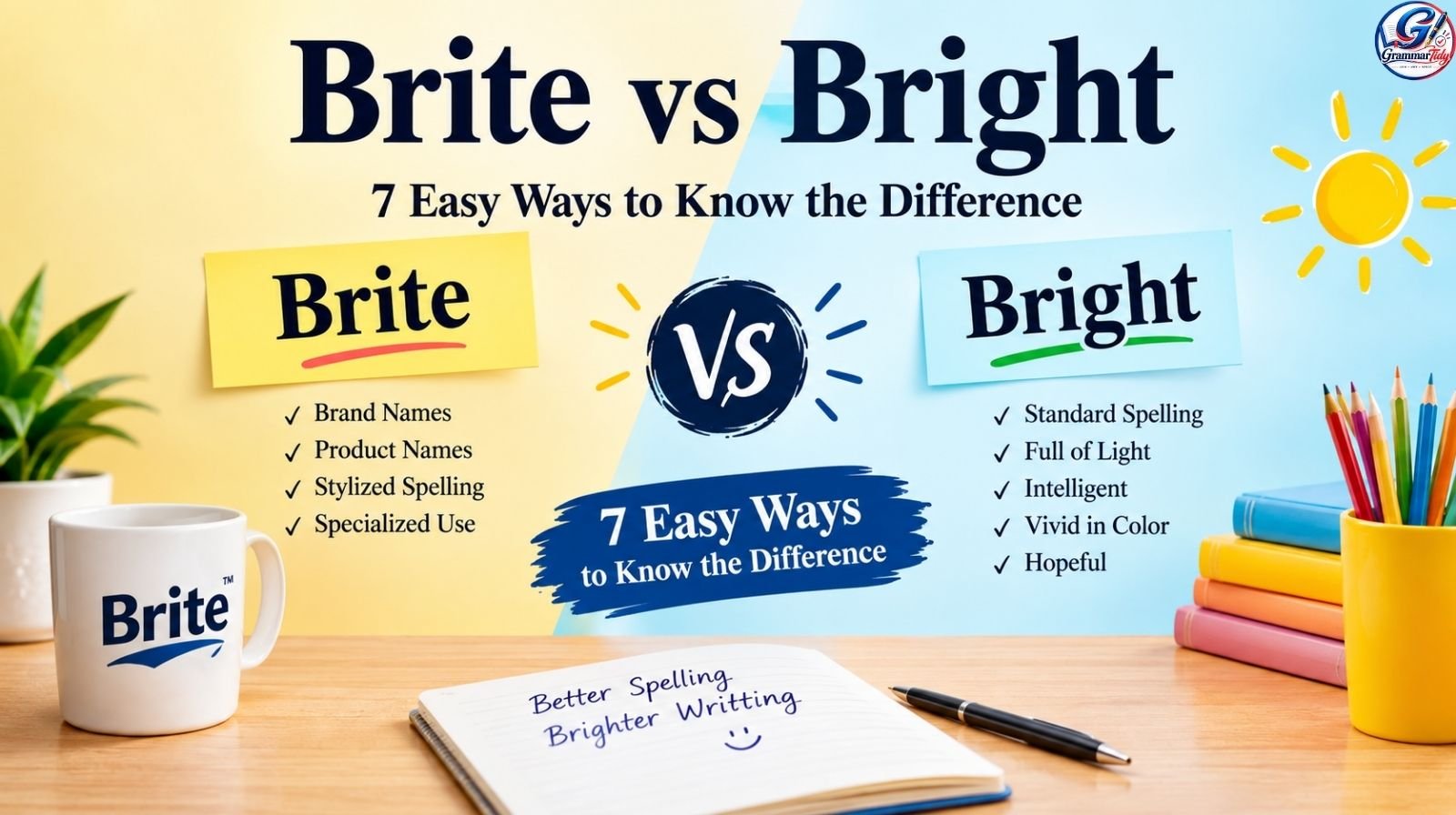
The key difference is simple: bright is the standard English spelling used for meanings such as full of light, vivid in color, intelligent, or hopeful.
Brite, meanwhile, is commonly seen as a stylized spelling in brand names, product names, and other specialized contexts.
Historical dictionaries also record brite in limited or obsolete senses, so it is not accurate to say the sequence of letters has never existed as a word.
This guide gives you 7 easy ways to distinguish Brite vs Bright, with practical examples, a comparison table, a real-life writing case study, and simple memory tricks.
Also Read: Accross vs Across: Which Is The Correct Spelling?
1. Brite vs Bright: The Quick Answer
If you are writing a normal English sentence, use “bright.”
Bright is the standard spelling:
The room was bright and cheerful.
She is a bright student.
He wore a bright blue shirt.
Brite can appear as a deliberate spelling choice in names, trademarks, product branding, or specialized terminology.
Historical sources also record brite as a rare/older variant in certain contexts. Therefore, the safest rule for everyday formal English is:
Writing a normal sentence → bright
Copying an official name or brand → preserve its exact spelling
Cambridge Dictionary defines bright in several standard senses, including “full of light,” strong in color, intelligent, and hopeful.
2. Bright Is the Standard Spelling in Everyday English
The first and easiest way to remember the difference is to look at ordinary English sentences.
What Does Bright Mean?
Bright is a versatile adjective. Depending on the context, it can describe:
- Something that gives or reflects a lot of light
- A strong or vivid color
- Someone who is intelligent
- Something hopeful or promising
- A cheerful or lively appearance
For example:
The bright sunlight filled the room.
Maria wore a bright yellow dress.
Daniel is a bright student.
The company has a bright future.
Cambridge lists these major meanings, including light, color, intelligence, and happiness or hope.
Why Is Bright So Easy to Confuse?
The pronunciation is the main reason.
Bright is pronounced approximately /braɪt/.
When people hear the word rather than see it, the gh is not pronounced as a separate sound. That can make a spelling such as brite seem logical.
However, English spelling cannot always be predicted from pronunciation.
Remember:
Sound tells you how a word is pronounced.
Standard spelling tells you how it should normally be written.
Also Read: Transferred vs Transfered: Which Is Correct?
3. Brite Is Often a Stylized Spelling
The second way to recognize the difference is to ask where you saw the word.
Brite in Brand and Product Names
You may encounter Brite in company names, product names, advertising, or trademarks.
For example, a business might deliberately choose a name such as:
Brite Solutions
or a product might use Brite as part of its official name.
In such cases, changing Brite to Bright could actually change the official name.
This is similar to other creative spellings used in branding. A company may alter a familiar word because the unusual spelling gives its name a distinct visual identity.
Brite Does Not Automatically Mean “Wrong”
This is an important distinction.
If someone writes:
The room is brite.
in an ordinary school essay, brite would normally be treated as a nonstandard spelling of bright.
But if a company’s official name contains Brite, then reproducing the name as Brite is correct.
Context matters.
4. Brite and Bright Can Have Different Historical Uses
The third way to understand the difference is to look beyond modern everyday English.
Historical Dictionary Evidence
Historical dictionary sources do record brite in limited senses. For example, Webster’s 1828 dictionary records brite or bright as a verb referring to becoming overripe, particularly in relation to wheat, barley, or hops. The source itself notes that the usage was not known to be common in the United States.
That means the statement “Brite has never been a word” is too absolute.
A more accurate explanation is:
Bright is the normal modern spelling for the common adjective, while Brite may appear in specialized, historical, commercial, or deliberately stylized contexts.
Why This Matters for Writers
Knowing this distinction helps you avoid two opposite mistakes:
- Treating every occurrence of Brite as a simple typo.
- Assuming Brite can freely replace bright in standard English.
Neither approach is reliable.
5. Look at the Meaning Before Choosing the Spelling
A fourth easy method is to check what you are trying to say.
Bright Meaning “Full of Light”
Use bright:
The stars are bright tonight.
We entered a bright room.
The flashlight is very bright.
Bright Meaning “Intelligent”
Again, use bright:
She is a bright student.
He is one of the brightest students in the class.
Bright Meaning “Vivid in Color”
Use bright:
She bought a bright red bag.
The wall is painted bright green.
Bright Meaning “Hopeful”
Use bright:
He has a bright future ahead of him.
The team’s prospects look bright.
These meanings are all established uses of bright in standard English.
6. Use Bright in School, Academic, and Professional Writing
When in doubt, this is probably the most useful rule.
Bright in Formal Writing
For essays, reports, emails, resumes, articles, assignments, and professional documents, bright is the normal choice when you mean the standard adjective.
Compare:
❌ The office has a brite atmosphere.
✅ The office has a bright atmosphere.
❌ She is a brite student.
✅ She is a bright student.
❌ We need a brite color for the presentation.
✅ We need a bright color for the presentation.
Why Standard Spelling Matters
In professional writing, readers expect conventional spelling. A creative spelling can distract from your meaning or make readers wonder whether it is a typo.
This principle also fits Google’s current guidance for people-first content: Google recommends content that is useful, reliable, well-written, and free from spelling or stylistic problems.
Also Read: Commit vs Comit: Correct Spelling And Usage
7. Use Brite When It Is Part of an Official Name
The sixth rule is almost the opposite of the previous one.
Don’t “Correct” a Brand Name
Suppose an organization officially calls itself:
Brite Learning Center
If you are writing about that organization, keep its official spelling.
Do not automatically rewrite it as:
Bright Learning Center
The latter may look grammatically familiar, but it could be a different name.
Brite as a Branding Choice
Stylized spellings can be useful to companies because they create a distinctive identity.
You may therefore see forms such as:
- Brite
- Lite
- Kwik
- Xpress
These spellings do not necessarily follow ordinary dictionary spelling conventions. Their purpose can be branding rather than standard prose.
Simple test: If Brite appears as part of a specific name, check the official spelling before changing it.
Remember the “GH” in Bright
The final method is the easiest memory trick.
The Bright Spelling Trick
Think:
Bright = light
Both words are strongly associated with illumination.
Picture a bright light and remember the longer spelling:
BRI + GHT
So when you mean something that is shining, colorful, intelligent, or hopeful, think:
“Bright needs GH.”
Brite vs Bright: One-Line Test
Before pressing publish, ask:
Am I using the word in an ordinary English sentence?
If yes, choose:
Bright ✅
If Brite is part of a proper name, product name, trademark, or specialized term, preserve the official spelling:
Brite ✅ when the name specifically uses it
This simple check eliminates most Brite vs Bright mistakes.
Also Read: Symptomatology vs Symptomology: Differences, Meaning, And Usage
Brite vs Bright: Quick Comparison Table
| Feature | Bright | Brite |
|---|---|---|
| Standard everyday spelling | ✅ Yes | ❌ Generally no |
| Means full of light | ✅ Yes | Usually not in standard prose |
| Means intelligent | ✅ Yes | ❌ No standard everyday use |
| Means vivid in color | ✅ Yes | ❌ No standard everyday use |
| Means hopeful/promising | ✅ Yes | ❌ No standard everyday use |
| Used in branding | Sometimes | ✅ Common stylized use |
| Can occur in official names | Yes | ✅ Yes |
| Historical/specialized uses | Yes | Yes, in limited sources |
| Best choice for normal formal writing | Bright | Usually avoid |
A 2025–2026 Evidence Snapshot
There is an important SEO and language-research point here: there is no reliable universal 2025–2026 statistic showing that “Brite” represents a specific percentage of English usage.
Numbers sometimes quoted online for the frequency of Brite versus Bright should therefore be treated cautiously unless they identify a transparent corpus and methodology.
What can be verified is more useful:
- Cambridge’s current dictionary entry recognizes bright as a standard English word with multiple meanings, including light, color, intelligence, and happiness/hope.
- Historical dictionary evidence shows that brite has existed in limited senses, so calling it universally nonexistent is misleading.
- Etymonline describes brite as a spelling variant of bright and notes its use in phonetic spelling reforms and advertising.
- Google’s current Search guidance emphasizes helpful, reliable, people-first content and specifically advises creators to avoid spelling and stylistic problems.
- Google’s Search Essentials, updated in December 2025, continues to recommend using the words people actually use when searching and placing relevant wording in prominent parts of a page.
The practical takeaway for 2026: use bright as the normal spelling in your own English writing, but do not “correct” Brite when it is an intentional official name or specialized usage.
Real-Life Case Study: A “Brite” in a Business Document
Imagine a marketing assistant preparing a company brochure.
The draft contains this sentence:
“Our new office uses brite colors to create a welcoming environment.”
The writer probably intends to say that the colors are vivid and attractive. In standard English, the sentence should therefore use bright:
“Our new office uses bright colors to create a welcoming environment.”
The marketing manager then notices that the company’s cleaning service is officially named Brite Facility Solutions.
The assistant initially changes the company name to Bright Facility Solutions, thinking the original spelling is a mistake. That creates a different problem: the company’s official name has been altered.
This example shows why context matters.
The adjective should be:
bright colors
The official company name should remain:
Brite Facility Solutions
The two forms may look almost identical and sound similar, but they serve different purposes. One follows standard English spelling; the other is a deliberate name chosen by an organization.
This is especially important for editors, content writers, journalists, students, and anyone preparing documents that contain company or product names. Before “correcting” an unusual spelling, check whether it is actually an intentional proper name.
Also Read: Filipino or Philipino? Meaning, Pronunciation, Spelling & Usage Explained In 2026
Common Brite vs Bright Mistakes
Mistake 1: Using Brite for Light
❌ The sun is very brite today.
✅ The sun is very bright today.
Mistake 2: Using Brite for Intelligence
❌ She is a brite student.
✅ She is a bright student.
Mistake 3: Changing an Official Name
❌ BrightStar Brite is written as BrightStar Bright.
✅ Preserve the exact official spelling if Brite is part of the name.
Mistake 4: Assuming Unusual Means Impossible
❌ “Brite” can never appear in English.
✅ “Brite” can appear in specialized, historical, or commercial contexts, but bright is the standard choice for the common adjective.
Brite vs Bright: A Simple 7-Step Checklist
Use this checklist whenever you are unsure.
- Are you describing light? → Use bright.
- Are you describing a vivid color? → Use bright.
- Are you describing an intelligent person? → Use bright.
- Are you describing a hopeful future? → Use bright.
- Is Brite part of an official brand or company name? → Keep Brite.
- Is it a specialized or historical term? → Check the relevant source or field.
- Are you simply writing normal English? → Choose bright.
The 5-Second Rule
If you are writing a normal sentence and you are still unsure:
Choose BRIGHT.
If you are copying a name:
Copy the name exactly.
Also Read: Important or Inportant: The Correct Spelling Explained (2026 Guide)
Brite vs Bright: Mini Quiz
1. Quick Start: Which Spelling Is Standard?
Which spelling is normally correct in everyday English?
A) Brite
B) Bright
C) Brighte
D) Briht
Answer: B) Bright
2. Pick the Right Sentence
Which sentence is correct?
A) The room is brite.
B) The room is bright.
C) The room is brighte.
D) The room is briht.
Answer: B) The room is bright.
3. Bright or Brite?
Which word means “full of light”?
A) Brite
B) Bright
C) Both equally in standard English
D) Neither
Answer: B) Bright
4. Spot the Correct Word
“She is a ___ student.”
A) brite
B) bright
C) briht
D) brighte
Answer: B) bright
5. What About Colors?
Which sentence uses the standard spelling?
A) He wore a brite red shirt.
B) He wore a bright red shirt.
C) He wore a briht red shirt.
D) He wore a brighte red shirt.
Answer: B) He wore a bright red shirt.
6. Brand Name Challenge
If a company’s official name is Brite Solutions, what should you do?
A) Change it to Bright Solutions
B) Change it to Brighte Solutions
C) Keep the official spelling
D) Remove the word completely
Answer: C) Keep the official spelling
7. Fill in the Blank
“The future looks ___.”
A) brite
B) bright
C) briht
D) brighte
Answer: B) bright
8. Is Brite Always a Typo?
True or False: “Brite” can appear as a deliberate spelling in brand or product names.
Answer: True
9. The GH Memory Trick
Which spelling contains the GH used in the standard word?
A) Brite
B) Bright
C) Brit
D) Brigt
Answer: B) Bright
10. Choose the Professional Version
Which sentence is best for a formal email?
A) Your idea is very brite.
B) Your idea is very bright.
C) Your idea is very briht.
D) Your idea is very brighte.
Answer: B) Your idea is very bright.
11. What Makes Brite Different?
In modern writing, Brite is most likely to be seen as:
A) The standard spelling of every use of bright
B) A stylized spelling or part of a name
C) The plural of bright
D) A completely unrelated punctuation mark
Answer: B) A stylized spelling or part of a name
12. Find the Correct Sentence
Which sentence is written correctly?
A) The stars look brite tonight.
B) The stars look bright tonight.
C) The stars look briht tonight.
D) The stars look brighte tonight.
Answer: B) The stars look bright tonight.
13. Can Brite Have Historical Uses?
True or False: Historical dictionary sources have recorded “brite” in limited or specialized uses.
Answer: True
14. The 5-Second Rule
If you are writing a normal English sentence and mean “full of light,” which word should you choose?
A) Brite
B) Bright
C) Brit
D) Brigt
Answer: B) Bright
15. Final Boss: Brite vs Bright
Which rule is the easiest to remember?
A) Always use Brite
B) Always use Bright, even in official names
C) Use Bright in normal English; preserve Brite when it is an official name or intentional spelling
D) Both spellings are always interchangeable
Answer: C) Use Bright in normal English; preserve Brite when it is an official name or intentional spelling
FAQs
1. Is Brite a correct spelling of Bright?
Not as the normal modern spelling of the common adjective. Use bright in standard English when you mean full of light, vivid, intelligent, cheerful, or promising. Brite can appear in names, branding, and limited historical or specialized uses.
2. What does Brite mean?
Brite does not normally function as the standard modern spelling of the common adjective bright. It is often used as a stylized spelling in commercial names and branding. Historical sources also record limited meanings and variant uses.
3. Which is correct: Brite or Bright?
For ordinary English writing, bright is the correct choice.
For example:
The room is bright.
She wore a bright dress.
He is a bright student.
Use Brite when the exact spelling is part of a proper name, brand, product, or specialized usage.
4. Are Brite and Bright pronounced the same?
In the common English use that causes this spelling confusion, they are pronounced alike or nearly alike, which is one reason people confuse the spellings. The important difference is their written form and context.
5. Can I use Brite in academic writing?
Generally, no when you simply mean bright. Academic writing should use the standard spelling bright.
However, if Brite is part of a quoted title, organization name, product name, or other proper name, retain the official spelling.
6. Why do companies spell Bright as Brite?
Companies and marketers sometimes use altered spellings to make a name visually distinctive or memorable. In those situations, Brite functions as a branding choice rather than the normal spelling used in prose.
7. How can I remember Brite vs Bright?
Use this simple memory trick:
Bright = light.
When you mean light, vivid color, intelligence, or a hopeful future, remember the GH in bright.
Conclusion:
The difference between Brite vs Bright becomes much easier once you separate standard English spelling from intentional naming.
For everyday sentences, school assignments, business emails, articles, reports, and professional writing, use bright:
bright light
bright colors
bright student
bright future
Brite may still appear in brand names, product names, advertising, specialized terminology, or historical sources. So don’t automatically assume every occurrence is a typo check the context first.
The easiest rule to remember is:
Normal English sentence? Use BRIGHT.
Official name or stylized term? Keep BRITE if that is its official spelling.
For clear and professional English, bright should be your default choice.
Discover More Article
- Humorous vs Humerous: Which Spelling Is Correct? 2026 Guide
- Lieing or Lying: Correct Spelling Guide 2026
- Continuous vs Continous: What’s The Difference? 2026
- Discard or Disgard: Which Spelling Is Correct?
Keep learning with more easy grammar lessons on GrammarTidy.com

Hi, I’m Noor Fatima, the author and creator of Grammar Tidy. I’m passionate about grammar, writing, and making language learning simple and enjoyable. Through Grammar Tidy, I share helpful tips, clear explanations, and practical guidance to help readers improve their writing, avoid common mistakes, and communicate with confidence. My goal is to make better grammar easy, useful, and accessible for everyone.