Have you ever written “disregulated” and wondered whether it should actually be “dysregulated”? You are not alone. The two words sound nearly identical, which makes the spelling easy to confuse.
The correct term for something that is functioning with impaired, abnormal, or poorly controlled regulation is dysregulated. Cambridge Dictionary defines dysregulated as describing a bodily process that is not controlled normally and also uses the term in psychology for difficulty controlling emotions.
In this guide, we will explain dysregulated vs disregulated, why the confusion happens, how to use the correct word, and provide practical examples you can use in everyday, academic, medical, and professional writing.
Dysregulated vs Disregulated: Which Word Is Correct?
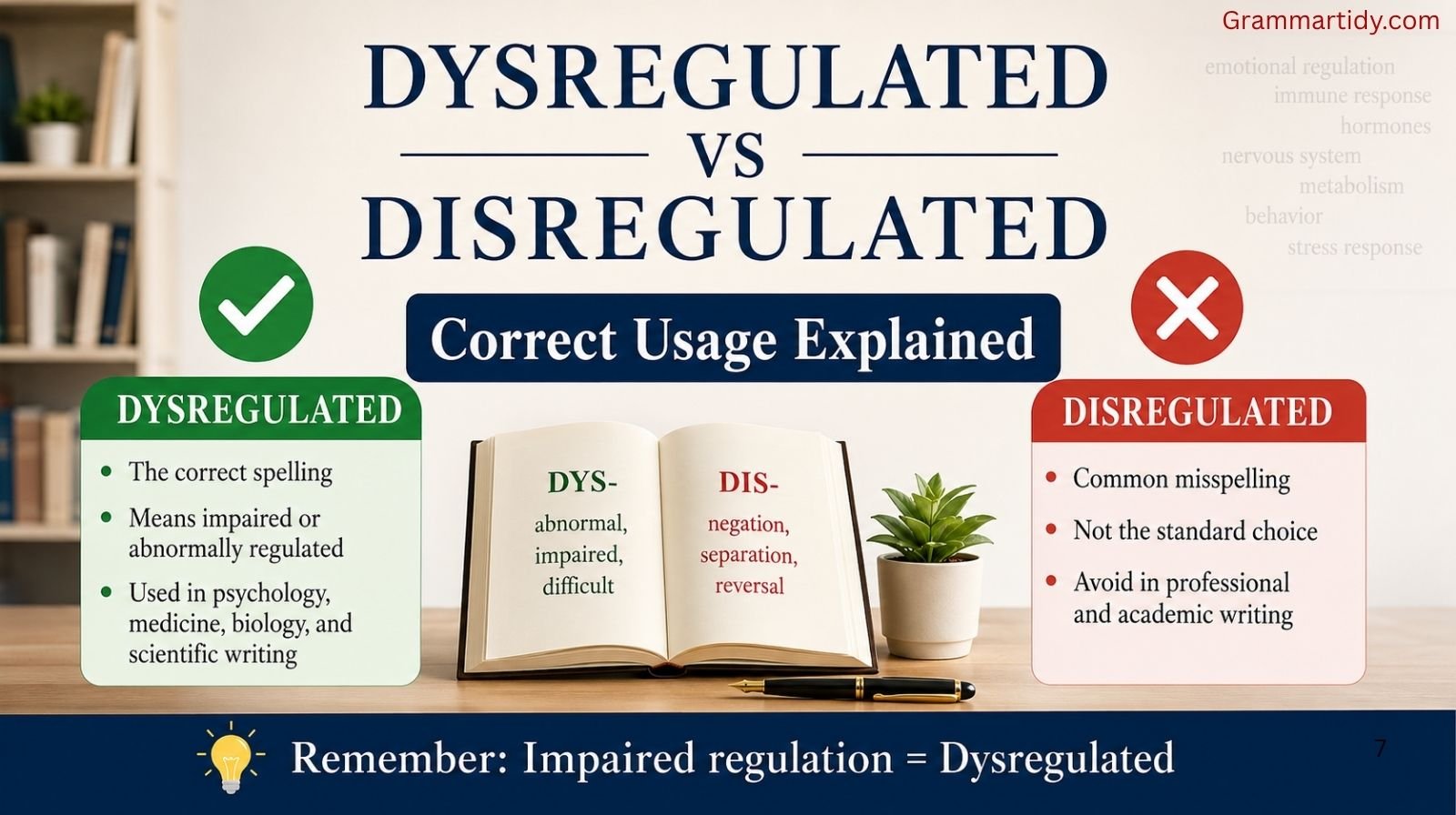
The short answer is simple: dysregulated is the standard choice when you mean that regulation is impaired or not functioning normally.
What Does “Dysregulated” Mean?
Dysregulated is an adjective formed from dysregulate and dysregulation. It describes something whose normal regulatory process is impaired, disrupted, or functioning abnormally.
Merriam-Webster Medical defines dysregulation as impairment of a physiological regulatory mechanism and lists dysregulated as the corresponding adjective.
For example:
- “The patient had dysregulated glucose metabolism.”
- “Chronic stress may contribute to emotional dysregulation.”
- “The researchers observed a dysregulated immune response.”
- “She felt emotionally dysregulated after the stressful event.”
The word is not limited to mental health. It is also used in medicine, biology, neuroscience, and other scientific fields.
Is “Disregulated” Correct?
Disregulated is generally not the form you should choose in modern standard English when you mean dysregulated.
It does appear online, but dictionary sources that address the term commonly identify it as a misspelling of dysregulated. For example, YourDictionary lists disregulated as a common misspelling, while Wiktionary likewise identifies it as a misspelling of dysregulated.
Therefore, in an essay, report, article, medical document, or professional communication, use dysregulated.
Why Do People Confuse Dysregulated and Disregulated?
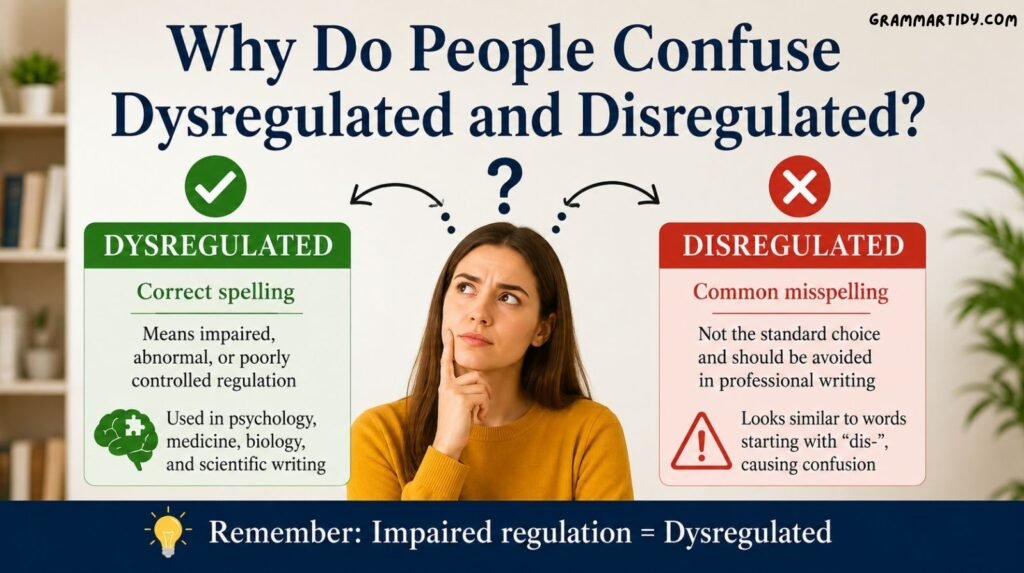
The confusion is understandable because English contains many familiar words beginning with dis-.
The Difference Between “Dys-” and “Dis-”
The prefixes look similar, but they have different functions.
Dys- is commonly associated with something abnormal, impaired, difficult, or faulty.
Examples include:
- dysfunction
- dyslexia
- dysphagia
- dysregulation
Dis-, depending on the word, can indicate negation, separation, reversal, or removal.
Examples include:
- disagree
- disconnect
- disapprove
- disorganize
So when you are describing impaired regulation, dys- is the appropriate formation.
A Simple Memory Trick
Think:
Dysregulated → dysfunctional regulation
If a system is still operating but is not regulating properly, think dysregulated.
For example:
Correct:
“The patient’s stress response appears dysregulated.”
Incorrect in this intended sense:
“The patient’s stress response appears disregulated.”
How to Use Dysregulated Correctly
The meaning of dysregulated becomes much easier to understand when you see it in different contexts.
Emotional Dysregulation
In psychology, dysregulated can describe difficulty managing or modulating emotional responses.
For example:
“The child became emotionally dysregulated after several stressful events.”
This does not necessarily mean the child is permanently unable to control emotions. Rather, the person’s emotional regulation may be impaired or overwhelmed in a particular situation.
Dysregulated Nervous System
You may also encounter phrases such as:
- dysregulated nervous system
- nervous system dysregulation
- stress-related dysregulation
- emotional dysregulation
For example:
“After prolonged stress, she reported feeling unable to settle her nervous system.”
When discussing health, however, it is important not to treat dysregulated as a diagnosis by itself. Context matters, and medical symptoms should be interpreted by an appropriately qualified professional.
Medical and Biological Uses
The term is also common in scientific writing.
Examples include:
“The disease is associated with dysregulated immune signaling.”
“Researchers examined dysregulated gene expression.”
“The study investigated dysregulated neurotransmission.”
A 2025 PubMed-indexed review, for example, discussed dysregulated redox signaling in relation to inflammatory pathways, mitochondrial dysfunction, autophagy, and cardiovascular disease.
This demonstrates an important point: dysregulated is a scientific term, not merely a modern mental-health expression.
Dysregulated vs Disregulated: Quick Comparison
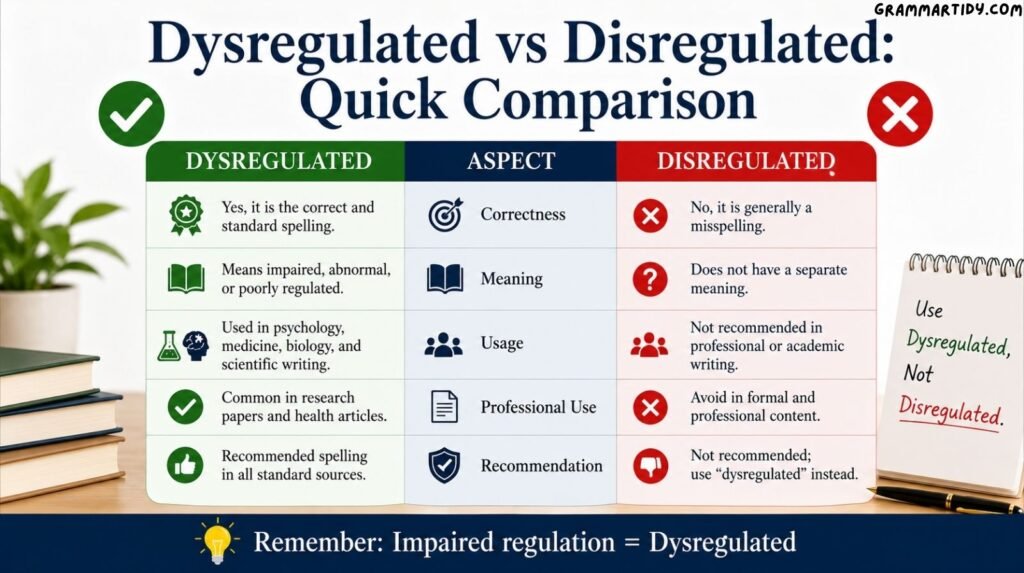
| Feature | Dysregulated | Disregulated |
|---|---|---|
| Standard modern usage | Yes | Generally no |
| Meaning | Abnormally or poorly regulated | Usually a misspelling of dysregulated |
| Medical writing | Common | Avoid |
| Psychology | Common | Avoid |
| Scientific writing | Common | Avoid |
| Recommended spelling | Dysregulated | Not recommended |
Correct and Incorrect Examples
Incorrect:
“His emotions became disregulated during the argument.”
Correct:
“His emotions became dysregulated during the argument.”
Incorrect:
“The immune system was disregulated.”
Correct:
“The immune system was dysregulated.”
Incorrect:
“Sleep deprivation left her feeling disregulated.”
Correct:
“Sleep deprivation left her feeling dysregulated.”
One useful caveat: if you simply mean that something is not regulated, another word may sometimes be more precise. Depending on the context, unregulated, poorly regulated, disorganized, or disrupted could be better choices.
A 2025–2026 Data Snapshot: Why Dysregulation Matters
Although this article is primarily about word choice, recent research shows why dysregulated appears so frequently in health and psychology writing.
A 2025 study published in Middle East Current Psychiatry examined the Dysregulation Profile among 3,642 clinical and 595 community participants aged 6–18 in Egypt. The researchers reported a positive Dysregulation Profile in 33.1% of the clinical sample, compared with 4.2% of the community sample.
Research published in 2026 has continued to examine emotion dysregulation in large youth datasets. One study using data from the Adolescent Brain Cognitive Development study analyzed 11,878 children aged 9–10 to investigate the prevalence and correlates of emotion dysregulation.
Another 2025 study analyzed 13,207 children and adolescents with ADHD to examine subgroups involving ADHD symptoms and emotional dysregulation.
These figures do not mean that everyone described as “dysregulated” has a mental-health disorder. Instead, they show how established the concept of dysregulation has become in contemporary psychological research.
Real-Life Example: Choosing the Right Word
Imagine a university student preparing for several exams at once.
She has been sleeping poorly, receiving constant messages from classmates, and worrying about an upcoming presentation. After receiving unexpected criticism from a professor, she becomes overwhelmed and has difficulty calming herself down.
A friend later writes:
“She was completely disregulated after the meeting.”
The spelling is incorrect for the intended meaning. The better version is:
“She was completely dysregulated after the meeting.”
Why?
Because the sentence describes a temporary difficulty with emotional regulation. Her emotional response was unusually intense and difficult to manage. The intended concept is impaired regulation, which is expressed by dysregulated.
Now consider a different sentence:
“Her schedule was disregulated.”
That sentence should not automatically be changed to dysregulated. If the writer simply means that the schedule became chaotic or poorly organized, disorganized, disrupted, or unstructured might be more natural.
This distinction is important. Good writing is not just about replacing a questionable word with a dictionary-approved word. It is about choosing the most accurate word for the intended meaning.
How to Remember the Correct Usage
Use “Dysregulated” for Impaired Regulation
When the intended meaning is abnormal, impaired, disrupted, or poorly functioning regulation, choose:
dysregulated
Examples:
- dysregulated emotions
- dysregulated glucose metabolism
- dysregulated immune response
- dysregulated behavior
- dysregulated signaling
Don’t Automatically Replace Every “Disregulated” With “Dysregulated”
Context still matters.
For example:
“The company operates in an unregulated market.”
Here, unregulated is the natural choice because the meaning is that the market lacks regulation or is not subject to regulatory control.
Similarly:
“The project became disorganized.”
If the problem is organization rather than regulation, disorganized is more precise.
Therefore, the best editing strategy is:
- Identify what you mean.
- Ask whether you mean impaired regulation.
- If yes, use dysregulated.
- If you mean something else, choose the more precise word.
Quick Mini Quizzes: Dysregulated vs Disregulated
Here are 15 short, easy, human-sounding quizzes based directly on the article. Each one has the answer immediately after it.
1. Which spelling is correct?
A) Disregulated
B) Dysregulated
C) Dysregulatted
D) Disregulatted
Answer: B) Dysregulated
2. What does “dysregulated” generally mean?
A) Completely removed
B) Normally controlled
C) Poorly or abnormally regulated
D) Professionally managed
Answer: C) Poorly or abnormally regulated
3. Which sentence is correct?
A) She felt emotionally disregulated.
B) She felt emotionally dysregulated.
C) She felt emotionally disorganizedly.
D) She felt emotionally unregulatedly.
Answer: B) She felt emotionally dysregulated.
4. Which prefix is used in “dysregulated”?
A) Dis-
B) Un-
C) Dys-
D) Re-
Answer: C) Dys-
5. Is “dysregulated” commonly used in psychology?
A) Yes
B) No
C) Only in literature
D) Only in business
Answer: A) Yes
6. Which phrase is correct?
A) Dysregulated emotions
B) Disregulated emotions
C) Dysregulating emotionses
D) Disregulating emotional
Answer: A) Dysregulated emotions
7. Which field can use the word “dysregulated”?
A) Medicine
B) Biology
C) Psychology
D) All of these
Answer: D) All of these
8. Complete the sentence: “The researchers observed a ______ immune response.”
A) disregulated
B) dysregulated
C) disorganized
D) unregulatedly
Answer: B) dysregulated
9. What is “dysregulation” related to?
A) Impaired regulation
B) Perfect organization
C) Spelling correction
D) Physical distance
Answer: A) Impaired regulation
10. Which word may be better than “dysregulated” when something simply lacks regulation?
A) Unregulated
B) Dyslexic
C) Dysfunctional
D) Dysregulated
Answer: A) Unregulated
11. Which sentence sounds natural and correct?
A) His emotions became dysregulated.
B) His emotions became disregulated.
C) His emotions became dysregulation.
D) His emotions became dysregulately.
Answer: A) His emotions became dysregulated.
12. Why do people often write “disregulated”?
A) It is always the preferred spelling.
B) It looks similar to familiar words beginning with “dis-.”
C) It is a medical abbreviation.
D) It is the plural form.
Answer: B) It looks similar to familiar words beginning with “dis-.”
13. Which sentence uses “unregulated” correctly?
A) His emotions were unregulatedly.
B) The market was unregulated.
C) Her immune system was unregulated emotions.
D) She became unregulatedly nervous.
Answer: B) The market was unregulated.
14. Which word should you normally use in professional writing?
A) Disregulated
B) Dysregulated
C) Disregulatted
D) Dysregulatted
Answer: B) Dysregulated
15. What is the easiest rule to remember?
A) Impaired regulation = dysregulated
B) Impaired regulation = disregulated
C) No regulation = dysregulated in every situation
D) Regulation always means disorganized
Answer: A) Impaired regulation = dysregulated
FAQs
Q1.Is “dysregulated” a real word?
A: Yes. Dysregulated is a recognized English adjective used in medical, biological, psychological, and scientific contexts. Cambridge Dictionary and Merriam-Webster Medical both document the term.
Q2. Is “disregulated” a real English word?
A: It appears in some online sources, but when it is used as an alternative spelling of dysregulated, it is generally treated as a misspelling or nonstandard form.
Q3. Is it “emotionally dysregulated” or “emotionally disregulated”?
A: The standard expression is emotionally dysregulated.
For example:
“He felt emotionally dysregulated after the stressful conversation.”
Q4. What does dysregulated mean in simple English?
A: It means not regulating or controlling something normally.
Depending on context, it can describe emotions, biological processes, hormones, immune responses, metabolism, behavior, or other systems.
Q5. Is dysregulated only used in psychology?
A: No. Psychology is one important area of usage, but the word is also common in medicine and biological sciences. Cambridge Dictionary gives both medical and psychological meanings.
Q6. What is the difference between dysregulated and unregulated?
A: Dysregulated usually suggests that an existing regulatory process is impaired or functioning abnormally.
Unregulated generally means that something is not regulated or controlled by a regulatory system.
For example:
- “The patient’s blood glucose was dysregulated.”
- “The product is sold in an unregulated market.”
The two words are therefore not always interchangeable.
Final Verdict:
When choosing between dysregulated vs disregulated, use dysregulated when you mean that something is functioning with abnormal, impaired, or disrupted regulation.
Dysregulated is the established term used across psychology, medicine, biology, and scientific writing. Disregulated is best avoided when it is simply being used as an alternative spelling.
The easiest rule to remember is:
Impaired regulation = dysregulated.
Before publishing an article, submitting an academic paper, or sending professional content, check the word one more time: d-y-s-r-e-g-u-l-a-t-e-d.
If you are unsure about another commonly confused English word pair, use the same approach: identify the intended meaning first, then choose the word whose definition actually matches it. That small habit can make your writing clearer, more precise, and more credible.
Keep learning with more easy grammar lessons on GrammarTidy.com

Hi, I’m Noor Fatima, the author and creator of Grammar Tidy. I’m passionate about grammar, writing, and making language learning simple and enjoyable. Through Grammar Tidy, I share helpful tips, clear explanations, and practical guidance to help readers improve their writing, avoid common mistakes, and communicate with confidence. My goal is to make better grammar easy, useful, and accessible for everyone.