
Have you ever written “offerred” and wondered whether you spelled it correctly? You are not alone. Many English learners and even experienced writers get confused about whether to use one or two “r” letters when writing the past tense of offer.
The correct spelling is offered, with one “r” followed by “ed.” The word “offerred” is a common misspelling and is not the standard spelling in modern English.
In this guide, you will learn the difference between offerred and offered, understand the spelling rule, explore real-life examples, and discover simple ways to remember the correct form in 2026.
Offerred or Offered: Which Spelling Is Correct?
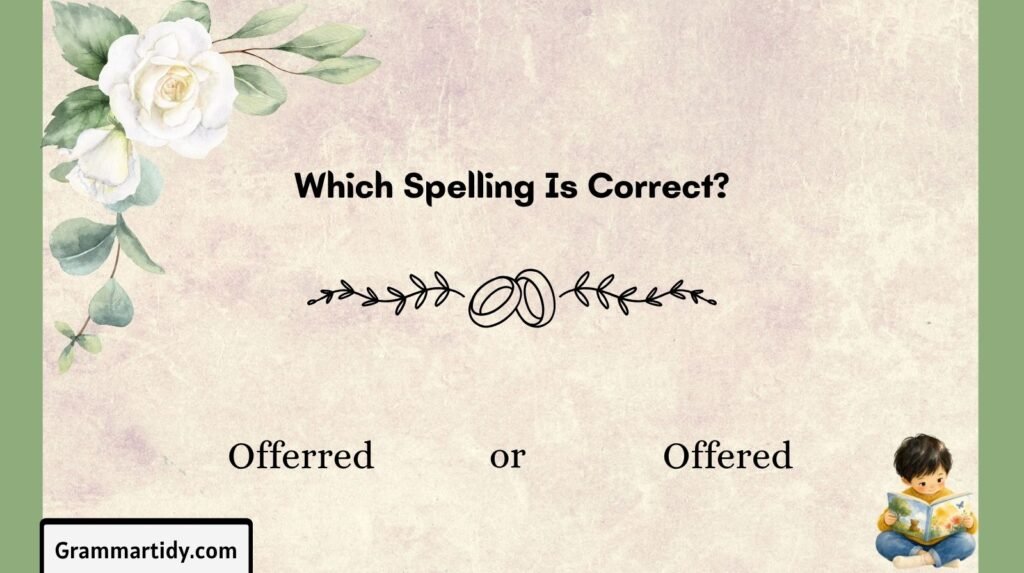
The correct spelling is offered. It is the past tense and past participle of the verb offer, meaning to present, provide, or express willingness to give something.
“Offerred” is incorrect in standard English because the final consonant of offer is not doubled when adding “-ed.”
Why Is Offered the Correct Spelling?
The base verb is offer.
To make its past tense, simply add “-ed”:
– Offer + ed = Offered
The original “r” remains unchanged, so the correct spelling contains two consecutive “f” letters and one “r” before “ed.”
Correct: She offered me a helping hand.
Incorrect: She offerred me a helping hand.
Is Offerred Ever Correct?
In standard modern English, “offerred” is considered a spelling mistake.
You may encounter it in informal messages, social media posts, or unedited writing. However, it is not the accepted spelling for formal emails, academic assignments, professional documents, or published articles.
Quick answer: Use “offered” whenever you mean that someone gave, suggested, or presented something in the past.
What Does Offered Mean? Definition and Usage
The word “offered” describes an action in which someone presented something, made something available, or expressed willingness to do something.
It is the past tense and past participle of “offer.”
Offered Meaning in Simple English
In simple words, “offered” means gave, presented, proposed, or made available, depending on the context.
For example:
- The company offered me a job.
- He offered to help with the project.
- The restaurant offered a special discount.
- She offered her advice during the meeting.
In each example, someone made something available or expressed willingness to provide it.
How to Use Offered in Different Situations
“Offered” can appear in everyday conversations, workplace communication, education, and business writing.
| Situation | Example |
|---|---|
| Employment | The company offered him a position. |
| Help | My friend offered to carry the bags. |
| Education | The university offered a new course. |
| Business | The store offered a seasonal discount. |
| Advice | She offered useful suggestions. |
The meaning changes slightly depending on the object or action, but the spelling remains the same.
Offered as a Past Tense and Past Participle
“Offered” has two common grammatical roles.
Past tense:
It describes an action that happened in the past.
Example:
They offered me a refund yesterday.
Past participle:
It appears with auxiliary verbs such as “has,” “have,” “had,” or in passive constructions.
Examples:
- The company has offered several solutions.
- She had offered her assistance before the meeting.
- A discount was offered to all customers.
Both forms use the same spelling: offered.
Why Do People Confuse Offerred and Offered?
Although “offered” is a relatively simple word, its spelling can confuse people because English has several different rules for adding “-ed” to verbs.
The Double-Consonant Rule Creates Confusion
Some English verbs double their final consonant before adding “-ed.”
For example:
- Stop → Stopped
- Plan → Planned
- Admit → Admitted
Because these words double their final consonant, writers sometimes assume that “offer” should become “offerred.”
However, “offer” already ends with a doubled consonant: “ff.” Its final letter is “r,” but the spelling pattern does not require another “r.”
Therefore:
- Offer → Offered
- Not: Offerred
Confusion Between Similar-Looking Words
English contains many verbs whose past-tense forms involve different spelling patterns.
| Base verb | Correct past tense |
|---|---|
| Offer | Offered |
| Refer | Referred |
| Prefer | Preferred |
| Transfer | Transferred |
| Suffer | Suffered |
Notice that “refer,” “prefer,” and “transfer” double the final “r” before “-ed,” while “offer” and “suffer” do not.
This difference is a common source of spelling mistakes.
Pronunciation Does Not Always Reveal Spelling
The pronunciation of “offered” may make the ending sound like a separate syllable: “of-ferd.”
However, pronunciation alone does not tell you whether to double a consonant.
The easiest approach is to remember the correct written form rather than guessing from how the word sounds.
Offered vs Offerred: Comparison Table and Grammar Rules
A quick comparison can help you recognize the correct spelling and avoid repeating the same mistake.
Quick Comparison Table
| Feature | Offered | Offerred |
|---|---|---|
| Correct spelling | Yes | No |
| Standard English | Yes | No |
| Meaning | Presented or made available | Intended meaning is usually “offered” |
| Grammar | Past tense and past participle | Misspelling |
| Formal writing | Appropriate | Avoid |
| Example | He offered me help. | He offerred me help. |
Also Read: Moment vs Momment: Difference, Meaning And Correct Usage
A Simple Step-by-Step Spelling Guide
Follow these steps whenever you need to write the past tense of “offer.”
- Start with the base verb: offer.
- Keep the original spelling intact.
- Add “-ed” to the end.
- Check that the result is “offered,” not “offerred.”
Quick spelling check
Which spelling is correct?OfferredOffered
Common Mistakes to Avoid
Watch out for these frequent errors:
- Writing “offerred” instead of “offered.”
- Adding an extra “r” because of words such as “referred.”
- Using “offered” when the sentence requires the base form “offer.”
- Confusing “offered” with “offering” or “offers.”
Examples:
Incorrect: I offerred to help yesterday.
Correct: I offered to help yesterday.
Incorrect: She has offerred a solution.
Correct: She has offered a solution.
Real-Life Case Study: How a Small Spelling Mistake Can Affect Professional Writing
Imagine a job applicant named Sarah who is preparing an email to a hiring manager. She wants to thank the manager for an employment opportunity and writes:
“Thank you for the position you offerred me. I am excited to join your team.”
Sarah’s message is understandable, and the hiring manager can easily recognize what she means. However, the incorrect spelling may distract from the professionalism of the email, particularly if the message is part of a formal application process.
Before sending the email, Sarah checks the spelling and corrects the sentence:
“Thank you for the position you offered me. I am excited to join your team.”
The corrected version communicates the same message while following standard English spelling conventions.
Now imagine a similar mistake in a business proposal. A sentence such as “We offerred a customized solution to our client” may be understood, but it can make the document look less carefully edited.
This example illustrates why proofreading matters. A single spelling error does not automatically determine someone’s ability or professionalism, but avoidable mistakes can distract readers from the intended message.
The practical lesson is simple: when writing about something provided or proposed in the past, check whether “offered” is the form you need. A quick spelling review can help make emails, reports, applications, and other professional documents clearer.
Also Read: Bachelor vs Batchelor: Difference And Correct Usage
Offerred or Offered: Spelling Trends and 2025–2026 Data

People searching for “offerred or offered” are usually looking for a quick spelling correction. However, there is an important difference between general spelling guidance and actual search-volume statistics.
What Can We Confirm About the Spelling in 2026?
The standard spelling remains offered in contemporary English. The spelling follows the established form of the verb “offer” plus the suffix “-ed.”
For current writing, the practical recommendation is unchanged:
- Use “offered” in academic writing.
- Use “offered” in business emails.
- Use “offered” in blog posts and website content.
- Avoid “offerred” unless reproducing a source exactly to discuss its spelling error.
Are There Verified Search Statistics for Offerred vs Offered?
There is no verified 2025–2026 search-volume dataset included in this article that establishes how many people search for “offerred” compared with “offered.”
It would be misleading to invent search counts, percentages, or year-over-year growth figures.
For SEO research, Google Trends can help compare relative search interest, while Google Search Console can show actual impressions and clicks for a website’s queries.
These tools measure different things, so their figures should not be treated as interchangeable.
Where to Check Current Search Data
- Google Trends Explore relative search interest for “offered” and “offerred” over a selected period and region.
- Google Search Console Review query impressions, clicks, and search performance for your own website.
- Cambridge Dictionary: Offer Check the meaning, pronunciation, and grammatical forms of “offer.”
These references support spelling and research verification. They do not establish a specific 2025–2026 misspelling rate.
Mini Quizzes: Offerred or Offered
Test your spelling skills with these 15 quick, fun, and easy quizzes! Each question includes its answer right after it.
Quiz 1: Pick the Correct Spelling
Which spelling is correct?
A) Offerred
B) Offered
Answer: B) Offered
Quiz 2: Fill in the Blank
She _____ to help me with my homework.
A) offerred
B) offered
Answer: B) offered
Also Read: Emersion vs Immersion: Differences And Correct Usage
Quiz 3: Spot the Spelling Mistake
Which word is misspelled?
A) Offered
B) Offerred
C) Offering
Answer: B) Offerred
Quiz 4: Complete the Sentence
The company _____ him a new job yesterday.
A) offered
B) offerred
Answer: A) offered
Quiz 5: True or False?
“Offerred” is the correct past tense of “offer.”
Answer: False. The correct spelling is “offered.”
Quiz 6: Choose the Correct Email
Which sentence is correct for a professional email?
A) Thank you for the opportunity you offerred me.
B) Thank you for the opportunity you offered me.
Answer: B) Thank you for the opportunity you offered me.
Quiz 7: What Is the Past Tense?
What is the past tense of “offer”?
A) Offerred
B) Offered
C) Offerring
Answer: B) Offered
Quiz 8: Quick Grammar Check
He has _____ me some useful advice.
A) offered
B) offerred
Answer: A) offered
Quiz 9: Which Sentence Looks Right?
A) My teacher offered extra help.
B) My teacher offerred extra help.
Answer: A) My teacher offered extra help.
Quiz 10: Remember the Rule
How do you spell the past tense of “offer”?
A) Offer + ed = Offered
B) Offer + red = Offerred
Answer: A) Offer + ed = Offered
Quiz 11: Find the Correct Word
The restaurant _____ us a special discount.
A) offerred
B) offered
Answer: B) offered
Quiz 12: Choose the Correct Past Participle
Which word completes the sentence?
“She has _____ to pay for lunch.”
A) offered
B) offerred
Answer: A) offered
Quiz 13: Catch the Typo!
Which sentence needs a spelling correction?
A) They offered me a seat.
B) They offerred me a seat.
Answer: B) They offerred me a seat.
Quiz 14: One “r” or Two?
How many letter “r”s appear in the correct spelling of “offered”?
A) One
B) Two
C) Three
Answer: A) One
Quiz 15: Final Spelling Challenge
Choose the correctly written sentence.
A) She offerred a wonderful suggestion.
B) She offered a wonderful suggestion.
C) She offerrred a wonderful suggestion.
Answer: B) She offered a wonderful suggestion.
Also Read: Encorporate vs Incorporate: Correct Usage Explained
FAQs
Q1. Is it offerred or offered?
“Offered” is correct. “Offerred” is a common misspelling and should be avoided in standard English.
Q2. Why is offered spelled with one r?
The base verb is “offer.” You add “-ed” without doubling the final “r,” giving you “offered.”
Q3. What is the past tense of offer?
The past tense is “offered.”
Example: He offered me a ride home.
Q4. Is offered a real word?
Yes. “Offered” is a standard English word and is the past tense and past participle of “offer.”
Q5. Is offerred ever acceptable in formal writing?
No. In standard formal English, use “offered.” The spelling “offerred” is generally considered incorrect.
Q6. What is the difference between offered and offering?
“Offered” is the past tense or past participle of “offer.” “Offering” is the present participle or gerund.
Examples:
- She offered help yesterday.
- She is offering help today.
Q7. How can I remember the correct spelling of offered?
Remember this simple formula:
Offer + ed = Offered
Keep the original “ff” and “r,” then add “ed.” Do not add another “r.”
Conclusion:
When choosing between “offerred” and “offered,” the correct spelling is always offered in standard modern English.
It is the past tense and past participle of “offer,” used when someone presented something, made something available, or expressed willingness to help.
Remember these key points:
- “Offered” is correct.
- “Offerred” is a common misspelling.
- Add “-ed” to “offer” without doubling the “r.”
- Use “offered” in academic, professional, and everyday writing.
The next time you write an email, assignment, or blog post, remember the simple formula: offer + ed = offered.
Discover More Article
- Grately vs Greatly: Differences And Correct Usage
- Courtesy vs Curtesy: Meaning, Usage And Common Mistakes
- Oversite vs Oversight: What’s The Difference And Which Word Should You Use?
Keep learning with more easy grammar lessons on GrammarTidy.com

Hi, I’m Noor Fatima, the author and creator of Grammar Tidy. I’m passionate about grammar, writing, and making language learning simple and enjoyable. Through Grammar Tidy, I share helpful tips, clear explanations, and practical guidance to help readers improve their writing, avoid common mistakes, and communicate with confidence. My goal is to make better grammar easy, useful, and accessible for everyone.