If you’ve ever paused mid-sentence wondering whether it’s “tying my shoes” or “tieing my shoes,” you’re not alone. This is one of the most common spelling mix-ups in English, and it trips up native speakers just as often as learners.
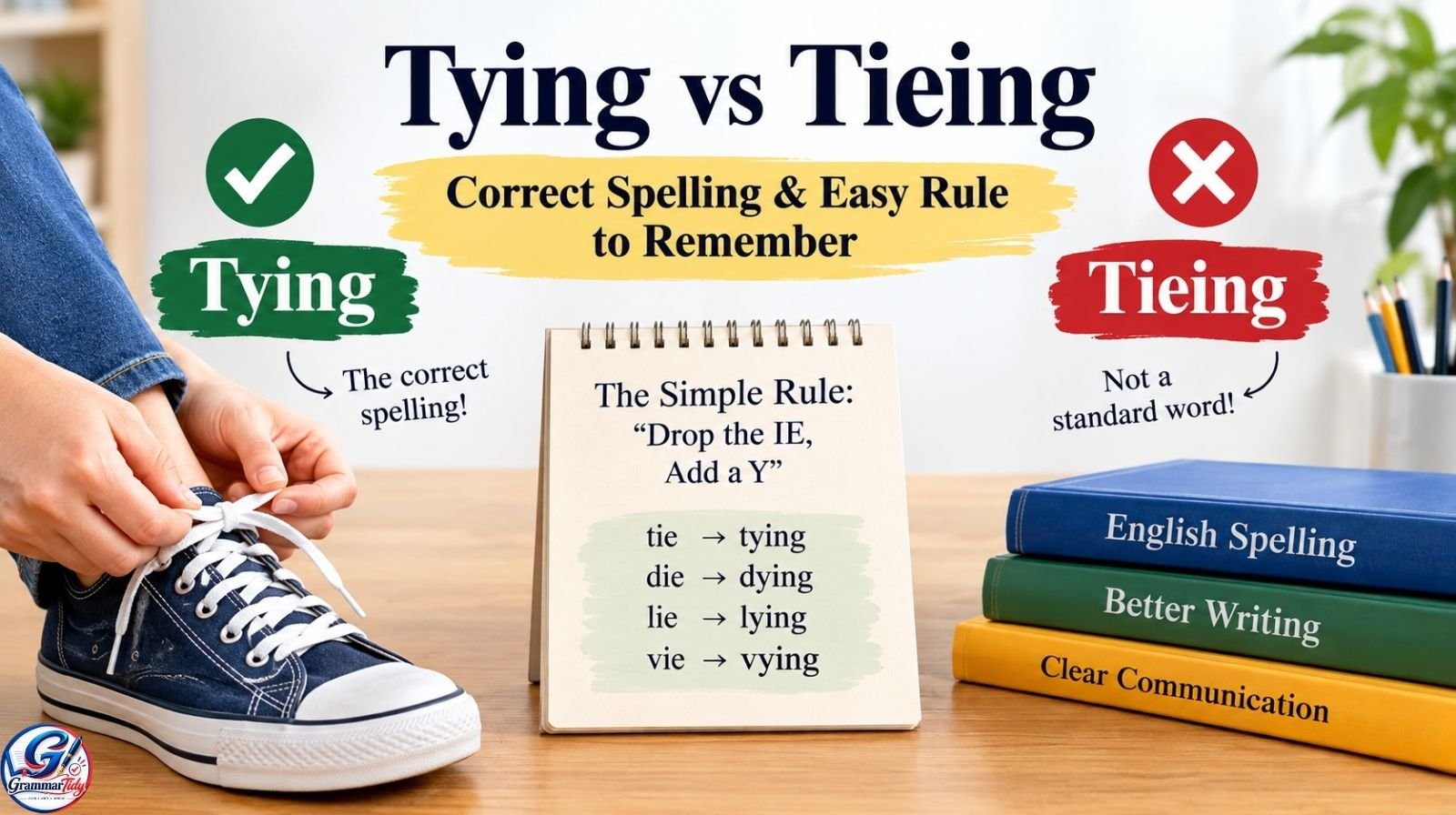
Here’s the short answer: “tying” is correct, and “tieing” is not a standard English word. However, the reason behind this rule is where most people get stuck.
Once you understand the simple pattern at play, you’ll never second-guess this spelling again and you’ll be able to apply the same logic to dozens of other tricky words.
This guide breaks down exactly why “tying” wins, gives you a memory trick you can use instantly, and shows you real examples so the rule sticks for good.
Also Read: Repore or Rapport: Which Spelling Is Correct? Meaning, Examples & Grammar Guide (2026)
Why “Tying” Is the Correct Spelling
The word “tie” follows a spelling pattern that governs how English verbs form their “-ing” version when they end in the letters “ie.”
The Rule Behind It
When a verb ends in “ie,” you drop the “e” and change the “i” to a “y” before adding “-ing.” So:
- tie → tying
- die → dying
- lie → lying
- vie → vying
This happens because English spelling avoids placing “i” directly before “ing,” since “iing” looks awkward and is hard to read. Swapping the final “ie” for a “y” keeps the word visually clean and easy to pronounce.
Why “Tieing” Feels Right (But Isn’t)
Most other verbs simply add “-ing” without changing anything, like “play” becoming “playing” or “jump” becoming “jumping.” Because that pattern is so common, our brains naturally want to apply it to “tie” as well, producing “tieing.”
Unfortunately, this specific “ie” ending is an exception, and dictionaries do not recognize “tieing” as a standard spelling.
The Simple Memory Trick to Never Mix Them Up Again
You don’t need to memorize grammar rules to get this right every time. A short mental shortcut works just as well.
The “Drop the IE, Add a Y” Trick
Whenever a word ends in “ie” and you need to add “-ing,” remember this three-step process:
- Remove the final “e.”
- Change the “i” to a “y.”
- Add “-ing.”
For example, applying this to “die” gives you “dy” + “ing” = “dying.” Applying it to “tie” gives you “ty” + “ing” = “tying.” Therefore, the same shortcut works consistently across every word in this category.
A Quick Visual Anchor
Some learners find it easier to picture the letter “y” physically replacing the “ie,” almost like a substitution swap. If you imagine crossing out the “ie” in “tie” and writing a “y” in its place, you get “tying” instantly, without needing to recall any formal spelling rule.
Tying vs Tieing: Side-by-Side Comparison
The table below makes the distinction easy to scan at a glance.
| Feature | Tying | Tieing |
|---|---|---|
| Dictionary status | Correct, standard spelling | Not a recognized word |
| Used in formal writing | Yes | No |
| Follows English spelling rule | Yes (ie → y + ing) | No |
| Example sentence | “She is tying her shoelaces.” | Incorrect usage |
| Found in style guides (AP, Chicago, MLA) | Yes | No |
As the table shows, “tying” is the only version accepted across dictionaries, style guides, and professional writing standards.
Also Read: Unaffected vs Uneffected: Which Word To Use Correctly?
Real-World Examples of “Tying” in a Sentence
Seeing the word in context makes the correct spelling easier to remember than reading the rule alone.
Everyday Examples
- “He spent the morning tying up loose ends before the presentation.”
- “The two teams ended up tying the match at 2-2.”
- “She’s tying a ribbon around the gift box.”
- “We’re tying the project timeline to the client’s budget approval.”
Common Phrases That Use “Tying”
Several everyday idioms rely on this exact spelling, including “tying the knot” (getting married), “tying yourself in knots” (overthinking something), and “tying up loose ends” (finishing remaining tasks).
Because these phrases appear constantly in both spoken and written English, getting the spelling right matters for everything from text messages to professional emails.
Case Study: How One Small Typo Affected a Business Email

Consider Sarah, a marketing coordinator at a mid-sized events company, who was drafting a client-facing email about a wedding planning package.
In her rush to finish before a deadline, she typed, “We recommend tieing the ceremony timeline to the reception schedule,” and sent it without a second read.
The client, a detail-oriented wedding planner, noticed the misspelling immediately and mentioned it in her reply, half-jokingly asking if the rest of the contract had been proofread as carefully as the email.
Sarah’s manager later flagged the exchange during a team meeting, not because one typo was catastrophic, but because it planted a seed of doubt about the company’s attention to detail during a high-stakes client relationship.
This story reflects a broader pattern documented in professional writing research: a Grammarly study of LinkedIn profiles found that people who did not advance to director-level positions within their first ten years made 2.5 times as many grammatical mistakes as their director-level peers.
Sarah’s case is a small-scale version of that same dynamic. After the incident, she started running a quick proofread pass on every client email, catching similar slip-ups before they left her outbox.
The lesson is simple: small spelling errors like “tieing” instead of “tying” rarely break a deal on their own, but they quietly chip away at credibility, especially in industries built on precision and trust.
Also Read: Triple vs Tripple: Which Is The Correct One To Use?
Spelling Mistakes by the Numbers: 2025-2026 Data
Spelling errors are far more common than most people assume, and the data backs this up.
- A Grammarly survey of 3,400 members of its global community found that 93% admitted to committing a mistake in a workplace email, and 64% specifically reported making embarrassing typos or grammatical errors.
- Global spelling data from 2025 shows that words like “definitely,” “license,” and “convenience” ranked among the top ten most commonly misspelled words worldwide, proving that even everyday vocabulary trips people up constantly.
- Poor writing habits carry a real cost at scale: unclear communication in the workplace can lead to roughly 25.5 hours of lost productivity per week for affected employees, with some teams seeing productivity drop by up to 30%.
These numbers highlight why small details, like correctly spelling “tying” instead of “tieing,” matter more than they might seem to on the surface. Clear, accurate writing consistently correlates with professionalism and trust.
Quick Checklist: Applying This Rule to Other Words
Once you understand the “tying” rule, you can apply it confidently to similar words. Use this checklist whenever you’re unsure:
- ✅ Does the word end in “ie”? (tie, die, lie, vie)
- ✅ Drop the final “e”
- ✅ Change the “i” to a “y”
- ✅ Add “-ing”
- ✅ Double-check the result doesn’t contain “iing,” which signals a spelling error
- ✅ Compare against a trusted dictionary if you’re still unsure
Words that follow this exact same pattern include “dying” (from die), “lying” (from lie), and “vying” (from vie). Notice that all of them follow the identical transformation as “tying.”
Also Read: Nominator vs Nominee: Differences, Definitions, And Correct Usage
Quick Quiz: Test Your “Tying vs Tieing” Knowledge
A fun way to lock in the rule no pressure, just quick brain checks!
1. The Classic One
Which spelling is correct: “tying” or “tieing”?
Answer: Tying! “Tieing” isn’t a real word in any dictionary.
2. Shoelace Check
“She’s ___ her shoelaces before the race.” Fill in the blank.
Answer: Tying as in “She’s tying her shoelaces.”
3. The Rule Reveal
What do you do to the letters “ie” before adding “-ing”?
Answer: Drop the “e” and change the “i” to a “y.”
4. Wedding Bells
Complete the idiom: “They’re finally ___ the knot next June.”
Answer: Tying “tying the knot” means getting married.
5. Spot the Twin
Which other word follows the exact same rule as “tie” → “tying”?
Answer: “Die” → “dying” (also works for “lie” → “lying” and “vie” → “vying”).
6. True or False
True or False: “Tieing” will pass most spell-checkers without a flag.
Answer: False most spell-checkers catch it and suggest “tying” instead.
7. Sports Moment
“The game ended in a ___ score of 3-3.” Which word fits?
Answer: Tying “a tying score.”
8. Why Not “Tieing”?
Why does English avoid spelling it “tieing”?
Answer: Because “iing” is awkward to read, so English swaps the “i” for a “y” instead.
9. Loose Ends
Finish the phrase: “Let’s finish ___ up loose ends before Friday.”
Answer: Tying “tying up loose ends.”
10. British or American?
Does “tying” change spelling between British and American English?
Answer: No it’s spelled the same way in both.
11. Overthinking It
Which phrase describes overanalyzing a problem: “tying yourself in knots” or “tieing yourself in knots”?
Answer: Tying yourself in knots same spelling rule applies here too.
12. Pattern Match
“Vie” becomes “vying.” Using the same logic, what does “lie” become?
Answer: Lying.
13. Real Talk
Is a misspelling like “tieing” likely to cost you a job on its own?
Answer: Not usually on its own, but frequent small errors can quietly hurt credibility over time.
14. Memory Trick Recap
What’s the 3-step trick for spelling words ending in “ie” correctly?
Answer: Drop the “e,” change “i” to “y,” then add “-ing.”
15. Final Boss Question
Which sentence is spelled correctly: “He is tying his tie” or “He is tieing his tie”?
Answer: “He is tying his tie” tying wins every time!
FAQs
Q. Is “tieing” ever correct in any context?
A: No. “Tieing” is not listed as a valid spelling in any major English dictionary, including Merriam-Webster or Oxford. It’s a common misspelling that results from applying the standard “-ing” rule to a word that follows a different pattern.
Q. Why doesn’t English just add “-ing” to “tie” like other verbs?
A: English generally avoids the letter combination “iing” because it’s visually awkward and inconsistent with how vowels typically pair in the language. Swapping the “ie” for a “y” solves this readability issue while preserving the word’s pronunciation.
Q. Are there other words that follow the same “ie to y” pattern?
A: Yes. “Die” becomes “dying,” “lie” becomes “lying,” and “vie” becomes “vying.” Each of these follows the identical drop-the-e, swap-i-for-y process used in “tying.”
Q. Does autocorrect usually catch “tieing” as an error?
A: Most modern spell-checkers and word processors will flag “tieing” as incorrect and suggest “tying” instead. However, it’s still worth learning the rule manually, since not every platform, app, or messaging tool runs a spell-check by default.
Q. Is “tying” used the same way in British and American English?
A: Yes. Unlike many words with regional spelling differences (such as “colour” versus “color”), “tying” is spelled identically in both British and American English. There is no regional variation for this particular word.
Q. What’s the easiest way to remember this rule long-term?
A: Practice writing out the four core examples tying, dying, lying, vying a few times until the pattern feels automatic. Most people find that once they’ve consciously applied the rule two or three times, it becomes second nature.
Final Thoughts
Getting “tying vs tieing” right comes down to one simple, reliable pattern: when a word ends in “ie,” drop the “e,” swap the “i” for a “y,” and add “-ing.” This small rule instantly resolves the confusion and applies consistently across similar words like “dying,” “lying,” and “vying.”
Therefore, the next time you’re drafting an email, a school assignment, or a quick text message, you can type “tying” with full confidence.
Want to sharpen your everyday writing even further? Bookmark this guide, share it with a colleague who still writes “tieing,” and start applying the same rule to other tricky verbs the next time you write.
Discover More Article
- Tapping vs Taping: Difference And Correct Usage Explained
- Prooving vs Proving Difference: Which Spelling Is Correct?
- Blankie vs Blanky: Difference And Correct Usage Explained
Keep learning with more easy grammar lessons on GrammarTidy.com

Hi, I’m Noor Fatima, the author and creator of Grammar Tidy. I’m passionate about grammar, writing, and making language learning simple and enjoyable. Through Grammar Tidy, I share helpful tips, clear explanations, and practical guidance to help readers improve their writing, avoid common mistakes, and communicate with confidence. My goal is to make better grammar easy, useful, and accessible for everyone.