If you have ever stopped while writing and wondered whether humorous or humerous is correct, you are not alone. These spellings look remarkably similar, but they do not have the same status in standard English.
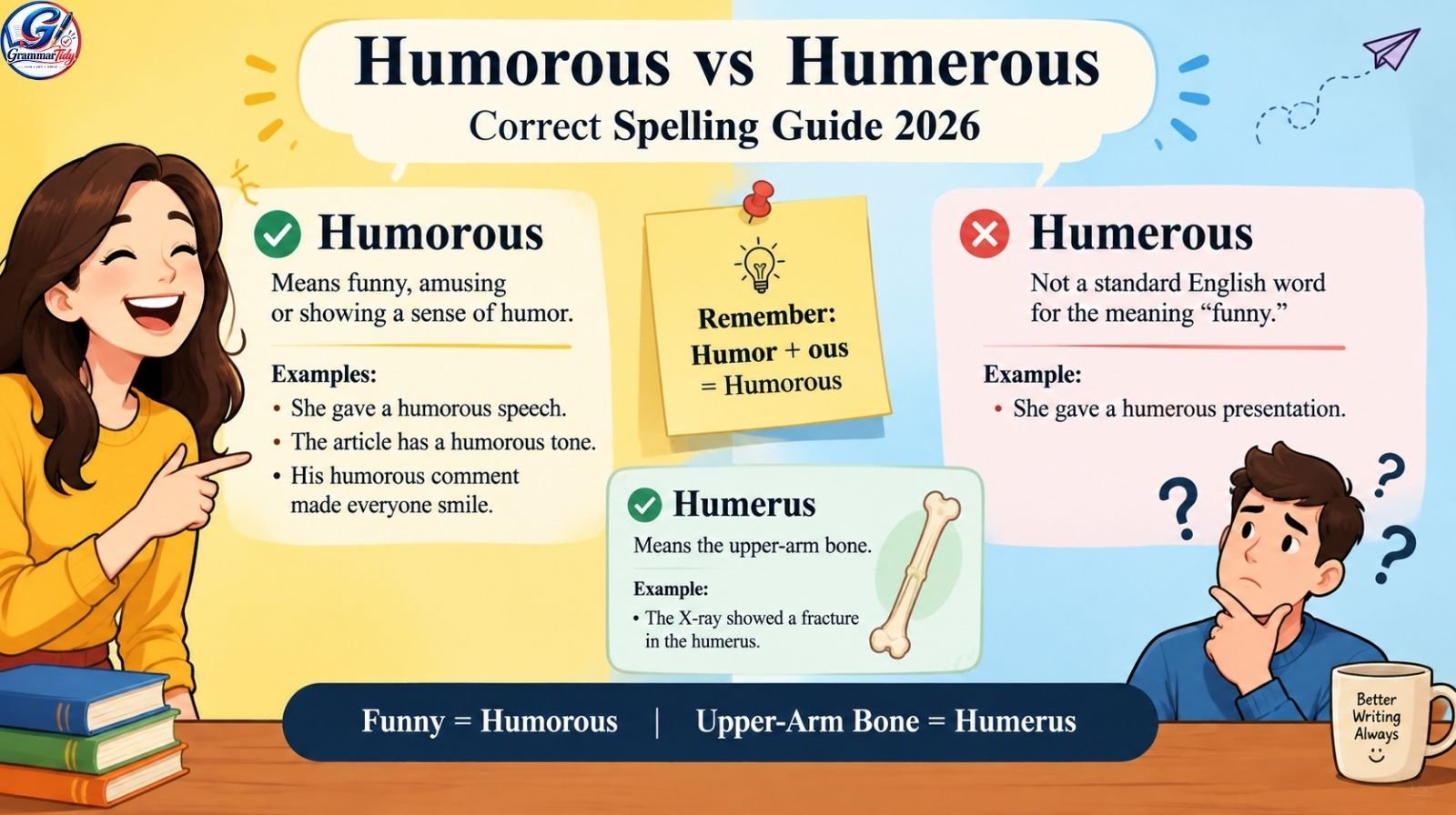
The correct spelling is humorous when you mean “funny,” “amusing,” or “related to humor.” Humerous is generally treated as a misspelling of humorous. There is also another genuine word, humerus, which refers to the long bone in the upper arm.
This 2026 guide explains the difference between humorous vs humerous, shows real sentence examples, explains why the mistake happens, and gives you an easy way to remember the correct spelling.
Also Read: Blankie vs Blanky: Difference And Correct Usage Explained
Humorous vs Humerous: What Is the Correct Spelling?
The short answer is simple:
Humorous = correct when you mean funny or amusing.
Humerous = incorrect/nonstandard spelling when you mean funny.
Humerus = correct when you mean the upper-arm bone.
Cambridge Dictionary defines humorous as something that is funny or makes you laugh. Oxford similarly defines it as funny or showing a sense of humor.
Humorous Is the Correct Word
Humorous is an adjective.
Examples:
- She gave a humorous speech.
- The book contains several humorous stories.
- His humorous comment made everyone smile.
- The article takes a humorous look at modern life.
The spelling is:
H-U-M-O-R-O-U-S
Why Humerous Is Usually Incorrect
Humerous is not the standard spelling of the adjective meaning funny or amusing. It is generally identified as a misspelling of humorous.
For example:
❌ She gave a humerous presentation.
✅ She gave a humorous presentation.
The mistake is easy to make because humerous, humorous, and humerus look and sound quite similar.
Why Do People Confuse Humorous and Humerous?
The confusion mainly comes from the arrangement of letters and the pronunciation.
Humorous Comes From Humor
A useful way to remember the spelling is to start with the noun:
humor + ous = humorous
For example:
- humor → humorous
- humor → humorously
- humor → humorist
- humor → humorless
If you remember the base word humor, the spelling of humorous becomes much easier.
In British English, the noun is commonly spelled humour, but the adjective is still humorous. Cambridge and Oxford both list humorous as the adjective.
Also Read: Oversite vs Oversight: What’s The Difference And Which Word Should You Use?
Humorous vs Humerus
Another source of confusion is humerus.
The words are very close visually:
| Word | Correct? | Meaning |
|---|---|---|
| humorous | ✅ Yes | Funny or amusing |
| humerous | ❌ No for this meaning | Common misspelling of humorous |
| humerus | ✅ Yes | Upper-arm bone |
| humor | ✅ Yes | Amusement or comic quality |
| humour | ✅ Yes | British spelling of humor |
So don’t accidentally replace humorous with humerus either.
For example:
The teacher gave a humorous explanation.
But:
The X-ray showed damage to the humerus.
The first sentence is about something funny. The second is about anatomy.
A Simple Memory Trick
Try this:
Funny → HUMOROUS
Bone → HUMERUS
Or remember:
Humor + ous = humorous
That tiny connection can prevent the spelling mistake.
How to Use Humorous Correctly in a Sentence
Understanding the meaning is useful, but seeing the word in context makes the spelling much easier to remember.
Humorous in Everyday English
You can use humorous to describe a person, comment, story, conversation, book, movie, speech, or situation.
Examples:
- My uncle is naturally humorous.
- She told a humorous story about her first job.
- His answer was surprisingly humorous.
- The teacher used a humorous example to explain the lesson.
- We watched a humorous movie last night.
Oxford notes that humorous is commonly used for stories, speeches, writers, and situations that show or express humor.
Humorous in Professional Writing
Humorous can also appear in business and professional communication, although the tone should match the audience.
For example:
The presentation used a humorous opening to make the subject more approachable.
Or:
The report takes a humorous but informative look at workplace communication.
However, humor is not appropriate in every professional situation. A formal complaint, legal document, serious announcement, or sensitive business message may require a more neutral tone.
Humorous in Academic and Educational Writing
Students can use humorous when describing writing, examples, characters, or communication.
For example:
The author uses a humorous tone throughout the essay.
Another example:
The teacher gave a humorous example to help students understand the difficult concept.
Notice that humorous describes the noun tone and example. That is because humorous is an adjective.
Also Read: Offerred or Offered: Which Spelling Is Correct & Why In 2026?
Humorous vs Humerous: Quick Comparison
Here’s the easiest side-by-side reference:
| Feature | Humorous | Humerous |
|---|---|---|
| Standard English word? | ✅ Yes | ❌ No, for the intended meaning |
| Meaning | Funny or amusing | Usually a misspelling of humorous |
| Part of speech | Adjective | |
| Correct example | A humorous story | |
| Root | Humor/humour | |
| Should you use it? | ✅ Yes | ❌ No |
What About Humerus?
Don’t confuse humerous with humerus.
Humerus is a real anatomical term referring to the bone extending from the shoulder to the elbow.
For example:
The doctor examined the patient’s humerus.
Therefore:
Humorous = funny
Humerus = upper-arm bone
Humerous = misspelling when intended to mean humorous
Also Read: Fiend or Feen: Which Spelling Is Correct & Why In 2026?
2025–2026 Data & Usage Snapshot
There is an important distinction between spelling evidence and search-volume data.
Public search engines do not provide a universally reliable, official number showing exactly how many people typed humerous instead of humorous. Therefore, assigning a precise monthly search-volume figure without access to a verified keyword database would be misleading.
However, several useful 2025–2026 indicators can be verified:
Current Reference Evidence
- Cambridge Dictionary currently lists humorous as an English adjective meaning funny or making you laugh.
- Oxford Advanced Learner’s Dictionary lists humorous and gives examples involving humorous stories, speeches, writers, and situations.
- Wiktionary’s June 2025 entry explicitly identifies humerous as a misspelling of humorous.
- A 2026 spelling guide also distinguishes humorous from the misspelling humerous, reinforcing that the confusion remains relevant in current online English-learning content.
There is also a broader SEO lesson here. Google’s current guidance emphasizes helpful, reliable, people-first content and specifically recommends avoiding spelling and stylistic errors. Google’s Search Essentials were updated in December 2025, while its helpful-content approach has been incorporated into its core ranking systems since March 2024.
So for a 2026 spelling article, the strongest approach is not to invent search statistics but to provide accurate dictionary evidence, clear examples, useful explanations, and genuinely helpful content.
Real-Life Case Study: A Small Spelling Error in a Presentation
Imagine a marketing employee preparing a presentation for a new advertising campaign.
One slide contains this sentence:
“Our campaign uses a humerous approach to connect with younger customers.”
The writer intended to say that the campaign uses a funny or playful style. However, the word humerous is not the standard adjective for that meaning.
Before the presentation is sent to the client, another team member reviews the slide and changes humerous to humorous.
That one-letter difference may seem minor, but it matters in professional communication. A spelling mistake can distract readers, reduce confidence in the document, and make polished content appear less carefully reviewed.
The corrected sentence becomes:
“Our campaign uses a humorous approach to connect with younger customers.”
Now the meaning is immediately clear.
This example also demonstrates why proofreading matters even when a word looks correct. Humerous looks believable because English contains related words such as humor, humorous, and humerus. A quick visual scan may not catch the problem.
The practical lesson is simple: when describing something as funny or amusing, connect the adjective back to humor. That gives you humorous, not humerous.
Also Read:Plandid or Candid: Which Is Correct? Meaning, Examples & Usage Guide (2026)
How to Remember the Correct Spelling of Humorous
Use the “Humor + OUS” Method
The easiest trick is:
HUMOR + OUS = HUMOROUS
Write the word in two parts:
HUMOR | OUS
Then combine them:
HUMOROUS
This makes it much harder to accidentally insert an e after hum.
Use the Funny-or-Bone Test
Ask yourself:
Am I talking about something funny?
If yes:
humorous
Are you talking about an upper-arm bone?
If yes:
humerus
Never use humerous for either meaning.
Check the Root Word
If you can remember humor, you can usually reconstruct humorous:
humor → humorous
For British English:
humour → humorous
The adjective remains humorous, even though the noun can be spelled humour. Cambridge explicitly lists humorous as the adjective in English usage.
Humorous vs Similar Words: Funny, Amusing, Witty, and Hilarious
Humorous has several related words, but they are not always identical.
Humorous vs Funny
Funny is the most everyday choice.
That was a funny story.
Humorous can sound slightly more descriptive or formal:
The article has a humorous tone.
Oxford explains that funny commonly means making you laugh, while humorous is more associated with showing or expressing humor.
Also Read: Filipino or Philipino? Meaning, Pronunciation, Spelling & Usage Explained In 2026
Humorous vs Amusing
Amusing means entertaining or giving pleasure while making you laugh or smile.
She told an amusing story.
Humorous emphasizes humor:
She wrote a humorous story.
Humorous vs Witty
Witty usually suggests clever humor.
He gave a witty response.
A response can be humorous without being particularly clever.
Humorous vs Hilarious
Hilarious generally means extremely funny.
The movie was hilarious.
Humorous is broader and does not necessarily mean something made everyone laugh loudly.
Therefore, a mildly funny article can be humorous without being hilarious. Oxford makes a similar distinction between these terms.
Common Mistakes to Avoid
Mistake 1: Writing “Humerous”
❌ The speaker gave a humerous speech.
✅ The speaker gave a humorous speech.
Mistake 2: Confusing Humorous With Humerus
❌ The comedian had a humerus personality.
✅ The comedian had a humorous personality.
But:
✅ The humerus is an upper-arm bone.
Mistake 3: Assuming British English Uses “Humourous”
British English commonly uses humour as the noun, but that does not mean the adjective should be spelled humourous.
Correct:
humour
humorous
Not:
humourous
Cambridge’s English dictionary lists humorous, while its entry for humour identifies humor as the US spelling of the noun.
Mistake 4: Trusting a Familiar-Looking Spelling
English contains many words that look plausible but are not standard spellings.
Humerous is a good example.
The fact that you see a spelling online does not automatically make it correct. Dictionary evidence is a better guide for standard usage.
Also Read: Transferring or Transfering: Correct Usage In Business, Technology & Everyday English In 2026
A Quick Step-by-Step Spelling Check
Before using the word, follow these four steps:
- Identify the meaning.
Do you mean funny or amusing? - Think of the root.
The root is humor or humour. - Add -ous.
humor + ous = humorous - Proofread the middle.
Make sure you have …mor…, not …mer…
Correct
The article has a humorous tone.
Incorrect
The article has a humerous tone.
Different Word
The fracture affected the humerus.
This three-way distinction solves most of the confusion.
Also Read: Prooving vs Proving Difference: Which Spelling Is Correct?
Mini Quiz: Humorous vs Humerous:
1. Quick Spelling Check
Which spelling is correct when you mean “funny”?
A) Humerous
B) Humorous
C) Humourous
D) Humerus
Answer: B) Humorous
2. Pick the Right Word
“She told a ______ story at dinner.”
A) humerous
B) humerus
C) humorous
D) humorus
Answer: C) humorous
3. Meaning Matters
What does humorous mean?
A) Related to a bone
B) Funny or amusing
C) Extremely serious
D) Difficult to understand
Answer: B) Funny or amusing
4. Spot the Mistake
Which sentence contains the spelling mistake?
A) He made a humorous comment.
B) It was a humorous speech.
C) She wrote a humerous article.
D) The story was humorous.
Answer: C) She wrote a humerous article.
5. Bone or Joke?
Which word refers to the long bone in the upper arm?
A) Humorous
B) Humerous
C) Humerus
D) Humor
Answer: C) Humerus
6. Complete the Sentence
“The comedian has a very ______ style.”
A) humorous
B) humerous
C) humerus
D) humorus
Answer: A) humorous
7. Easy Memory Trick
Which formula helps you remember the spelling?
A) Humor + ous = humorous
B) Humer + ous = humorous
C) Humor + us = humorous
D) Humerus + ous = humorous
Answer: A) Humor + ous = humorous
8. True or False?
“Humerous” is the standard spelling when you mean funny or amusing.
Answer: False
The standard spelling is humorous.
9. Choose the Correct Sentence
Which sentence is written correctly?
A) The movie was humerous.
B) The movie was humorous.
C) The movie was humerus.
D) The movie was humorus.
Answer: B) The movie was humorous.
10. British English Challenge
Which spelling is correct as an adjective in British English?
A) Humourous
B) Humerous
C) Humorous
D) Humerus
Answer: C) Humorous
The noun can be humour in British English, but the adjective is humorous.
11. Find the Correct Pair
Which pair is matched correctly?
A) Humorous = upper-arm bone
B) Humerus = funny
C) Humorous = funny
D) Humerous = amusing
Answer: C) Humorous = funny
12. Fill in the Blank
“His ______ answer made everyone laugh.”
A) humerous
B) humorous
C) humerus
D) humourus
Answer: B) humorous
13. Which One Doesn’t Belong?
Which word is related to anatomy rather than humor?
A) Humorous
B) Funny
C) Amusing
D) Humerus
Answer: D) Humerus
14. Final Spelling Test
Which is the correct spelling?
A) HUMEROUS
B) HUMERUS
C) HUMOROUS
D) HUMORUS
Answer: C) HUMOROUS
15. One Last Challenge!
Complete this sentence:
“The writer uses a ______ tone throughout the article.”
A) humerous
B) humerus
C) humorous
D) humorus
Answer: C) humorous
Remember: Humorous = funny 🎯
Humerus = upper-arm bone 🦴
FAQs
Q1. Is “humorous” or “humerous” correct?
Humorous is correct when you mean funny, amusing, or expressing humor. Humerous is generally a misspelling of humorous.
Q2. Is “humerous” a real English word?
It is not the standard English adjective meaning funny. Reference sources identify it as a misspelling of humorous.
Q3. How do you spell humorous correctly?
The correct spelling is:
H-U-M-O-R-O-U-S
A useful memory trick is humor + ous = humorous.
Q4. What does humorous mean?
Humorous means funny, amusing, or characterized by humor. It can describe a person, story, comment, speech, article, movie, tone, or situation.
Q5. What is the difference between humorous and humerus?
Humorous means funny or amusing. Humerus is the anatomical name for the long bone of the upper arm.
Example:
She wrote a humorous article.
The X-ray showed a fracture in the humerus.
Q6. Is “humourous” correct in British English?
No. Although British English commonly spells the noun as humour, the standard adjective is humorous, not humourous.
Q7. Is humorous an adjective?
Yes. Humorous is an adjective because it describes a person, thing, action, style, tone, story, or situation.
Example:
She gave a humorous presentation.
Final Verdict:
When you mean funny, amusing, or expressing humor, use humorous.
Humerous is generally a misspelling and should be avoided in standard English. If you’re talking about the bone in the upper arm, use humerus instead.
The easiest rule to remember is:
Funny = humorous
Upper-arm bone = humerus
And if you still hesitate, go back to the root:
humor + ous = humorous
Use humorous vs humerous correctly in your writing, proofread the middle of the word, and you will avoid one of those small spelling errors that can make otherwise polished writing look careless.
Discover More Article
- Amount or Ammount: Which Word Is Correct? (2026)
- Genious or Genius: Which Word Is Correct? Common Mistakes Explained (2026)
- Important or Inportant: The Correct Spelling Explained (2026 Guide)
- Writing or Writting: Which Spelling Is Actually Correct? (2026 Guide)
Keep learning with more easy grammar lessons on GrammarTidy.com

Hi, I’m Noor Fatima, the author and creator of Grammar Tidy. I’m passionate about grammar, writing, and making language learning simple and enjoyable. Through Grammar Tidy, I share helpful tips, clear explanations, and practical guidance to help readers improve their writing, avoid common mistakes, and communicate with confidence. My goal is to make better grammar easy, useful, and accessible for everyone.