Have you ever typed “transfering” and wondered whether you need one r or two?
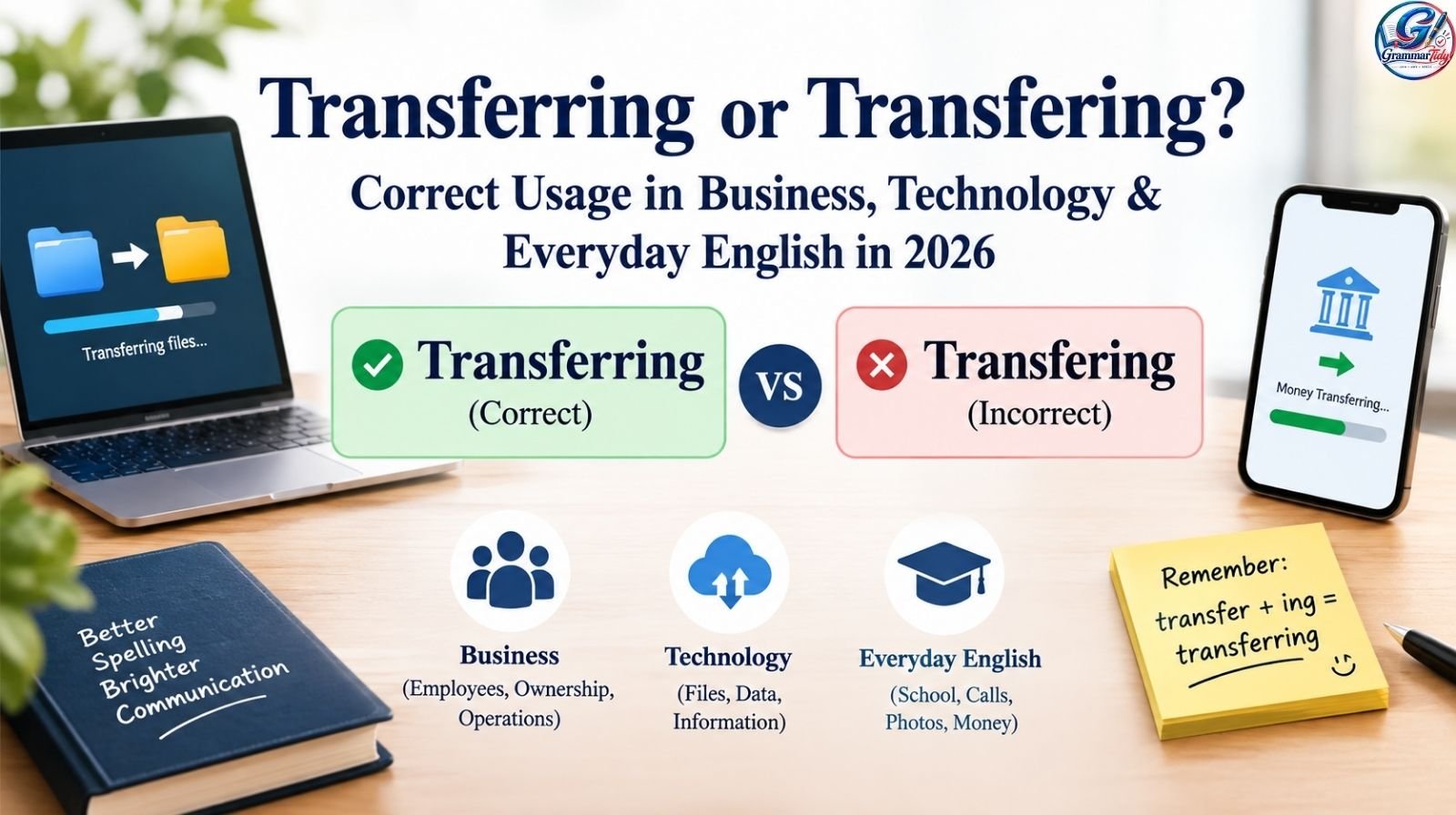
You are not alone. The correct spelling is “transferring”, with a double r. “Transfering” is a common misspelling and should not be used in standard English. Current entries from Cambridge, Oxford, and Collins all give transferring as the present-participle form of transfer.
This small spelling difference matters because transferring appears frequently in business emails, banking, technology, education, workplace communication, and everyday English.
In this guide, you will learn why transferring has two r’s, how to use it correctly, and how the word works in business, technology, and everyday sentences.
Also Read: Blankie vs Blanky: Difference And Correct Usage Explained
Transferring or Transfering: Which Spelling Is Correct?
The answer is straightforward:
| Word | Correct? | Example |
|---|---|---|
| Transferring | ✅ Correct | We are transferring the files. |
| Transfering | ❌ Incorrect | We are transfering the files. |
Transferring is the standard English spelling. It is the present participle and gerund form of transfer. Cambridge and Oxford both explicitly list transferring as the -ing form of transfer.
Why Is Transferring the Correct Spelling?
The spelling comes from the consonant-doubling pattern used when forming certain -ing and -ed forms.
The base verb is:
transfer → transferring
The final r is doubled before -ing, giving:
transfer + ing = transferring
Not:
transfer + ing = transfering ❌
What Does Transferring Mean?
Transferring generally means moving something or someone from one place, person, position, system, or organization to another.
For example:
- She is transferring money to another account.
- We are transferring the files to a new computer.
- The employee is transferring to another department.
- The company is transferring ownership of the property.
Cambridge defines transfer in several related ways, including moving people or things, changing jobs or locations, and changing ownership or control.
Why Does “Transferring” Have Two Rs?
The double r is the part that causes most of the confusion.
The Simple Spelling Pattern
When forming certain words with -ing, English sometimes doubles the final consonant of the base verb.
Consider these examples:
- refer → referring
- prefer → preferring
- occur → occurring
- transfer → transferring
The important point is that transfer follows the spelling pattern that produces the double r in transferring.
Oxford lists the verb forms as:
- transfer
- transferred
- transferring
A Simple Memory Trick
Think of the word in two parts:
trans-FER + ring
Then remember:
Transfer + ing = transferring
The second r is not optional.
If you write transfering, you have dropped a letter from the standard form.
Transferring vs Transferred
The same doubling pattern appears in the past form:
- transfer → transferred
- transfer → transferring
For example:
The company transferred the project last month.
The company is transferring the project this month.
Both forms retain the doubled r.
Also Read: Grately vs Greatly: Differences And Correct Usage
Transferring in Business English
The word transferring is especially common in professional communication because businesses constantly move people, money, information, responsibilities, and ownership.
Cambridge’s Business English entry includes examples involving transferring jobs, business operations, forms, and money.
Transferring Employees
Businesses may transfer employees between departments, offices, or locations.
Correct:
The company is transferring three employees to its Lahore office.
Incorrect:
The company is transfering three employees to its Lahore office.
The meaning is clear in both sentences, but only the first has the standard spelling.
Transferring Ownership
The word is also common when discussing property, businesses, assets, or legal ownership.
The owner is transferring the property to his daughter.
Oxford lists transfer as a verb that can mean officially arranging for something to belong to another person or for another person to control it.
Transferring Money
Banking is another everyday business context:
I am transferring the payment today.
The finance department is transferring the funds to the supplier.
Notice that the spelling does not change based on whether you are talking about money, employees, or property.
Transferring in Technology and Digital Communication

Technology has made transferring an extremely practical word.
We regularly transfer files, photos, databases, applications, data, and information between devices and systems.
Transferring Files
For example:
I am transferring the files from my laptop to the server.
Or:
The software is transferring the files automatically.
Oxford specifically provides examples involving transferring data to a memory stick and transferring songs from a computer to a phone.
Transferring Data
In technology writing, you might see:
- transferring data
- transferring information
- transferring files
- transferring records
- transferring applications
- transferring databases
For example:
The company is transferring data to its new cloud platform.
The technology may change, but the spelling remains the same.
Also Read: Encorporate vs Incorporate: Correct Usage Explained
Transferring Information Between Systems
Businesses often move information from one platform to another during system upgrades or migrations.
For example:
The IT team is transferring customer records to the new system.
This usage is particularly relevant when discussing software migrations, cloud services, databases, and digital transformation.
Transferring in Everyday English
You do not need to work in technology or business to use transferring.
The word appears in ordinary situations involving schools, jobs, transportation, money, phone calls, and personal files.
Transferring Schools or Universities
Maria is transferring to another university next semester.
Oxford gives transfer the meaning of moving from one school, job, place, or situation to another.
Transferring a Phone Call
You may also hear:
I’ll transfer your call to the sales department.
Or:
The receptionist is transferring the caller to customer service.
This is another established meaning of transfer: sending a telephone call to another number or person.
Transferring Photos
A common everyday example is moving photos between devices:
I’m transferring my photos to my new phone.
This is especially common when upgrading smartphones or backing up personal files.
Transferring vs Transfering: 2025–2026 Reference Check
Rather than relying on random online spelling advice, it is useful to check established dictionaries.
What Current Reference Sources Show
A 2025–2026 reference check gives a consistent result:
| Reference source | Form listed |
|---|---|
| Cambridge Dictionary | transferring |
| Oxford Learner’s Dictionaries | transferring |
| Collins Dictionary | transferring |
Cambridge identifies transferring as the present participle of transfer. Oxford lists transferring as the -ing form. Collins likewise gives transferring as the present participle and includes it in the verb forms for transfer.
That makes the practical takeaway clear: transferring is the standard form used by major English dictionaries in current reference material.
What About “Transfering”?
The one-r spelling can appear online because people make spelling mistakes, especially while typing quickly.
A current Wiktionary entry explicitly describes transfering as a misspelling of transferring.
Importantly, the existence of a misspelled form online does not make it an accepted standard spelling.
Also Read: Moment vs Momment: Difference, Meaning And Correct Usage
Case Study: A Small Spelling Mistake in a Business Email
Imagine that a project manager is preparing an important email for a client.
The manager writes:
“Our technical team is currently transfering your account information to the new platform.”
The intended meaning is perfectly understandable. However, the spelling contains a mistake.
Before sending the email, the manager checks the word and changes it to:
“Our technical team is currently transferring your account information to the new platform.”
This small correction matters in a professional setting because business communication often represents an organization to customers, partners, and colleagues.
The situation also demonstrates why the mistake can be easy to make. When someone thinks of the base verb transfer and simply attaches -ing, it may seem natural to write transfering. But English spelling sometimes requires changes when suffixes are added.
The same pattern appears in other words such as refer → referring and prefer → preferring.
The lesson is simple: when writing an important email, report, proposal, or technical document, do not automatically assume that adding -ing leaves every spelling unchanged. For this particular verb, the standard form is always transferring.
Common Mistakes With Transferring
Mistake 1: Dropping the Second R
❌ The system is transfering the data.
✅ The system is transferring the data.
Mistake 2: Writing “Transfered”
The same problem can happen with the past tense.
❌ The files were transfered yesterday.
✅ The files were transferred yesterday.
Mistake 3: Assuming British and American English Differ
Some English words have different British and American spellings.
For example:
- British: travelling
- American: traveling
However, transferring is spelled with two r’s in both varieties.
Also Read: Bachelor vs Batchelor: Difference And Correct Usage
Mistake 4: Confusing “Transfer” With “Transferring”
These are different grammatical forms.
I will transfer the files tomorrow.
I am transferring the files now.
The first is the base form; the second is the -ing form.
Quick Comparison: Transferring vs Transfering
| Feature | Transferring | Transfering |
|---|---|---|
| Standard spelling | ✅ Yes | ❌ No |
| Base word | transfer | transfer |
| Suffix | -ing | -ing |
| Correct form | transferring | — |
| Business writing | Use it | Avoid it |
| Technology writing | Use it | Avoid it |
| Everyday English | Use it | Avoid it |
Correct Examples
She is transferring money to her savings account.
We are transferring the customer data.
He is transferring to another department.
The school is transferring his records.
Incorrect Examples
She is transfering money. ❌
We are transfering the customer data. ❌
He is transfering to another department. ❌
The school is transfering his records. ❌
How to Remember the Correct Spelling of Transferring
Use the “Double R” Shortcut
When you see transfer + ing, immediately think:
transfer → transferring
Not:
transfer → transfering
Connect It With “Referring”
Another useful memory connection is:
- refer → referring
- prefer → preferring
- transfer → transferring
Seeing the same double-letter pattern in related verbs can make the spelling easier to remember.
Also Read: Emersion vs Immersion: Differences And Correct Usage
Use a Quick Visual Check
Before sending an important message, look at the middle of the word:
transfeRRing
If there is only one r after fe, check the spelling again.
Mini Quiz: Transferring or Transfering?
1. Quick Spelling Check
Which spelling is correct?
A) Transfering
B) Transferring
C) Transferering
D) Transferrring
Answer: B) Transferring
2. Fill the Gap
“She is ______ money to her savings account.”
A) transfering
B) transferring
C) transferringg
D) transfer
Answer: B) transferring
3. Business Email Test
Which sentence is professionally correct?
A) We are transfering the documents.
B) We are transferring the documents.
C) We are transferingg the documents.
D) We are transferr the documents.
Answer: B) We are transferring the documents.
4. Technology Time
Which sentence uses the correct spelling?
A) The system is transferring data.
B) The system is transfering data.
C) The system is transfer data.
D) The system is transferrring data.
Answer: A) The system is transferring data.
5. One or Two Rs?
How many r’s appear together in the middle of transferring?
A) One
B) Two
C) Three
D) Four
Answer: B) Two
6. Spot the Mistake
Which sentence contains the spelling mistake?
A) She is transferring the files.
B) He is transferring to another department.
C) They are transfering the payment.
D) We are transferring the records.
Answer: C) They are transfering the payment.
Also Read: Fiend or Feen: Which Spelling Is Correct & Why In 2026?
7. Past Tense Challenge
Which is the correct past-tense form of transfer?
A) Transfered
B) Transferred
C) Transferredd
D) Transferd
Answer: B) Transferred
8. Everyday English
Choose the correct sentence:
A) I’m transferring my photos to my new phone.
B) I’m transfering my photos to my new phone.
C) I’m transferringg my photos to my new phone.
D) I’m transfer my photos to my new phone.
Answer: A) I’m transferring my photos to my new phone.
9. Remember the Formula
Which spelling pattern is correct?
A) Transfer + ing = transfering
B) Transfer + ing = transferring
C) Transfer + ing = transferringg
D) Transfer + ing = transfer-ing
Answer: B) Transfer + ing = transferring
10. Workplace Check
Which sentence is correct?
A) The employee is transfering to another office.
B) The employee is transferring to another office.
C) The employee is transferrring to another office.
D) The employee is transfer to another office.
Answer: B) The employee is transferring to another office.
11. Data Transfer Test
Pick the correctly spelled phrase:
A) Transfering data
B) Transferring data
C) Transferrring data
D) Transfer dataing
Answer: B) Transferring data
12. Which One Belongs?
Which word is the correct -ing form of transfer?
A) Transfered
B) Transfer
C) Transferring
D) Transferment
Answer: C) Transferring
13. Catch the Typo
Which sentence should be corrected?
A) The company is transferring ownership.
B) The IT team is transferring files.
C) She is transferring schools.
D) The bank is transfering the funds.
Answer: D) The bank is transfering the funds.
14. Final Spelling Battle
Which word should you use in a formal report?
A) Transfering
B) Transferring
C) Transferrring
D) Transfer-ing
Answer: B) Transferring
15. The Final Challenge
Complete the sentence correctly:
“The team is ______ customer information to the new system.”
A) transfering
B) transferred
C) transferring
D) transfer
Answer: C) transferring
FAQs
1. Is “transfering” a correct English word?
No. Transfering is considered a misspelling of transferring in standard English. Current dictionary references list transferring as the correct present-participle form.
2. Why does transferring have two Rs?
The spelling follows the consonant-doubling pattern used when forming the -ing form of transfer. The correct formation is:
transfer + ing → transferring
3. Is transferring spelled differently in British and American English?
No. Both British and American English use transferring.
4. What does transferring mean?
It generally means moving someone or something from one place, person, position, system, or organization to another. It can refer to money, information, files, employees, property, schools, or many other things.
5. What is the past tense of transfer?
The past tense and past participle are transferred.
Example:
The company transferred the employee to another office.
6. Is “transferring” used in technology?
Yes. Common technology expressions include transferring files, transferring data, and transferring information. Oxford specifically provides technology-related examples involving data and files.
7. What is the easiest way to remember transferring?
Remember:
transfer + ing = transferring
The key is the double R.
Conclusion:
When choosing between transferring or transfering, the correct standard spelling is transferring.
The word is the -ing form of transfer and is used when talking about moving people, money, information, files, property, responsibilities, or other things from one place or person to another.
The rule becomes easier once you remember:
transfer → transferring
Not:
transfer → transfering
Major current dictionaries, including Cambridge, Oxford, and Collins, consistently list transferring as the correct form.
So whether you are writing a business email, technology document, banking message, academic assignment, or everyday text, use transferring with the double r.
Discover More Article
- Plandid or Candid: Which Is Correct? Meaning, Examples & Usage Guide (2026)
- Filipino or Philipino? Meaning, Pronunciation, Spelling & Usage Explained In 2026
- Prooving vs Proving Difference: Which Spelling Is Correct?
Keep learning with more easy grammar lessons on GrammarTidy.com

Hi, I’m Noor Fatima, the author and creator of Grammar Tidy. I’m passionate about grammar, writing, and making language learning simple and enjoyable. Through Grammar Tidy, I share helpful tips, clear explanations, and practical guidance to help readers improve their writing, avoid common mistakes, and communicate with confidence. My goal is to make better grammar easy, useful, and accessible for everyone.