Have you ever wondered whether to write sustain or substain? These spellings look similar, so it is easy to see why someone might confuse them while writing an email, an assignment, or a professional report. However, only one is the standard English spelling.
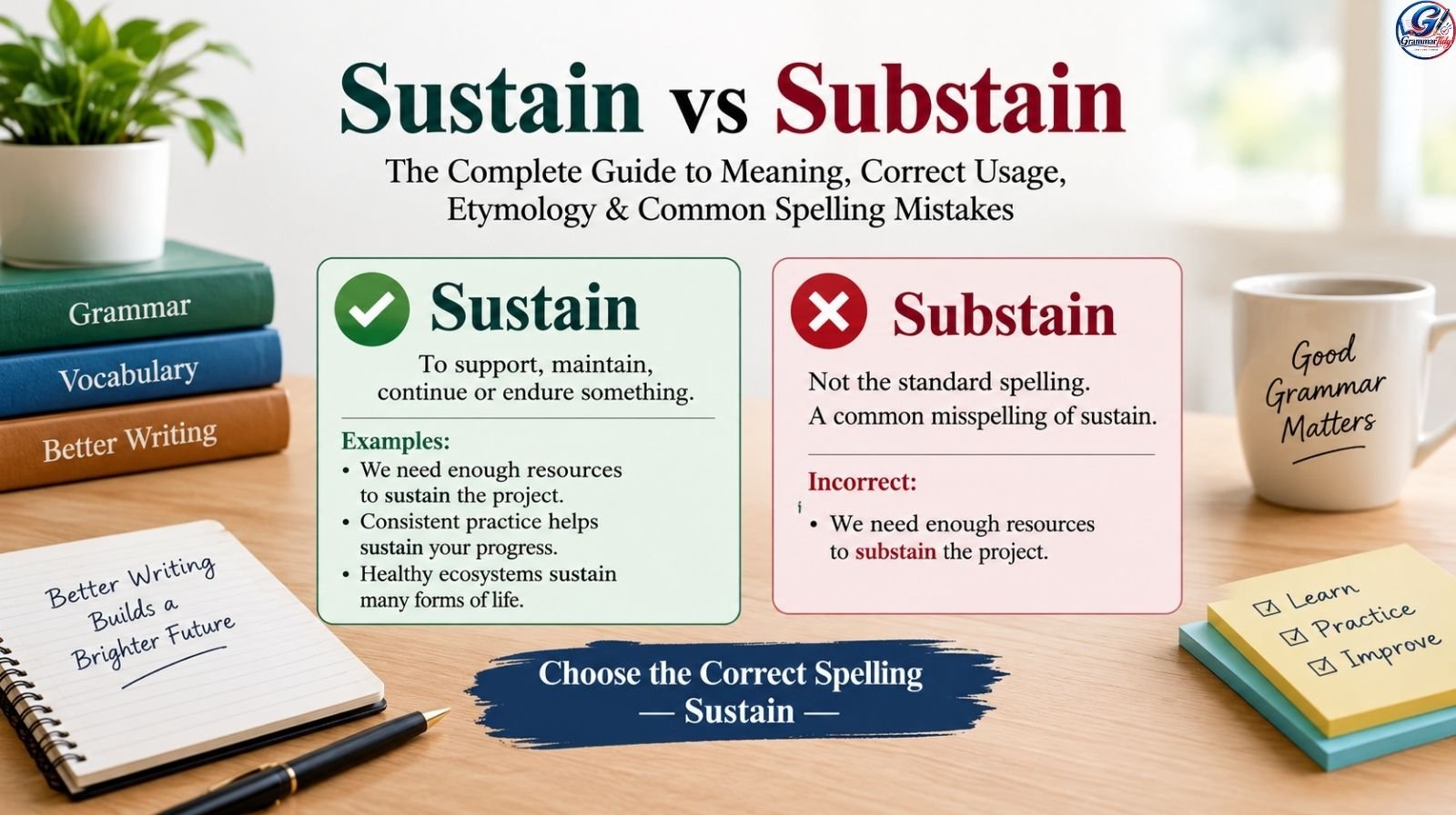
In the sustain vs substain comparison, sustain is the correct spelling, while substain is a common misspelling that should generally be avoided in standard English.
The word sustain means to support, maintain, continue, or endure something, depending on the context.
Understanding this difference will help you write more accurately and communicate your ideas with confidence. In this guide, you will discover the correct spelling, definition, pronunciation, word history, practical sentence examples, and simple ways to remember the difference.
Also Read: Goodmorning or Good Morning: The Correct Usage (And Why It Actually Matters)
Sustain vs Substain: Which Spelling Is Correct?
The easiest way to understand this spelling comparison is to remember that sustain is the established English word. The spelling substain adds an unnecessary b after the initial su.
Sustain: The Correct Spelling
Sustain is a standard English verb meaning to support, maintain, continue, or endure something.
Examples:
- We need enough resources to sustain the project.
- Regular practice helps sustain your progress.
- The business cannot sustain these expenses indefinitely.
- Healthy ecosystems sustain many forms of life.
Substain: The Incorrect Spelling
Substain is not the standard spelling of the verb intended in these examples. It is generally a misspelling of sustain.
Incorrect: We need enough resources to substain the project.
Correct: We need enough resources to sustain the project.
The correct spelling remains sustain in both British and American English.
Why Do People Write Substain?
There are several possible reasons for this mistake:
- Letter confusion: Writers may insert a b because they associate the word with substance or substantial.
- Pronunciation uncertainty: People sometimes rely on how a word sounds rather than how it is conventionally spelled.
- Typing errors: An extra letter can appear when someone types quickly.
- Word familiarity: Someone who has rarely encountered sustain in writing may remember an incorrect version.
These are possible explanations rather than proof that every writer makes the same mistake. The practical solution is to learn the correct spelling and recognize it in context.
Also Read: Skiis or Skis: Which Spelling Is Correct?
Sustain Meaning, Definition, and Pronunciation
The verb sustain has several related meanings. It can describe keeping something active, providing the necessities of life, supporting someone emotionally, or experiencing damage or injury. Its intended meaning depends on the sentence.
What Does Sustain Mean?
In simple English, to sustain something means to keep it going, support it, or bear it without giving way.
Here are its main meanings:
| Meaning | Example |
|---|---|
| Maintain or continue | The team worked hard to sustain its performance. |
| Support or provide for | Crops help sustain the local community. |
| Endure or withstand | She sustained the pressure during the competition. |
| Experience injury or damage | The building sustained serious damage in the storm. |
| Support emotionally | His family sustained him through difficult times. |
Notice that sustain does not always have a positive meaning. For example, a person can sustain an injury, meaning they experience or suffer that injury.
How Do You Pronounce Sustain?
The word sustain is commonly pronounced suh-STAYN, with the stress on the second syllable.
Its pronunciation can be represented as /səˈsteɪn/.
Break it into two parts:
- suh the first, unstressed syllable
- STAYN the second, stressed syllable
The word contains seven letters: S-U-S-T-A-I-N.
Remember the spelling as SUS + TAIN. This can help you recognize the word when writing it, although it is a memory aid rather than a complete explanation of its historical origin.
Also Read: Genuinity or Genuity: The Hidden Truth Behind This Confusing Word
How to Use Sustain in Everyday Sentences
The word appears in many everyday and professional contexts.
- Work: We must sustain our productivity throughout the week.
- Education: Consistent study habits sustain long-term learning.
- Health: A balanced diet helps sustain energy throughout the day.
- Business: The company needs sufficient revenue to sustain its operations.
- Environment: Healthy ecosystems sustain many forms of life.
- Personal life: Her determination sustained her during challenging times.
These examples show why learning sustain is useful beyond correcting a single spelling mistake.
Etymology of Sustain: Where Does the Word Come From?
Understanding a word’s history can make its spelling easier to remember. The word sustain has a long history in English and comes from older French and Latin forms associated with holding up, supporting, and enduring.
The Latin and French Roots of Sustain
Sustain entered English through Old French forms such as sostenir and sustenir, which trace back to the Latin verb sustinere. The Latin word carried the sense of holding up or bearing something.
Over time, the English verb developed several connected meanings:
- Supporting something physically.
- Providing what is necessary for life.
- Maintaining an activity or condition.
- Enduring hardship or pressure.
- Experiencing an injury, loss, or other damage.
These meanings are linked by the broad idea of bearing, supporting, or keeping something in a particular state.
Does the History Explain Why Substain Is Incorrect?
The historical development of sustain helps explain its established spelling. The word was not formed by simply adding sub- to the modern English word stain.
Although its Latin history involves forms related to sub- and tenere (to hold), the modern English spelling is sustain, not substain. Adding a b because the word seems related to substance is not a valid spelling rule.
A useful distinction is:
- Sustain the established verb with meanings related to support and endurance.
- Substance a separate word referring to material or the essential nature of something.
- Substain a misspelling when intended as the ordinary verb sustain.
Learning the word’s origin is helpful, but remembering its modern spelling is what matters most in everyday writing.
Also Read: Fairing or Faring: When Each Word Makes Sense
Common Spelling Mistakes and How to Avoid Them
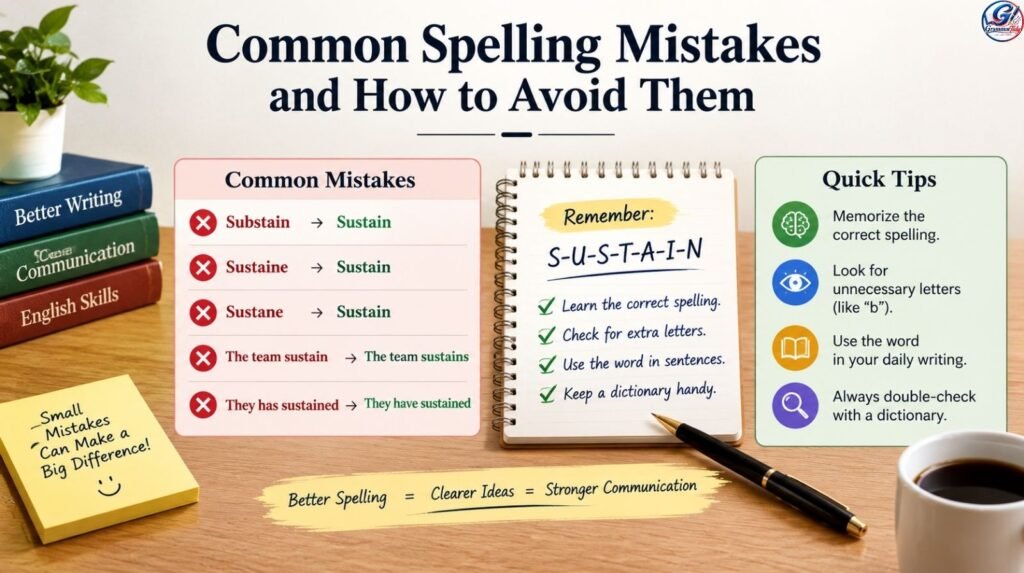
Spelling mistakes often occur when a word resembles another familiar word or when writers try to spell it based on sound. The sustain vs substain error is a good example of why recognizing a word’s standard written form matters.
Common Errors Involving Sustain
Here are some incorrect forms or usage problems to watch for:
| Incorrect form or usage | Correct form | Explanation |
|---|---|---|
| Substain the project | Sustain the project | Remove the unnecessary b. |
| Sustaine the effort | Sustain the effort | Do not add an unnecessary final e. |
| Sustane the system | Sustain the system | Keep the correct vowel sequence. |
| The team sustain its effort | The team sustains its effort | Use the correct verb form for a singular subject in the present tense. |
| They has sustained progress | They have sustained progress | Match the auxiliary verb to the subject. |
The final two examples concern grammar rather than spelling alone. Recognizing this distinction helps you correct the entire sentence instead of focusing on just one word.
How to Remember the Correct Spelling
Try these simple techniques:
- Memorize the exact sequence: S-U-S-T-A-I-N.
- Connect it to a familiar phrase: “Sustain the effort.”
- Write it in context: Create a sentence such as, “We must sustain our progress.”
- Check the word visually: Look for the unnecessary b in substain.
- Use a dictionary when uncertain: A reliable dictionary can confirm spelling, meaning, pronunciation, and grammatical usage.
The most effective technique is repeated use in meaningful sentences. Instead of memorizing the letters in isolation, practice using sustain in different contexts.
Also Read: Gage or Gauge: What’s The Difference? Explained Simply
Sustain vs Substain: A Quick Comparison Checklist
Use this checklist when editing your work.
- Am I trying to express the meaning of support, maintenance, continuation, or endurance?
- Have I spelled the word S-U-S-T-A-I-N?
- Have I avoided inserting an unnecessary b?
- Does the verb agree with its subject?
- Does the sentence communicate the intended meaning clearly?
If you can answer yes to these questions, you are much less likely to make this particular spelling error.
Real-Life Case Study: Correcting Sustain in Professional Writing
Imagine a small business owner preparing a proposal for a new customer-support program. The proposal explains how the company plans to maintain service quality while its customer base grows.
In the first draft, the owner writes:
Our company will substain excellent customer service while expanding into new markets.
The sentence communicates the general idea, but the spelling error makes the proposal look less polished. A potential client may notice the mistake and question the care taken with the rest of the document.
The corrected version is:
Our company will sustain excellent customer service while expanding into new markets.
The correction is simple, but it improves the professionalism of the sentence without changing its intended meaning.
The owner then reviews the surrounding paragraph:
To sustain service quality, we will train new employees, monitor customer feedback, and maintain consistent response times. These measures will help us sustain customer satisfaction as demand increases.
In this example, sustain is used correctly to describe maintaining service quality and customer satisfaction over time. The repeated word could also be revised for style:
Also Read: Bougie vs Boujee: The Real Difference Most People Miss
To maintain service quality, we will train new employees, monitor customer feedback, and maintain consistent response times. These measures will help us sustain customer satisfaction as demand increases.
This example illustrates two useful editing lessons. First, correcting substain to sustain resolves the spelling error. Second, proofreading the complete sentence can reveal opportunities to improve clarity and reduce repetition.
The scenario is illustrative rather than a documented company case study, but the editing principles apply to business proposals, emails, academic assignments, reports, and website content. Accurate spelling helps readers focus on the message instead of being distracted by avoidable errors.
Sustain vs Substain: Spelling Statistics and Research for 2025–2026
When discussing spelling mistakes, it is important to separate verified information from assumptions. Although sustain is an established English word, a reliable, verified statistic showing how many people misspell it as substain in 2025 or 2026 is not available in this article.
Instead of inventing a percentage, we can use established spelling principles and explain how researchers can investigate spelling patterns responsibly.
What Do Reference Sources Tell Us?
The following findings provide a reliable foundation for understanding the word and researching its usage.
- Dictionary evidence: Standard dictionaries establish sustain as the recognized spelling and explain its meanings, pronunciation, and grammatical usage.
- Historical evidence: The word’s history traces its development through French and Latin forms associated with supporting and enduring.
- Search-data limitations: Search interest and spelling variations do not necessarily reveal how frequently individual writers make a particular mistake.
These points establish the word’s standard form and explain some limitations of measuring spelling behavior online. They do not establish a specific error rate for substain.
Also Read: Modelling or Modeling: Which Spelling Is Correct?
How Can Spelling Trends Be Investigated in 2025–2026?
Researchers who want to measure this particular spelling error could use a structured approach:
| Research method | What it can establish | Important limitation |
|---|---|---|
| Dictionary verification | Whether sustain is a recognized standard word | Does not measure how often people misspell it |
| Search-query analysis | How often selected spellings appear in an appropriate dataset | Search volume alone does not reveal every writer’s intention |
| Anonymized writing samples | How frequently the error appears in a defined collection of texts | Results depend on the sample and its size |
| Spell-checker correction logs | How often a system flags a particular spelling | One tool’s users may not represent all English writers |
Key takeaway for 2025–2026: The evidence supports using sustain as the standard spelling, but a specific percentage of people who write substain should not be reported without a verifiable dataset. This distinction is important for accurate, trustworthy educational content.
Frequently Asked Questions
1. Is Sustain or Substain Correct?
Sustain is correct. Substain is a misspelling when used to express the ordinary meaning of supporting, maintaining, or enduring something.
2. What Does Sustain Mean in Simple English?
Sustain means to keep something going, support it, or endure something. For example, “The team worked together to sustain its success.”
3. Why Do People Confuse Sustain and Substain?
The extra b may come from a typing mistake, uncertainty about spelling, or an association with words such as substance. However, sustain is the established spelling.
4. Is Sustain Correct in British and American English?
Yes. Sustain is the standard spelling in both British and American English. There is no standard regional spelling difference that makes substain correct.
5. What Is the Past Tense of Sustain?
The simple past tense is sustained. The past participle is also sustained.
Examples:
- Present: We sustain the program.
- Past: We sustained the program.
- Present perfect: We have sustained the program.
6. Can Sustain Have a Negative Meaning?
Yes. Although sustain often means to support or maintain something, it can also mean to experience damage, injury, or loss.
For example: “The vehicle sustained significant damage in the accident.”
7. How Can I Remember the Spelling of Sustain?
Remember the seven-letter sequence S-U-S-T-A-I-N. Practice writing phrases such as “sustain progress,” “sustain growth,” and “sustain an effort.” Avoid inserting a b after su.
Conclusion:
The difference between sustain and substain is straightforward: sustain is the correct standard English spelling, while substain is an incorrect spelling for the intended meaning.
The word sustain can mean to support, maintain, continue, or endure something. Its historical roots help explain its development, while its everyday uses show why it is valuable in academic, professional, and personal writing.
To avoid this common spelling mistake, remember the sequence S-U-S-T-A-I-N, practice using it in sentences, and consult a reliable dictionary whenever you are uncertain.
You can also review your writing before submitting an assignment, publishing an article, or sending a professional email.
Discover More Article
- Vender vs Vendor: Which Is Correct In 2026?
- Puting or Putting: Which Spelling Is Correct In 2026?
- Gluing or Glueing: Which Spelling Is Correct And Why It Matters?
- Lended vs Lent: Meaning, Grammar Rules And Correct Usage
Keep learning with more easy grammar lessons on GrammarTidy.com

Hi, I’m Noor Fatima, the author and creator of Grammar Tidy. I’m passionate about grammar, writing, and making language learning simple and enjoyable. Through Grammar Tidy, I share helpful tips, clear explanations, and practical guidance to help readers improve their writing, avoid common mistakes, and communicate with confidence. My goal is to make better grammar easy, useful, and accessible for everyone.