Have you ever typed a morning greeting and wondered whether to write goodmorning or good morning? It seems like a tiny spelling question, but using the correct form can make your messages, emails, and everyday writing look more polished.
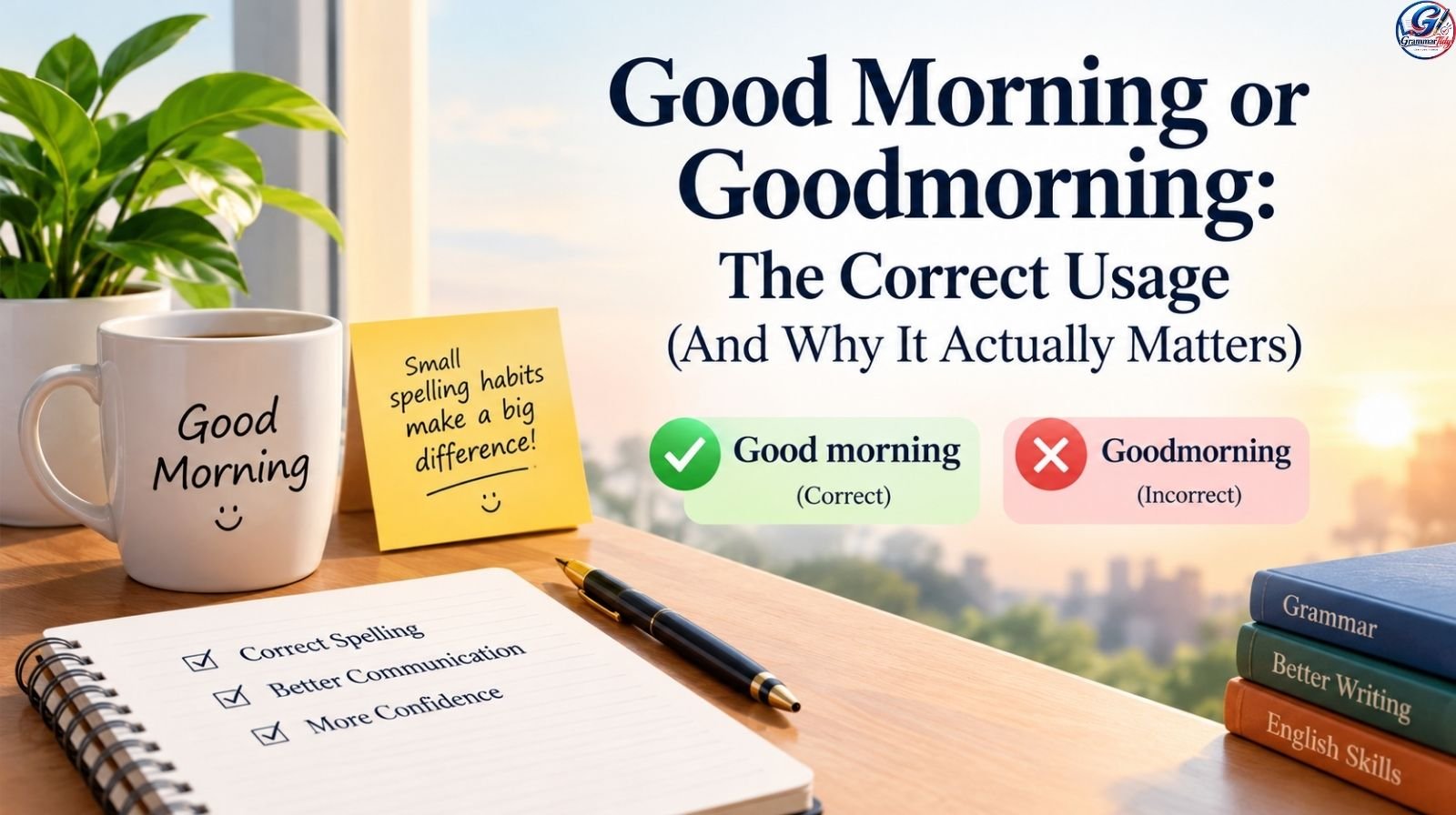
The correct spelling is good morning, written as two separate words. The single-word version, goodmorning, is not the standard spelling in English.
Whether you are greeting a friend, sending an email to your manager, or writing a social media caption, understanding this simple rule can help you communicate more confidently.
Let’s explore the meaning, grammar, examples, common mistakes, and capitalization rules behind this everyday expression.
What Is the Correct Spelling: Goodmorning or Good Morning?
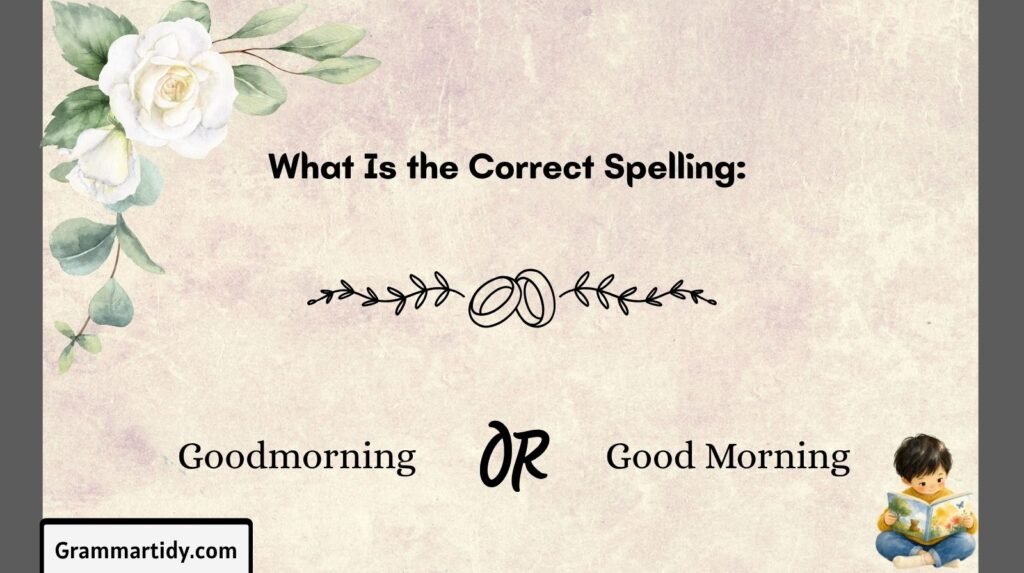
The correct spelling is good morning, with a space between good and morning. It is a conventional English greeting used when meeting someone or communicating during the morning.
The expression is widely used in everyday conversations, professional emails, school assignments, and online messages. By contrast, goodmorning combines the two words into a single form that is not standard English.
Why Is Good Morning Written as Two Words?
The expression contains two distinct words:
- Good: An adjective that expresses something positive.
- Morning: A noun referring to the early part of the day.
Together, these words form a familiar greeting.
Examples:
- Correct: Good morning, Sarah!
- Incorrect: Goodmorning, Sarah!
- Correct: I hope you have a good morning.
- Incorrect: I hope you have a goodmorning.
The key is to keep the two words separate, whether you are greeting someone or describing the quality of their morning.
Is Goodmorning Ever Correct?
In ordinary English writing, goodmorning is considered a spelling error when you intend to use the standard greeting.
You might occasionally encounter it in usernames, creative brand names, informal messages, or deliberately stylized text. However, those special uses do not make it the standard grammatical form.
For schoolwork, professional emails, articles, and other formal writing, always choose good morning.
Quick Comparison: Good Morning vs. Goodmorning
| Expression | Correct? | Explanation |
|---|---|---|
| Good morning | Yes | Standard two-word greeting |
| Goodmorning | No | Nonstandard spelling |
| Good morning, everyone. | Yes | Correct greeting with punctuation |
| I hope you have a good morning. | Yes | Correct use in a sentence |
| Goodmorning, everyone. | No | Missing space |
Easy rule to remember: Whenever you mean the everyday English greeting, write good morning as two words.
Why Does Using Good Morning Correctly Matter?
Spelling mistakes do not always prevent readers from understanding a message. Nevertheless, small errors can affect how clear, careful, and professional your writing appears.
Using good morning correctly helps maintain consistent spelling and makes your writing easier to read.
Also Read: Caraway vs GreenPan: A Complete Cookware Comparison Guide
1. It Makes Professional Communication Look Polished
Imagine sending an email to a client with this opening:
“Goodmorning, Mr. Ahmed. I am writing to confirm our meeting.”
The message is understandable, but the greeting contains a spelling mistake.
A better version is:
“Good morning, Mr. Ahmed. I am writing to confirm our meeting.”
The second version follows standard English conventions and presents a more polished first impression.
2. It Helps English Learners Build Better Habits
English contains many expressions that look as though they could be written as one word but are conventionally written separately.
For example:
- Good morning
- Good afternoon
- Good evening
- Thank you
- A lot
Learning these forms helps students develop stronger spelling habits and avoid repeating common errors.
3. It Supports Clear and Consistent Writing
Consistency matters when writing blog posts, business messages, school assignments, and website content.
If you use good morning correctly throughout a document, readers can focus on your message rather than noticing unnecessary spelling mistakes.
However, remember that one minor typo does not automatically make writing unprofessional. The goal is to communicate clearly and carefully, not to expect perfection in every informal message.
When Does the Difference Matter Most?
The distinction is particularly useful in:
- Formal emails and workplace communication.
- School assignments and examinations.
- Website content and published articles.
- Business letters and customer messages.
- English-learning exercises and grammar tests.
For a quick text to a friend, the meaning may still be obvious if you accidentally join the words. For formal writing, however, the standard spelling is the better choice.
How to Use Good Morning in Sentences
The expression good morning can appear at the beginning of a conversation, at the start of an email, or within a sentence describing someone’s day.
The correct wording depends on the situation, but the spelling remains the same.
Good Morning as a Greeting
When you meet someone or begin a morning conversation, you can use the expression by itself or address a particular person.
Examples:
- Good morning!
- Good morning, Mom.
- Good morning, everyone.
- Good morning, teacher.
- Good morning, team. Let’s begin the meeting.
Notice that a comma commonly separates the greeting from the name or group being addressed.
Also Read: With or Without You Lyrics: Meaning, Song Details And More
Good Morning in Emails and Messages
A greeting can set the tone for the rest of your message. In professional correspondence, a polite opening is often a useful choice.
Examples:
Formal email:
Good morning, Ms. Khan,
I hope you are doing well. I am writing to ask about the status of my application.
Workplace message:
Good morning, team. Today’s meeting will begin at 10 a.m.
Friendly text:
Good morning! Hope you slept well.
Message to a teacher:
Good morning, Sir. Could you please explain the homework assignment?
The phrase works in both formal and informal communication. Choose the greeting that suits your relationship with the recipient and the purpose of your message.
Good Morning When Describing the Day
The phrase does not always function as a greeting. It can also describe the kind of morning someone experiences or hopes to have.
Examples:
- I had a good morning at work.
- We enjoyed a good morning walk in the park.
- I hope you have a good morning.
- It was a good morning for a cup of coffee.
In these sentences, good describes morning. The two words remain separate because they perform their usual grammatical roles.
Good Morning Capitalization and Punctuation Rules

Correct spelling is only one part of writing the greeting properly. Capitalization and punctuation also depend on where the expression appears.
Also Read: Claritin or Allegra: Which One Is Better For Allergies?
Should Good Morning Be Capitalized?
Use Good morning when it begins a sentence or serves as the opening of a message.
Use good morning when it appears in the middle of a sentence and ordinary sentence capitalization applies.
Examples:
- Beginning of a sentence: Good morning, everyone.
- Middle of a sentence: I said good morning to my neighbor.
- Email greeting: Good morning, Mr. Ali,
- Describing the day: We had a good morning together.
In email greetings, some style guides and organizations capitalize both words when using a title-style format, such as “Good Morning, Team.” However, ordinary sentence-style capitalization uses “Good morning, team.”
The important thing is to follow the style you have chosen consistently.
Which Punctuation Should You Use?
Punctuation depends on whether the greeting stands alone or introduces the rest of your message.
| Example | Best use |
|---|---|
| Good morning! | A cheerful standalone greeting |
| Good morning, Sarah. | A greeting addressed to someone |
| Good morning, team, | An email salutation in a suitable format |
| Good morning. How are you? | Two separate sentences |
| I hope you have a good morning. | A complete sentence |
Tip: When addressing someone directly, use a comma to separate the greeting from their name: “Good morning, David.”
A Real-Life Example: How One Small Spelling Mistake Can Affect a Message
Consider a fictional example involving Ayesha, a recent graduate applying for a marketing position.
One morning, Ayesha sends an email to a hiring manager to follow up on her interview. She begins with this line:
“Goodmorning, Ms. Roberts. Thank you for taking the time to interview me yesterday.”
The hiring manager can understand the message without difficulty. The spelling error does not change Ayesha’s meaning, and there is no reason to assume it will automatically harm her chances of getting the job.
However, Ayesha wants her email to demonstrate attention to detail. Before sending a follow-up message to another employer, she checks the greeting and corrects it:
“Good morning, Ms. Roberts. Thank you for taking the time to interview me yesterday.”
She also reviews the rest of her message for spelling, punctuation, and clarity. Her final email is easier to read and follows standard professional writing conventions.
What can we learn from this example? Small details are worth checking, especially when writing to someone you do not know well.
Nevertheless, professional communication involves much more than spelling a greeting correctly. The relevance of your message, its tone, its clarity, and your qualifications all matter.
Ayesha’s example illustrates a practical proofreading habit rather than proving that a single spelling mistake changes a hiring outcome.
The lesson is simple: use the correct spelling, proofread when the situation calls for it, and focus on communicating your message clearly.
Also Read: Soder or Solder? Easy Guide with Simple Words And Clear Examples
Good Morning in 2025–2026: Usage, Language Data, and Writing Trends
People continue to use morning greetings in everyday conversations, email, messaging apps, and workplace communication. Yet it is important to distinguish documented language facts from assumptions about current usage.
What Do Established English Rules Confirm?
The standard English form is good morning. It is a conventional greeting used to address someone politely during the morning.
Examples include:
- Good morning! How are you?
- Good morning, everyone, and welcome.
- Good morning. I hope you are having a pleasant day.
These examples demonstrate the established spelling and common sentence patterns. They are illustrative examples, not measurements of how frequently people used the greeting in 2025 or 2026.
Are There Reliable Statistics About Goodmorning vs. Good Morning?
As of October 2026, no verified, comprehensive 2025–2026 dataset is established in this article that quantifies the number of people who write goodmorning instead of good morning across emails, social media, and other communication channels.
Therefore, it would be misleading to invent a percentage, search-volume figure, or error rate.
For writers and website publishers, the most useful conclusions are:
- Standard English spelling uses good morning as two words.
- Correct spelling supports clarity and consistency.
- Search performance should not be judged by spelling alone.
- Helpful, reliable content should prioritize readers’ needs rather than rely on keyword repetition.
How Can You Research Usage Trends Yourself?
If you want actual numerical data for a 2025–2026 article update, consider these approaches:
- Google Trends: Compare interest in “good morning” and “goodmorning.” Remember that Trends reports normalized relative interest, not total searches or the percentage of people making spelling mistakes.
- Website search data: Review your website’s impressions and clicks for relevant queries if you have access to sufficient search performance data.
- A defined text sample: Compare the two spellings in a documented collection of public text, explaining the sample, time period, and limitations.
These methods can help you investigate search or writing patterns without presenting unsupported figures as facts.
Also Read: Zyrtec or Benadryl: Which One Should You Actually Take?
FAQs
1. Is Goodmorning One Word or Two?
The correct standard spelling is good morning, written as two words. Goodmorning is a nonstandard spelling and should be avoided in ordinary English writing.
2. Is Good Morning Grammatically Correct?
Yes. Good morning is a standard English greeting used to greet someone politely in the morning. It can also appear in sentences such as “I hope you have a good morning.”
3. Should I Write Good Morning or Goodmorning in an Email?
Write Good morning as two words. For example, “Good morning, Sarah,” is an appropriate professional email opening.
4. Should Both Words in Good Morning Be Capitalized?
Not always. Standard sentence-style capitalization uses “Good morning” at the beginning of a sentence. Capitalizing both words may be appropriate in certain title-style formats or under an organization’s style guide.
5. Is Good Morning Formal or Informal?
It works in both formal and informal settings. You can use it with friends, teachers, coworkers, customers, and business contacts. The surrounding wording determines how formal the complete message sounds.
6. Is Good Morning Correct in British and American English?
Yes. Both British and American English use good morning as the standard spelling. The expression is widely understood in both varieties.
7. Can I Write Good Morning Without a Comma?
Yes, when the greeting stands alone, as in “Good morning!” When addressing someone directly, use a comma: “Good morning, James.”
Conclusion:
When deciding between goodmorning or good morning, the answer is straightforward: good morning is the correct standard spelling.
Keep the words separate when greeting someone, opening a professional email, writing a school assignment, or describing someone’s morning. Capitalize the expression according to its position in the sentence, and use commas when directly addressing a person or group.
This small spelling habit can make your writing more polished and consistent without requiring complicated grammar rules.
Ready to improve your everyday English? Start by using good morning correctly in your next message, then apply the same attention to detail to the rest of your writing.
Discover More Article
- When Does Trick-or-Treating Start? Halloween Hours Guide
- GitLab or GitHub: Which One Should You Choose?
- Nosey or Nosy: Which Spelling Is Correct?
- Natzi or Nazi: The Correct Spelling, Meaning, And Why It Matters
Keep learning with more easy grammar lessons on GrammarTidy.com

Hi, I’m Noor Fatima, the author and creator of Grammar Tidy. I’m passionate about grammar, writing, and making language learning simple and enjoyable. Through Grammar Tidy, I share helpful tips, clear explanations, and practical guidance to help readers improve their writing, avoid common mistakes, and communicate with confidence. My goal is to make better grammar easy, useful, and accessible for everyone.