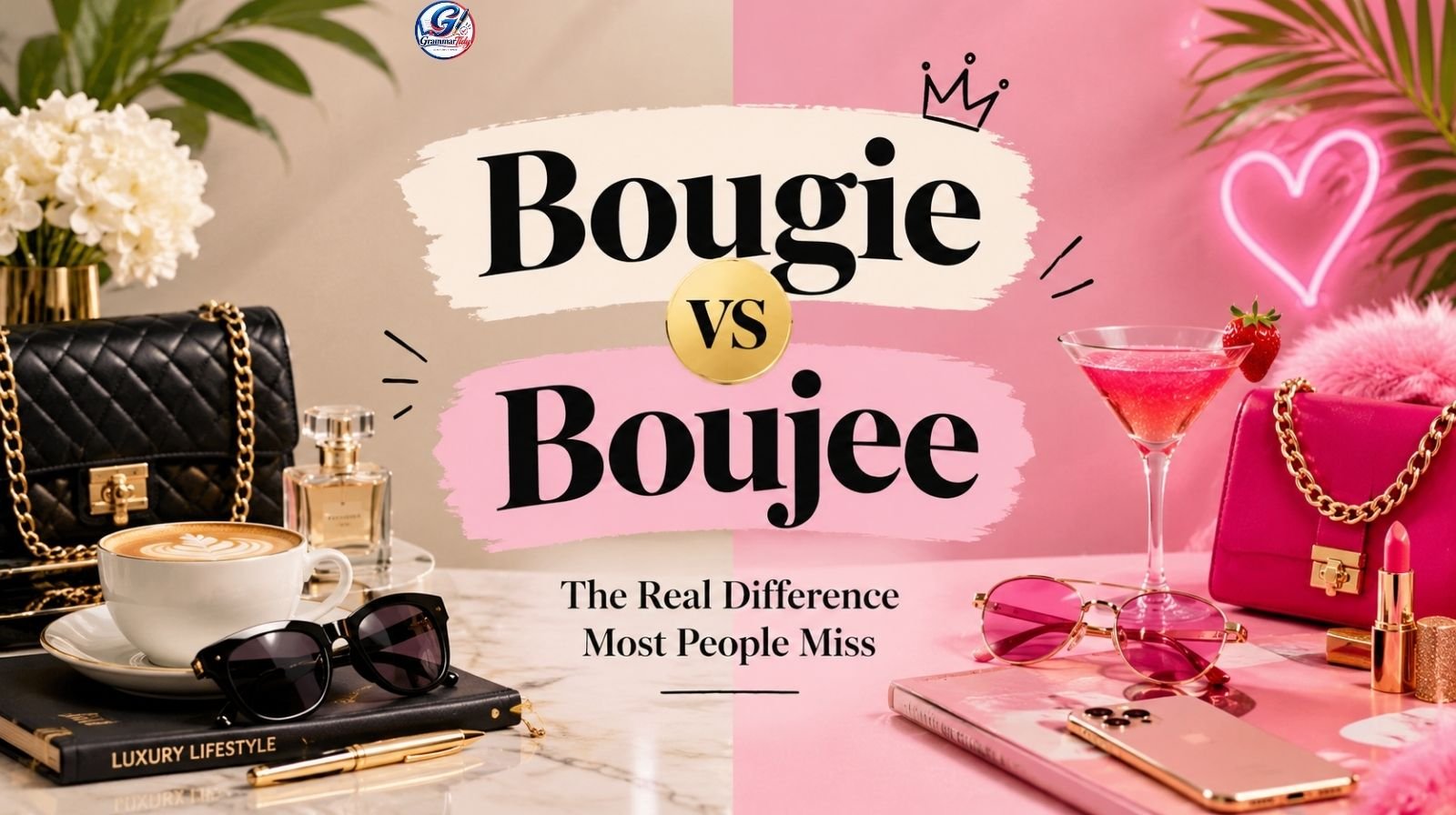
Have you ever seen someone describe a fancy restaurant, expensive outfit, or luxurious lifestyle as bougie or boujee and wondered which word is correct? You are not alone.
The difference between bougie vs boujee can be confusing because both words are used to describe luxury, expensive tastes, and fashionable lifestyles.
The simple answer is that both spellings are used in modern English slang, and their meanings overlap. However, bougie is the more established spelling, while boujee is strongly associated with contemporary hip-hop culture and informal social media language.
Depending on the situation, either word can sound complimentary, playful, or slightly critical.
In this guide, you will learn what each word means, where the terms came from, how they differ, and which spelling to use in everyday conversations, captions, and writing.
Also Read: Pre vs Post: What’s The Real Difference? (With 100+ Examples)
What Is the Difference Between Bougie vs Boujee?
The main difference between bougie and boujee is their spelling, cultural associations, and typical tone not a strict difference in meaning. Both can describe someone who enjoys luxury or something that looks fancy, expensive, or upscale.
Bougie vs Boujee at a Glance
| Bougie | Boujee |
|---|---|
| More established spelling | Popular slang variant |
| Often describes fancy or upscale tastes | Often describes a luxurious or fashionable lifestyle |
| Can sound playful or critical | Often sounds playful or celebratory |
| Common in everyday informal English | Common in casual conversations and social media |
What Does Bougie Mean?
Bougie is an informal word commonly used to describe a person, place, product, or lifestyle that seems fancy, expensive, sophisticated, or concerned with social status.
It can be positive or negative, depending on the context.
For example:
- “She has a bougie taste in coffee.” This suggests that she prefers premium or specialty coffee.
- “That hotel looks so bougie.” This suggests that the hotel looks luxurious.
- “He’s acting bougie since he got promoted.” This may tease him for acting superior or becoming overly concerned with status.
The word does not necessarily mean someone is wealthy. A person can enjoy expensive-looking things without having a large income.
What Does Boujee Mean?
Boujee is a recognized slang variant of bougie. It is frequently used to describe a luxurious, stylish, or glamorous lifestyle, especially in casual conversations, music, and social media posts.
For example:
- “Her birthday dinner was boujee.”
- “I’m feeling boujee today, so let’s order dessert.”
- “They booked a boujee hotel for their anniversary.”
In these examples, the word adds a playful sense of luxury. It can suggest treating yourself, enjoying a special experience, or celebrating success.
Also Read: Honour or Honor: Which Spelling Should You Use?
Where Did Bougie and Boujee Come From?
Understanding the history of these words explains why they are so closely related but can feel different in everyday conversation.
The Connection to the Word Bourgeois
The slang word bougie is connected to bourgeois, a word derived from French and historically associated with the middle class.
Over time, bourgeois also developed critical associations with materialism, conventional attitudes, and social respectability. The shortened slang form bougie came to describe people or things perceived as overly fancy, status-conscious, or pretentious.
For example, someone might say:
“My friend won’t drink regular coffee anymore. She’s getting bougie!”
The speaker is joking that the friend has developed expensive or particular tastes.
The historical connection is useful because it explains why bougie can carry a hint of criticism even when it describes something attractive or luxurious.
How Boujee Became Popular
The spelling boujee gained widespread mainstream attention through hip-hop culture, particularly the 2016 song “Bad and Boujee” by Migos featuring Lil Uzi Vert.
The song helped bring the term into mainstream popular culture and associated it with success, fashionable living, and enjoying luxury while maintaining a connection to one’s roots.
Today, people use boujee in Instagram captions, TikTok videos, text messages, and everyday conversations.
For example:
“Finally booked that rooftop restaurant. We’re going boujee tonight!”
The sentence communicates excitement about a stylish or expensive experience.
However, it is important to recognize that the term has cultural roots in African American English and hip-hop. Its meaning can be richer than simply calling something fancy.
Bougie vs Boujee: Meaning, Tone, and Usage Compared
Although the two spellings overlap, understanding their usual tone can help you choose the right one.
A Quick Comparison Table
| Feature | Bougie | Boujee |
|---|---|---|
| Basic meaning | Fancy, upscale, or pretentious | Fancy, luxurious, or fashionable |
| Spelling | More established form | Popular slang variant |
| Typical tone | Playful, descriptive, or critical | Often playful, trendy, or celebratory |
| Common contexts | Everyday speech, lifestyle descriptions, informal writing | Music, social media, captions, casual conversation |
| Can be complimentary? | Yes | Yes |
| Can be critical? | Yes | Yes |
| Formal writing | Usually too informal for formal prose | Usually too informal for formal prose |
These are general tendencies, not fixed rules. A person can use bougie as a compliment or boujee sarcastically.
Real Examples of Bougie and Boujee
Here are some everyday examples showing how both words work.
Example 1: Food
- Bougie: “This café serves bougie little desserts.”
- Boujee: “Let’s get boujee and order the fancy dessert platter.”
Both suggest something luxurious or indulgent.
Example 2: Fashion
- Bougie: “Those designer sunglasses look bougie.”
- Boujee: “Her entire outfit is giving boujee energy.”
The first sounds descriptive, while the second sounds more like a playful social media comment.
Example 3: Travel
- Bougie: “That resort is too bougie for our budget.”
- Boujee: “We’re taking a boujee vacation this summer.”
The first expresses concern about cost; the second emphasizes an exciting luxury experience.
Also Read: Soder or Solder? Easy Guide with Simple Words And Clear Examples
Which Word Should You Choose?
Use this simple checklist:
- Choose bougie when you want the more established spelling for general informal English.
- Choose boujee when you want a distinctly casual, contemporary slang feel.
- Use either when describing luxury, expensive tastes, or a fancy lifestyle, provided the tone fits.
- In formal reports, academic papers, and professional documents, consider alternatives such as upscale, luxurious, or high-end.
For example, “The hotel offers a luxurious experience” is more suitable for a professional travel report than “The hotel is boujee.”
How to Use Bougie vs Boujee in Real-Life Situations
The best way to understand slang is to see how people use it in context. The following examples demonstrate how tone and situation affect the meaning.
Everyday Conversations
Imagine two friends discussing a new restaurant.
Friend A: “Have you seen the prices at that new restaurant?”
Friend B: “Yes! It’s so bougie, but the food looks amazing.”
Here, bougie describes the restaurant as upscale and expensive. The comment may be slightly teasing, but it does not necessarily express disapproval.
Now imagine another conversation:
Friend A: “What are we doing for your birthday?”
Friend B: “We’re dressing up and going to a boujee rooftop restaurant!”
In this example, boujee communicates excitement about a glamorous experience.
Social Media Captions
Both words work naturally in casual posts and captions.
Examples using bougie:
- “A little bougie, a lot of happy.”
- “My coffee order is getting bougie.”
- “Living my bougie little life.”
Examples using boujee:
- “Feeling boujee on a budget.”
- “Boujee brunch with my favorite people.”
- “A boujee night out was exactly what I needed.”
These captions use humor and personality to make ordinary experiences feel special.
A Real-Life Writing Case Study
Consider a small lifestyle blogger named Maya who is preparing two posts for her website and social media account. She has visited a new restaurant that features elegant lighting, premium desserts, decorative table settings, and expensive menu items.
For her website review, Maya initially writes: “This boujee restaurant offers an unforgettable dining experience.”
The sentence is understandable, but she wants the review to sound polished and useful to readers comparing restaurants. She changes it to: “This upscale restaurant offers an elegant dining experience, with premium desserts and carefully presented dishes.”
The revised sentence communicates the same general idea while using language that suits a descriptive review.
Later, Maya creates an Instagram caption for photographs from the same visit. This time, she writes: “A little boujee brunch never hurt anybody!”
That caption fits the relaxed, playful mood of social media. It also gives her audience a sense of personality rather than sounding like a formal review.
Maya’s example illustrates an important writing lesson: the best word depends on the audience and purpose. Upscale works well when clarity and professionalism matter, while boujee can be effective when a casual, expressive tone is the goal.
She does not need to treat one spelling as universally wrong; she simply chooses the wording that best suits each situation.
Also Read: Where to Watch Deal or No Deal Island: Streaming Guide
Bougie and Boujee in 2025–2026: Usage and Popularity
Both terms remain recognizable in modern English slang, but it is important to distinguish documented facts from assumptions about current popularity.
What the Available Evidence Shows
There is no single authoritative public statistic establishing the total number of people who used bougie or boujee worldwide in 2025 or 2026. Without a defined dataset, it would be misleading to claim that one spelling is definitively more popular across every platform or country.
However, several useful indicators help explain their continued visibility.
- Dictionary recognition: Both spellings are used in contemporary informal English, with boujee recognized as a variant of bougie.
- Popular culture: The success of Migos’ “Bad and Boujee” helped establish the spelling in mainstream culture. The song spent nine weeks at No. 1 on the Billboard Hot 100 in 2017.
- Search-interest measurement: Search trends can help writers compare interest in the two spellings over a selected period and region. Such measurements show relative interest rather than an exact worldwide count of searches.
What This Means for Writers in 2026
For current writing, the safest conclusion is that both forms are recognizable, but their suitability depends on context.
If you are writing an educational article, bougie is a sensible default spelling. If you are writing a playful caption, meme, or piece of dialogue, boujee may better capture the intended voice.
If you want to determine which spelling is searched more often in 2026, compare both terms over the same period and in the same region. Do not treat general cultural visibility as proof of exact search volume.
Also Read: Continuous vs Continous: What’s The Difference? 2026
Frequently Asked Questions
1. Is Bougie or Boujee the Correct Spelling?
Both are accepted in informal usage. Bougie is the more established spelling, while boujee is a recognized slang variant. Choose based on your audience and intended tone.
2. Does Boujee Mean Rich?
Not necessarily. Boujee usually describes a luxurious lifestyle, expensive tastes, or a fashionable appearance. Someone can act boujee or enjoy boujee experiences without being wealthy.
3. Is Calling Someone Bougie an Insult?
It can be, but it depends on context. Friends may use bougie playfully to describe someone who loves fancy restaurants or premium products. In a more critical context, it can suggest snobbery or excessive concern with status.
4. How Do You Pronounce Bougie and Boujee?
Both are generally pronounced “BOO-zhee” in English, with the final sound similar to the ending of beige. Pronunciation can vary slightly by speaker and accent.
5. Can I Use Boujee in Professional Writing?
It is usually better to avoid boujee in formal reports, academic assignments, and professional documents. Words such as luxurious, upscale, sophisticated, and high-end are more appropriate when you need a neutral, professional tone.
6. What Is the Opposite of Bougie or Boujee?
There is no single exact opposite. Depending on the sentence, alternatives include simple, unpretentious, modest, casual, or down-to-earth.
For example, “She prefers a simple, unpretentious lifestyle” expresses the opposite of a lifestyle focused on luxury and status.
Conclusion:
The real difference between bougie vs boujee comes down to spelling, tone, and cultural associations. Both words can describe luxury, expensive tastes, fashionable experiences, or a lifestyle that feels a little fancy.
Bougie is the more established spelling and can sound descriptive, playful, or critical. Boujee is a popular slang variant associated with hip-hop culture and often adds a trendy, celebratory feel. Neither spelling is automatically wrong in casual English.
Remember this simple rule: use bougie for the established form and boujee when you want a more stylized slang feel. For professional writing, choose a clearer alternative such as upscale or luxurious.
Now that you know the difference, you can use both words more confidently in conversations, captions, and everyday writing. If this guide helped clear up the confusion, share it with someone who has wondered whether bougie and boujee mean the same thing.
Discover More Article
- Who Won The Vietnam War: U.S. Or Vietnam?
- Claritin or Allegra: Which One Is Better For Allergies?
- With or Without You Lyrics: Meaning, Song Details And More
- Goodmorning or Good Morning: The Correct Usage (And Why It Actually Matters)
Keep learning with more easy grammar lessons on GrammarTidy.com

Hi, I’m Noor Fatima, the author and creator of Grammar Tidy. I’m passionate about grammar, writing, and making language learning simple and enjoyable. Through Grammar Tidy, I share helpful tips, clear explanations, and practical guidance to help readers improve their writing, avoid common mistakes, and communicate with confidence. My goal is to make better grammar easy, useful, and accessible for everyone.