Have you ever paused while writing a sentence and wondered whether to use combatting or combating? You are not alone. These spellings look almost identical, and the extra letter can make even confident writers hesitate.
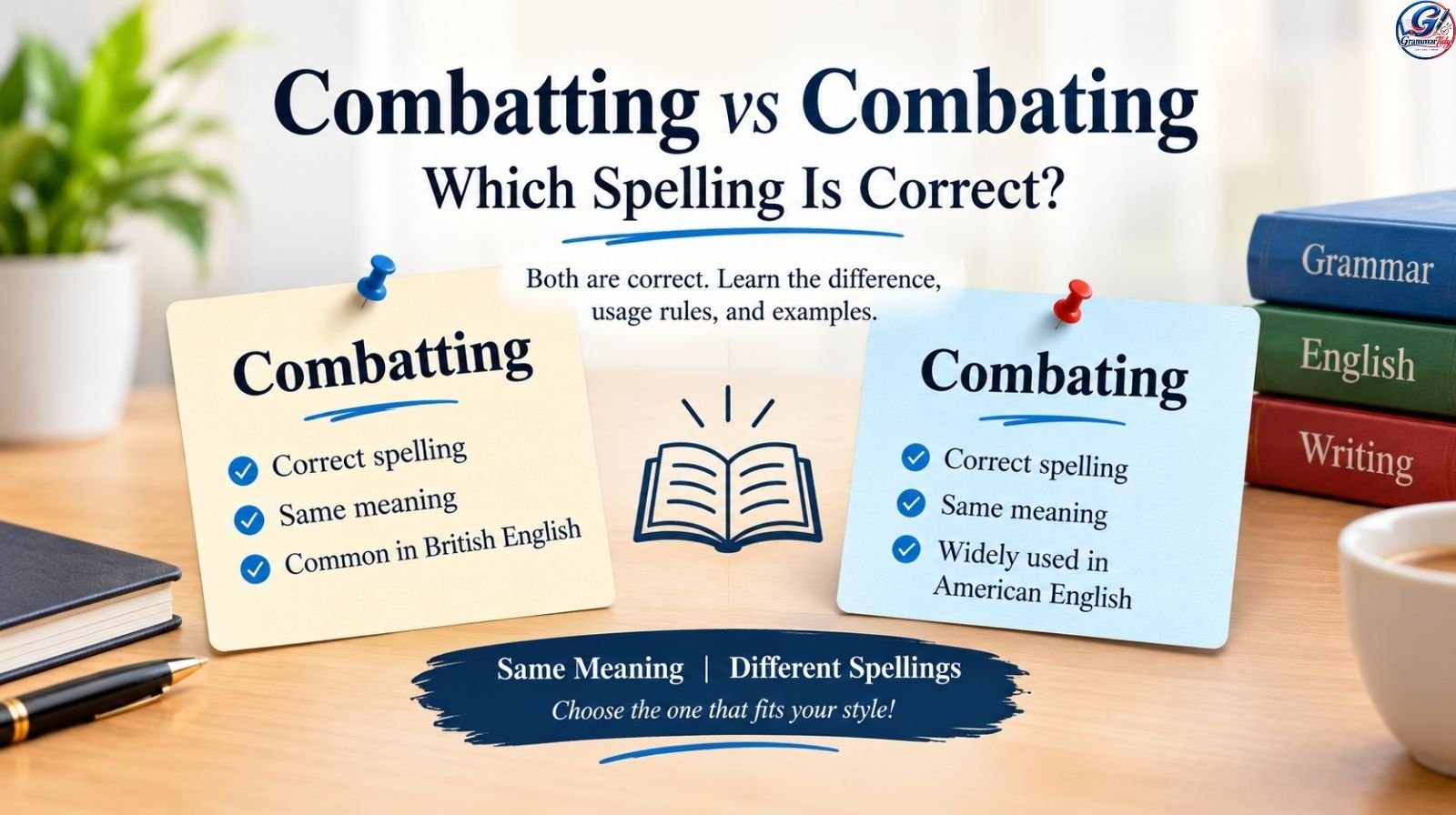
The good news is that both combatting and combating are correct English spellings. They are forms of the verb combat, meaning to fight against, resist, or take action to overcome something harmful. The difference is spelling, not meaning.
In this guide to combatting vs combating, you will learn why both forms exist, how to use them in sentences, which spelling to choose for professional writing, and how to avoid common mistakes in 2026.
Also Read: With or Without You Lyrics: Meaning, Song Details And More
Is It Combatting or Combating? The Correct Answer
Both combatting and combating are accepted spellings of the present participle of combat. The form combating uses one t after the letter a, while combatting doubles the final t before adding -ing.
The two forms communicate the same meaning and can be used in the same grammatical contexts.
What Does Combating Mean?
Combating means actively fighting, resisting, or working to reduce a problem. It often appears in discussions about health, crime, misinformation, pollution, discrimination, and other challenges.
Examples:
- The organization is combating food insecurity in rural communities.
- Researchers are combating the spread of infectious diseases.
- The school introduced new policies for combating bullying.
In each sentence, combating describes an ongoing effort to address a problem.
What Does Combatting Mean?
Combatting has the same meaning as combating. It is also an accepted spelling, particularly recognizable in British English writing.
Examples:
- The charity is combatting poverty through education.
- Local authorities are combatting illegal dumping.
- The campaign focuses on combatting online abuse.
None of these sentences changes meaning if combatting is replaced with combating.
Also Read: Claritin or Allegra: Which One Is Better For Allergies?
Quick Comparison: Combatting vs Combating
| Feature | Combating | Combatting |
|---|---|---|
| Correct spelling | Yes | Yes |
| Meaning | Fighting against or resisting | Fighting against or resisting |
| Grammatical form | Present participle or gerund | Present participle or gerund |
| Spelling pattern | One final t before -ing | Double final t before -ing |
| Best practical choice | A straightforward default | An equally valid alternative |
The main point is simple: neither spelling is automatically wrong. Choose a form that suits your preferred dictionary, publication style, or regional writing convention.
Why Do Combatting and Combating Have Two Spellings?

English spelling includes words that accept more than one form. The difference often comes from spelling conventions, historical development, and the way dictionaries record usage.
The word combat is one example. Both spellings are recognized forms of the verb. Therefore, writers do not need to treat the double-T version as a spelling mistake.
Understanding the Double-T Spelling Rule
Many English verbs double their final consonant before adding -ing, particularly when the verb ends in a consonant-vowel-consonant pattern and the final syllable is stressed.
For example:
- Run → running
- Stop → stopping
- Admit → admitting
However, English spelling rules have exceptions and variations. With combat, both combating and combatting are accepted, so you do not need to treat the double-T form as incorrect.
Is Combatting British English and Combating American English?
It is tempting to assume that each spelling belongs exclusively to a different English variety, but the distinction is not that simple.
Both forms are recognized in different English-language contexts, and neither is restricted to one country. Regional preferences and editorial conventions may influence which form a writer chooses.
For practical writing, follow your organization’s preferred dictionary or style guide. Consistency matters more than trying to assign a strict national label to either spelling.
Also Read: 31st or 31th: Which Is Correct? Meaning, Rules & Examples
How to Use Combatting vs Combating in Sentences
Knowing that both spellings are correct is useful, but understanding how they function in a sentence helps you write with confidence.
Both forms can describe an ongoing action or function as a gerund, which is a verb form used as a noun.
Examples in Everyday English
Here are examples of both spellings in common situations.
Using combating:
- The city is combating rising levels of air pollution.
- Regular exercise can help in combating stress.
- The team is combating misinformation through public education.
- New regulations are aimed at combating financial fraud.
Using combatting:
- The organization is combatting hunger in underserved communities.
- The researchers are combatting the spread of harmful bacteria.
- The campaign is focused on combatting workplace discrimination.
- The government announced new measures for combatting cybercrime.
All eight examples are grammatically acceptable. The spelling choice does not change the meaning.
Examples in Academic and Professional Writing
In formal writing, the verb combat often appears in discussions of policy, research, business, and public health.
| Context | Example sentence |
|---|---|
| Academic | The study examines strategies for combating misinformation. |
| Business | The company is combatting payment fraud with stronger security measures. |
| Public health | Health workers are combating the spread of preventable diseases. |
| Education | Teachers are combating bullying through classroom policies. |
| Environment | Local groups are combatting plastic pollution. |
You can substitute combatting for combating in each sentence without changing its meaning.
Also Read: Yuwen Win or Lose: Does Yuwen Win or Lose?
Common Mistakes to Avoid
When choosing between these spellings, avoid the following errors:
- Calling combatting incorrect: It is a recognized spelling, not automatically a typo.
- Assuming the meanings differ: Both words express the same action.
- Mixing spellings without a reason: Choose one form for consistency within a document.
- Using the wrong verb form: Write “They are combating the problem,” not “They are combating the problem yesterday.”
The final example is incorrect because its verb tense does not fit the time reference. The spelling itself is not the problem.
Which Spelling Should You Use in 2026?
There is no universal rule requiring every writer to choose combating over combatting, or the reverse. The best choice depends on your audience, publication standards, and personal preference.
A Simple Guide to Choosing the Right Form
Use this checklist when editing an article, report, assignment, or business document.
- For general writing, choose either accepted spelling.
- For academic work, check the dictionary or style guide recommended by your institution.
- For business documents, follow your organization’s editorial standards.
- For websites, use one spelling consistently across related pages where practical.
- For proofreading, remember that both forms are valid.
If you want a simple default, combating is a reasonable choice because it is a widely recognized form and avoids the extra letter. However, this is a practical preference, not a rule that makes combatting incorrect.
A Real-Life Editing Case Study
Imagine that an editor is preparing a public-awareness article about online scams for a nonprofit organization. The first draft contains the following sentence:
“The organization is combatting online fraud by educating older adults about suspicious messages.”
During proofreading, another editor changes combatting to combating, believing that the original spelling is wrong. A third reviewer questions the change because they have seen combatting used in published reports.
The editorial team reviews the spelling conventions used in its existing content and confirms that both forms are acceptable. The disagreement is therefore not about grammar or meaning; it is about spelling preference.
The team decides to use combating throughout the article because it fits the publication’s chosen spelling convention. The editor then searches the document for other instances of combatting and updates them to match. The rest of the article remains unchanged.
In a later article, the same organization may choose combatting if that spelling better fits its established editorial practice. That choice would also be correct.
This example demonstrates a useful editing principle: proofreading should distinguish genuine errors from acceptable variations. An editor should not mark a valid spelling as wrong simply because another form is preferred. Instead, the goal is to maintain accuracy, consistency, and readability while respecting established language conventions.
Also Read: Where to Watch Deal or No Deal Island: Streaming Guide
Combatting vs Combating: Spelling Facts and 2025–2026 Evidence
For spelling questions, dictionary evidence provides a more reliable foundation than unsupported claims about which version is supposedly correct.
What Do Spelling References Tell Us?
Standard English dictionaries recognize both combating and combatting as forms of the verb combat. Both retain the same basic meaning: to fight against, resist, or work to reduce something harmful.
The key spelling facts are:
- Combating uses one final t before -ing.
- Combatting uses two consecutive t letters before -ing.
- Both forms are grammatically acceptable.
- Neither spelling creates a different meaning.
- A publication’s preferred spelling convention can determine which form its writers use.
What Does the 2025–2026 Evidence Tell Us?
As of October 2026, both spellings remain acceptable forms of the verb combat. However, a reliable, directly comparable 2025–2026 dataset measuring their relative frequency across all English writing is not available for this article.
That distinction is important. Search-result counts, isolated examples, and individual website preferences are not enough to establish a definitive worldwide usage ranking.
The available spelling evidence supports three conclusions:
- Both spellings are correct. They are recognized forms of the same verb.
- Their meanings are identical. The additional t does not create a difference in meaning or grammar.
- Consistency is the practical priority. Writers should follow the relevant dictionary or editorial policy rather than treating one accepted form as a universal error.
For SEO writing, spelling accuracy should be combined with clear explanations, relevant examples, useful structure, and content that genuinely answers readers’ questions. A well-organized article helps readers understand the topic without unnecessary repetition or unsupported claims.
Also Read: Soder or Solder? Easy Guide with Simple Words And Clear Examples
Frequently Asked Questions
1. Is combatting or combating correct?
Both are correct. Combating and combatting are accepted present participles of the verb combat. Neither spelling changes the meaning.
2. Is combatting a British spelling?
Combatting is used in British English, but it is not exclusive to Britain. Both spellings are recognized forms of English, and writers may choose according to their preferred conventions.
3. Is combating more common in American English?
Combating is a widely recognized spelling in American English. However, both forms are valid, and the information presented here does not establish a precise, current frequency comparison.
4. Does combatting mean something different from combating?
No. Both mean fighting against, resisting, or working to reduce a problem. For example, “combating poverty” and “combatting poverty” express the same idea.
5. Why does combatting have two Ts?
The spelling combatting doubles the final T before adding -ing. English accepts this form alongside combating, so the extra letter does not make the word incorrect.
6. Which spelling should I use in an essay or professional email?
Choose the spelling recommended by your teacher, employer, publisher, or preferred dictionary. If no specific convention applies, either spelling is acceptable. Use the same form consistently throughout your document.
Conclusion:
The answer to combatting vs combating is straightforward: both spellings are correct, and both mean the same thing. The difference is simply whether the final T is doubled before adding -ing.
Use combating or combatting according to your preferred spelling convention, and follow your chosen form consistently. When in doubt, consult a reputable dictionary rather than assuming that an unfamiliar spelling is wrong.
Whether you are writing an academic essay, a blog post, a business report, or a public-awareness campaign, understanding this small spelling variation can make proofreading easier and help you communicate more confidently.
Discover More Article
- Layed or Laid (2026): Easy Guide To Understand The Difference
- Began vs Begun: Which Form Goes Where?
- Gage or Gauge: What’s The Difference? Explained Simply
- Sustain vs Substain: The Complete Guide To Meaning, Correct Usage, Etymology & Common Spelling Mistakes
Keep learning with more easy grammar lessons on GrammarTidy.com

Hi, I’m Noor Fatima, the author and creator of Grammar Tidy. I’m passionate about grammar, writing, and making language learning simple and enjoyable. Through Grammar Tidy, I share helpful tips, clear explanations, and practical guidance to help readers improve their writing, avoid common mistakes, and communicate with confidence. My goal is to make better grammar easy, useful, and accessible for everyone.