Have you ever written “I lended him my book” and wondered whether it was grammatically correct? You are not alone.
Lended vs lent is a common English grammar confusion because many verbs form their past tense by adding -ed, while others follow different patterns.
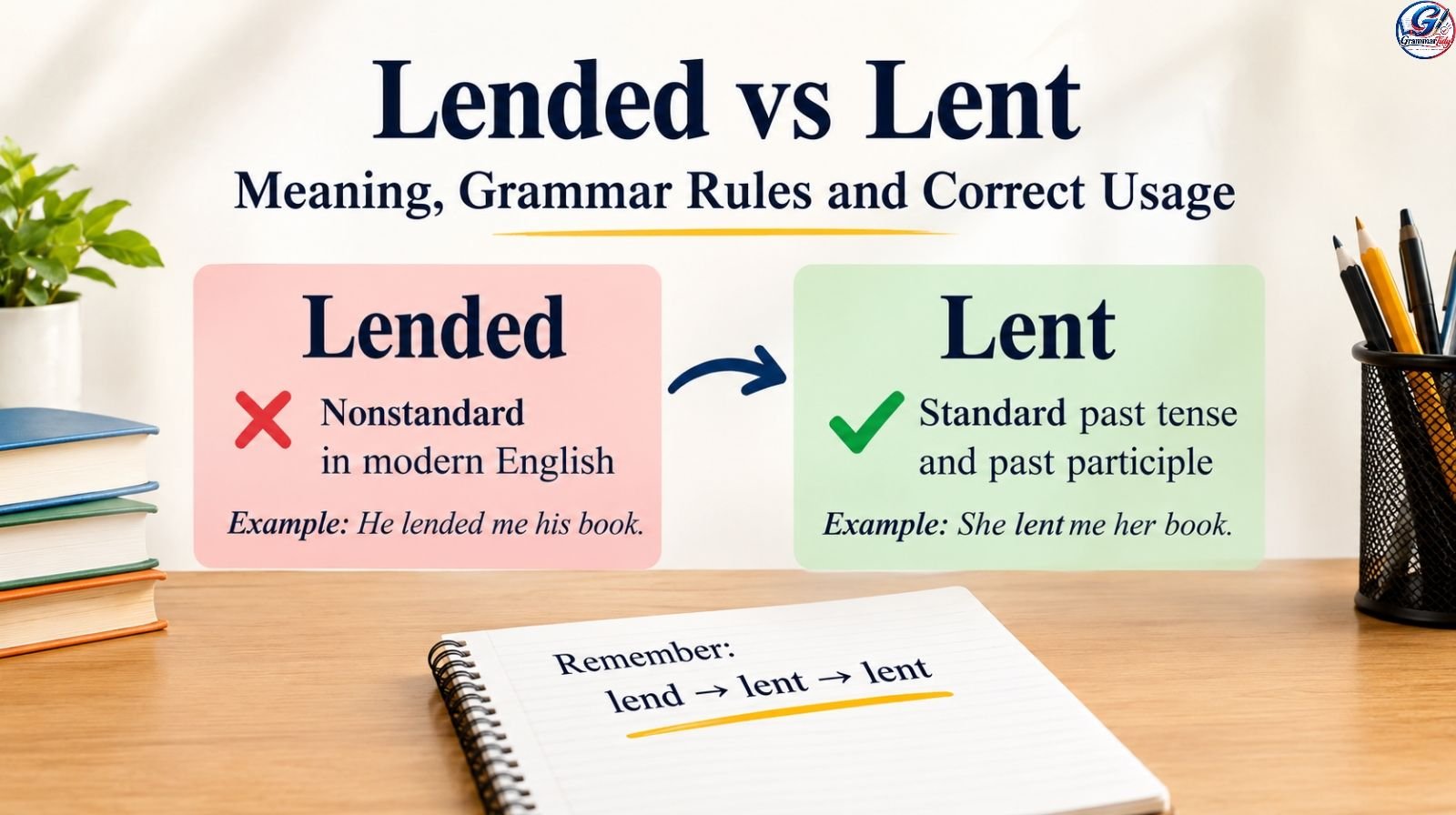
The correct past tense and past participle of lend is lent, not lended in standard modern English. For example, you should write, “She lent me her notebook yesterday,” rather than “She lended me her notebook yesterday.”
In this guide, you will learn the meaning of both forms, understand the grammar rules behind them, explore practical examples, and discover how to use lent correctly in everyday conversations, school assignments, and professional writing.
Also Read: Win or Lose Episodes: Complete Episode Guide (2026)
What Is the Difference Between Lended vs Lent?
The main difference between lended and lent is grammatical correctness. Lent is the standard past tense and past participle of lend, while lended is generally considered nonstandard and should be avoided in formal and standard English writing.
What Does Lent Mean?
Lent is the past tense and past participle of the verb lend. It means that someone gave another person something temporarily, with the expectation that it would be returned. It can also refer to giving money or providing help and support.
Examples:
- My brother lent me his laptop for the weekend.
- The bank lent the company enough money to expand.
- She has lent her support to the community project.
- They lent us their chairs for the family gathering.
In each sentence, lent describes an action involving a temporary transfer, financial loan, or contribution.
What Does Lended Mean?
Lended is a form people sometimes create by applying the regular past-tense rule of adding -ed to a verb. However, lend is an irregular verb, so its standard past form is lent.
For example:
- Incorrect in standard English: He lended me his bicycle.
- Correct: He lent me his bicycle.
Although readers may understand what lended means, it is not the recommended form in standard English. For schoolwork, business communication, articles, and other edited writing, use lent.
Quick Comparison: Lended vs Lent
| Feature | Lent | Lended |
|---|---|---|
| Grammatical status | Standard English | Nonstandard in modern English |
| Past tense of lend | Correct | Not recommended |
| Past participle of lend | Correct | Not recommended |
| Formal writing | Appropriate | Avoid |
| Example | She lent me $20. | She lended me $20. |
Quick answer: If you are deciding between lended and lent, choose lent.
Also Read: GitLab or GitHub: Which One Should You Choose?
What Are the Grammar Rules for Lent?
Understanding the grammar rules for lent makes it easier to use the word correctly. The key is to remember that lend is an irregular verb and does not follow the usual -ed pattern.
The Three Main Forms of Lend
The verb lend has three essential forms that you should memorize.
| Verb form | Correct word | Example |
|---|---|---|
| Base form | Lend | I lend books to my classmates. |
| Simple past | Lent | I lent him a book yesterday. |
| Past participle | Lent | I have lent him several books. |
| Present participle | Lending | She is lending me her notes. |
| Third-person singular | Lends | He lends money to his brother. |
Notice that both the simple past and past participle use the same word: lent.
When Should You Use Lent?
Use lent when describing a completed action in the past.
Examples:
- I lent my umbrella to Sarah this morning.
- The teacher lent us some reference books.
- They lent their car to a relative last week.
You can also use lent with helping verbs such as has, have, and had when forming perfect tenses.
Examples:
- I have lent him my calculator.
- She has lent her expertise to the team.
- We had lent them the equipment before the event began.
The grammar patterns are simple:
- Simple past: Subject + lent + object.
- Present perfect: Subject + has/have + lent + object.
- Past perfect: Subject + had + lent + object.
Also Read: Who Won The Vietnam War: U.S. Or Vietnam?
Why Is Lend an Irregular Verb?
Regular verbs typically form their simple past tense by adding -ed. For example, walk becomes walked, and help becomes helped.
Irregular verbs follow different patterns. For example:
- Give → gave
- Take → took
- Send → sent
- Lend → lent
Because lend is irregular, adding -ed does not produce its standard past tense. Remembering the three forms lend, lent, lent is the easiest way to avoid this mistake.
How to Use Lent Correctly in Everyday English
Learning a grammar rule is helpful, but seeing the word in real situations makes it easier to remember. The verb lend can describe sharing personal belongings, providing financial assistance, or contributing support.
Using Lent for Objects and Personal Belongings
Use lent when someone allows another person to use an item temporarily.
Examples:
- My friend lent me her favorite novel.
- Dad lent me his car for the afternoon.
- The library lent us several books for our research project.
- James lent his headphones to his younger brother.
In these examples, the items are expected to be returned.
Using Lent for Money and Financial Help
Lent also describes giving money to someone who is expected to repay it.
Examples:
- My uncle lent me $100 to cover an unexpected expense.
- The bank lent the business money to purchase new equipment.
- She lent her friend some money until payday.
Remember that lend describes giving something temporarily, whereas borrow describes receiving something temporarily.
For example:
- Correct: I lent him my pen.
- Correct: He borrowed my pen.
Both sentences describe the same situation from different perspectives.
Using Lent for Support and Figurative Meaning
The word lend is not limited to physical objects or money. It can also mean providing help, credibility, influence, or a particular quality.
Examples:
- Her experience lent credibility to the proposal.
- The music lent a peaceful atmosphere to the room.
- Several volunteers lent their support to the campaign.
- His explanation lent greater clarity to the discussion.
These examples demonstrate that lent can describe both literal and figurative actions.
Also Read: Winter Spring Summer or Fall: Meaning, Movie, And Season Order
Lended vs Lent: A Real-Life Writing Example

Consider a student named Alex who is preparing an English assignment about a school project. Alex wants to explain how classmates helped one another by sharing books and other supplies.
In the first draft, Alex writes:
“I lended my science book to Maria because she forgot hers. Later, Maria lended me her calculator for our mathematics homework. Our teacher also lended us some reference materials.”
The meaning is understandable, but the repeated use of lended makes the writing nonstandard. If Alex submits the assignment in this form, a teacher may mark the verb forms as grammatical errors.
Alex checks the verb forms and revises the paragraph:
“I lent my science book to Maria because she forgot hers. Later, Maria lent me her calculator for our mathematics homework. Our teacher also lent us some reference materials.”
The revised paragraph is grammatically correct and reads naturally. Alex then checks another sentence: “I have lended my notes to several classmates.” Because the sentence uses the present perfect tense, Alex replaces lended with lent: “I have lent my notes to several classmates.”
This example illustrates an important lesson. Grammar mistakes do not always prevent readers from understanding a message, but using the correct forms improves clarity and professionalism.
By learning the pattern lend, lent, lent, Alex can avoid the same mistake in future assignments, emails, and reports.
The practical takeaway: Whenever you are writing about something you gave someone temporarily, use lent for the past tense and past participle.
Also Read: When Does Trick-or-Treating Start? Halloween Hours Guide
Lended vs Lent: 2025–2026 Grammar and Usage Facts

When checking a confusing word, established dictionaries and consistent grammar rules are more useful than guessing from a word’s appearance. The following comparison summarizes the standard verb forms and their practical use.
Standard Grammar Findings
| Grammar feature | Correct form or finding |
|---|---|
| Base verb | Lend |
| Simple past tense | Lent |
| Past participle | Lent |
| Present participle | Lending |
| Third-person singular | Lends |
| Standard form in formal writing | Lent |
| Is lended recommended? | No |
What Do These Findings Tell Us?
The grammar rules provide three useful observations:
- The standard past tense is lent: Use it when describing a completed action in the past.
- The past participle is also lent: The same form works with has, have, and had.
- The rule remains consistent for 2025–2026 usage: There is no need to switch to lended in modern standard English.
These are grammar facts, not search-volume statistics. No verified search-volume figure is provided here for the exact phrase lended vs lent, so a specific number of searches would be misleading.
For practical purposes, the conclusion is clear: use lent in standard English, regardless of whether you are writing in British or American English.
Also Read: With or Without You Lyrics: Meaning, Song Details And More
Frequently Asked Questions
1. Is Lended or Lent Correct?
Lent is correct in standard English. It is the simple past tense and past participle of lend. For example, “She lent me her book” is correct, while “She lended me her book” is nonstandard.
2. Is Lended Ever Acceptable?
People may occasionally use lended informally or as a result of applying the regular -ed rule. However, it is not the standard form recommended for formal writing. Avoid it in academic work and professional communication.
3. What Is the Past Tense of Lend?
The past tense of lend is lent.
Example: “I lent my friend some money yesterday.”
4. What Is the Past Participle of Lend?
The past participle is also lent.
Example: “I have lent my friend some money.”
5. What Is the Difference Between Lend and Borrow?
Lend means to give something to another person temporarily, while borrow means to receive or use something temporarily with permission.
Examples:
- I lent my sister a jacket.
- I borrowed a jacket from my sister.
6. Is Lent Correct in Both British and American English?
Yes. Lent is the standard past tense and past participle in both British and American English. You do not need a different spelling for either variety.
Conclusion:
When comparing lended vs lent, the correct choice in standard English is lent. The verb lend is irregular, which means its past tense and past participle do not follow the usual -ed pattern.
Remember these essential forms:
- Present tense: lend
- Past tense: lent
- Past participle: lent
- Present participle: lending
For example, write “I lent my friend a book yesterday” and “I have lent my friend several books.” Avoid lended in standard English writing.
Whether you are preparing an assignment, writing an email, or improving your everyday grammar, remembering lend, lent, lent will help you communicate more confidently.
Discover More Article
- Nosey or Nosy: Which Spelling Is Correct?
- Natzi or Nazi: The Correct Spelling, Meaning, And Why It Matters
- Goodmorning or Good Morning: The Correct Usage (And Why It Actually Matters)
- Gluing or Glueing: Which Spelling Is Correct And Why It Matters?
Keep learning with more easy grammar lessons on GrammarTidy.com

Hi, I’m Noor Fatima, the author and creator of Grammar Tidy. I’m passionate about grammar, writing, and making language learning simple and enjoyable. Through Grammar Tidy, I share helpful tips, clear explanations, and practical guidance to help readers improve their writing, avoid common mistakes, and communicate with confidence. My goal is to make better grammar easy, useful, and accessible for everyone.