Have you ever wondered whether to write fairing or faring? These two words look almost identical, but their meanings are quite different.
Choosing the wrong one can make an otherwise clear sentence confusing, especially when describing how someone is doing or discussing parts of a motorcycle or aircraft.
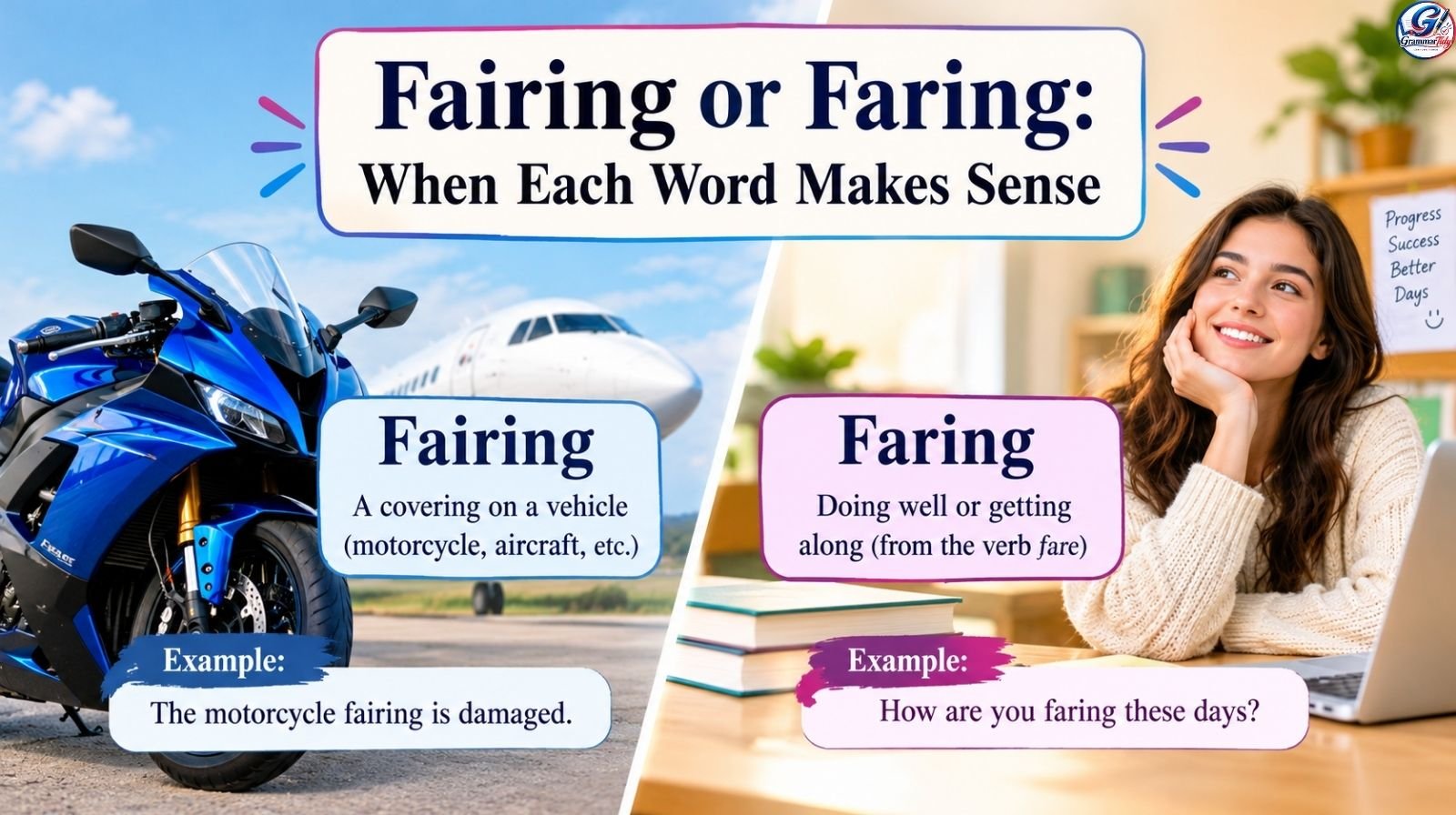
The good news is that learning the difference between fairing and faring is simple. Fairing is usually a protective or aerodynamic covering on a vehicle, while faring is the -ing form of the verb fare, meaning to get along, perform, or experience a situation.
In this guide, you’ll learn what each word means, see practical examples, explore common mistakes, and discover an easy trick to remember which spelling to use.
Fairing or Faring: What Is the Difference?
The main difference between fairing and faring is their meaning and grammatical function. Although they sound the same in many English accents, they are not interchangeable.
What Does Fairing Mean?
Fairing is a noun that commonly describes a shaped covering on a vehicle, such as a motorcycle, airplane, or racing car. Its purpose is often to reduce air resistance, improve aerodynamics, protect components, or create a smoother appearance.
Examples include:
- The mechanic replaced the damaged motorcycle fairing.
- The aircraft’s fairing helps create a smoother aerodynamic shape.
- She ordered a new front fairing for her racing bike.
- Engineers designed a lightweight fairing to improve the vehicle’s performance.
In these sentences, fairing refers to a physical object or component.
What Does Faring Mean?
Faring is the present participle of the verb fare. The verb fare means to get along, do, perform, or experience a particular situation.
Examples include:
- How are you faring after your first week at work?
- The students are faring well in their examinations.
- Small businesses are faring better this year than last year.
- Our team is faring poorly against stronger opponents.
Here, faring describes how someone or something is doing under particular circumstances.
Quick Comparison
| Word | Meaning | Example |
|---|---|---|
| Fairing | A covering, often on a vehicle | The motorcycle fairing is cracked. |
| Faring | Doing or getting along | She is faring well at college. |
| Fairing | A traditional gift from a fair | The child received a small fairing. |
Easy rule: If you mean a vehicle covering, use fairing. If you mean how someone or something is doing, use faring.
When Should You Use Fairing or Faring?
Choosing between fairing and faring becomes easier when you consider the subject of your sentence. Are you describing an object, or are you explaining how someone or something is doing?
Use Faring to Describe Progress or Performance
Use faring when discussing progress, success, challenges, or someone’s experience in a situation.
Examples:
- How are you faring in your new job?
- The business is faring well despite rising costs.
- The athletes are faring better this season.
- Our team is faring poorly against stronger opponents.
- How are the children faring at their new school?
Notice that you can often replace faring with doing without changing the basic meaning.
For example:
The students are faring well.
This means:
The students are doing well.
Use Fairing to Describe a Physical Structure
Use fairing when referring to a vehicle component, aerodynamic covering, or a gift associated with a fair.
Examples:
- The motorcycle’s side fairing needs repair.
- Engineers inspected the aircraft’s new fairing.
- The rocket’s payload fairing protects its cargo during launch.
- She purchased a traditional fairing at the local fair.
In these examples, fairing names something rather than describing performance.
A Quick Decision Guide
| If your sentence is about… | Correct word | Example |
|---|---|---|
| Personal well-being | Faring | How are you faring? |
| Academic performance | Faring | He is faring well in school. |
| Business progress | Faring | The company is faring better. |
| Motorcycle bodywork | Fairing | The fairing is damaged. |
| Aircraft design | Fairing | The aircraft fairing was inspected. |
| A gift from a fair | Fairing | She received a small fairing. |
Common Mistakes With Fairing and Faring

One of the most frequent errors is writing fairing when asking how someone is doing. This mistake happens because the words sound alike in many accents.
Is It “How Are You Fairing” or “How Are You Faring”?
The correct expression is “How are you faring?”
The sentence asks about a person’s condition, progress, or experience. Since faring comes from the verb fare, it is the correct choice.
Incorrect for this meaning:
- How are you fairing after the move?
- The students are fairing well in their classes.
- How is the company fairing this year?
Correct versions:
- How are you faring after the move?
- The students are faring well in their classes.
- How is the company faring this year?
Why Do People Confuse These Words?
There are three main reasons:
- Similar pronunciation: In many English accents, the words sound alike.
- Similar spelling: Both words contain nearly the same letters, making them easy to mix up.
- Unfamiliar vocabulary: Many people know the word fair but are less familiar with fare as a verb meaning to do or progress.
The solution is to learn each word through its meaning rather than relying on pronunciation alone.
A Simple Memory Trick
Remember these two connections:
- Faring → Fare → Doing: “How are you faring?” means “How are you doing?”
- Fairing → Physical covering: Think of the streamlined exterior of a motorcycle or aircraft.
This technique helps you choose the correct word quickly, especially when writing emails, essays, reports, and website content.
Fairing or Faring in Real-Life Writing
Understanding a spelling rule is helpful, but applying it to everyday situations makes it easier to remember. Consider the following case study.
Case Study: A Student Writing a Progress Report
Imagine a university student named Alex who is preparing a short progress report about a group project. Alex wants to explain that the team is managing its workload successfully and has completed most of its tasks.
The first draft reads:
Our team is fairing well with the project, and we expect to finish before the deadline.
Although the sentence is understandable, it uses the wrong word. Alex is describing the team’s progress, not a physical structure. The correct sentence is:
Our team is faring well with the project, and we expect to finish before the deadline.
Later in the same report, Alex describes a separate engineering assignment involving a model aircraft. This time, the sentence reads:
We redesigned the aircraft’s faring to improve its external shape.
Here, the intended meaning concerns a physical component, so the correct spelling is fairing:
We redesigned the aircraft’s fairing to improve its external shape.
These two examples demonstrate why context matters more than pronunciation. The first sentence describes how a team is doing; the second identifies a component of an aircraft.
By checking the meaning of each word before submitting the report, Alex can improve the accuracy and professionalism of the writing. The same approach works in academic assignments, workplace communication, technical documentation, and everyday conversations.
The lesson is simple: identify the intended meaning first, then select the spelling that matches it.
Fairing or Faring: Language Facts and 2025–2026 Data
When comparing commonly confused words, it is useful to distinguish established linguistic information from numerical claims about how often people make mistakes.
What Do the Definitions Tell Us?
The meanings of these words provide a clear distinction:
- Faring: The present participle of fare, a verb used to describe how someone succeeds, progresses, or manages a situation.
- Fairing: A technical noun for a structure or exterior surface that helps reduce aerodynamic drag.
- Fairing in another context: A traditional gift or small item associated with a fair, particularly in British usage.
These definitions confirm that both spellings are legitimate English words, but they have different uses.
What Can We Confirm for 2025–2026?
There is no verified, comprehensive 2025–2026 statistic established here that measures how often writers confuse fairing and faring. It would be misleading to invent a percentage, search-volume figure, or error rate.
However, the established definitions support three reliable conclusions:
- Both spellings are valid English words.
- Faring is the grammatical form of the verb fare used to discuss progress or circumstances.
- Fairing is commonly used as a technical noun for a streamlined covering or structure.
For writers, these distinctions are more useful than an unsupported popularity statistic because they directly determine which word belongs in a sentence.
How Can You Check Your Usage?
When you encounter an unfamiliar expression, consider the meaning of the entire sentence. You can also compare the word with a familiar alternative.
For instance, checking the phrase “How are you faring?” makes its intended meaning clearer than considering the word faring alone.
This approach supports accurate writing without relying on unverified claims about language trends.
Frequently Asked Questions
1. Which Is Correct: Fairing or Faring?
Both are correct words, but they have different meanings. Use faring to describe how someone or something is doing. Use fairing for a streamlined vehicle covering or, in a less common British usage, a gift from a fair.
2. Is It “Faring Well” or “Fairing Well”?
Faring well is correct when you mean doing well or making progress.
Example: The new employee is faring well in her role.
Fairing well is not the standard expression for describing someone’s progress.
3. What Does “How Are You Faring?” Mean?
It means “How are you doing?” or “How are you managing?” It is often used to ask about someone’s progress, circumstances, or ability to cope with a situation.
Example: How are you faring after moving to a new city?
4. What Is a Fairing on a Motorcycle?
A motorcycle fairing is an exterior panel or covering designed to streamline the motorcycle, manage airflow, and sometimes protect internal components or the rider from wind and debris.
Example: The mechanic replaced the cracked front fairing.
5. Are Fairing and Faring Homophones?
Yes, in many English accents, fairing and faring are homophones because they share the same pronunciation. Their different meanings and spellings are why context is essential.
6. How Can I Remember the Difference Between Fairing and Faring?
Connect faring with fare, meaning doing or progressing. Connect fairing with a physical covering, especially one found on a motorcycle or aircraft.
If you can replace the word with doing, you probably need faring.
Conclusion:
The difference between fairing or faring is simple once you focus on meaning. Faring describes how someone or something is doing, coping, or progressing. Fairing usually refers to a physical structure that streamlines a vehicle, although it can also mean a gift from a fair.
Remember these examples:
- How are you faring? Asking how someone is doing.
- The motorcycle fairing is damaged. Describing a physical component.
Before you finish your next email, essay, report, or blog post, take a moment to check the meaning behind the word. This small habit can prevent common spelling mistakes and make your writing clearer.
Want to improve your English further? Explore more commonly confused words, practise using them in your own sentences, and keep building your confidence one word at a time.
Discover More Article
- Seperate vs Separate: How to Spell It Correctly
- Orientated vs Oriented: Which Word Is Correct?
- Gage or Gauge: What’s The Difference? Explained Simply
- Potatoes or Potatos: Which Spelling Is Correct? (2026)
Keep learning with more easy grammar lessons on GrammarTidy.com

Hi, I’m Noor Fatima, the author and creator of Grammar Tidy. I’m passionate about grammar, writing, and making language learning simple and enjoyable. Through Grammar Tidy, I share helpful tips, clear explanations, and practical guidance to help readers improve their writing, avoid common mistakes, and communicate with confidence. My goal is to make better grammar easy, useful, and accessible for everyone.