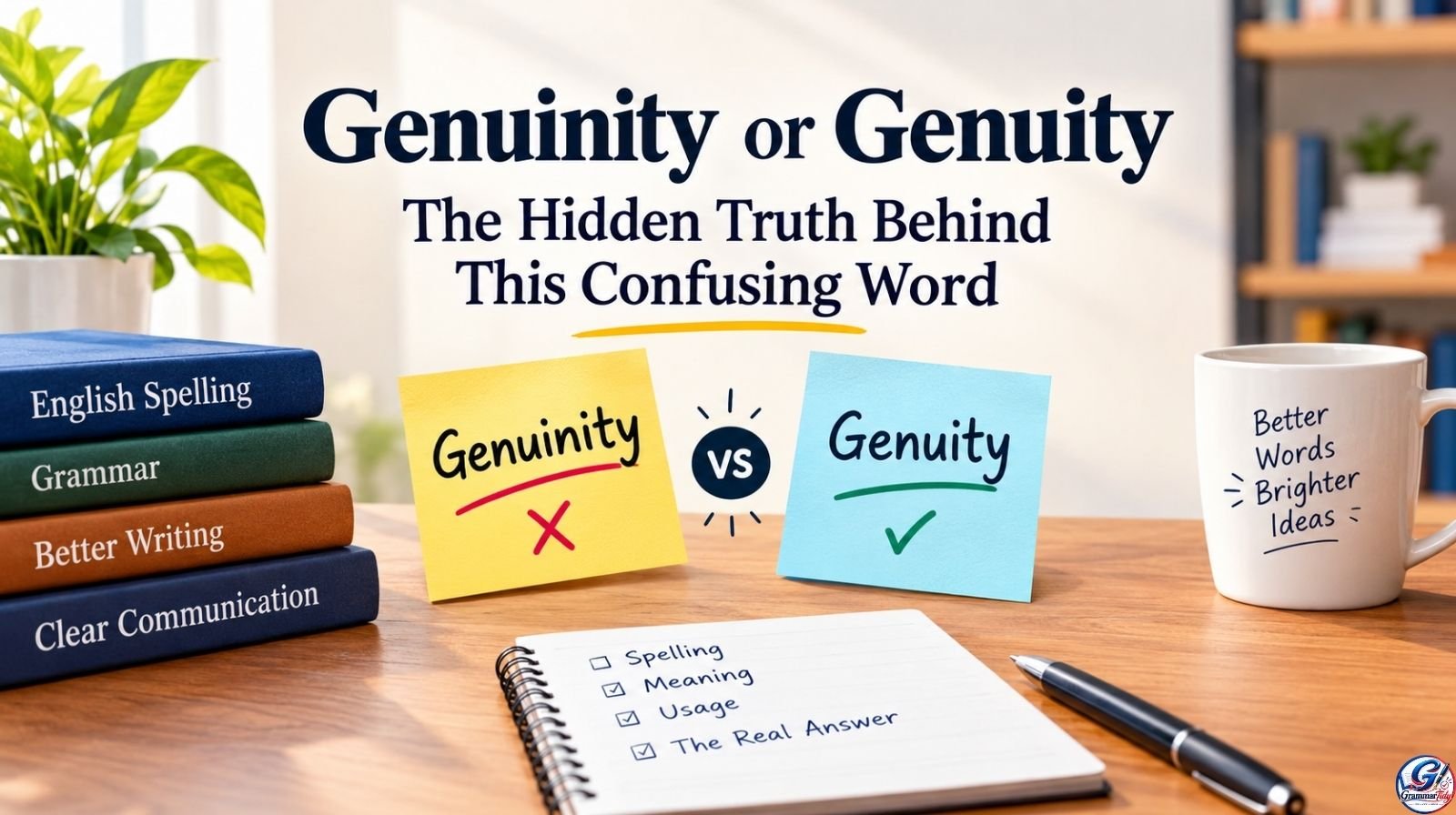
Have you ever wondered whether genuinity or genuity is the correct word when describing honesty, authenticity, or something real? These two spellings can confuse writers because both appear to be related to the familiar word genuine.
However, choosing the right expression requires understanding standard English usage, word formation, and context.
The important point is that neither “genuinity” nor “genuity” is a common, well-established choice in everyday standard English.
If you want to describe the quality of being genuine, the words genuineness and authenticity are usually better options. Although genuity may appear in specialized or historical contexts, it is uncommon in modern writing.
In this guide, you will discover what these words mean, why people confuse them, which alternatives to use, and how to write more clearly and confidently.
Also Read: Vinal vs Vinyl: Which Is The Correct One To Use?
What Do Genuinity and Genuity Mean?
The confusion between genuinity and genuity begins with their apparent connection to the adjective genuine. Both forms look as though they could describe the quality of being real, sincere, or authentic.
However, a word that looks grammatically possible is not necessarily the most natural or accepted choice in modern English.
Understanding Genuinity
Genuinity is an uncommon formation that some writers use to mean the quality of being genuine. It follows a pattern that may seem logical: adding a noun-forming ending to a related adjective.
For example, someone might write:
- “I appreciated the genuinity of her apology.”
- “The genuinity of the product was questioned.”
Readers can probably understand these sentences, but the wording sounds unusual to many English speakers. More natural alternatives would be:
- “I appreciated the genuineness of her apology.”
- “The authenticity of the product was questioned.”
Therefore, although genuinity communicates an understandable idea, it is generally better to choose a more established noun.
Understanding Genuity
Genuity is also an uncommon word, sometimes encountered in discussions of genuine character or authenticity. However, it is not the usual noun used to describe the quality of being genuine in contemporary everyday English.
For example, a writer might attempt this sentence:
– “The genuity of his intentions was obvious.”
A clearer, more conventional version is:
- “The sincerity of his intentions was obvious.”
- “The genuineness of his intentions was obvious.”
The main lesson is simple: do not assume that genuity is the standard alternative simply because it is shorter than genuinity.
Also Read: Accross vs Across: Which Is The Correct Spelling?
Is Genuinity or Genuity the Correct Word?
Neither spelling is the preferred everyday choice when you want to express the quality of being genuine. In most situations, genuineness is the safest direct alternative, while authenticity and sincerity work well in specific contexts.
Genuinity vs. Genuity: Quick Comparison
| Word | General usage | Recommended alternative |
|---|---|---|
| Genuinity | Uncommon; may be used to mean the quality of being genuine | Genuineness |
| Genuity | Rare in ordinary contemporary writing | Genuineness or authenticity |
| Genuineness | Established noun describing the quality of being genuine | Use when appropriate |
| Authenticity | Established noun emphasizing whether something is real or authentic | Use for objects, claims, and identity |
| Sincerity | Established noun emphasizing honest feelings or intentions | Use for apologies, emotions, and communication |
Why Genuineness Is Usually Better
The adjective genuine has a well-established noun form: genuineness. This form is familiar, clear, and suitable for formal as well as informal writing.
Consider these examples:
- Unusual: “Her genuinity impressed everyone.”
- Better: “Her genuineness impressed everyone.”
Another example:
- Unusual: “We questioned the genuity of the document.”
- Better: “We questioned the authenticity of the document.”
The best replacement depends on the intended meaning. Use genuineness for the general quality of being genuine, authenticity when something’s originality or legitimacy matters, and sincerity when discussing honest feelings or intentions.
Why Do People Confuse Genuinity and Genuity?
English contains many words that form nouns through different endings. Because these patterns are not always predictable, people sometimes create words that appear logical but are not the most natural choices.
Also Read: Meating vs Meeting: Difference And Correct Usage
The Influence of the Word Genuine
The adjective genuine means real, authentic, or sincere rather than false or artificial.
Examples include:
- “This is a genuine leather bag.”
- “She gave me a genuine smile.”
- “His concern for the community is genuine.”
When writers want to turn this adjective into a noun, they may experiment with endings such as -ity or -ness. That can lead to forms like genuity and genuinity.
However, English does not follow one universal rule for forming nouns. For example:
- Kind → kindness
- Honest → honesty
- Authentic → authenticity
- Genuine → genuineness
Notice that honesty and authenticity have their own established forms. Similarly, genuine is most naturally associated with genuineness in standard contemporary usage.
Why Similar-Looking Words Are Not Always Interchangeable
A spelling can look reasonable without being the conventional choice. This is particularly common when people learn English through reading, social media, or informal conversations.
For instance, a writer might assume that because authenticity is a noun, genuinity must be equally common. Yet familiar usage matters just as much as apparent word formation.
To avoid confusion, consider the audience, context, and meaning of the sentence. In professional writing, choosing a recognized word is generally better than using an unusual form that may distract readers.
Real-Life Example: Choosing the Right Word in Professional Writing
Imagine a small online business that sells handmade leather accessories. The owner wants to publish a product description explaining why customers should trust the quality of the goods.
In the first draft, the owner writes:
“The genuinity of our leather products makes them special. Every item is carefully created with genuine materials, and our customers can trust the genuity of our craftsmanship.”
The message is understandable, but both genuinity and genuity make the paragraph sound awkward. Customers may pause to consider the unusual wording instead of focusing on the products.
The owner revises the description:
“The genuineness of our materials makes each product special. Every item is carefully crafted, and we are committed to the authenticity of our materials and the quality of our workmanship.”
The revised version communicates the same basic idea using more familiar vocabulary. It also distinguishes between two related concepts: whether the materials are genuine and whether the craftsmanship meets the business’s standards.
The owner could improve the copy further by using concrete details, such as the type of leather, manufacturing process, or product warranty, provided those claims are accurate.
What does this example teach us? Word choice is not simply about deciding whether a spelling is possible. It is about helping readers understand the intended message naturally and confidently.
In business writing, educational content, and product descriptions, established vocabulary can improve clarity and credibility.
Also Read: Commit vs Comit: Correct Spelling And Usage
Genuinity or Genuity: Language Trends and Statistics for 2025–2026

When researching an uncommon word, it is useful to distinguish between measurable language data and general observations about usage.
What Can We Verify About These Words?
As of 2026, there is no verified statistic presented here that establishes an exact percentage of English speakers who use genuinity rather than genuity.
Nor is there a reliable numerical basis in this article for claiming that one spelling has become more popular during 2025–2026.
Instead, the practical distinction is based on standard contemporary usage: genuineness, authenticity, and sincerity are established alternatives for the meanings most writers intend.
For a more quantitative comparison, researchers can consult these resources:
- Google Books Ngram Viewer: Useful for comparing the historical frequency of words in its digitized book collection. Its results reflect that collection, not all English communication.
- Merriam-Webster Dictionary: Useful for checking established word meanings, spelling, and usage information.
- Cambridge Dictionary: Useful for understanding contemporary definitions and examples of common English vocabulary.
These resources can help investigate word history and usage, but results should be interpreted carefully. A word appearing in a book or online text does not automatically make it the preferred spelling in standard English.
Also Read: Symptomatology vs Symptomology: Differences, Meaning, And Usage
How to Evaluate Word Usage Accurately
When investigating genuinity and genuity, follow this simple process:
- Check reputable dictionaries for definitions and usage labels.
- Compare the words with established alternatives, particularly genuineness and authenticity.
- Examine examples from edited writing rather than relying only on isolated social media posts.
- If using a frequency database, record the search date, time period, and limitations of the data.
- Choose the wording that communicates your meaning clearly to your intended audience.
This method avoids unsupported claims and gives readers a more reliable answer than invented statistics or unverified popularity rankings.
How to Use the Best Alternative in Everyday Writing
The easiest way to avoid this spelling confusion is to identify exactly what you want to express. The best alternative depends on whether you mean something is real, someone is sincere, or a quality is genuine.
Genuineness vs. Authenticity vs. Sincerity
These three words overlap, but they are not always interchangeable.
Genuineness refers broadly to the quality of being genuine, real, or sincere.
Example: “The genuineness of her concern was clear.”
Authenticity emphasizes whether something is genuine, original, or true to its claimed identity.
Example: “The museum verified the authenticity of the painting.”
Sincerity focuses on honest feelings, intentions, or communication.
Example: “His sincere apology showed his sincerity.”
Choosing the right noun makes your sentence more precise.
A Simple Checklist for Choosing the Right Word
Before using genuinity or genuity, ask yourself these questions:
- Am I describing the general quality of being genuine? Use genuineness.
- Am I discussing whether an object, document, or claim is authentic? Use authenticity.
- Am I describing someone’s honest emotions or intentions? Use sincerity.
- Am I writing for a formal, academic, or professional audience? Prefer established vocabulary.
- Am I quoting a historical source that uses an unusual word? Preserve the original wording when necessary, but explain it if readers might be confused.
This checklist provides a practical way to make your writing clearer without getting stuck on an uncommon spelling.
Also Read: Transferred vs Transfered: Which Is Correct?
Frequently Asked Questions
1. Is genuinity a real word?
Genuinity appears in some writing as a term for the quality of being genuine, but it is uncommon and is generally not the preferred choice in standard contemporary English. Genuineness is usually more natural.
2. Is genuity grammatically correct?
Genuity is a rare form that may appear in specialized or historical contexts. However, it is not the normal noun used in everyday English to express the quality of being genuine. Consider genuineness or authenticity instead.
3. What is the correct noun form of genuine?
The established noun form is genuineness. For example, “I appreciated the genuineness of her response.”
4. What is the difference between genuineness and authenticity?
Genuineness describes the general quality of being genuine or sincere. Authenticity often emphasizes whether something is original, real, or true to its claimed identity.
5. Can I use genuinity in academic writing?
It is better to avoid genuinity in most academic writing unless you are discussing the term itself or quoting a source that uses it. Choose genuineness, authenticity, or sincerity according to your intended meaning.
6. Why do people search for genuinity or genuity?
People may encounter these forms online or create them by analogy with familiar words such as authenticity and honesty. Because both forms look plausible, writers often search for clarification about which one is conventional.
Conclusion:
When comparing genuinity or genuity, the most useful answer is that neither is the preferred everyday word for the quality of being genuine. Although both forms may appear in writing, they are uncommon and can make a sentence sound unnatural.
For clear, confident English, choose genuineness when you mean the general quality of being genuine, authenticity when you mean something is real or original, and sincerity when you mean honest feelings or intentions.
The next time you are unsure about an unusual word, check its established usage rather than relying only on how its spelling looks.
Want to improve your English spelling and word choice? Explore more practical grammar guides to learn the differences between confusing words and write with greater confidence.
Discover More Article
- Labelling or Labeling: What’s The Correct Spelling? (2026)
- Potatoes or Potatos: Which Spelling Is Correct? (2026)
- Gage or Gauge: What’s The Difference? Explained Simply
- Fairing or Faring: When Each Word Makes Sense
Keep learning with more easy grammar lessons on GrammarTidy.com

Hi, I’m Noor Fatima, the author and creator of Grammar Tidy. I’m passionate about grammar, writing, and making language learning simple and enjoyable. Through Grammar Tidy, I share helpful tips, clear explanations, and practical guidance to help readers improve their writing, avoid common mistakes, and communicate with confidence. My goal is to make better grammar easy, useful, and accessible for everyone.