Have you ever wondered whether to write gage or gauge? These two spellings look almost identical and sound the same in their common modern uses, so it is easy to confuse them. However, one spelling is much more common in everyday English.
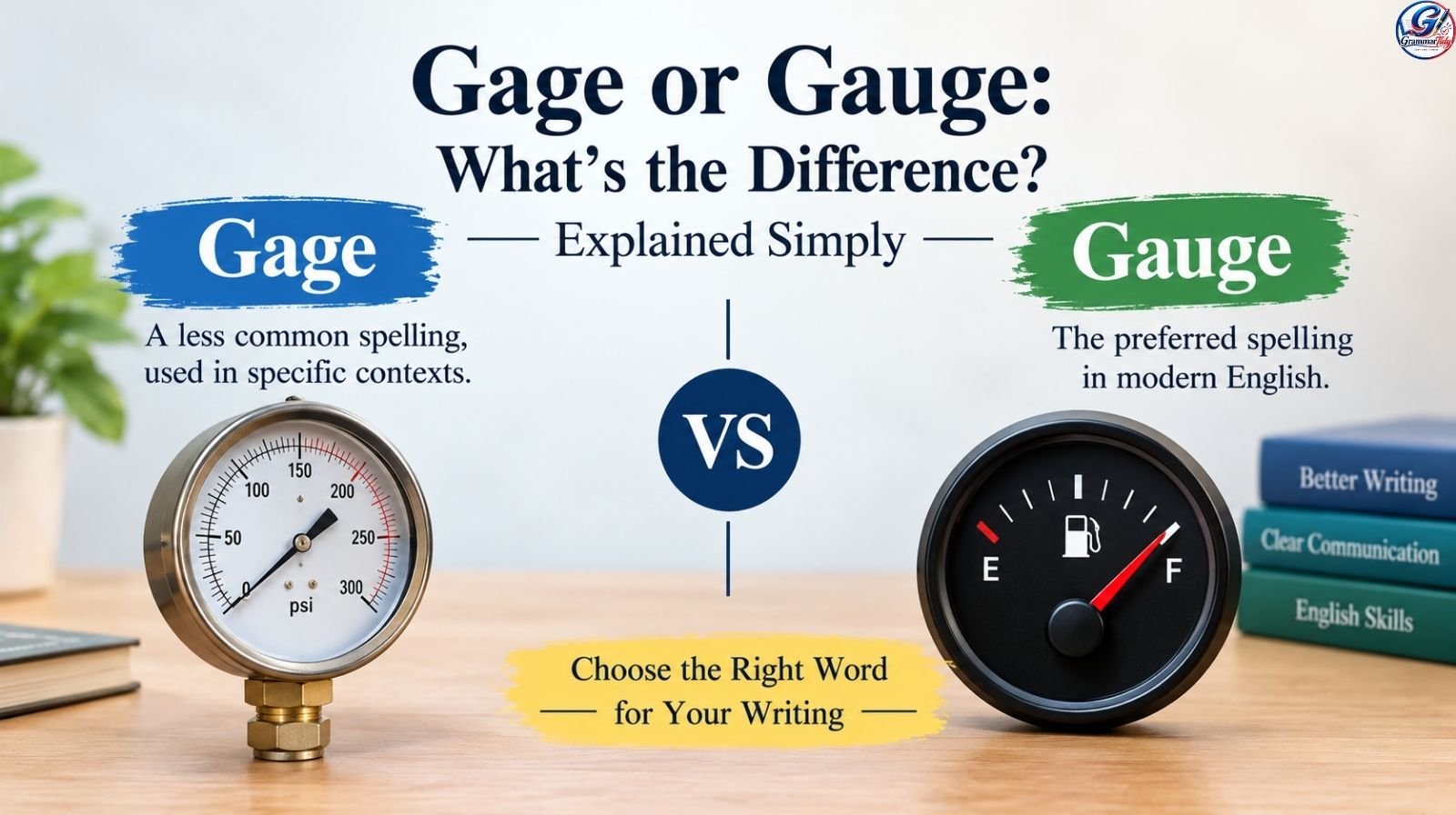
Gauge is the preferred spelling in modern English when you mean to measure, estimate, judge, or refer to a measuring instrument.
Gage is also a recognized spelling in certain contexts, including specialized technical terminology, and it has a separate historical meaning related to a pledge or challenge.
In this guide, you will learn the meaning of each word, when to use it, how the spellings differ, and which one is best for your writing.
Also Read: With or Without You Lyrics: Meaning, Song Details And More
What Is the Difference Between Gage and Gauge?
The main difference between gage and gauge is their frequency of use and context. Although both can refer to measurement, gauge is the standard choice for most modern writing, while gage is a less common variant.
What Does Gauge Mean?
The word gauge can function as both a noun and a verb.
As a noun, it refers to a measuring instrument, a measurement standard, or a way to judge something. As a verb, it means to measure, estimate, or evaluate.
Examples:
- The driver checked the fuel gauge before leaving.
- We need to gauge customer interest before launching the product.
- The mechanic used a pressure gauge to check the tire.
- Her response helped me gauge how she felt about the idea.
In each sentence, gauge relates to measuring something physically or assessing something more abstractly.
What Does Gage Mean?
Gage is a recognized alternative spelling of gauge in some measurement-related contexts. However, it is much less common in general English.
It also has an older, separate meaning: a pledge or an object offered as a sign of a challenge.
Examples:
- The technician consulted the equipment’s established gage terminology.
- In a historical story, a knight threw down his gage as a challenge.
- The mechanic checked the pressure gauge before operating the machine.
The last example illustrates the preferred general spelling. In technical settings, you may encounter gage in established terminology, so it is worth checking the relevant industry’s conventions.
Also Read: When Does Trick-or-Treating Start? Halloween Hours Guide
When Should You Use Gage or Gauge?
The right choice depends on what you mean and where you are writing. For ordinary emails, school assignments, blog posts, and business documents, gauge is generally the safest option.
Use Gauge for Measurement
Choose gauge when referring to a measuring device, a standard of measurement, or the act of evaluating something.
Examples:
- The fuel gauge showed that the tank was nearly empty.
- We measured the wire’s thickness using the specified gauge.
- The survey helped us gauge customer satisfaction.
- It is difficult to gauge the project’s overall progress.
These examples cover both physical measurements and judgments based on information.
Use Gauge to Estimate or Judge
You can also use gauge when you want to assess a situation, understand someone’s reaction, or estimate the likely outcome of an event.
Examples:
- I wanted to gauge his reaction before sharing the news.
- The company surveyed customers to gauge demand.
- It is too early to gauge the team’s performance.
- Her expression helped me gauge whether she agreed.
In these sentences, the word does not describe a physical instrument. Instead, it means to evaluate or estimate.
When Is Gage Appropriate?
Use gage when it appears in an established technical term, product name, document, or industry convention that specifically uses that spelling. It may also be appropriate when discussing the historical meaning of a pledge or challenge.
For example:
- The engineering document uses the term gage throughout.
- The historian explained the meaning of a knight’s gage.
- The manufacturer specifies a particular gage standard.
Do not automatically replace every occurrence of gage with gauge. A technical document may follow a deliberate naming or terminology convention, and proper names must retain their correct spelling.
Also Read: Who Won The Vietnam War: U.S. Or Vietnam?
Gage vs. Gauge: Comparison Table
The following table summarizes the difference and helps you choose the right spelling.
| Feature | Gauge | Gage |
|---|---|---|
| General usage | Preferred and widely used | Less common |
| Measurement meaning | Standard spelling | Recognized variant |
| Measuring instruments | Commonly used | Appears in some technical terminology |
| Estimating or judging | Standard choice | Less common variant |
| Historical meaning | Not the usual word for a pledge | Can mean a pledge or challenge |
| Best choice for everyday writing | Yes | Usually avoid as a variant |
Quick Rule to Remember
If you are writing a sentence and are unsure which spelling to choose, use this simple rule:
- Measuring or estimating something? Choose gauge.
- Writing about a historical pledge or challenge? Gage may be the appropriate word.
- Following a technical manual or industry standard? Check the terminology used in that context.
- Writing an ordinary email, essay, or blog post? Prefer gauge.
For example, write, “We need to gauge interest in the new service,” rather than “We need to gage interest in the new service” in ordinary prose.
Real-Life Example: Choosing Gage or Gauge at Work
Imagine that a manufacturing company is preparing a new machine for production. The quality-control team must check several components, review the equipment specifications, and report whether the machine is ready for use.
During the inspection, one technician writes, “The pressure gage indicates a reading outside the expected range.” Another technician writes, “The pressure gauge indicates a reading outside the expected range.”
Both spellings may appear in technical environments, but the team needs to determine which term its documentation standard uses.
Also Read: Goodmorning or Good Morning: The Correct Usage (And Why It Actually Matters)
If the company follows a manual that consistently uses gage, the technician should preserve that terminology where appropriate.
If the team is preparing a general report for customers, suppliers, and nontechnical readers, gauge is usually the clearer choice.
The same distinction applies when the team evaluates customer feedback. A report might say, “We surveyed 100 customers to gauge their interest in the updated machine.” Here, gauge means to estimate or assess interest rather than measure pressure with a physical instrument.
This example shows why context matters. A technical spelling convention may differ from ordinary writing preferences, but that does not mean every use of gage is preferable. Writers should distinguish between established technical terminology and everyday English.
The practical lesson is simple: use gauge as your default, preserve verified technical terms when necessary, and make sure the spelling communicates the intended meaning.
Gage or Gauge in 2025–2026: Usage Facts and Statistics
When comparing spellings, it is important to distinguish documented language usage from numerical claims. There is no verified, comprehensive 2025–2026 statistic presented in this article that establishes an exact percentage of English writers who use gage rather than gauge.
However, several useful observations explain the difference between these spellings.
Gauge Is the Preferred Modern Spelling
In contemporary general English, gauge is much more common than gage when referring to measurements, measuring instruments, or estimates.
Historically, both spellings have been used. Over time, gauge became the preferred spelling in general writing, while gage remained in some specialized and historical contexts.
Measurement Remains an Important Application
Gauges are used in many practical settings, including automotive systems, manufacturing, engineering, and scientific measurement.
For example:
- A fuel gauge helps drivers monitor the fuel level.
- A pressure gauge measures pressure in a system.
- A temperature gauge indicates temperature.
- A wire gauge identifies a wire’s thickness according to a particular sizing system.
These examples demonstrate how the word is used in everyday life and technical communication.
Also Read: Natzi or Nazi: The Correct Spelling, Meaning, And Why It Matters
What Should Writers Take Away in 2026?
For modern writing, the practical recommendation remains straightforward:
- Use gauge in everyday writing and general informational content.
- Follow the terminology in verified technical documentation when it deliberately uses gage.
- Avoid claiming that one spelling accounts for a specific percentage of modern usage without reliable data supporting that figure.
This approach prioritizes accuracy over unsupported statistics.
Common Mistakes to Avoid When Using Gage or Gauge
Even though the difference is relatively simple, writers sometimes make avoidable mistakes when choosing between these words.
Mistake 1: Assuming Gage Is Always Incorrect
It is too broad to say that gage is always wrong. Dictionaries recognize it as a variant of gauge in certain meanings, and it also has a separate historical meaning.
Incorrect advice: “Never use gage under any circumstances.”
Better advice: “Use gauge in general writing, but check the context before changing gage in technical or historical material.”
Mistake 2: Using Gage in Ordinary Expressions
Although the variant exists, it may look unusual to readers in everyday prose.
Less preferred: “We need to gage public opinion.”
Preferred: “We need to gauge public opinion.”
The second sentence uses the spelling most readers expect.
Also Read: Win or Lose Episodes: Complete Episode Guide (2026)
Mistake 3: Confusing Gauge With a Specific Measurement
A gauge may be an instrument or a standard, but the word does not automatically tell readers what is being measured.
For example:
- The pressure gauge showed a high reading.
- The fuel gauge indicated that the tank was almost empty.
- The survey was used to gauge customer satisfaction.
In the first two examples, the word refers to a measuring instrument. In the third, it means to assess something.
Mistake 4: Changing Technical Terms Without Checking
If you are editing an engineering report, product specification, or equipment manual, do not use automatic find-and-replace to change every instance of gage to gauge.
Check whether the spelling is part of an established term, product name, or documented standard.
This small precaution can prevent errors in technical writing.
Also Read: GitLab or GitHub: Which One Should You Choose?
Frequently Asked Questions
1. Is Gage or Gauge the Correct Spelling?
Gauge is the preferred spelling in modern general English when referring to measurement, a measuring device, or an estimate. Gage is a recognized variant and is also used in certain technical and historical contexts.
2. Are Gage and Gauge Pronounced the Same?
Yes. In their common modern uses, both are pronounced the same way, approximately “gayj,” rhyming with page. Their similar pronunciation is one reason writers sometimes confuse them.
3. Is Gage an Acceptable Spelling in American English?
Yes, in certain contexts. Gage is recognized as a variant of gauge, including in American English. However, gauge remains the safer choice for most everyday American writing.
4. Should I Write Pressure Gage or Pressure Gauge?
For general writing, pressure gauge is the preferred form. Some technical documents use pressure gage, so follow the applicable terminology when working with established specifications or industry documentation.
5. What Does Gauge Mean as a Verb?
As a verb, gauge means to measure, estimate, or judge something.
Examples:
- We need to gauge the temperature.
- She tried to gauge his reaction.
- The business surveyed customers to gauge demand.
6. What Does Gage Mean in Historical Writing?
In historical contexts, gage can refer to a pledge or an object symbolizing a challenge. For example, a knight throwing down a glove as a challenge could be described as offering a gage.
This meaning differs from the modern measurement-related use of gauge.
Conclusion:
When deciding between gage and gauge, remember that gauge is the preferred spelling for most modern English writing. It works when describing measuring instruments, standards of measurement, and the act of estimating or judging something.
Gage is not simply a meaningless misspelling. It is a recognized variant in some contexts and has a separate historical meaning related to a pledge or challenge. It may also appear in established technical terminology.
For everyday emails, articles, essays, and business communication, choose gauge unless there is a specific reason to use another form.
Now that you understand the difference, you can choose the right spelling with greater confidence. If this guide helped you, share it with someone who wants to improve their spelling and everyday English writing.
Discover More Article
- Unenroll vs Disenroll: Which One Is Correct?
- Cancellation vs Cancelation: Which Spelling Is Correct?
- Aide vs Aid: The Person Who Helps And The Help Itself
- Began vs Begun: Which Form Goes Where?
Keep learning with more easy grammar lessons on GrammarTidy.com

Hi, I’m Noor Fatima, the author and creator of Grammar Tidy. I’m passionate about grammar, writing, and making language learning simple and enjoyable. Through Grammar Tidy, I share helpful tips, clear explanations, and practical guidance to help readers improve their writing, avoid common mistakes, and communicate with confidence. My goal is to make better grammar easy, useful, and accessible for everyone.