Have you ever typed “writting” and wondered whether it looks right? You are not alone. Writing and writting can be confusing because many English words double their final consonant before adding -ing. However, in this case, only one spelling is standard.
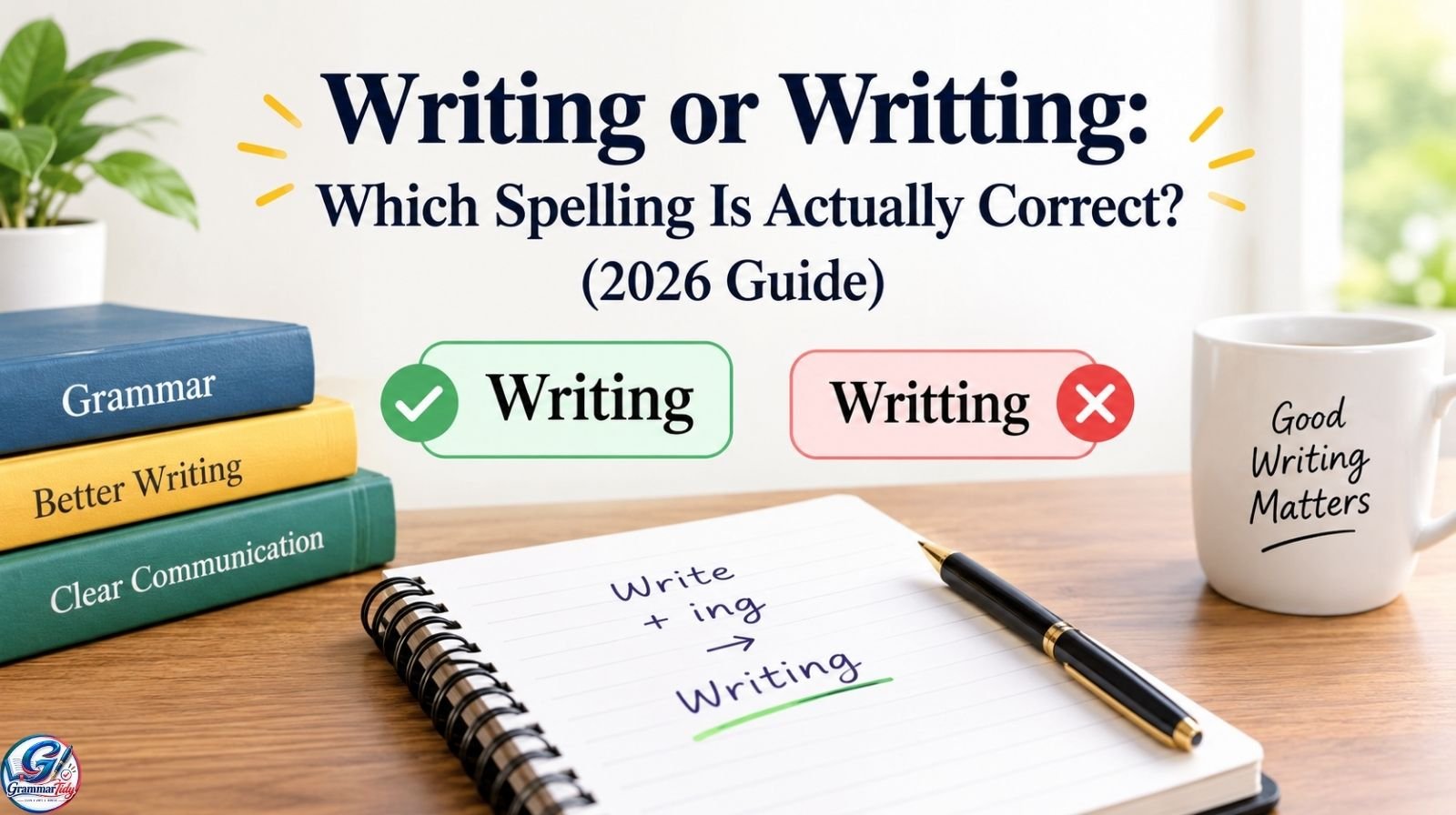
The correct spelling is writing. Writting is a common spelling mistake.
In this guide, you will learn why writing is correct, why writting is wrong, how the spelling rule works, and how to remember the difference easily.
Writing or Writting: Which Spelling Is Correct?
The correct spelling is writing, with only one t.
Writing is the -ing form of the verb “write.” Cambridge Dictionary defines writing as the activity or skill of producing written words and also as something that has been written or printed.
Also Read: Grately vs Greatly: Differences And Correct Usage
Writing Is the Correct Form
The word changes from:
write → writing
Notice what happens:
- write
- remove the final e
- add -ing
- writing
So:
write + ing = writing
Examples:
- I am writing an email.
- She enjoys writing stories.
- He is writing a report.
- They were writing notes during the lecture.
Writting Is Incorrect
Writting is not the standard spelling of the -ing form of write.
❌ I am writting a letter.
✅ I am writing a letter.
❌ She enjoys writting articles.
✅ She enjoys writing articles.
Therefore, whenever you mean the activity or process of putting words into written form, use writing.
Why Is “Writting” Incorrect?
The confusion usually comes from English spelling rules involving doubled consonants.
English does sometimes double the final consonant before -ing, but the rule does not apply to every verb.
The Rule Behind Writing
When a verb ends in a final -e, the usual spelling rule is to remove the e before adding -ing.
For example:
| Base Verb | Correct -ing Form |
|---|---|
| write | writing |
| make | making |
| take | taking |
| give | giving |
| come | coming |
| love | loving |
Cambridge’s grammar guidance specifically gives write → writing as an example of dropping final -e before adding -ing.
Why We Do Not Add Another “T”
The word write ends with the letter e, not with a short-vowel-plus-single-consonant pattern that would normally trigger consonant doubling.
So this is correct:
write → writing
Not:
write → writting
The spelling writting incorrectly adds an extra t.
Writing vs. Other Words That Double the Consonant
Compare writing with verbs where doubling really does occur:
- run → running
- sit → sitting
- stop → stopping
- plan → planning
- commit → committing
Cambridge explains that consonant doubling can occur when a verb ends in a vowel followed by a single consonant and the relevant syllable is stressed.
That is why running has two n’s, but writing has only one t.
Writing Meaning, Definition, and Examples
Understanding the meaning of writing makes it easier to recognize when the word is being used correctly.
What Does Writing Mean?
Writing can refer to the activity of creating words, sentences, stories, articles, books, or other written material. It can also refer to handwriting or something that has been written.
For example:
Her writing is very clear.
Here, writing refers to her handwriting or written style.
Another example:
I enjoy writing about language.
Here, writing refers to the activity of producing written content.
Cambridge lists several meanings of writing, including handwriting, written material, literary work, and the activity of creating written work.
Common Sentences With Writing
Here are some natural examples:
- I am writing a new article today.
- She spends an hour writing every morning.
- His writing style is easy to understand.
- They are writing a report for the manager.
- Writing clearly is important in professional communication.
- The teacher asked students to practice writing.
Writing in Different Contexts
The word appears naturally in many situations:
Academic writing
Good academic writing should be clear and organized.
Business writing
Professional writing should communicate ideas accurately.
Creative writing
She joined a creative writing course.
Everyday writing
I am writing a quick message to my friend.
Also Read: Nominator vs Nominee: Differences, Definitions, And Correct Usage
Writing or Writting: Quick Comparison
A simple comparison can help you remember the difference.
| Feature | Writing | Writting |
|---|---|---|
| Correct spelling | ✅ Yes | ❌ No |
| Base word | write | write |
| Correct -ing form | writing | |
| Meaning | The act/style/product of writing | Incorrect spelling |
| Used in standard English | ✅ Yes | ❌ No |
| Example | She is writing a book. | She is writting a book. ❌ |
The Easy Rule
Remember this:
write → remove e → writing
Do not double the t.
A Useful Spelling Pattern
Compare:
- write → writing
- make → making
- take → taking
- drive → driving
- hope → hoping
These words lose their final e before -ing.
On the other hand:
- sit → sitting
- run → running
- stop → stopping
- plan → planning
These can double their final consonant under the relevant spelling rules.
A Real-Life Case Study: The “Writting” Mistake in Professional Communication
Imagine an employee preparing an important email for a client. The employee wants to say:
“I am writing to confirm your appointment.”
While quickly typing the message, they write:
“I am writting to confirm your appointment.”
The meaning is still understandable, but the spelling mistake can make the message look less polished. This can matter particularly in formal emails, reports, applications, academic assignments, and website content where accuracy is important.
The employee checks a dictionary and discovers that the standard form is writing. Cambridge lists writing as the correct form and its grammar guidance explains that verbs ending in -e, such as write, normally drop the final e before -ing.
The employee corrects the sentence:
“I am writing to confirm your appointment.”
This small correction demonstrates an important lesson: not every verb that looks as though it should double a consonant actually does so. Learning the underlying spelling pattern is more useful than simply memorizing individual words.
Also Read: Triple vs Tripple: Which Is The Correct One To Use?
Writing Spelling Rule: What the 2025–2026 Evidence Shows
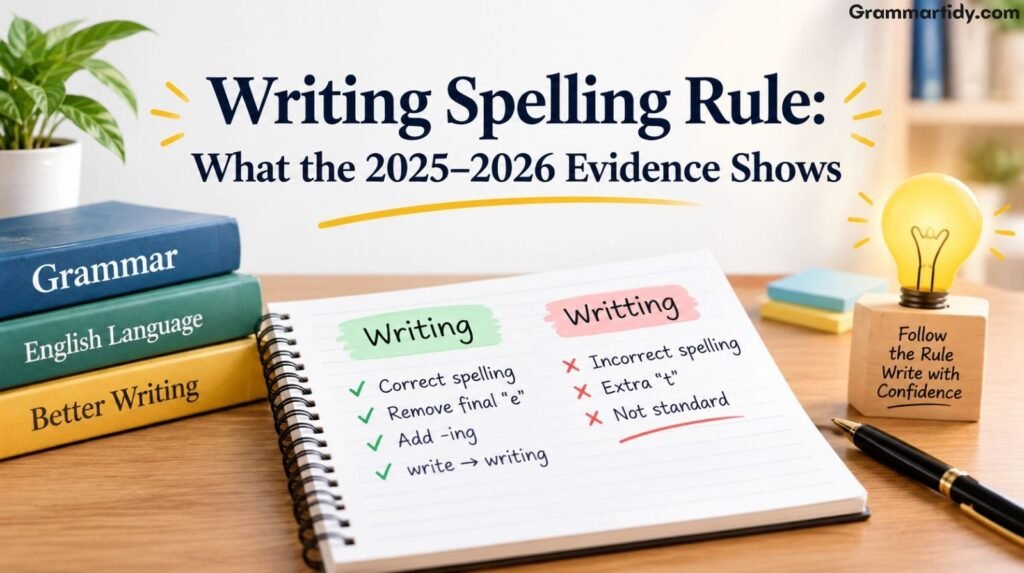
There is an important distinction between language-rule evidence and search-volume data.
As of 2026, major learner-dictionary and grammar references continue to document writing as the standard form and explain the spelling pattern behind it.
Cambridge’s current grammar material states that English spelling follows basic rules but also contains exceptions; it also notes that around 75% of English words follow basic spelling rules.
For the specific typo “writting,” there is no widely accepted public 2025–2026 dataset from a major dictionary or language authority that establishes a precise global percentage of people who make this particular mistake. Therefore, it would be misleading to invent a specific typo-frequency statistic.
What can be verified is:
- writing is the dictionary-standard form.
- write → writing follows the standard final-e + -ing spelling pattern.
- English spelling rules include consonant-doubling patterns, which can explain why learners may incorrectly produce forms such as writting.
- Cambridge identifies double letters as a common source of English spelling errors.
So, for 2025–2026 writing and editing, the reliable takeaway remains straightforward: use “writing,” not “writting.”
How to Remember the Correct Spelling of Writing
If you repeatedly confuse writing and writting, use a simple memory trick.
Remember: “Write Loses E”
Start with:
WRITE
Now remove the final E:
WRIT
Then add:
ING
Result:
WRITING
This gives you:
WRITE → WRIT → WRITING
Not:
WRITE → WRITT → WRITTING ❌
Connect Writing With Written
Another helpful connection is:
- write
- wrote
- written
- writing
These are different forms of the same verb.
Examples:
I write every day.
I wrote an article yesterday.
I have written three articles.
I am writing another article now.
Cambridge identifies written as the past participle of write and lists the forms writing, wrote, and written in its dictionary material.
Use the “One T” Check
Before publishing, ask yourself:
Does “writing” have one T or two?
The answer is:
One T: WRITING.
That tiny visual check can prevent the mistake.
Also Read: Blankie vs Blanky: Difference And Correct Usage Explained
Common Mistakes With Writing
The writting error is not the only mistake people can make with this word.
Mistake 1: Writting
❌ She is writting an essay.
✅ She is writing an essay.
Mistake 2: Writeing
Some learners remove the wrong letter pattern and produce:
❌ writeing
✅ writing
The final e is removed before -ing.
Mistake 3: Confusing Writing With Written
Writing and written are different forms.
She is writing a report.
She has written a report.
The first describes an ongoing activity; the second uses the past participle.
Mistake 4: Confusing Writing With Writer
A writer is a person who writes.
She is writing a novel.
She is a writer.
The words are related, but they have different grammatical functions.
Writing in British and American English
One useful point is that writing is standard in both British and American English.
Unlike spelling differences such as:
- colour / color
- centre / center
- organise / organize
there is no standard British-versus-American variation where writting becomes acceptable.
British English
I am writing an email.
American English
I am writing an email.
The spelling remains writing in both varieties.
Cambridge notes that British and American English can differ in some spelling conventions, while its entry for writing gives the standard form used in English.
Also Read: Prooving vs Proving Difference: Which Spelling Is Correct?
Mini Quiz: Writing or Writting?
1. Quick Spelling Check: Which One Is Correct?
A) Writting
B) Writing
C) Writin
D) Writeing
Answer: B) Writing ✅
2. Fill the Gap: What Belongs Here?
“I am ___ an email to my manager.”
A) writting
B) writing
C) writeing
D) writen
Answer: B) writing ✅
3. One T or Two?
How many t’s are in the correct spelling of writing?
A) One
B) Two
C) Three
D) None
Answer: A) One ✅
4. Spot the Mistake!
Which sentence contains the spelling mistake?
A) She is writing a story.
B) He is writing a report.
C) They are writting notes.
D) I enjoy writing.
Answer: C) They are writting notes. ❌
The correct sentence is: They are writing notes. ✅
5. The Easy Formula
Which formula gives the correct spelling?
A) write + ing = writting
B) write − e + ing = writing
C) write + t + ing = writing
D) writ + e + ing = writing
Answer: B) write − e + ing = writing ✅
6. Meaning Match
What does writing generally refer to?
A) The activity of producing written words
B) Only speaking aloud
C) Only reading books
D) Only typing numbers
Answer: A) The activity of producing written words ✅
7. Grammar Time!
Which sentence uses writing correctly?
A) She is writing a novel.
B) She is writting a novel.
C) She is writeing a novel.
D) She writing a novel.
Answer: A) She is writing a novel. ✅
8. Can You Catch This Typo?
Which word should replace writting?
“He is writting a business report.”
A) written
B) writer
C) writing
D) wrote
Answer: C) writing ✅
9. What Happens to the Final “E”?
When changing write into writing, what happens to the final e?
A) It stays
B) It becomes a t
C) It is removed
D) It becomes an n
Answer: C) It is removed ✅
10. Choose the Correct Pair
Which pair is spelled correctly?
A) write → writting
B) write → writeing
C) write → writing
D) write → writen
Answer: C) write → writing ✅
11. Writing or Written?
Which word fits best?
“She is ___ a letter right now.”
A) written
B) writing
C) wrote
D) writer
Answer: B) writing ✅
12. British or American?
Is writing spelled the same way in standard British and American English?
A) Yes
B) No
Answer: A) Yes ✅
13. Which Sentence Looks Professional?
A) I am writting to confirm your appointment.
B) I am writeing to confirm your appointment.
C) I am writing to confirm your appointment.
D) I am writen to confirm your appointment.
Answer: C) I am writing to confirm your appointment. ✅
14. Remember the Rule!
Which memory trick helps you spell writing correctly?
A) Double the T
B) Keep the final E
C) Remove the E, then add ING
D) Add T before ING
Answer: C) Remove the E, then add ING ✅
15. Final Challenge: Writing or Writting?
Complete the sentence:
“Good ___ makes communication clearer.”
A) writting
B) writing
C) writeing
D) writen
Answer: B) writing 🎯
Also Read: Tapping vs Taping: Difference And Correct Usage Explained
FAQs
1. Is “writting” a correct spelling?
No. Writting is a misspelling. The correct form is writing.
2. Is it writing or writting?
The correct spelling is writing, with one t.
3. Why is writing not spelled writting?
Because write ends in silent e. Before adding -ing, the e is removed: write → writing. The consonant is not doubled.
4. What is the past tense of write?
The past tense is wrote.
She wrote a letter yesterday.
The past participle is written:
She has written a letter.
5. What is the -ing form of write?
The -ing form is writing.
He is writing a book.
6. Is “writing” the same in British and American English?
Yes. Writing is the standard spelling in both British and American English.
7. How can I remember writing vs. writting?
Use the simple formula:
WRITE − E + ING = WRITING
Remember: one T, not two.
Final Verdict:
The correct spelling is writing.
Writting is a misspelling and should be avoided in academic, professional, formal, and everyday standard English.
The easiest rule to remember is:
write → remove the final e → writing
So whenever you are unsure, choose:
✅ Writing
❌ Writting
Whether you are writing an email, writing an essay, writing a report, or writing an article, the correct spelling always has one “t.”
If you often mix up English spellings like this, bookmark this guide and check the spelling before submitting important writing. A few seconds of proofreading can make your communication clearer, cleaner, and more professional.
Discover More Article
- Repore or Rapport: Which Spelling Is Correct? Meaning, Examples & Grammar Guide (2026)
- Unaffected vs Uneffected: Which Word To Use Correctly?
- Acception vs Exception: Which One Is Actually Correct? (2026)
- Important or Inportant: The Correct Spelling Explained (2026 Guide)
Keep learning with more easy grammar lessons on GrammarTidy.com

Hi, I’m Noor Fatima, the author and creator of Grammar Tidy. I’m passionate about grammar, writing, and making language learning simple and enjoyable. Through Grammar Tidy, I share helpful tips, clear explanations, and practical guidance to help readers improve their writing, avoid common mistakes, and communicate with confidence. My goal is to make better grammar easy, useful, and accessible for everyone.