Have you ever written “grately” when you meant “greatly” and wondered whether both spellings are correct?
You are not alone. English spelling mistakes often happen when a familiar word is typed quickly, especially in emails, assignments, social media posts, and professional documents. However, when comparing Grately vs Greatly, the answer is straightforward: greatly is the correct standard English word, while grately is generally a misspelling.
In this guide, you will learn the meaning of greatly, why people mistakenly write grately, how to use greatly correctly in sentences, and simple ways to remember the correct spelling.
What Is the Difference Between Grately and Greatly?
The main difference between Grately vs Greatly is simple:
- Greatly is a correct English adverb.
- Grately is not the standard spelling of the word in modern English.
Greatly means very much, to a large extent, or significantly. Cambridge Dictionary defines greatly as meaning “very much,” particularly when describing the amount or degree of something.
Quick Answer
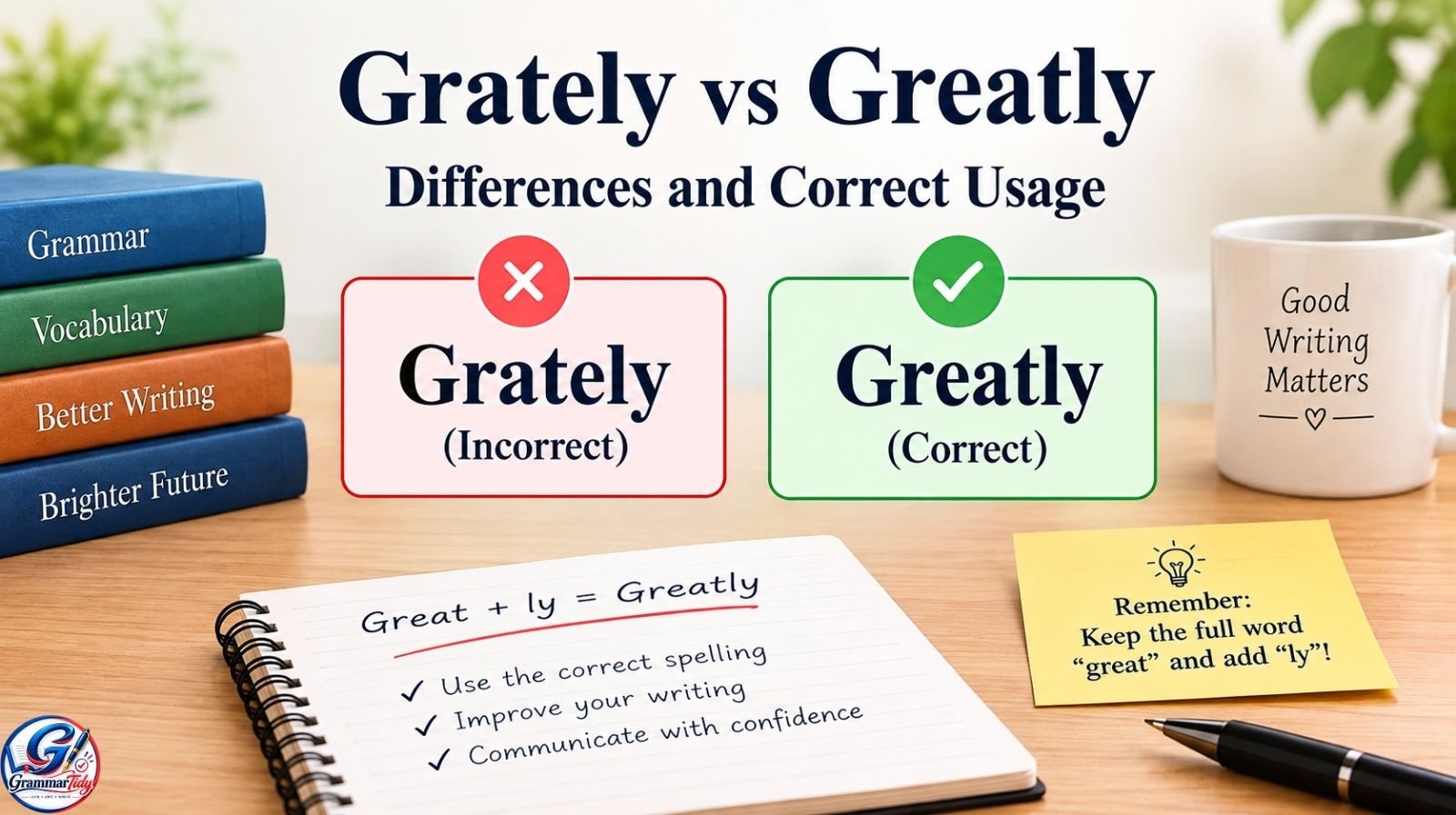
Correct spelling: Greatly ✅
Incorrect standard spelling: Grately ❌
For example:
- The new technology has greatly improved productivity.
- I greatly appreciate your support.
- Her confidence has greatly increased.
Grately vs Greatly Comparison Table
| Feature | Grately | Greatly |
|---|---|---|
| Standard English word? | ❌ No | ✅ Yes |
| Correct spelling? | ❌ No | ✅ Yes |
| Meaning | No standard meaning | Very much; significantly |
| Common usage | Typing or spelling mistake | Formal and everyday writing |
| Example | ❌ I grately appreciate it. | ✅ I greatly appreciate it. |
The easiest rule is this: If you mean “very much” or “to a significant degree,” use greatly.
Also Read: Encorporate vs Incorporate: Correct Usage Explained
What Does Greatly Mean?
The word greatly is an adverb. It usually describes the degree to which something happens, changes, improves, affects someone, or is appreciated.
According to Merriam-Webster, greatly can mean “to a great extent or degree” or “very much.”
Greatly Meaning: “Very Much”
One of the most common uses of greatly is to show a strong feeling or significant amount.
Examples:
- I greatly admire her work.
- We greatly appreciate your patience.
- He will be greatly missed.
In these sentences, greatly strengthens the meaning of the verb.
Greatly Meaning: “Significantly”
Greatly can also describe an important change or effect.
Examples:
- Exercise can greatly improve your energy levels.
- The weather greatly affected the event.
- Technology has greatly changed modern communication.
Greatly Meaning: “To a Large Degree”
Sometimes greatly shows that something differs or changes considerably.
For example:
- Their opinions differ greatly.
- Prices can vary greatly between locations.
- The two experiences were greatly different.
Therefore, greatly is especially useful when describing strong impact, significant improvement, major change, or a large degree of difference.
Grately vs Greatly: Which Spelling Is Correct?
When discussing Grately vs Greatly, only greatly is the correct spelling in standard English.
Why Is “Greatly” Correct?
The word is formed from:
Great + -ly = Greatly
The suffix -ly commonly changes an adjective into an adverb.
For example:
- Quick → Quickly
- Slow → Slowly
- Careful → Carefully
- Great → Greatly
Therefore:
Great + ly = Greatly
The spelling grately incorrectly removes part of the word great.
Also Raed: Moment vs Momment: Difference, Meaning And Correct Usage
Common Incorrect Example
❌ I am grately thankful for your help.
Correct Version
✅ I am greatly thankful for your help.
Is Grately Ever Correct?
In normal modern English writing, grately should not be used as a replacement for greatly.
If you see grately in an email, article, school assignment, or online post, it is usually a spelling error or typing mistake.
Why Do People Confuse Grately and Greatly?
The confusion between grately vs greatly usually happens because English spelling and pronunciation do not always follow perfectly simple patterns.
The Words Sound Similar When Spoken Quickly
When people pronounce greatly, the middle sound may be less noticeable in fast speech.
As a result, someone may incorrectly type:
grately
instead of:
greatly
However, the correct spelling still keeps the full word great.
Typing Quickly Causes Spelling Errors
Many spelling mistakes happen because people type faster than they proofread.
For example:
- Email messages
- Social media comments
- Text messages
- Blog posts
- School assignments
A writer may know the correct word but accidentally leave out a letter.
Autocorrect Is Not Always Reliable
Modern writing tools can help identify mistakes, but they are not perfect. Context still matters.
A spelling checker may not catch every unusual word, especially if a typo resembles another possible name or term. Therefore, proofreading remains important.
The Simple Memory Rule
Remember:
If the word comes from “great,” keep “great” inside “greatly.”
Great → Greatly
That one rule can prevent the mistake.
How to Use Greatly Correctly in a Sentence
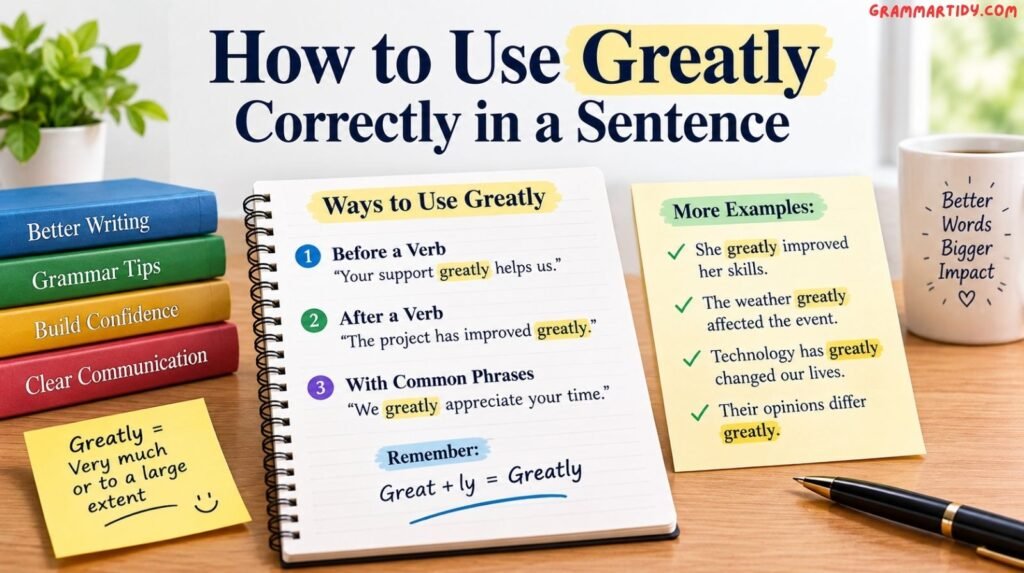
Knowing the correct spelling is important, but understanding how to use greatly will make your writing more natural.
Greatly Before a Verb
Greatly often appears before a verb.
Examples:
- Your feedback greatly helps us.
- The decision greatly affected the company.
- The update greatly improved performance.
Greatly After a Verb
In some sentences, greatly can appear after the verb or verb phrase.
Examples:
- Her writing has improved greatly.
- The situation changed greatly.
- Their views differ greatly.
Both sentence structures can be correct depending on the verb and context.
Also Read: Bachelor vs Batchelor: Difference And Correct Usage
Common Word Combinations With Greatly
Here are some natural phrases:
- greatly appreciate
- greatly improve
- greatly affect
- greatly increase
- greatly reduce
- greatly admire
- greatly benefit
- greatly influence
- differ greatly
- vary greatly
Cambridge Dictionary examples show greatly being used naturally with words such as improved, declined, affected, and appreciated.
Grately vs Greatly: Real-Life Writing Case Study
Imagine that Sarah is applying for a remote marketing position. She carefully writes her cover letter and includes the sentence:
“I would be grately thankful for the opportunity to discuss my experience.”
The sentence communicates the right idea, but grately creates a spelling error in an important professional document.
Sarah later changes the sentence to:
“I would be greatly thankful for the opportunity to discuss my experience.”
An even more natural version would be:
“I would greatly appreciate the opportunity to discuss my experience.”
The difference may seem small, but professional writing depends on accuracy. A spelling mistake does not automatically mean someone lacks knowledge or ability. However, repeated mistakes can distract readers from the message.
This example also shows why context matters. Sarah did not need a completely different word. She simply needed the correct spelling and a more natural phrase.
Also Read: Emersion vs Immersion: Differences And Correct Usage
The lesson is clear: when you are writing an important email, application, report, or article, take a moment to check words that look slightly unfamiliar. A few seconds of proofreading can greatly improve clarity and professionalism.
Grately vs Greatly in Modern Writing: 2025–2026 Context
Accurate spelling remains important in digital communication because written content is now used everywhere from professional emails and websites to job applications and online publishing.
Dictionary resources continue to identify greatly as the standard English word meaning very much or to a significant extent. Merriam-Webster’s current dictionary entry also provides modern examples of greatly in contemporary writing.
Why This Matters in 2025–2026
Modern writers produce more written content than ever before across:
- Emails
- Websites
- Social platforms
- Online learning platforms
- Business communication
- Job applications
This makes basic spelling accuracy increasingly valuable.
A single typo may not change the meaning completely. However, repeated spelling errors can reduce readability and make polished content look less professional.
Also Read: Really vs Realy: Which Is Correct? And Proper Usage
A Practical Writing Checklist
Before publishing or sending important content, check:
- Is greatly spelled correctly?
- Did you accidentally write grately?
- Does greatly fit naturally in the sentence?
- Would another word such as significantly or very much sound better?
- Have you proofread the final sentence?
Small checks like these can greatly improve the quality of your writing.
Common Mistakes When Using Greatly
Even after learning the correct spelling, writers can still make usage mistakes.
Mistake 1: Writing “Grately”
❌ I grately appreciate your support.
✅ I greatly appreciate your support.
This is the most common error in the Grately vs Greatly comparison.
Mistake 2: Using Greatly When “Very” Sounds More Natural
Although greatly means very much, it cannot replace very in every sentence.
For example:
❌ This is greatly beautiful.
More natural:
✅ This is very beautiful.
Greatly works better with verbs describing change, effect, appreciation, influence, and degree.
For example:
- greatly improved
- greatly appreciated
- greatly affected
- greatly increased
Mistake 3: Overusing Greatly
Using the same intensifier repeatedly can make writing sound unnatural.
Instead of:
The update greatly improved the system and greatly increased speed and greatly reduced errors.
Try:
The update significantly improved the system, increased speed, and reduced errors.
Therefore, use greatly naturally rather than repeatedly.
How to Remember the Correct Spelling of Greatly
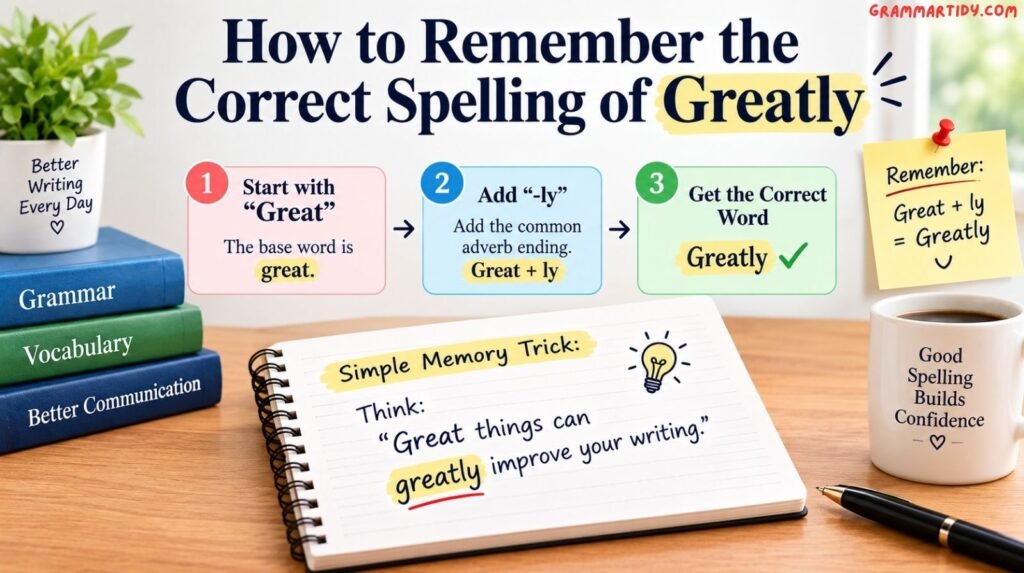
Here is the easiest way to remember the word.
Step 1: Start With “Great”
The base word is:
Great
Step 2: Add “-ly”
Now add the common adverb ending:
Great + ly
Step 3: Get the Correct Word
Greatly ✅
Not:
Grately ❌
A Simple Memory Trick
Think:
Great things can greatly improve your writing.
Because the word great is clearly visible inside greatly, remembering the spelling becomes much easier.
Grately vs Greatly: Quick Examples
Here are some examples to help you understand the difference immediately.
Correct Examples
✅ I greatly appreciate your help.
✅ The project has greatly improved.
✅ Her advice greatly influenced my decision.
✅ The two results differ greatly.
✅ We will greatly miss him.
Incorrect Examples
❌ I grately appreciate your help.
❌ The project has grately improved.
❌ Her advice grately influenced my decision.
In every standard writing situation above, greatly is the correct choice.
Unique and Catchy Mini Quizzes: Grately vs Greatly
Quiz 1: Pick the Correct Word
Which spelling is correct?
A) Grately
B) Greatly
Answer: B) Greatly ✅
Quiz 2: Quick Spelling Check
Complete the sentence:
I _____ appreciate your help.
A) Grately
B) Greatly
Answer: B) Greatly ✅
Quiz 3: What Does Greatly Mean?
What does greatly usually mean?
A) Very much
B) Very small
C) Never
Answer: A) Very much ✅
Quiz 4: Spot the Correct Sentence
Which sentence is correct?
A) She grately improved her skills.
B) She greatly improved her skills.
Answer: B) She greatly improved her skills. ✅
Quiz 5: True or False?
“Grately” is the standard spelling in English.
Answer: False ❌
The correct spelling is greatly. ✅
Quiz 6: Complete the Word
Great + ly = ?
A) Grately
B) Greatly
C) Greatlee
Answer: B) Greatly ✅
Quiz 7: Choose the Right Sentence
Which sentence looks professional?
A) We grately appreciate your support.
B) We greatly appreciate your support.
Answer: B) We greatly appreciate your support. ✅
Quiz 8: Fix the Mistake
Find the incorrect word:
“The new system grately improved productivity.”
Answer: Grately ❌
Correct word: Greatly ✅
Quiz 9: Fast Choice
Which word means “significantly” in this context?
A) Greatly
B) Grately
Answer: A) Greatly ✅
Quiz 10: Writing Challenge
Choose the correct sentence:
A) Prices vary grately.
B) Prices vary greatly.
Answer: B) Prices vary greatly. ✅
Quiz 11: Remember the Base Word
Which word helps you remember the spelling of greatly?
A) Great
B) Gate
C) Rate
Answer: A) Great ✅
Great + ly = Greatly
Quiz 12: Email Test
You are writing a professional email. Which sentence should you use?
A) I grately appreciate your time.
B) I greatly appreciate your time.
Answer: B) I greatly appreciate your time. ✅
Quiz 13: One-Word Challenge
Which one is a common spelling mistake?
A) Greatly
B) Grately
Answer: B) Grately ❌
Quiz 14: Complete the Sentence
Technology has _____ changed modern communication.
A) Grately
B) Greatly
Answer: B) Greatly ✅
Quiz 15: Final Grammar Challenge
What is the golden rule for remembering greatly?
A) Remove letters from “great”
B) Keep the full word “great” and add “ly”
C) Replace “ea” with “a”
Answer: B) Keep the full word “great” and add “ly” ✅
FAQs
Q. Is Grately a real word?
A: Grately is not the standard English spelling for the adverb meaning “very much” or “significantly.” In that context, you should use greatly.
Q. Is Greatly spelled with “ea”?
A: Yes. The correct spelling is:
G-R-E-A-T-L-Y
The word comes from great plus the suffix -ly.
Q. What does greatly mean?
A: Greatly means very much, to a large extent, or significantly.
Q. Can I say “I greatly appreciate it”?
A: Yes. “I greatly appreciate it” is grammatically correct and commonly used, especially in formal or professional writing.
Q. What is another word for greatly?
A: Depending on the sentence, alternatives include:
- significantly
- considerably
- very much
- substantially
- highly
Choose the alternative that sounds most natural in context.
Q. Why do people write Grately instead of Greatly?
A: People usually write grately because of typing mistakes, fast writing, or confusion about the spelling of the base word great.
Conclusion:
The difference between Grately vs Greatly is ultimately simple: greatly is the correct standard English spelling, while grately is generally a misspelling when you mean “very much” or “to a significant extent.”
Remember that greatly comes from the word great, followed by -ly:
Great + ly = Greatly
Whether you are writing an email, school assignment, business document, blog post, or social media update, using the correct spelling can greatly improve the clarity and professionalism of your writing.
The next time you are unsure, remember one simple rule: keep the full word “great” in “greatly.”
Discover More Article
- Quantify vs Qualify: Differences And Correct Usage
- Excited vs Exited: Learn The Difference And Usage
- Dysregulated vs Disregulated: Correct Usage Explained
Keep learning with more easy grammar lessons on GrammarTidy.com

Hi, I’m Noor Fatima, the author and creator of Grammar Tidy. I’m passionate about grammar, writing, and making language learning simple and enjoyable. Through Grammar Tidy, I share helpful tips, clear explanations, and practical guidance to help readers improve their writing, avoid common mistakes, and communicate with confidence. My goal is to make better grammar easy, useful, and accessible for everyone.