Have you ever wondered whether you should write blankie vs blanky? These two spellings look very similar, sound almost identical, and are often used when talking about a child’s favorite comfort blanket.
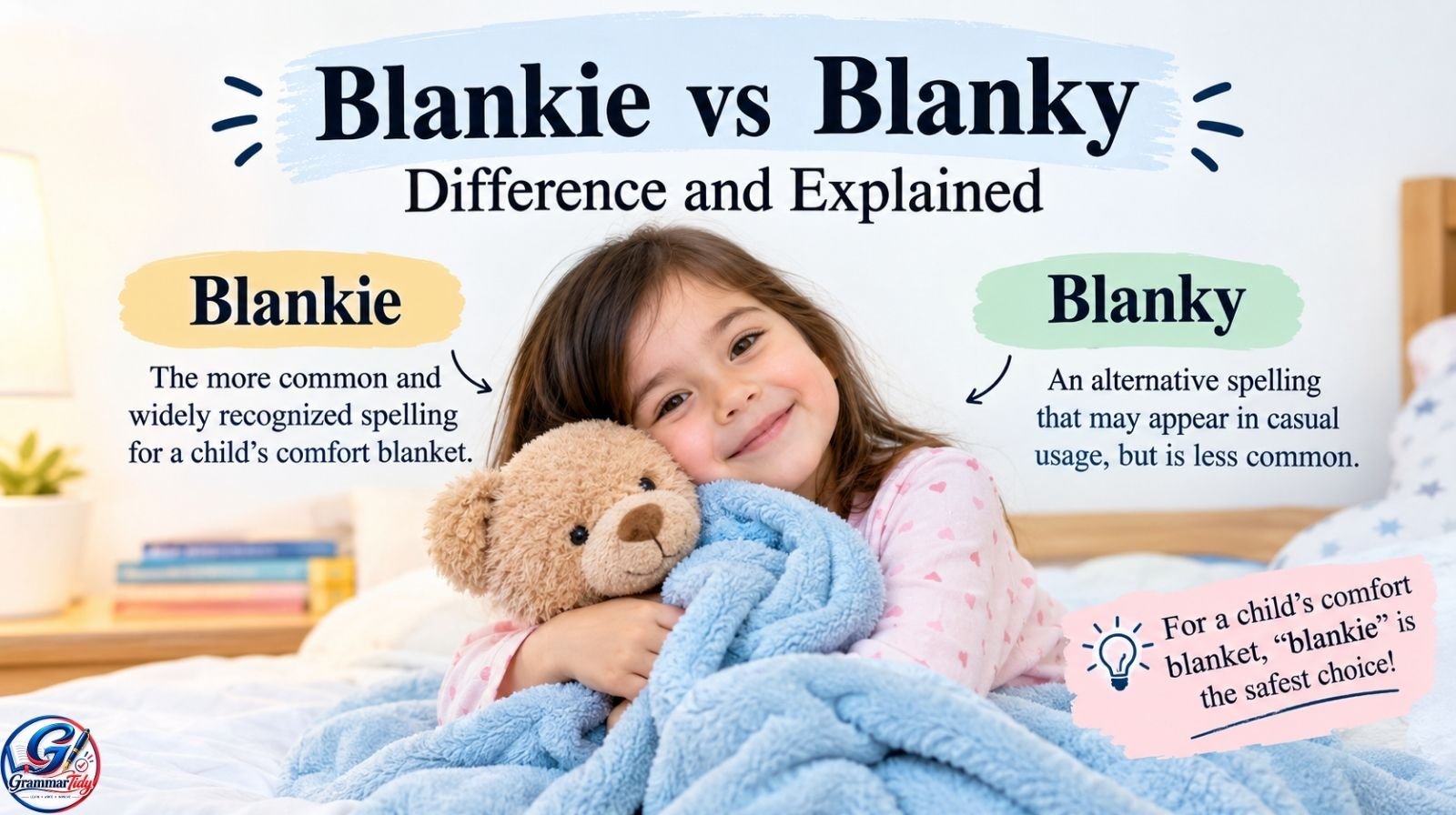
However, there is an important difference in how commonly and appropriately these spellings are used. Blankie is the more established and widely recognized informal term for a child’s blanket, while blanky may appear as an alternative spelling in casual contexts.
In this guide, you’ll learn what blankie vs blanky means, which spelling is safer to use, how the words differ, and how to use them naturally in real sentences.
What Is the Difference Between Blankie and Blanky?
The simplest answer is this:
Blankie is the more established informal spelling for a child’s comfort blanket, while blanky is a less standard or alternative spelling that may appear in casual usage.
The meaning people usually intend is the same: a soft blanket that provides warmth, comfort, or emotional security, especially for a young child.
| Feature | Blankie | Blanky |
|---|---|---|
| Main meaning | Child’s comfort blanket | Usually an alternative spelling |
| Usage | More established | Less common in this meaning |
| Tone | Informal and affectionate | Informal and casual |
| Best choice for general writing | Yes | Usually not the safest choice |
| Dictionary treatment | Clearly recognized as a noun | Can have different meanings depending on the dictionary |
Cambridge Dictionary defines blankie as an informal term, mainly used in American English, for a blanket especially one used by a young child for comfort and security.
Also Read: Bachelor vs Batchelor: Difference And Correct Usage
Quick Example
- Correct and familiar: “The toddler cannot sleep without her blankie.”
- Casual alternative: “Where did you put your blanky?”
Both may be understood in everyday conversation. However, blankie is generally the clearer choice for broad audiences.
The Featured Snippet Answer
Blankie and blanky usually refer to the same type of comfort blanket, but blankie is the more established and widely recognized spelling. For general writing, parenting content, and everyday American English, blankie is usually the safest choice.
What Does Blankie Mean?
A blankie is an informal and affectionate word for a blanket, especially a small blanket or security blanket used by a child.
The word creates a warmer and more personal feeling than simply saying blanket.
Blankie Meaning in Everyday English
Imagine these two sentences:
- “Please bring your blanket.”
- “Please bring your blankie.”
The first sentence sounds neutral.
The second sentence sounds more affectionate and personal. It often makes readers think of a child’s favorite comfort item.
Merriam-Webster defines blankie as “a child’s blanket” and records the word’s first known use as 1899.
Examples of Blankie in Sentences
- “Liam takes his blankie everywhere.”
- “The baby held her blankie while falling asleep.”
- “Don’t forget Mia’s blankie before leaving for the trip.”
- “His old blue blankie has been his favorite comfort blanket for years.”
Why Does the Word Sound So Affectionate?
The ending -ie often gives English words a smaller, friendlier, or more affectionate feeling.
For example:
- dog → doggie
- aunt → auntie
- sweet → sweetie
- blanket → blankie
Therefore, blankie naturally fits the warm and child-friendly context in which the word is usually used.
Blankie vs Blanky: Which Spelling Should You Use?
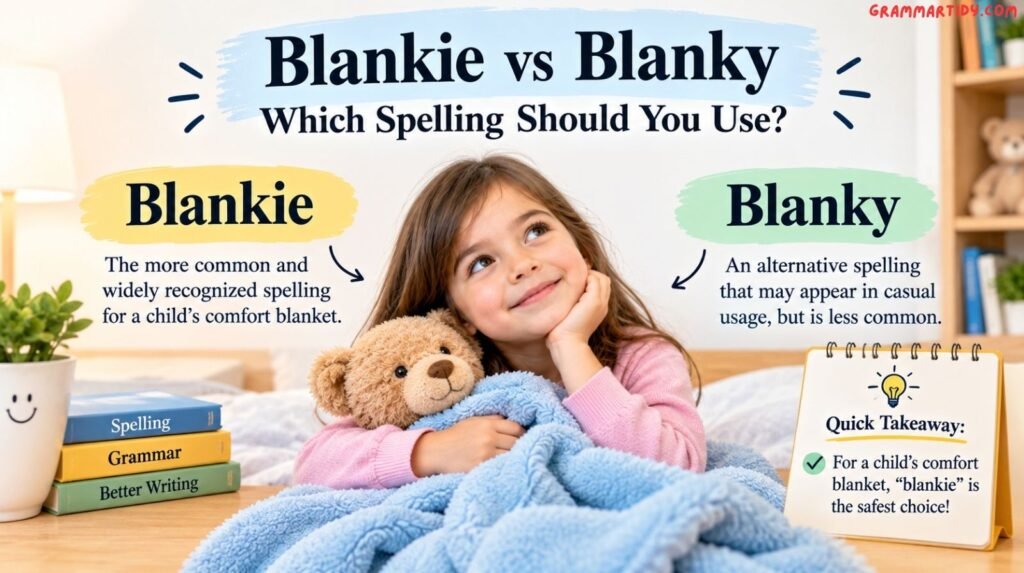
When choosing between blankie vs blanky, your audience and writing context matter.
For most general writing, blankie is the safer choice.
Use “Blankie” for Clear, Familiar Usage
Choose blankie when writing:
- Parenting articles
- Children’s stories
- Casual blog posts
- Family-related content
- General American English content
- Product descriptions aimed at broad audiences
For example:
“Every night, Noah sleeps with his favorite blankie.”
This spelling immediately communicates the intended meaning to most readers.
When Might You See “Blanky”?
You may see blanky in:
- Family conversations
- Children’s dialogue
- Informal social media posts
- Personal nicknames
- Creative writing
For example:
“I want my blanky!” the child shouted.
In dialogue, informal spelling can reflect how a family or character naturally speaks.
However, consistency is important. If you choose one spelling for an article or story, avoid switching randomly between blankie and blanky.
Also Read: Emersion vs Immersion: Differences And Correct Usage
A Simple Rule to Remember
Writing for a broad audience? Choose blankie.
This simple rule will help you avoid unnecessary spelling confusion.
Why Do People Confuse Blankie vs Blanky?
The confusion between blankie vs blanky is completely understandable because both words have almost the same pronunciation.
Both Endings Can Represent a Similar Sound
When people hear the word spoken aloud, they hear a final “ee” sound.
That sound can be represented by different spelling patterns in English. Therefore, someone hearing the word for the first time might naturally write:
- blankie
- blanky
- blankey
This is especially common with informal words that people learn through conversation rather than formal writing.
Informal Words Often Have Spelling Variations
Words used in family conversations, baby talk, and childhood settings often develop multiple written forms.
For example, people may encounter variations in affectionate language because informal speech does not always follow one rigid spelling pattern.
However, dictionary recognition helps writers choose the clearest form.
Cambridge specifically lists blankie as an informal term and also notes blankey as an alternative form, while Merriam-Webster’s entry for blanky gives it a different British adjective meaning. This is why context and dictionary source matter when discussing these spellings.
How to Avoid the Mistake
Before choosing a spelling, ask yourself:
- Am I referring to a child’s comfort blanket?
- Is my writing informal or child-focused?
- Do I want the most widely recognizable spelling?
If the answer is yes, blankie is usually your best choice.
Blankie vs Blanky in Real-Life Writing: A Case Study
Consider a parenting blogger named Sarah who is writing an article about helping toddlers adjust to bedtime routines.
While drafting her article, she writes:
“Many children feel safer when they sleep with their favorite blanky.”
Later, she creates a product description for a children’s comfort blanket and writes:
“This soft blankie is perfect for bedtime.”
Now the article contains two different spellings for the same object. Although many readers may understand both, the inconsistency can make the writing feel less polished.
Sarah checks established dictionary references and discovers that blankie is clearly recognized as an informal word for a child’s blanket. She then updates her article so that every reference uses the same spelling:
“Many children feel safer when they sleep with their favorite blankie.”
“This soft blankie is perfect for bedtime.”
The final version feels more consistent and professional while still keeping a warm, human tone.
What Can Writers Learn From This Example?
The biggest lesson is not simply about choosing blankie vs blanky. It is about writing consistently.
When an informal word has multiple spellings:
- Choose the clearest established form.
- Consider your audience.
- Check reliable dictionaries.
- Use the same spelling throughout your content.
This approach improves readability and helps readers focus on your message rather than your spelling choices.
Blankie vs Blanky: Usage and Language Data for 2025–2026
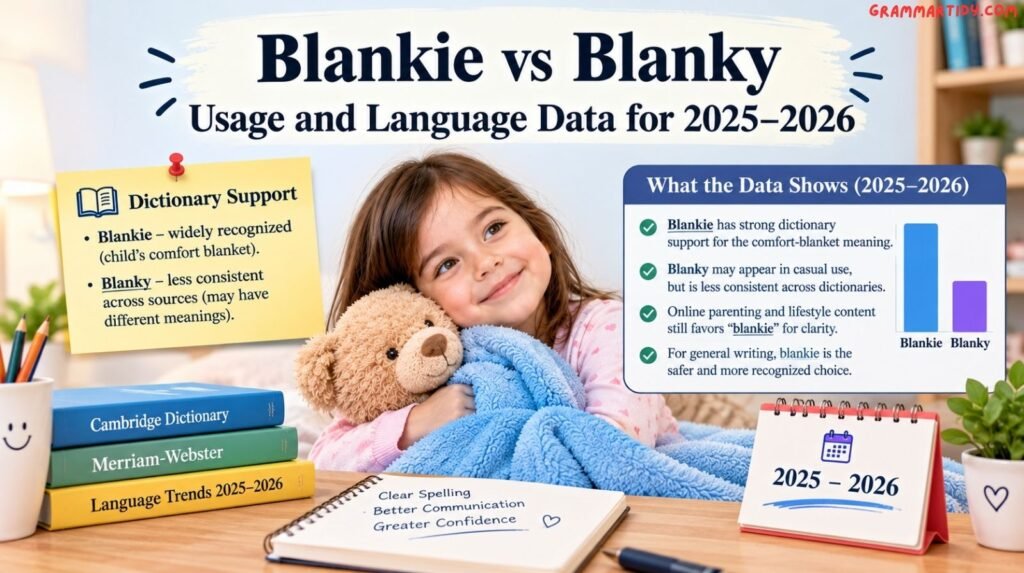
Language usage continues to evolve through parenting websites, social media, digital publishing, and everyday online communication. However, dictionary evidence remains especially useful when deciding which spelling is the most established.
As of dictionary references available in 2025–2026, Cambridge continues to list blankie as an informal term, mainly associated with American English, describing a blanket used by a young child for comfort. Merriam-Webster also maintains blankie as a dictionary entry meaning “a child’s blanket.”
What Does This Data Tell Us?
The important point is that blankie has strong dictionary support for the comfort-blanket meaning.
Meanwhile, blanky can create more confusion because dictionary treatment is not identical across sources. For example, Merriam-Webster lists blanky as a British adjective connected with “blankety-blank,” rather than defining it as a child’s blanket.
The Practical 2026 Writing Recommendation
For writers, bloggers, students, and content creators:
Use “blankie” when referring to a child’s favorite comfort blanket unless you intentionally want to preserve a personal or informal spelling variation.
This recommendation is based on clarity and established dictionary usage rather than a strict grammar rule.
How to Remember the Correct Spelling of Blankie
If you often forget whether to write blankie vs blanky, use this simple memory trick.
Think: Blanket + “-ie”
Remember the pattern:
Blanket → Blankie
The -ie ending helps create the affectionate, child-friendly version of the original word.
Also Read: Transferred vs Transfered: Which Is Correct?
Connect It With Similar Words
You can also remember these familiar patterns:
- dog → doggie
- aunt → auntie
- sweet → sweetie
- blanket → blankie
The pattern makes blankie easier to remember.
Use This Quick Checklist
Before publishing your writing, check:
- ✅ Does the word refer to a child’s comfort blanket?
- ✅ Is the context informal?
- ✅ Do I want the clearest spelling for a general audience?
- ✅ Have I used the same spelling consistently?
If yes, blankie is usually the right choice.
When Should You Use “Blanket” Instead?
Although blankie is useful in casual conversation, it is not appropriate for every situation.
Use “Blanket” in Formal Writing
Choose blanket when writing:
- Academic papers
- Medical documents
- Formal reports
- Professional communication
- General product specifications
For example:
Informal:
“The child brought her blankie to daycare.”
More neutral:
“The child brought her blanket to daycare.”
Tone Makes the Difference
The difference is often about tone rather than the physical object itself.
Blanket sounds neutral and standard.
Blankie sounds affectionate, informal, and personal.
Therefore, choose the word that matches your audience and purpose.
Unique and Catchy Mini Quiz Questions: Blankie vs Blanky
Quiz 1: Pick the Right Word ok
Which word is the safer choice for a child’s comfort blanket?
Answer: Blankie ✅
Quiz 2: Quick Meaning Check ok
What does blankie usually mean?
Answer: A child’s favorite comfort blanket 🛏️
Quiz 3: Spelling Challenge ok
Which spelling is more widely recognized for a child’s blanket?
Answer: Blankie ✍️
Quiz 4: True or False ok
Blankie is usually an informal and affectionate word.
Answer: True ✅
Quiz 5: Fill in the Blank ok
“The toddler cannot sleep without her ______.”
Answer: Blankie 🧸
Quiz 6: Choose the Tone ok
Which word sounds more neutral and formal?
Answer: Blanket ✅
Also Read: Symptomatology vs Symptomology: Differences, Meaning, And Usage
Quiz 7: Easy Choice ok
Which word is better for a general parenting article?
Answer: Blankie 👶
Quiz 8: Meaning Match ok
A blankie often gives a child what?
Answer: Comfort and security ❤️
Quiz 9: Quick Spelling Test ok
How do you spell the plural of blankie?
Answer: Blankies ✅
Quiz 10: Spot the Best Sentence ok
Which sentence uses the word naturally?
A. “The baby hugged her blankie.”
B. “The baby calculated her blankie.”
Answer: A. The baby hugged her blankie. ✅
Quiz 11: Remember the Rule ok
For a broad audience, which spelling is usually the safest choice?
Answer: Blankie ✨
Quiz 12: Formal or Informal? ok
Is blankie usually formal English?
Answer: No, it is informal. ✅
Quiz 13: Word Connection ok
Blankie is most closely connected to which word?
Answer: Blanket 🛌
Quiz 14: Consistency Challenge ok
If you choose blankie in your article, what should you do next?
Answer: Use the same spelling consistently throughout the article. ✅
Quiz 15: Final Quick Check ok
What is the easiest rule to remember?
Answer: For a child’s comfort blanket, “blankie” is usually the safest default spelling. 🎯
Also Read: Commit vs Comit: Correct Spelling And Usage
FAQs
Q. Is blankie or blanky correct?
A: Blankie is the more established spelling when referring to a child’s comfort blanket. Blanky may appear as an informal alternative, but blankie is generally the safer choice for broad audiences.
Q. What does blankie mean?
A: A blankie is an informal word for a blanket, especially a small blanket or security blanket used by a child for comfort.
Q. Is blanky a real word?
A: Yes, blanky exists as a word, but its dictionary meaning and treatment can vary. It may also be used informally as an alternative spelling for a comfort blanket in casual contexts.
Q. Is blankie formal English?
A: No. Blankie is informal language. In formal or professional writing, blanket or comfort blanket is usually more appropriate.
Q. How do you spell the plural of blankie?
A: The plural of blankie is blankies.
For example:
“The children packed their blankies before the family trip.”
Q. Is blankie mainly an American word?
A: Cambridge labels blankie as informal and mainly associated with American English.
Q. Does blankie mean the same thing as a security blanket?
A: Often, yes. A blankie commonly refers to a child’s favorite blanket that provides comfort and emotional security, which is why it can function as a type of security blanket.
Conclusion:
The difference between blankie vs blanky mainly comes down to spelling preference, clarity, and context.
If you are referring to a child’s favorite comfort blanket, blankie is generally the more established and recognizable spelling. It has clear dictionary support and works naturally in parenting, family, and informal writing.
Blanky may still appear in casual conversation or personal writing, but it is less straightforward for a broad audience and can have different dictionary treatment.
So, if you’re unsure which word to choose, remember this simple rule:
For a child’s comfort blanket, use “blankie” as your safest default.
Now that you understand blankie vs blanky, you can write with more confidence and choose the spelling that best matches your audience and context.
Discover More Article
- Grately vs Greatly: Differences And Correct Usage
- Moment vs Momment: Difference, Meaning And Correct Usage
- Encorporate vs Incorporate: Correct Usage Explained
Keep learning with more easy grammar lessons on GrammarTidy.com

Hi, I’m Noor Fatima, the author and creator of Grammar Tidy. I’m passionate about grammar, writing, and making language learning simple and enjoyable. Through Grammar Tidy, I share helpful tips, clear explanations, and practical guidance to help readers improve their writing, avoid common mistakes, and communicate with confidence. My goal is to make better grammar easy, useful, and accessible for everyone.