Have you ever typed “prooving” and wondered whether it was the correct spelling? You are not alone. English spelling rules can sometimes be confusing, especially when a word changes form before adding -ing.
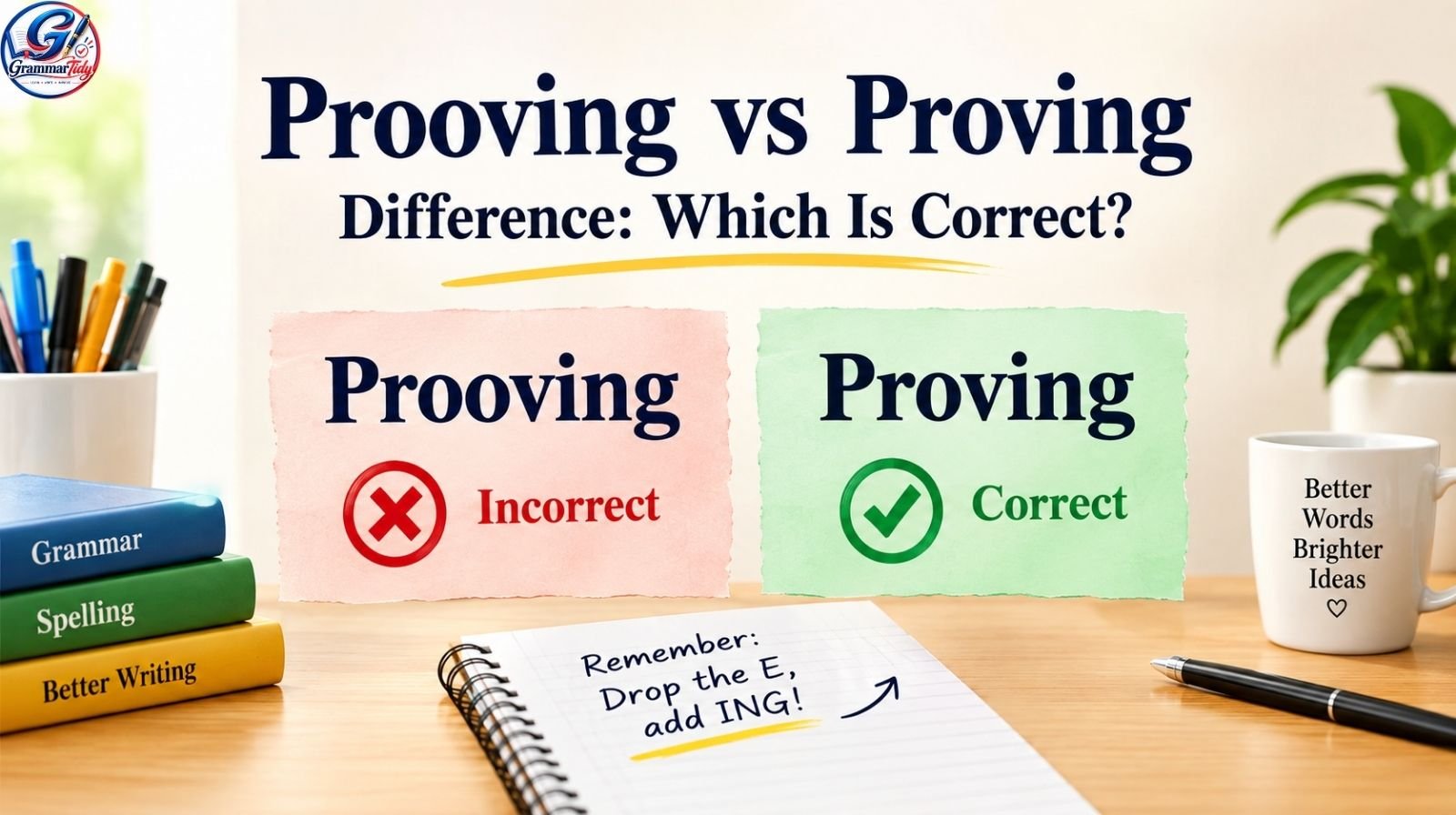
The quick answer to the prooving vs proving difference is simple: proving is correct, while prooving is a misspelling in standard English.
The confusion usually happens because the base verb is prove, and some writers incorrectly assume that they should simply add -ing to the complete word. However, English spelling rules require a small change first.
In this guide, you will learn what proving means, why prooving is incorrect, how to remember the correct spelling, and how to use the word naturally in real sentences.
Also Read: Blankie vs Blanky: Difference And Correct Usage Explained
Prooving vs Proving Difference: The Quick Answer
If you need a fast answer, here it is:
Proving is the correct spelling. Prooving is incorrect in standard English.
| Word | Correct? | Meaning | Example |
|---|---|---|---|
| Proving | ✅ Yes | Showing that something is true or valid | She is proving her point. |
| Prooving | ❌ No | Common spelling mistake | ❌ She is prooving her point. |
The prooving vs proving difference is not about two words with different meanings. Only proving is the standard English word.
What Does Proving Mean?
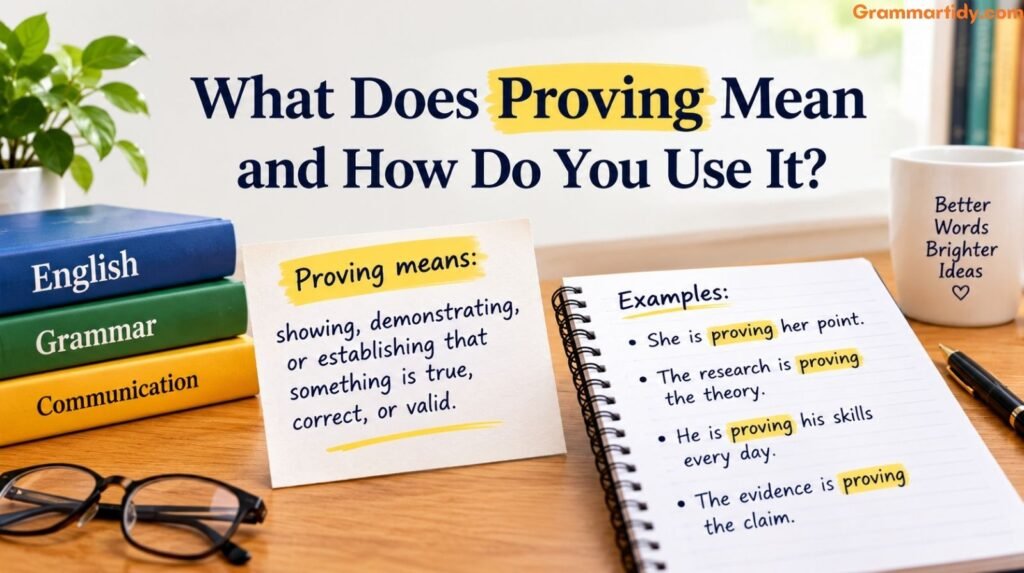
Proving is the present participle of the verb prove. It generally means showing, demonstrating, or establishing that something is true, correct, valid, or effective.
For example:
- She is proving that her idea works.
- The scientist is proving the theory through research.
- He is proving his skills every day.
- The evidence is proving the claim.
Major dictionaries identify proving as the present participle of prove.
Is Prooving Ever Correct?
No. Prooving is not the standard spelling of the present participle of prove.
Whether you are writing an essay, email, article, academic assignment, business document, or social media post, use proving.
❌ The evidence is prooving his argument.
✅ The evidence is proving his argument.
Why Is It Proving Instead of Prooving?
The answer becomes much easier when you understand a basic English spelling rule.
The Silent-E Rule Before Adding -ing
Many English verbs ending in a silent e drop the final e before adding -ing.
Here are some common examples:
- make → making
- take → taking
- write → writing
- move → moving
- use → using
- prove → proving
Therefore:
prove + ing → proving
Not:
prove + ing → prooving ❌
The final e in prove is removed before -ing is added.
Also Read: Encorporate vs Incorporate: Correct Usage Explained
Breaking Down the Correct Spelling
Let’s look at the word step by step:
PROVE
⬇ Remove the final silent E
PROV
⬇ Add ING
PROVING
This simple spelling pattern explains the entire prooving vs proving confusion.
Other Words That Follow a Similar Pattern
You can remember the rule by comparing prove with other familiar verbs:
| Base Word | Incorrect Form | Correct -ing Form |
|---|---|---|
| Make | Makeing ❌ | Making ✅ |
| Move | Moveing ❌ | Moving ✅ |
| Use | Useing ❌ | Using ✅ |
| Write | Writeing ❌ | Writing ✅ |
| Prove | Prooving ❌ | Proving ✅ |
The pattern is clear: when the final e is silent, it is often dropped before adding -ing.
What Does Proving Mean and How Do You Use It?
The word proving can appear in several everyday situations. Its meaning depends slightly on the context, but it usually involves demonstrating truth, ability, or effectiveness.
Proving Something Is True
One common meaning of proving is showing that something is true through evidence or facts.
For example:
- The lawyer is proving the case with new evidence.
- The experiment is proving the scientist’s theory.
- She is proving that the information is accurate.
In these examples, proving means demonstrating or establishing truth.
Proving Your Ability
You can also use proving when someone demonstrates their skills or abilities.
For example:
- Ahmed is proving that he can lead the team.
- The young player is proving his talent.
- She is proving herself as a successful manager.
This usage is common in professional, educational, and sports-related writing.
Proving Something Effective
Sometimes, proving describes results that show whether something works.
For example:
- The new strategy is proving successful.
- The treatment is proving effective.
- Remote learning is proving useful for some students.
The broader verb prove can mean establishing truth or validity and demonstrating a particular quality or worth.
Also Read: Grately vs Greatly: Differences And Correct Usage
Prooving vs Proving in Real-Life Writing
Understanding spelling rules is useful, but seeing them in real situations makes the difference easier to remember.
Academic Writing
In academic writing, accuracy matters because spelling mistakes can reduce clarity and professionalism.
❌ This research is prooving the hypothesis.
✅ This research is proving the hypothesis.
❌ The experiment is prooving successful.
✅ The experiment is proving successful.
Business Communication
Professional communication also requires correct spelling.
Imagine writing:
Our latest campaign is prooving highly successful.
The spelling mistake may distract readers.
The correct sentence is:
Our latest campaign is proving highly successful.
Everyday Digital Communication
The same rule applies to emails, messages, captions, and online posts.
Examples:
- This experience is proving valuable.
- The results are proving encouraging.
- She keeps proving everyone wrong.
No matter where you use the word, proving remains the correct spelling.
A Real-Life Writing Case Study: How One Small Spelling Error Can Affect Clarity
Consider a university student named Sarah who is preparing an important research presentation. Her topic focuses on whether a new learning method improves student performance. Throughout her presentation, she writes sentences such as:
“The results are prooving that the method works.”
At first, Sarah does not notice the spelling problem because prooving looks logical to her. She thinks that since the base word is prove, adding -ing should simply create prooving.
However, while proofreading her presentation, she checks the word in a trusted dictionary and discovers that the correct form is proving. She then learns the silent-e rule:
prove → proving
After correcting the spelling throughout her work, the sentences become clearer and more professional:
“The results are proving that the method works.”
This example shows why understanding spelling patterns is more useful than simply memorizing individual words. Once Sarah understands the rule, she can also recognize similar patterns such as make → making and move → moving.
The lesson is simple: when you understand why a spelling changes, you are much less likely to repeat the mistake.
Aslo Read: Moment vs Momment: Difference, Meaning And Correct Usage
Proving vs Prooving: Common Mistakes to Avoid
The most common problem is assuming that every letter in the base word remains unchanged before adding -ing.
Mistake 1: Keeping the Silent E
❌ prove → prooving
✅ prove → proving
The final e is removed.
Mistake 2: Adding an Extra O
Some writers visually connect prove with the incorrect spelling prooving because of the o sound.
However, pronunciation does not determine the spelling here.
The correct form is always:
P-R-O-V-I-N-G
Mistake 3: Confusing Proving With Proved or Proven
These forms are related, but they are used differently.
- Prove — base form
- Proving — present participle
- Proved — simple past
- Proven — commonly used as a past participle or adjective
For example:
- I want to prove my point.
- She is proving her point.
- She proved her point.
- The idea has been proven successful.
Merriam-Webster notes that proved and proven can both function as past participle forms in appropriate contexts.
How to Remember the Correct Spelling of Proving
Here is an easy method to remember the correct spelling.
Step 1: Start With Prove
The original word is:
PROVE
Step 2: Remove the Silent E
Before adding -ing, remove the final silent e:
PROV
Step 3: Add ING
Now add -ing:
PROVING
A Simple Memory Trick
Think:
“Drop the E, then add ING.”
So:
PROVE → PROVING
This trick works for many common English verbs.
Quick Spelling Checklist
Before writing proving, ask yourself:
- Is the base word prove? ✅
- Does it end with a silent e? ✅
- Should the final e be removed before adding -ing? ✅
- Is the final spelling proving? ✅
If your answer is yes, you have the correct spelling.
Also Read: Bachelor vs Batchelor: Difference And Correct Usage
Prooving vs Proving: Usage and Language Accuracy in 2025–2026
Accurate spelling remains important in modern digital communication. Although spell-check tools can catch many mistakes, writers should not depend entirely on software.
A spelling error can still appear in:
- Emails
- Blog posts
- Academic assignments
- Business reports
- Social media captions
- Website content
- Online comments
Why Accuracy Still Matters
Google’s guidance for helpful content emphasizes creating reliable, useful, people-first information and encourages content creators to focus on trust, expertise, and satisfying user experiences. Accurate language supports those goals by making content easier to understand and more trustworthy.
For writers and publishers in 2025–2026, this means that basic language accuracy remains part of creating a professional reading experience.
Dictionary Evidence Supports Proving
Current major dictionary references consistently list proving as the present participle of prove. Cambridge Dictionary explicitly identifies proving in this grammatical role, while Merriam-Webster lists proving among the standard forms of the verb.
Therefore, there is no standard spelling competition between the two forms:
Proving = Correct
Prooving = Incorrect
Mini Quiz: Prooving vs Proving
Quiz 1: Which spelling is correct?
A) Prooving
B) Proving
Answer: B) Proving ✅
Quiz 2: Complete the word: Prove → _____
A) Prooving
B) Proving
Answer: B) Proving ✅
Quiz 3: What happens to the final e in “prove” before adding -ing?
A) It stays
B) It is removed
Answer: B) It is removed ✅
Quiz 4: Spot the correct sentence!
A) She is prooving her point.
B) She is proving her point.
Answer: B) She is proving her point. ✅
Quiz 5: Is “prooving” a correct standard English spelling?
A) Yes
B) No
Answer: B) No ✅
Quiz 6: Which word means showing that something is true?
A) Proving
B) Prooving
Answer: A) Proving ✅
Also Read: Emersion vs Immersion: Differences And Correct Usage
Quiz 7: Choose the correct spelling!
The evidence is _____ the claim.
A) Prooving
B) Proving
Answer: B) Proving ✅
Quiz 8: What is the base word of “proving”?
A) Prove
B) Proof
Answer: A) Prove ✅
Quiz 9: Which spelling rule helps form “proving”?
A) Keep the silent e
B) Drop the silent e before adding -ing
Answer: B) Drop the silent e before adding -ing ✅
Quiz 10: True or False?
“Proving” can be used when someone shows their ability.
Answer: True ✅
Quiz 11: Which sentence is written correctly?
A) The new plan is prooving successful.
B) The new plan is proving successful.
Answer: B) The new plan is proving successful. ✅
Quiz 12: Finish the spelling pattern!
Make → Making
Move → Moving
Prove → _____
A) Prooving
B) Proving
Answer: B) Proving ✅
Quiz 13: Which letters correctly spell the word?
A) P-R-O-O-V-I-N-G
B) P-R-O-V-I-N-G
Answer: B) P-R-O-V-I-N-G ✅
Quiz 14: What is the easiest memory trick?
A) Keep the E and add ING
B) Drop the E and add ING
Answer: B) Drop the E and add ING ✅
Quiz 15: Final Spelling Challenge!
Which one should you confidently use in your writing?
A) Prooving ❌
B) Proving ✅
Answer: B) Proving ✅
FAQs
Q. Is Prooving a Real Word?
A: No. Prooving is not the standard English spelling. The correct form is proving.
Q. Why Does Prove Become Proving?
A: The final silent e in prove is removed before adding -ing.
prove → proving
Q. How Do You Spell Proving Correctly?
A: The correct spelling is:
P-R-O-V-I-N-G
Q. Is Proving the Present Tense of Prove?
A: Proving is the present participle form of prove. It is often used with helping verbs such as is, are, was, or were.
For example:
She is proving her argument.
Q. Can I Use Proving in Academic Writing?
A: Yes. Proving is appropriate in academic writing when discussing evidence, research, arguments, theories, or results.
Q. What Is the Difference Between Proving and Proven?
A: Proving describes an ongoing action:
The evidence is proving the claim.
Proven is commonly used as a past participle or adjective:
The method has been proven effective.
Q. What Is the Easiest Way to Remember Proving?
A: Remember this rule:
Drop the silent E and add ING.
prove → proving
Conclusion:
The prooving vs proving difference is straightforward once you understand the spelling rule. Proving is the correct English spelling, while prooving is a common misspelling.
The reason is simple: the verb prove drops its final silent e before -ing is added.
Remember:
prove → proving ✅
prooving ❌
Whether you are writing an essay, email, article, research paper, or social media post, using the correct spelling helps your writing look clearer and more professional.
The next time you wonder about “prooving vs proving,” remember the rule: drop the E, add ING, and confidently write “proving.”
Discover More Article
- Submission vs Submittion: Learn The Difference
- Courtesy vs Curtesy: Meaning, Usage And Common Mistakes
- Shinning vs Shining: Correct Spelling And Usage
Keep learning with more easy grammar lessons on GrammarTidy.com

Hi, I’m Noor Fatima, the author and creator of Grammar Tidy. I’m passionate about grammar, writing, and making language learning simple and enjoyable. Through Grammar Tidy, I share helpful tips, clear explanations, and practical guidance to help readers improve their writing, avoid common mistakes, and communicate with confidence. My goal is to make better grammar easy, useful, and accessible for everyone.