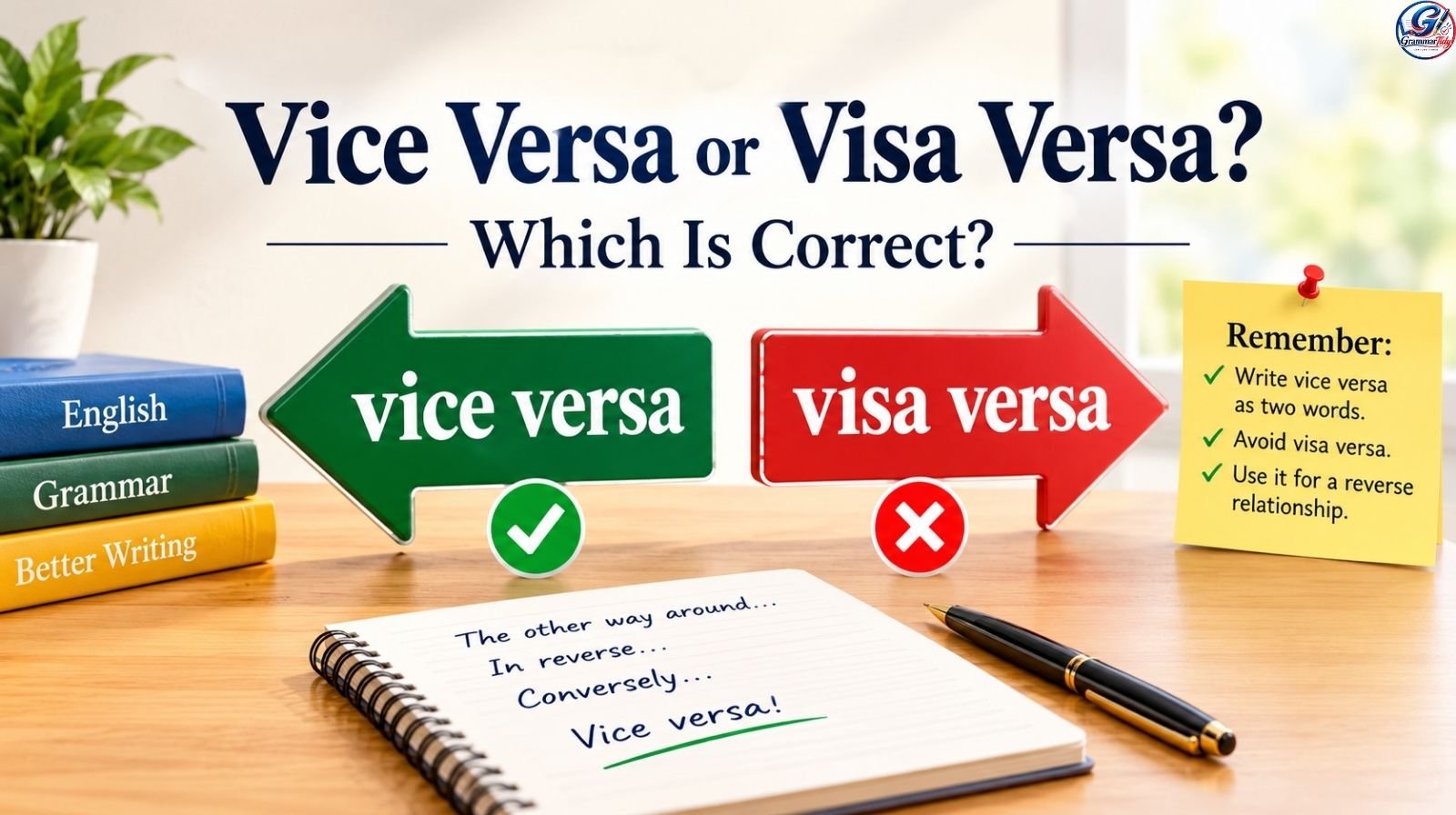
Have you ever written “visa versa” and wondered whether it was the correct spelling? You are not alone. When comparing vice versa or visa versa, the correct spelling is vice versa.
The phrase means “the other way around” or “in reverse order.”
Although “visa versa” may seem reasonable because of the way the expression sounds, it is a common spelling mistake.
Understanding the phrase’s meaning, origin, and proper usage will help you write more accurately in emails, essays, articles, and everyday conversations.
In this guide, you will learn why vice versa is correct, how to use it in sentences, and which common mistakes to avoid.
Also Read: Labelling or Labeling: What’s The Correct Spelling? (2026)
What Is the Correct Spelling: Vice Versa or Visa Versa?
The correct spelling is vice versa, written as two separate words. “Visa versa” is a misspelling and should be avoided in standard English writing.
Why Is Vice Versa Correct?
The phrase vice versa comes from Latin and has been used in English for centuries. It describes a situation in which a relationship, action, or statement works in the opposite direction.
For example:
- Correct: I help my brother, and vice versa.
- Incorrect: I help my brother, and visa versa.
The correct sentence means that your brother helps you, too.
The expression has an established meaning in English dictionaries and is widely accepted in both formal and informal writing.
Also Read: Potatoes or Potatos: Which Spelling Is Correct? (2026)
Why Do People Write Visa Versa?
The mistake usually happens because people write words according to how they hear them. Depending on the speaker’s accent, vice versa can sound similar to “visa versa.”
When people learn the phrase through conversation rather than reading, they may remember its pronunciation but not its spelling.
Consider these examples:
- Correct: You can teach me, and vice versa.
- Incorrect: You can teach me, and visa versa.
- Correct: Parents influence their children, and vice versa.
- Incorrect: Parents influence their children, and visa versa.
Quick rule: Whenever you mean “the other way around,” write vice versa, never visa versa.
What Does Vice Versa Mean?
The expression vice versa means that the opposite direction or reversed relationship is also true. It helps writers avoid repeating an idea that readers can easily understand from the context.
Simple Definition of Vice Versa
In everyday English, vice versa can mean:
- The other way around
- In reverse
- Conversely
- The reverse is also true
Also Read: Unenroll vs Disenroll: Which One Is Correct?
For example:
“Ali respects Sara, and Sara respects Ali.”
You can shorten this sentence to:
“Ali respects Sara, and vice versa.”
The shorter version communicates the same idea without repeating Sara’s action.
Vice Versa Examples in Everyday English
Here are some practical examples that demonstrate the meaning of the phrase.
| Sentence | Meaning |
|---|---|
| I call my parents, and vice versa. | My parents call me, too. |
| Teachers learn from students, and vice versa. | Students learn from teachers, and teachers learn from students. |
| You can travel from Lahore to Islamabad or vice versa. | You can also travel from Islamabad to Lahore. |
| Cats can frighten dogs, and vice versa. | Dogs can frighten cats, too. |
| Good communication builds trust, and vice versa. | Trust can also support good communication. |
Notice that the phrase works when the relationship or action can reasonably be reversed. It does not mean that two things are always identical or interchangeable in every respect.
When Should You Use Vice Versa?
Use vice versa when you want to express a reverse relationship without repeating the complete statement.
For example:
- In conversation: “I don’t like bothering him, and vice versa.”
- In education: “Students can teach their classmates, and vice versa.”
- In business: “Our company supports its partners, and vice versa.”
- In travel: “You can take the train from City A to City B or vice versa.”
However, make sure your reader can identify what is being reversed. If the sentence is complicated, repeating the original idea may be clearer than using vice versa.
Vice Versa or Visa Versa: Key Differences
The main difference between these expressions is spelling and correctness. They are not two alternative expressions with different meanings.
Also Read: Cancellation vs Cancelation: Which Spelling Is Correct?
Comparison Table
| Feature | Vice Versa | Visa Versa |
|---|---|---|
| Correct spelling | Yes | No |
| Accepted standard expression | Yes | No |
| Meaning | The other way around | No standard meaning as this expression |
| Origin | Latin | Misspelling of vice versa |
| Appropriate for formal writing | Yes | No |
| Common reason for use | Correct English usage | Phonetic spelling mistake |
How to Remember the Correct Spelling
Use this simple three-step method whenever you are unsure.
- Remember the first word: It is vice, beginning with V-I-C-E.
- Remember the second word: It is versa, beginning with V-E-R-S-A.
- Check the meaning: If you mean “the other way around,” use vice versa.
For instance, write “I support my friends, and vice versa,” rather than “I support my friends, and visa versa.”
Is Vice Versa One Word or Two?
In standard English, vice versa is written as two words. It is not normally written as “viceversa,” and the hyphenated form “vice-versa” is generally unnecessary in modern English usage.
How to Use Vice Versa Correctly in Sentences
Understanding the definition is only the first step. To use vice versa correctly, identify the two people, actions, places, or ideas whose relationship can be reversed.
Use Vice Versa in Everyday Conversations
The phrase is useful in casual conversations because it makes sentences shorter and more natural.
Examples:
- “I miss my best friend, and vice versa.”
- “My sister helps me with homework, and vice versa.”
- “I enjoy listening to his stories, and vice versa.”
Each example suggests that the relationship works in both directions.
Use Vice Versa in Academic and Professional Writing
You can also use the phrase in essays, reports, presentations, and workplace communication.
Examples:
- “Economic conditions can influence consumer behavior, and vice versa.”
- “Managers influence their teams, and vice versa.”
- “Reading can improve vocabulary, and vocabulary knowledge can support reading.”
The last example illustrates an important point: a sentence can be grammatically correct while its underlying claim needs more careful thought. Reading may improve vocabulary, but vocabulary knowledge does not automatically improve reading in every situation.
Therefore, use the phrase only when the reverse statement makes sense.
Also Read: Bougie vs Boujee: The Real Difference Most People Miss
Real-Life Case Study: Correcting a Workplace Email
Imagine a marketing assistant preparing an email for a colleague. The original message reads:
“Our team shares ideas with the design department, and visa versa. Both teams benefit from regular communication.”
The intended meaning is clear, but the spelling error makes the email look less polished. In a professional setting, small errors can distract readers from the main message, particularly when the communication is being sent to a client or senior manager.
The assistant reviews the sentence and changes it to:
“Our team shares ideas with the design department, and vice versa. Both teams benefit from regular communication.”
This correction fixes the spelling without changing the message. It also keeps the sentence concise because the writer does not need to repeat that the design department shares ideas with the marketing team.
Before sending the email, the assistant checks the remaining text for other common spelling mistakes and confirms that the phrase accurately represents a two-way exchange.
The lesson is simple: correct spelling and clear context work together. Replacing “visa versa” with “vice versa” improves the accuracy of the writing, while checking the meaning ensures that the expression communicates the intended relationship.
Vice Versa in 2025–2026: Spelling, Usage, and Data
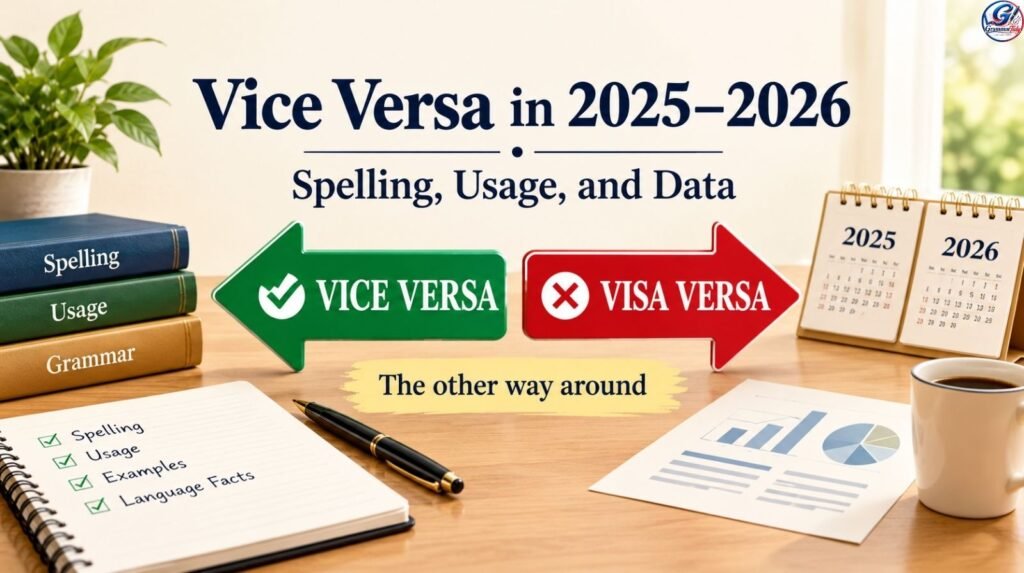
Correct spelling remains important in digital communication, education, and professional writing. However, it is equally important to distinguish verified language facts from search statistics or assumptions about how frequently a mistake occurs.
Also Read: Goodmorning or Good Morning: The Correct Usage (And Why It Actually Matters)
What Current English Usage Tells Us
The established usage of the expression remains consistent in 2025–2026:
- Vice versa is the recognized English expression.
- Its meaning is “in reverse order” or “the other way around.”
- The expression has Latin origins and a long history in English.
- “Visa versa” is a spelling error when intended as this expression.
These are established language facts rather than newly emerging spelling rules.
What the 2025–2026 Data Can and Cannot Tell Us
There is no verified statistic available in this article that establishes the exact number or percentage of English writers who misspell vice versa as visa versa in 2025–2026.
Search interest can help researchers understand what people look for online, but it does not automatically reveal how many people use a particular spelling incorrectly. Results may also vary by country, language, and time period.
For that reason, it would be misleading to invent a percentage or claim that a specific number of people make this error.
The practical takeaway for writers in 2026 is straightforward: use a trusted dictionary when checking unfamiliar expressions, proofread important writing, and prioritize clarity over assumptions about how popular a spelling might be.
Also Read: Natzi or Nazi: The Correct Spelling, Meaning, And Why It Matters
Frequently Asked Questions
1. Is It Vice Versa or Visa Versa?
Vice versa is correct. “Visa versa” is a common misspelling caused by the similar pronunciation of the phrase.
2. What Does Vice Versa Mean in Simple English?
It means “the other way around.” For example, “I help my friend, and vice versa” means your friend helps you, too.
3. Is Vice Versa a Latin Phrase?
Yes. Vice versa comes from Latin and refers to a reversed order or relationship.
4. Can I Use Vice Versa in Formal Writing?
Yes. You can use it in academic writing, business emails, reports, and professional documents, provided the reverse relationship is clear.
5. Is Vice Versa Written as One Word or Two?
It is normally written as two separate words: vice versa.
6. Does Vice Versa Need a Hyphen?
No. Standard modern English usage generally writes it without a hyphen.
7. What Is Another Word for Vice Versa?
Depending on the sentence, alternatives include “conversely,” “in reverse,” “the other way around,” and “in the opposite direction.” Choose the alternative that best preserves your intended meaning.
Conclusion:
When choosing between vice versa or visa versa, the answer is clear: vice versa is the correct spelling. The phrase means “the other way around” and helps express a reversed relationship without repeating an entire statement.
Remember these three rules:
- Write vice versa as two words.
- Avoid “visa versa” in standard English.
- Use the phrase only when the reverse relationship makes sense.
Whether you are writing an email, completing an assignment, publishing a blog post, or improving your everyday English, getting small details right can make your writing clearer and more professional.
Discover More Article
- 22th or 22nd: Which Is Correct? Simple Grammar Rule And Examples
- Fairing or Faring: When Each Word Makes Sense
- Genuinity or Genuity: The Hidden Truth Behind This Confusing Word
- Todays or Today’s: Which Spelling Is Correct?
Keep learning with more easy grammar lessons on GrammarTidy.com

Hi, I’m Noor Fatima, the author and creator of Grammar Tidy. I’m passionate about grammar, writing, and making language learning simple and enjoyable. Through Grammar Tidy, I share helpful tips, clear explanations, and practical guidance to help readers improve their writing, avoid common mistakes, and communicate with confidence. My goal is to make better grammar easy, useful, and accessible for everyone.