Have you ever wondered whether to write todays or today’s in a sentence? Although these two spellings look almost identical, the apostrophe makes an important grammatical difference.
Choosing the wrong form can make your emails, school assignments, articles, and professional documents look less polished.
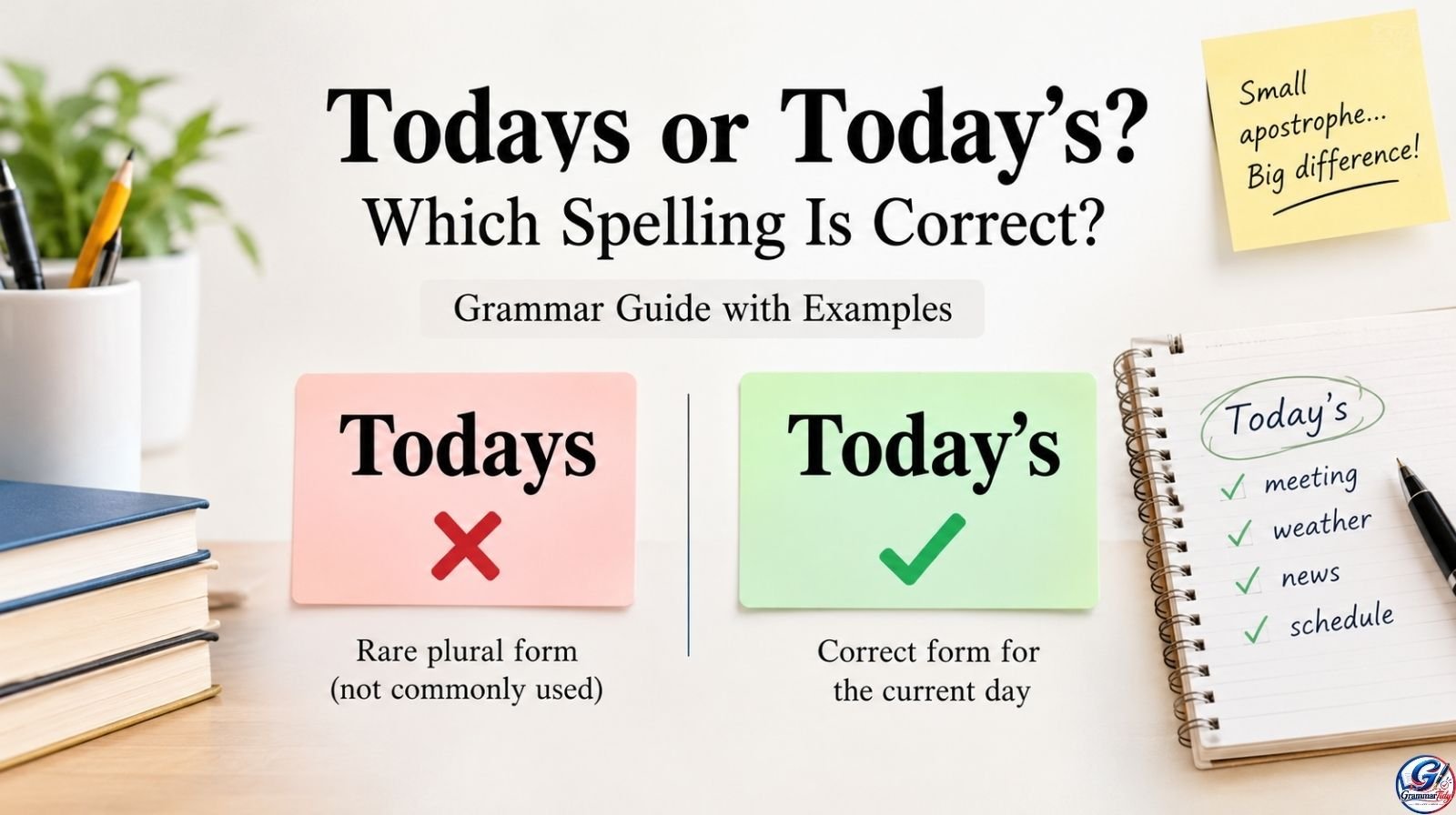
Today’s is the correct spelling when you want to refer to something associated with the current day, such as today’s meeting, today’s weather, or today’s news. Todays is also possible in English, but it is a rare plural form of today.
In this grammar guide, you will learn the difference between todays and today’s, understand the apostrophe rule, explore practical examples, and discover how to avoid this common spelling mistake.
Also Read: Potatoes or Potatos: Which Spelling Is Correct? (2026)
Todays or Today’s: Which Is Correct?
The correct choice depends on what you want to express. In most everyday writing, today’s is the form you need because it connects the current day with an event, activity, or thing.
For example:
- Correct: Today’s meeting starts at 10 a.m.
- Incorrect for the intended meaning: Todays meeting starts at 10 a.m.
The second sentence is missing an apostrophe because the meeting is associated with today.
What Does Today’s Mean?
Today’s is the possessive form of today. It expresses a relationship between the current day and something happening, existing, or being discussed on that day.
Examples include:
- Today’s lesson was easy to understand.
- Today’s weather is warmer than yesterday’s.
- I have finished today’s assignments.
- Today’s newspaper contains an interesting story.
Notice that the apostrophe appears before the letter s. This follows the usual rule for forming the possessive of a singular noun.
Is Todays Ever Correct?
Yes, although it is rarely needed in everyday English. Todays can be used as the plural of today when a writer deliberately refers to multiple days as separate experiences or occasions.
For example:
- We should appreciate our todays instead of worrying constantly about tomorrow.
- The todays of childhood felt different from the todays of adulthood.
These examples use todays in a reflective or literary sense. In ordinary sentences about a meeting, date, class, or event happening now, use today’s.
Also Read: Seperate vs Separate: How to Spell It Correctly
Understanding the Apostrophe Rule in Today’s
The main difference between todays and today’s is punctuation. An apostrophe can show possession or a relationship between words, and it can also mark omitted letters in contractions. In today’s meeting, it shows the relationship between today and the meeting.
Why Today’s Needs an Apostrophe
In English, a singular noun commonly forms its possessive by adding an apostrophe and s. The word today follows this pattern.
Here is the basic structure:
Singular noun + ’s = possessive form
Examples:
| Base word | Correct possessive form |
|---|---|
| Today | Today’s |
| Tomorrow | Tomorrow’s |
| Monday | Monday’s |
| Teacher | Teacher’s |
| Company | Company’s |
For example, today’s schedule means the schedule associated with today, just as Monday’s schedule means the schedule associated with Monday.
Common Mistakes to Avoid
Writers sometimes leave out the apostrophe when typing quickly. However, this small punctuation error can make a sentence appear careless.
Compare these examples:
| Incorrect | Correct |
|---|---|
| Todays date is October 27. | Today’s date is October 27. |
| Todays class was interesting. | Today’s class was interesting. |
| I checked todays news. | I checked today’s news. |
| Todays weather is beautiful. | Today’s weather is beautiful. |
Quick tip: If you mean something connected with the current day, write today’s. If you are simply describing when an action occurs, use today without an apostrophe.
For example, “I will finish the report today” is correct because today functions as an adverb, not a possessive noun.
Does Today’s Also Mean “Today Is”?
Yes. Depending on the sentence, today’s can represent a contraction of today is or today has.
Examples:
- Today’s the day we have been waiting for.
(Today’s means today is.) - Today’s been unusually busy.
(Today’s means today has.)
However, when the word comes directly before a noun, as in today’s meeting, it usually indicates a possessive relationship.
Understanding the context helps you choose the right interpretation.
Also Read: Layed or Laid (2026): Easy Guide To Understand The Difference
How to Use Today’s Correctly in Sentences
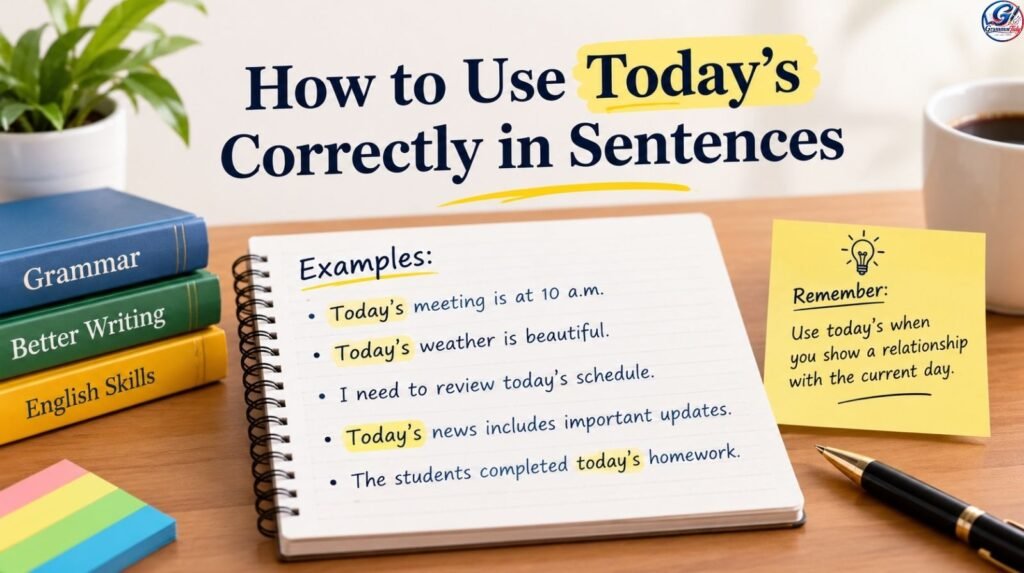
Using today’s correctly becomes easy once you recognize the relationship it expresses. It commonly appears before nouns describing events, activities, information, or things associated with the current day.
Examples of Today’s in Everyday English
Here are practical examples you can use as models for your own writing:
- Today’s meeting: Today’s meeting has been postponed until noon.
- Today’s weather: Today’s weather is perfect for a walk.
- Today’s lesson: Today’s lesson explains how apostrophes work.
- Today’s news: Today’s news includes several important updates.
- Today’s schedule: I need to review today’s schedule before leaving.
- Today’s date: Could you confirm today’s date?
- Today’s homework: The students completed today’s homework.
- Today’s goal: Today’s goal is to finish the project.
In each example, the apostrophe connects today to the noun that follows it.
Today vs. Today’s: Understanding the Difference
Although the words are related, they serve different grammatical purposes.
| Word | Grammatical use | Example |
|---|---|---|
| Today | Refers to the current day | I am working today. |
| Today’s | Shows a relationship with the current day | Today’s work is almost finished. |
| Todays | Rare plural noun | We should value our todays. |
Consider these two sentences:
- “I have an appointment today.”
- “Today’s appointment is at 3 p.m.”
The first sentence tells you when the appointment takes place. The second identifies the appointment associated with today.
A Simple Trick to Remember the Correct Spelling
When you are unsure whether to use todays or today’s, ask yourself whether the word expresses a relationship between the current day and something else.
For example:
- Today’s lunch
- Today’s report
- Today’s deadline
- Today’s class
If this is the meaning you want, include the apostrophe.
If you are simply describing when an action occurs, use today without adding anything.
- I will call you today.
- We are studying today.
- She arrives today.
This simple distinction can help you avoid most mistakes involving today’s and todays.
Also Read: Aide vs Aid: The Person Who Helps And The Help Itself
Real-Life Example: Correcting Today’s in Professional Writing
Imagine that a marketing assistant is preparing an email to send to a team of colleagues. The message includes the following sentence:
“Todays meeting will cover the new campaign, updated deadlines, and next weeks content plan.”
The message is understandable, but it contains two missing apostrophes. A reader may notice the errors, especially in a professional environment where clear communication matters.
The corrected sentence is:
“Today’s meeting will cover the new campaign, updated deadlines, and next week’s content plan.”
Why is this version correct? First, today’s meeting refers to the meeting scheduled for the current day. Second, next week’s content plan refers to the plan associated with the following week. Both expressions use possessive forms to show a relationship between a time expression and a noun.
The assistant can improve the rest of the email by checking other time-related expressions, such as Monday’s deadline, tomorrow’s presentation, and this week’s priorities. These expressions follow similar patterns.
This example illustrates an important lesson: apostrophes are small, but they help communicate meaning precisely. A quick proofreading pass can catch errors before an email reaches clients, colleagues, or managers. The goal is not to add apostrophes everywhere; it is to use them where grammar requires them.
Todays or Today’s in 2025–2026: Grammar and Usage Facts
The distinction between todays and today’s is a grammar issue rather than a newly emerging spelling trend. The standard apostrophe rule remains relevant in 2026, especially in digital writing, where people frequently type messages, emails, captions, and articles quickly.
What Do Recent Data Sources Tell Us?
There is no reliable, widely established 2025–2026 statistic showing the exact percentage of writers who confuse todays with today’s. Therefore, it would be misleading to claim that a particular percentage of people make this mistake.
Search interest can provide clues about what people want to learn, but it does not automatically prove how often a grammatical error occurs. Search data can also be affected by spelling variations, punctuation, and differences in how people phrase their queries.
Also Read: Began vs Begun: Which Form Goes Where?
Key Facts for Writers in 2026
| Grammar fact | Explanation |
|---|---|
| Standard possessive | Today’s meeting |
| Standard adverb | I will finish it today. |
| Rare plural form | Todays, used in special contexts |
| Apostrophe placement | Before the final s in today’s |
| Common error | Writing “todays date” instead of “today’s date” |
For students, bloggers, editors, and professionals, the most useful takeaway is straightforward: learn the apostrophe rule and apply it consistently. Accurate examples and careful proofreading are more useful than unsupported statistics about spelling mistakes.
Also Read: Gage or Gauge: What’s The Difference? Explained Simply
Frequently Asked Questions
1. Is Todays or Today’s Correct?
Today’s is correct when referring to something associated with the current day, such as today’s meeting or today’s weather. Todays is a rare plural form of today.
2. Is It Today’s Date or Todays Date?
The correct form is today’s date. The apostrophe shows the relationship between today and the date being discussed.
Example: “What is today’s date?”
3. Why Does Today’s Have an Apostrophe?
Today’s has an apostrophe because it is generally the possessive form of today. The apostrophe and s connect the day with a related noun, as in today’s schedule.
4. Can Todays Be Used Without an Apostrophe?
Yes, but it is uncommon. Todays can function as the plural of today in sentences referring to multiple days or different experiences of the present.
Example: “We should appreciate our todays.”
5. Is Today’s a Contraction?
Sometimes. In a sentence such as “Today’s a special day,” it means “today is.” In “Today’s lesson is useful,” it is possessive. Context determines its meaning.
6. Is Today’s Correct in Formal Writing?
Yes. Today’s is grammatically correct in formal writing, including academic work, business emails, reports, and professional articles, when used appropriately.
Conclusion:
When deciding between todays or today’s, remember that the apostrophe makes the difference in meaning. Today’s is the standard choice when referring to something connected with the current day, including today’s date, today’s meeting, and today’s news. Todays is a legitimate but uncommon plural form used in particular contexts.
To avoid mistakes, identify the word’s grammatical role, check whether it expresses a relationship with a noun, and proofread your writing before publishing or sending it.
Whether you are writing a blog post, an email, a school assignment, or a social media caption, using apostrophes correctly makes your writing clearer and more professional.
Want to improve your English grammar? Keep practicing with everyday examples, and remember: when you mean something associated with the current day, choose today’s.
Discover More Article
- Gluing or Glueing: Which Spelling Is Correct And Why It Matters?
- Lended vs Lent: Meaning, Grammar Rules And Correct Usage
- Sustain vs Substain: The Complete Guide To Meaning, Correct Usage, Etymology & Common Spelling Mistakes
- Combatting vs Combating In 2026: Which Spelling Is Correct And Why It Matters
Keep learning with more easy grammar lessons on GrammarTidy.com

Hi, I’m Noor Fatima, the author and creator of Grammar Tidy. I’m passionate about grammar, writing, and making language learning simple and enjoyable. Through Grammar Tidy, I share helpful tips, clear explanations, and practical guidance to help readers improve their writing, avoid common mistakes, and communicate with confidence. My goal is to make better grammar easy, useful, and accessible for everyone.