Have you ever written “She layed the book on the table” and wondered whether it was correct? If so, you are not alone. The difference between layed or laid confuses many English learners because most regular verbs form their past tense by adding -ed.
However, lay is an irregular verb, so its past tense follows a different pattern.
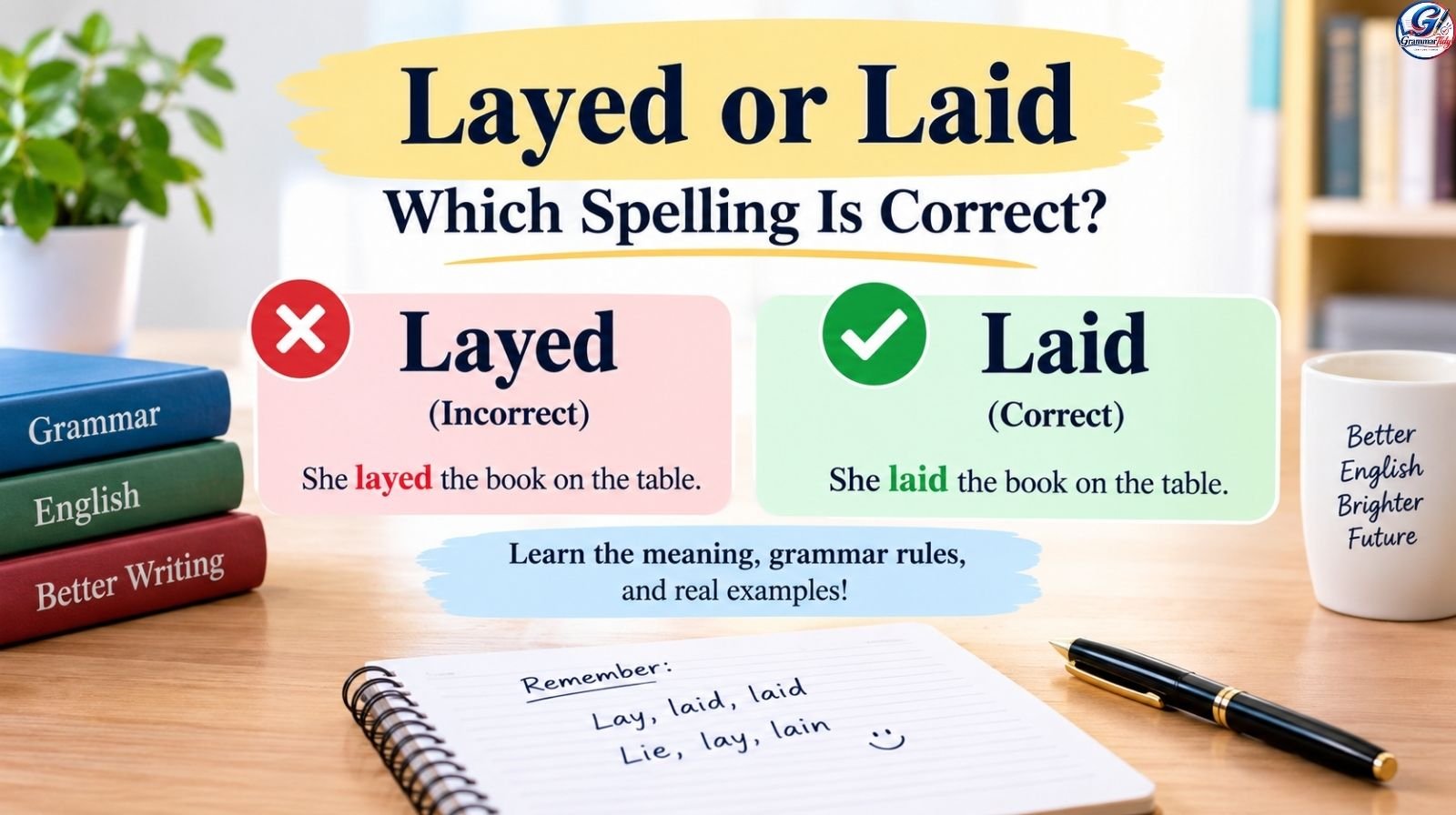
The correct spelling is usually “laid,” not “layed.” For example, you should write, “She laid the book on the table.” The word laid is the past tense and past participle of lay, which means to put or place something somewhere.
In this easy 2026 guide, you will learn the meanings, spelling rules, common mistakes, and practical examples of laid. You will also discover how lay, lie, and laid differ so you can choose the right word confidently.
Also Read: Natzi or Nazi: The Correct Spelling, Meaning, And Why It Matters
What Is the Difference Between Layed and Laid?
The main difference is that laid is the standard, correct spelling for the past tense and past participle of the verb lay, while layed is generally considered incorrect in standard modern English.
The confusion happens because many English verbs use -ed to show past actions. For example, walk becomes walked, and play becomes played. However, lay changes to laid instead.
What Does Laid Mean?
Laid is the past tense and past participle of lay. It describes putting, placing, or arranging something in a particular position.
Examples:
- She laid her phone beside the laptop.
- He laid the keys on the kitchen counter.
- The workers laid the foundation for the new building.
- The hen has laid three eggs.
- I had laid the documents on your desk before the meeting.
In each example, laid describes an action involving something being placed or produced.
Is Layed Ever Correct?
In ordinary writing, you should use laid instead of layed when you mean the past tense of lay.
Incorrect: She layed the blanket on the bed.
Correct: She laid the blanket on the bed.
Although layed may appear in informal writing, online posts, or nonstandard usage, it is not the accepted spelling for this verb in standard English.
For school assignments, professional emails, blog posts, and formal documents, choose laid.
Quick Comparison: Layed vs. Laid
| Word | Standard usage | Example |
|---|---|---|
| Laid | Correct past tense of lay | She laid the book down. |
| Layed | Nonstandard spelling in this context | She layed the book down. |
| Lay | Present tense of lay | I lay the towel on the chair. |
| Laying | Present participle of lay | He is laying the tiles. |
Quick answer: If you mean that someone placed something somewhere in the past, use laid.
Why Is Laid the Correct Spelling in 2026?
The reason is simple: lay is an irregular English verb. Unlike regular verbs, it does not form its past tense by adding -ed.
Understanding the Irregular Verb Lay
English contains many irregular verbs that change their spelling in the past tense.
Consider these examples:
| Present tense | Past tense | Past participle |
|---|---|---|
| Lay | Laid | Laid |
| Say | Said | Said |
| Pay | Paid | Paid |
| Make | Made | Made |
| Take | Took | Taken |
Notice that these verbs do not all follow the regular -ed pattern. Learning their forms helps you avoid spelling and grammar mistakes.
For example:
- Present: I lay the folder on the desk.
- Past: I laid the folder on the desk.
- Past participle: I have laid the folder on the desk.
Writing layed in these sentences applies a regular spelling pattern to an irregular verb.
Also Read: Goodmorning or Good Morning: The Correct Usage (And Why It Actually Matters)
How to Remember the Correct Form
Use this simple memory trick: Lay, laid, laid.
Repeat the three forms aloud and use them in short sentences.
- Today, I lay the book on the desk.
- Yesterday, I laid the book on the desk.
- I have laid the book on the desk already.
Practicing the same pattern makes the correct spelling easier to remember.
You can also remember the related forms say, said, said and pay, paid, paid. These examples show why adding -ed is not always correct.
What Do Grammar References Say?
The Cambridge Dictionary’s grammar guide identifies laid as the past simple and -ed form of lay and explicitly rejects layed in this context.
Similarly, the U.S. Centers for Disease Control and Prevention’s clear-writing guide, published in 2025, explains the distinction among lay, lie, laid, and lain.
These references support the standard spelling rule: use laid when the verb means to put or place something.
How to Use Laid, Lay, and Lie Correctly
One reason people search for layed or laid is that they also confuse lay with lie. These verbs have related meanings, but their grammatical uses are different.
When Should You Use Lay?
Use lay when someone puts or places something somewhere. In this meaning, the verb takes an object.
Examples:
- I lay my jacket on the chair every evening.
- Please lay the papers on my desk.
- She will lay the baby gently in the crib.
- They lay bricks to build the wall.
Ask yourself: What is being placed?
If you can identify the object being placed, lay may be the correct verb.
For example, in “She laid the book on the table,” the book is the object.
When Should You Use Laid?
Use laid when the placing action happened in the past or when the past participle is needed.
Examples:
- He laid his wallet beside the computer.
- We laid the carpet last weekend.
- The teacher has laid the books on the shelf.
- They had laid the groundwork before the project began.
Remember that laid can also appear in passive constructions.
For example: “The new road was laid last year.”
Here, laid describes the road’s installation.
Also Read: Bougie vs Boujee: The Real Difference Most People Miss
When Should You Use Lie Instead?
Use lie when a person or animal reclines or rests in a horizontal position. In this meaning, the verb does not take a direct object.
Its forms are:
| Verb form | Correct word | Example |
|---|---|---|
| Present | Lie | I lie down after lunch. |
| Past | Lay | I lay down yesterday. |
| Present participle | Lying | I am lying on the sofa. |
| Past participle | Lain | I have lain here for an hour. |
This distinction is important because lay is also the past tense of lie.
Compare these sentences:
- Correct: I lay on the sofa yesterday.
- Correct: I laid the blanket on the sofa yesterday.
The first sentence describes a person reclining. The second describes a person placing a blanket.
The verb lie can also mean to tell something untrue. In that case, its past tense is lied: “He lied about his age.”
Common Mistakes With Layed or Laid: Examples and Corrections
Understanding the rule is easier when you see how it works in everyday situations. Below are common mistakes and their correct alternatives.
Incorrect and Correct Sentence Examples
| Incorrect sentence | Correct sentence |
|---|---|
| She layed the baby in the crib. | She laid the baby in the crib. |
| I layed my phone on the table. | I laid my phone on the table. |
| He has layed the foundation. | He has laid the foundation. |
| They layed the tiles yesterday. | They laid the tiles yesterday. |
| The hen layed an egg. | The hen laid an egg. |
| I layed the documents beside your laptop. | I laid the documents beside your laptop. |
| We had layed the groundwork already. | We had laid the groundwork already. |
These corrections follow the standard spelling of lay in its past forms.
Real-Life Example: A Student Corrects a Writing Mistake
Imagine a student named Emma preparing an English assignment about her weekend activities.
She writes:
“On Saturday, I layed my books on the desk, cleaned my room, and started studying for my exam.”
The sentence is understandable, but it contains a spelling error. Emma knows that many verbs form their past tense by adding -ed, so she assumes that layed follows the same pattern.
Before submitting her assignment, she checks a grammar reference and discovers that lay is irregular. Its past tense is laid, not layed.
She corrects the sentence:
“On Saturday, I laid my books on the desk, cleaned my room, and started studying for my exam.”
Emma then reviews the rest of her assignment. She finds another sentence: “After studying, I lay on my bed for twenty minutes.”
Also Read: Cancellation vs Cancelation: Which Spelling Is Correct?
This sentence is correct because she is describing herself reclining, not placing an object somewhere. The past tense of lie is lay.
By comparing the two sentences, Emma learns an important lesson: correcting spelling sometimes requires understanding the meaning of a verb, not simply changing its letters.
The next time she writes an assignment, email, or report, she remembers the pattern lay, laid, laid and the separate pattern lie, lay, lain. This helps her write more accurately and recognize similar mistakes in other people’s writing.
The example illustrates a practical proofreading strategy: identify the intended meaning, determine the verb’s tense, and then select the appropriate form.
A Simple Checklist for Choosing the Right Word
Before submitting your writing, follow these steps:
- Identify the action. Are you placing an object somewhere or reclining yourself?
- Check the tense. Is the action happening now, in the past, or described using a past participle?
- Choose the correct form. Use lay for the present act of placing, laid for its past tense and past participle, and lie for reclining in the present.
- Read the sentence again. Make sure the word communicates the intended meaning.
For example, if you mean that you placed a book on the desk yesterday, write “I laid the book on the desk yesterday.”
Layed or Laid in 2025–2026: Grammar Facts and Statistics
Readers often want to know whether spelling rules have changed in 2026 and how frequently people make this mistake. It is important to distinguish established grammar facts from statistics that have not been verified.
Have the Spelling Rules Changed in 2026?
No. In standard modern English, laid remains the accepted past tense and past participle of lay.
The 2025 CDC clear-writing guide explains the difference between lay, lie, laid, and lain. The Cambridge Dictionary’s grammar guidance also confirms the same forms.
These references show that the spelling rule remains consistent in current usage.
What Do the Available Data Tell Us?
There is no verified, comprehensive 2025–2026 statistic established here that measures how many English speakers write layed instead of laid. Therefore, it would be misleading to invent a percentage or claim that a specific number of people make this mistake.
However, several reliable resources can help writers investigate English usage:
- Cambridge Dictionary: Its grammar guidance identifies laid as the correct form and explains the distinction between lay and lie.
- CDC clear-writing guide (2025): It provides practical examples showing how to use lay, lie, laid, and lain correctly.
- Google Books Ngram Viewer: This tool lets users examine the frequency of words and phrases in its book corpus over time. Its documentation explains how the data work.
Google Books Ngram Viewer can help researchers compare historical word usage, but it does not directly measure how many people make spelling mistakes in everyday writing. A meaningful comparison would require a defined search term, corpus, and time range.
Also Read: Unenroll vs Disenroll: Which One Is Correct?
Why These Facts Matter for Writers
Even a small spelling error can make an otherwise clear sentence look less polished. Students may lose marks for incorrect spelling, while professionals may want to avoid unnecessary errors in emails, reports, and presentations.
Learning the correct form is a straightforward way to improve writing accuracy. Instead of relying on an unverified statistic, focus on the established grammar rule and practice it in real sentences.
Frequently Asked Questions
1. Is It Layed or Laid?
Laid is correct when you need the past tense or past participle of lay. For example, “She laid the book on the table.” Layed is a nonstandard spelling in this context.
2. Why Is Layed Incorrect?
Lay is an irregular verb. Its past tense and past participle are both laid, rather than a form created by adding -ed. Therefore, standard English uses laid, not layed.
3. Is Laid the Past Tense of Lay?
Yes. The past tense of lay is laid, and its past participle is also laid.
Examples:
- Yesterday, she laid the blanket on the bed.
- She has laid the blanket on the bed.
4. Is “I Layed Down” Correct?
In standard English, neither I layed down nor I laid down is the preferred form when you mean that you reclined.
The traditional grammatical form is “I lay down” for the past tense of lie.
For example: “I lay down for a short nap yesterday.”
In everyday speech, many people use laid down, but formal writing generally follows the distinction between lay and lie.
5. What Is the Difference Between Laid and Lain?
Laid is the past tense and past participle of lay, meaning to put or place something.
Lain is the past participle of lie, meaning to recline or rest in a horizontal position.
Examples:
- She laid the book on the desk.
- She has lain in bed all morning.
6. Is Laid Correct in American and British English?
Yes. Laid is the standard spelling in both American and British English when used as the past tense or past participle of lay. There is no standard American-versus-British spelling difference in this case.
Conclusion:
When deciding between layed or laid, remember that laid is the correct standard spelling for the past tense and past participle of lay. Although layed may look reasonable, it does not follow the established spelling of this irregular verb.
Use laid when someone places an object somewhere, as in “She laid her phone on the desk.” Use lay as the past tense of lie when describing someone reclining, as in “She lay on the sofa.”
The easiest way to remember the difference is to practice the forms: lay, laid, laid and lie, lay, lain.
Now that you understand the rule, you can avoid this common grammar mistake in your everyday writing.
Found this guide helpful? Save it for future reference and share it with someone who wants to improve their English spelling and grammar.
Discover More Article
- Labelling or Labeling: What’s The Correct Spelling? (2026)
- Potatoes or Potatos: Which Spelling Is Correct? (2026)
- Seperate vs Separate: How to Spell It Correctly
- Orientated vs Oriented: Which Word Is Correct?
Keep learning with more easy grammar lessons on GrammarTidy.com

Hi, I’m Noor Fatima, the author and creator of Grammar Tidy. I’m passionate about grammar, writing, and making language learning simple and enjoyable. Through Grammar Tidy, I share helpful tips, clear explanations, and practical guidance to help readers improve their writing, avoid common mistakes, and communicate with confidence. My goal is to make better grammar easy, useful, and accessible for everyone.