Have you ever wondered whether to write aide or aid when talking about someone who helps or the help they provide?
These two words sound exactly alike, but their meanings and grammatical uses are different. Understanding aide vs aid can help you avoid spelling mistakes in emails, school assignments, professional documents, and everyday writing.
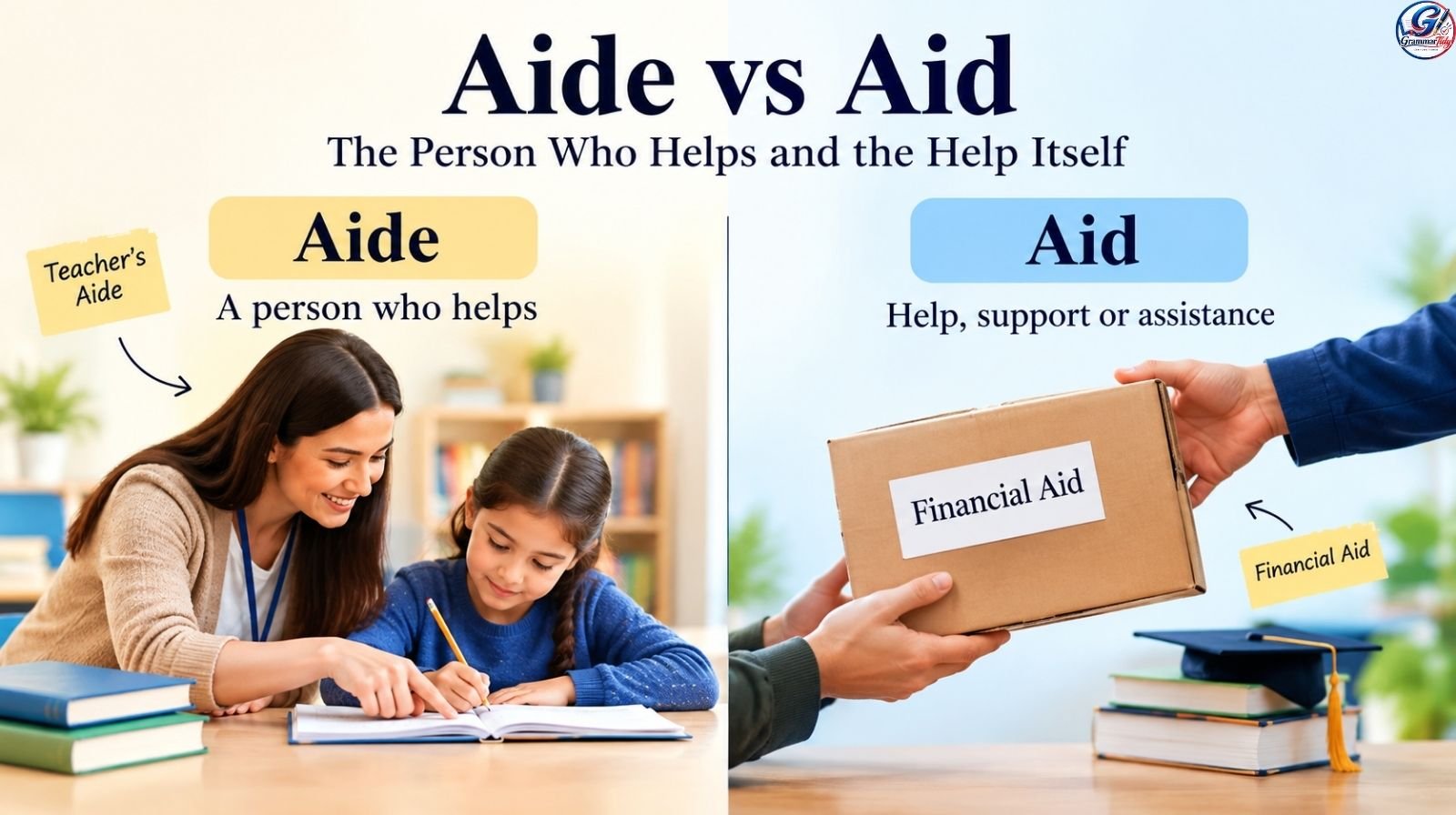
The simplest way to remember the difference is that an aide is a person who provides assistance, while aid is help, support, or the act of helping. Although both words are related to assistance, they are not interchangeable in every sentence.
In this guide, you’ll learn what each word means, how to use it correctly, common mistakes to avoid, and practical examples that make the distinction easy to remember.
Also Read: Lieing or Lying: Correct Spelling Guide 2026
Aide vs Aid: What Is the Difference?
The main difference between aide and aid is that one usually refers to a person, while the other refers to assistance itself.
What Does Aide Mean?
An aide is a person who assists someone else with a particular task, responsibility, or role. The word often appears in professional, educational, medical, and political contexts.
For example:
- The teacher’s aide helped students complete their assignments.
- The senator’s aide arranged the meeting.
- A nursing aide assisted the elderly patient.
- The principal asked an administrative aide to organize the files.
In each sentence, aide identifies a person who provides help.
What Does Aid Mean?
Aid means help, assistance, support, or resources provided to someone who needs them. It can function as both a noun and a verb.
As a noun:
- The organization provided financial aid to students.
- Emergency aid arrived after the storm.
- First aid helped the injured cyclist.
As a verb:
- Volunteers aid families affected by flooding.
- Good lighting can aid concentration.
- The new program will aid small businesses.
The important distinction is that aid refers to the assistance or the action of helping, not usually the person providing it.
Also Read: Continuous vs Continous: What’s The Difference? 2026
Quick Comparison Table
| Feature | Aide | Aid |
|---|---|---|
| Main meaning | A person who helps | Help or assistance |
| Part of speech | Noun | Noun and verb |
| Example | The aide answered the phone. | The charity provided aid. |
| Common phrases | Teacher’s aide, political aide | Financial aid, first aid |
| Memory tip | Think of a helper | Think of help itself |
Quick answer: If you mean a person who helps, use aide. If you mean help, support, or the act of helping, use aid.
How to Use Aide and Aid Correctly in Sentences
The easiest way to choose the correct word is to identify what your sentence describes. Is it describing a person, the assistance provided, or an action that helps someone?
Examples of Aide in Everyday Writing
Use aide when referring to someone whose role involves assisting another person or group.
Examples include:
- School: The classroom aide helped the children with reading.
- Healthcare: The home health aide prepared the patient’s meal.
- Politics: A presidential aide briefed reporters.
- Business: The executive aide scheduled appointments.
- Personal support: The aide helped the older man get dressed.
Notice that every example refers to an individual with a supporting role.
Examples of Aid as a Noun
Use aid when discussing assistance, resources, or support.
Examples include:
- The university offers financial aid to eligible students.
- The community received disaster aid after the hurricane.
- The injured player received first aid.
- The nonprofit provides food aid to struggling families.
- The government approved additional economic aid.
Here, the word describes something provided or received rather than the person responsible for providing it.
Examples of Aid as a Verb
When aid is used as a verb, it describes an action that helps improve a situation or makes something easier.
Examples:
- Regular exercise may aid recovery.
- Clear instructions aid understanding.
- Volunteers aid residents during emergencies.
- The new software will aid the research process.
A useful test is to replace aid with help. If the sentence still makes sense, aid is likely the correct choice.
For example, “Clear instructions help understanding” communicates the same general idea as “Clear instructions aid understanding.”
Also Read: Discard or Disgard: Which Spelling Is Correct?
Aide vs Aid: Common Mistakes and How to Avoid Them
Although the words sound alike, using the wrong one can make a sentence confusing or grammatically incorrect.
Mistake 1: Using Aid for a Person
Incorrect: The teacher’s aid helped the students.
Correct: The teacher’s aide helped the students.
Why? The sentence refers to a person assisting the teacher, so aide is the appropriate word.
Mistake 2: Using Aide for Assistance
Incorrect: The family received financial aide.
Correct: The family received financial aid.
Why? Financial assistance is called financial aid. The word aide would refer to a person, not money or support.
Mistake 3: Confusing Aid With Aiding
Both aid and aiding can describe helping, but they have different grammatical forms.
Examples:
- Correct: Volunteers aid the community.
- Correct: Volunteers are aiding the community.
- Correct: The volunteers’ aid was valuable.
Use aid for the base verb or as a noun, and aiding for the participle or gerund form when the sentence requires it.
A Simple Step-by-Step Guide
Follow these steps whenever you are unsure which spelling to use.
- Identify the meaning. Are you referring to a person or to assistance?
- Check the sentence. If it identifies a helper, aide is usually correct.
- Try the word “help.” If it fits naturally as a noun or verb, aid may be correct.
- Review common expressions. Write teacher’s aide, financial aid, and first aid.
- Read the sentence again. Make sure the selected word conveys the intended meaning.
This quick process works well for academic writing, professional emails, reports, and everyday communication.
Also Read: Brite vs Bright: 7 Easy Ways To Know The Difference
Aide vs Aid in Real-Life Situations
The difference becomes easier to understand when you see how these words work in realistic situations.
Case Study: A School’s Student Support Program
Imagine a school introducing a program to help students who are struggling with reading and writing. The principal assigns a classroom aide to work alongside the teacher. The aide helps students understand instructions, practice reading, and complete classroom activities.
At the same time, the school receives additional funding to purchase books, learning materials, and educational software. The funding is intended to support students who need extra help.
How should the two words be used in a report about this program?
A correct description might read:
“The classroom aide worked with students who needed additional support. The school also received educational aid to purchase reading materials and improve its learning resources.”
The word aide identifies the person who works directly with students. The word aid describes the financial and material support the school receives.
Now imagine that a student writes, “The school received educational aide.” The sentence suggests that the school received a person rather than assistance.
If the student writes, “The classroom aid worked with students,” the intended meaning is understandable, but aide is the more appropriate spelling for the person in that role.
This example shows why the distinction matters. Both words relate to helping, but choosing the right one makes writing more precise and professional.
Also Read: Humorous vs Humerous: Which Spelling Is Correct? 2026 Guide
Aide and Aid in Professional Communication
These words also appear frequently in workplace documents, public announcements, and reports.
Consider these examples:
- A medical aide assists patients with everyday care.
- Medical aid helps patients access treatment or essential supplies.
- A political aide supports an elected official.
- Financial aid helps eligible students pay educational expenses.
- A research aide assists a research team.
- Research aid can refer to resources or support that help research progress.
The context determines which word is appropriate. When you focus on the difference between the helper and the help, the correct spelling becomes much easier to recognize.
Aide vs Aid: Usage Trends and Language Facts in 2025–2026
Understanding current language usage can help writers recognize why both words remain relevant. However, it is important to distinguish established language facts from measured search or usage statistics.
What Current Language Data Can Tell Us
As of 2026, aide and aid remain established English words with distinct meanings. Their pronunciation is identical in common English usage, making them examples of homophones.
Here are several reliable language facts:
- Pronunciation: Both words are generally pronounced the same way, like “ayd.”
- Grammar: Aide is a noun referring to a person. Aid can be a noun or a verb.
- Compound expressions: Both occur in common expressions, including teacher’s aide, first aid, and financial aid.
- Spelling accuracy: The correct choice depends on the intended meaning and grammatical role.
Also Read: In Process vs In Progress: The Real Difference With 20+ Examples
Are There Verified 2025–2026 Statistics?
There is no single authoritative statistic that establishes how often writers confuse aide with aid in 2025–2026. Without a documented corpus study or a published dataset measuring these specific errors, giving an exact percentage would be misleading.
For an evidence-based understanding of English vocabulary and word usage, writers can consult established dictionaries and language references.
A dictionary definition helps establish meaning, while a corpus or documented usage study can provide quantitative evidence about how words appear in real writing.
For this topic, the most useful evidence is the words’ established definitions and their use in context rather than an unsupported numerical claim.
Frequently Asked Questions
1. Is It Aide or Aid for a Person Who Helps?
Use aide for a person who assists someone else. For example, “The teacher’s aide helped the students with their work.”
2. Is Financial Aide or Financial Aid Correct?
Financial aid is correct. It refers to money or other assistance provided to help someone pay for education or related expenses.
3. Is Teacher’s Aide or Teacher’s Aid Correct?
Teacher’s aide is the standard expression when referring to a person who assists a teacher. The word aide identifies the helper.
4. Can Aid Be Used as a Verb?
Yes. Aid can mean to help, support, or make something easier. For example, “Regular practice can aid learning.”
5. Are Aide and Aid Pronounced the Same Way?
Yes. They are homophones in standard English pronunciation, meaning they sound alike but have different spellings and meanings.
6. What Is the Easiest Way to Remember Aide vs Aid?
Remember that an aide is a helper, while aid is the help itself. For example, a teacher’s aide provides help, while financial aid provides support.
Conclusion:
Understanding aide vs aid is simple once you focus on what each word represents. An aide is a person who provides assistance, while aid refers to help, support, resources, or the act of helping.
Use aide in expressions such as teacher’s aide, nursing aide, and political aide. Choose aid for phrases such as financial aid, first aid, and disaster aid, or when describing an action that helps someone.
The next time you encounter these words, ask yourself one simple question: Am I talking about the person who helps or the help itself? That quick check can prevent common spelling mistakes and make your writing clearer.
If you found this guide helpful, explore more spelling and grammar comparisons to strengthen your everyday English and write with greater confidence.
Discover More Article
- Seperate vs Separate: How to Spell It Correctly
- Orientated vs Oriented: Which Word Is Correct?
- Layed or Laid (2026): Easy Guide To Understand The Difference
- Anticlockwise vs Counterclockwise: Key Usage Differences Explained
Keep learning with more easy grammar lessons on GrammarTidy.com

Hi, I’m Noor Fatima, the author and creator of Grammar Tidy. I’m passionate about grammar, writing, and making language learning simple and enjoyable. Through Grammar Tidy, I share helpful tips, clear explanations, and practical guidance to help readers improve their writing, avoid common mistakes, and communicate with confidence. My goal is to make better grammar easy, useful, and accessible for everyone.