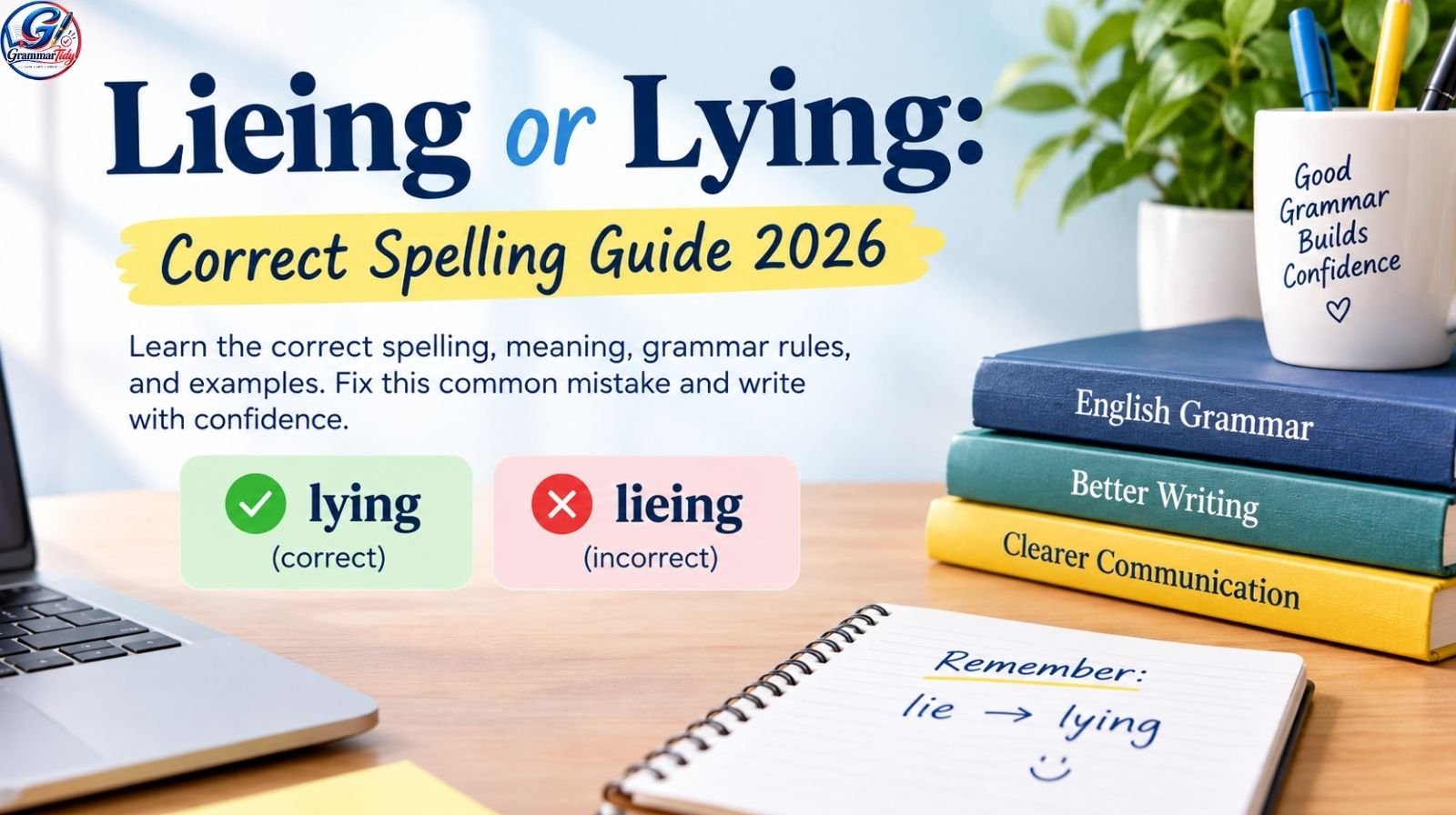
If you have ever wondered whether the correct spelling is “lieing” or “lying,” you are not alone. The correct spelling is lying. “Lieing” is a common spelling mistake, especially when people try to form the present participle of lie by simply adding -ing.
The rule is easier once you understand how lie changes when -ing is added. Major dictionaries, including Cambridge, list lying as the present participle of lie.
In this guide, you will learn why lying is correct, why lieing is incorrect, how to use lying in real sentences, and how to remember the spelling in 2026 and beyond.
Also Read: Commit vs Comit: Correct Spelling And Usage
Is It Lieing or Lying?
The correct spelling is lying.
| Spelling | Correct? | Explanation |
|---|---|---|
| Lying | ✅ Yes | Correct present participle of lie |
| Lieing | ❌ No | Incorrect spelling |
| Layed | ❌ No | Incorrect form of lay |
| Laying | ✅ Yes | Present participle of lay |
Cambridge Dictionary specifically identifies lying as the present participle of lie.
Why Is “Lying” Correct?
The confusion comes from the way English verbs change when -ing is added.
You might expect:
lie + ing = lieing
But English does not form this word as lieing. Instead, the final -ie changes to -y before -ing:
lie → lying
So:
She is lying on the sofa.
Not:
She is lieing on the sofa. ❌
This is one of those spelling patterns that is easier to remember as a complete word rather than trying to construct it letter by letter.
Why Is Lieing Incorrect?
The spelling lieing looks logical at first because many English verbs simply take -ing.
For example:
- walk → walking
- talk → talking
- read → reading
- jump → jumping
However, lie behaves differently.
The Spelling Change
The standard form is:
LIE → LYING
The ie changes to y before the -ing ending.
This gives us:
- lie → lying
- die → dying
- tie → tying
Therefore, writing lieing follows a pattern that English does not use for these words.
“Lying” Is the Standard Dictionary Form
Current dictionary references confirm that lying is the standard present-participle form of lie. Cambridge lists the verb lie with lying as its present participle, while Dictionary.com also defines lying as the present participle of lie.
So if you are writing an email, school assignment, article, report, or professional document, use lying.
Read More: Really vs Realy: Which Is Correct? And Proper Usage
How to Use Lying Correctly in a Sentence
The word lying can be used in different contexts because lie has more than one meaning.
Lying Means Being in a Resting Position
When lie means to be in a horizontal or resting position, its present participle is lying.
Examples:
- The baby is lying on the bed.
- My dog is lying under the table.
- She was lying on the beach.
- The book is lying on the floor.
- He spent the afternoon lying on the sofa.
Cambridge gives the same basic grammatical pattern: lie means to be in or move into a horizontal position, and its present participle is lying.
Lying Can Also Mean Not Telling the Truth
The verb lie can also mean to say or write something untrue with the intention of deceiving someone.
Its present participle is still lying.
Examples:
- He is lying to his parents.
- She knew that he was lying.
- Why are you lying to me?
- The witness was lying about what happened.
Cambridge distinguishes these two meanings but gives lying as the present participle for both.
Lie vs. Lay vs. Lying: The Easy Difference
One reason people write lieing is that lie, lay, lying, and laying can be confusing.
Lie
Lie usually means to be in a resting or horizontal position.
I want to lie down.
Its forms are:
lie → lay → lain → lying
Cambridge lists lay as the past tense and lain as the past participle when lie means to recline or be in a position.
Lay
Lay means to put or place something somewhere and normally takes an object.
Please lay the book on the table.
Its forms are:
lay → laid → laid → laying
Cambridge explains that lay requires an object, while lie does not.
Lying
Lying is the present participle of lie.
She is lying on the couch.
It can describe either a physical position or the act of telling an untruth.
Also Read: Accross vs Across: Which Is The Correct Spelling?
Quick Comparison
| Word | Basic meaning | Example |
|---|---|---|
| Lie | Rest or recline | I want to lie down. |
| Lay | Put something down | Lay the book here. |
| Lying | Resting/reclining or telling an untruth | He is lying on the bed. |
| Laying | Putting something down | She is laying the papers on the desk. |
Grammarly similarly explains that lie does not take a direct object, while lay does, and specifically warns that the present participle of lie is lying, not lieing.
Lieing or Lying: 2025–2026 Usage Check
When checking a spelling question such as this, it is important to distinguish current dictionary evidence from unsupported claims about search volume.
What Current References Show
As of 2026, major English-language reference sources continue to recognize lying as the standard present participle of lie.
- Cambridge Dictionary lists lying as the present participle of lie.
- Dictionary.com likewise identifies lying as the present participle of lie.
- Grammarly’s grammar guidance explicitly states that the present participle is lying, not lieing.
- Google Trends provides current search-interest data, but its public interface does not establish that lieing is a standardized English spelling.
Therefore, the useful 2025–2026 takeaway is straightforward: “lying” remains the accepted spelling, while “lieing” should be treated as a spelling error.
There is no reliable basis for inventing a precise percentage of people who misspell lying as lieing. For an accuracy-focused article, dictionary and grammar references are more appropriate evidence than an unsupported search-volume statistic.
Case Study: A Simple Writing Mistake With a Professional Impact
Imagine a student preparing an English-language presentation about workplace communication. While reviewing the final slides, the student writes:
“The employee was lieing about the missing documents.”
The sentence may still be understandable to the reader, but the spelling error immediately stands out in a formal document. A teacher, editor, or employer could interpret the mistake as a lack of proofreading rather than a misunderstanding of the message.
The student checks the verb lie and initially assumes that adding -ing produces lieing. After checking a reliable dictionary, however, they discover that the correct form is lying.
The sentence is corrected to:
“The employee was lying about the missing documents.”
The lesson is useful beyond this one word. English contains many irregular spelling patterns, so it is risky to assume that every verb simply accepts -ing without a spelling change. In professional writing, a quick dictionary check can prevent small errors from appearing in emails, reports, presentations, resumes, and online content.
The same principle applies whenever you are uncertain about lieing or lying: check the base verb and its established participle rather than relying only on what looks logical.
How to Remember the Correct Spelling of Lying
Remember: Lie Changes to Lying
A simple memory trick is:
LIE → LYING
Think of the Y as replacing the IE before -ing.
So avoid:
❌ lieing
Use:
✅ lying
Remember Similar Words
You can reinforce the pattern with:
- die → dying
- tie → tying
- lie → lying
These three words provide a useful spelling pattern.
Use the Sentence Test
Whenever you hesitate, create a short sentence:
“She is ___ on the bed.”
The correct answer is:
“She is lying on the bed.”
If the sentence contains the physical-position meaning of lie, lying is the form you need.
Also Read: Quantify vs Qualify: Differences And Correct Usage
Common Mistakes With Lie and Lying
Mistake 1: Writing Lieing
❌ He is lieing on the sofa.
✅ He is lying on the sofa.
Mistake 2: Confusing Lying With Laying
❌ She is laying on the bed.
When you mean that she is resting on the bed:
✅ She is lying on the bed.
But when she is putting something somewhere:
✅ She is laying the clothes on the bed.
Mistake 3: Confusing the Past Tense
The physical-position verb lie has the past tense lay:
Yesterday, I lay on the couch.
But lay itself has laid as its past tense:
Yesterday, I laid the book on the desk.
This distinction is one of the major reasons lie and lay are frequently confused.
Mini Quiz: Lieing or Lying
1. Quick Start: Which Spelling Is Correct?
A) Lieing
B) Lying
Answer: B) Lying ✅
2. Fill the Gap: She Is ___ on the Sofa.
A) Lieing
B) Lying
Answer: B) Lying ✅
3. Spot the Mistake!
Which sentence is spelled correctly?
A) He is lieing on the bed.
B) He is lying on the bed.
Answer: B) He is lying on the bed. ✅
4. What Happens to “Lie” + “-ing”?
Which form is correct?
A) Lieing
B) Lying
Answer: B) Lying ✅
Also Read: Symptomatology vs Symptomology: Differences, Meaning, And Usage
5. Grammar Check: Pick the Right Word
“She is ___ about what happened.”
A) lieing
B) lying
Answer: B) lying ✅
6. Can You Catch the Error?
Which word is incorrect?
A) Lying
B) Lieing
Answer: B) Lieing ❌
7. Remember This Pattern!
Which pair is correct?
A) Lie → Lieing
B) Lie → Lying
Answer: B) Lie → Lying ✅
8. Lying or Laying?
“She is ___ on the couch.”
A) Lying
B) Laying
Answer: A) Lying ✅
9. What Does “Lying” Mean Here?
“He is lying on the floor.”
A) He is resting there.
B) He is putting something there.
Answer: A) He is resting there. ✅
10. Truth or Trick?
Is “lieing” the standard spelling of the present participle of lie?
A) Yes
B) No
Answer: B) No ✅
11. Choose the Correct Sentence
A) She was lieing about her age.
B) She was lying about her age.
Answer: B) She was lying about her age. ✅
12. Past Tense Challenge
When lie means “rest in a horizontal position,” what is its past tense?
A) Lay
B) Layed
Answer: A) Lay ✅
13. Which One Looks Right?
A) The dog is lying under the table.
B) The dog is lieing under the table.
Answer: A) The dog is lying under the table. ✅
14. Final Spelling Test
Complete this sentence:
“Why are you ___ to me?”
A) lieing
B) lying
Answer: B) lying ✅
15. The Big Finish! 🎯
What is the easiest spelling to remember?
A) Lie → Lieing
B) Lie → Lying
Answer: B) Lie → Lying ✅
FAQs
1. Is “lieing” a correct spelling?
No. Lieing is not the standard spelling. The correct present participle of lie is lying.
2. Is it lying or lieing?
It is lying.
Correct:
She is lying on the bed.
Incorrect:
She is lieing on the bed.
3. Why does lie become lying?
When lie takes the -ing form, its spelling changes from lie to ly before the ending:
lie + ing → lying
This is an established English spelling pattern rather than a simple addition of the letters ing.
4. What is the present participle of lie?
The present participle of lie is lying. Cambridge Dictionary explicitly lists lying as the present participle.
5. Is “laying” the same as “lying”?
No. Lying comes from lie, while laying comes from lay.
The child is lying on the bed.
The mother is laying the blanket on the bed.
6. What is the past tense of lie?
When lie means to recline or be in a horizontal position, the past tense is lay:
I lay on the sofa yesterday.
When lie means to tell an untruth, the past tense is lied:
He lied about his age.
Cambridge distinguishes these two meanings and their different verb forms.
Final Verdict:
The answer is clear: lying is the correct spelling.
“Lieing” is incorrect, even though it may seem logical to form the word by adding -ing directly to lie. The correct form is:
Lie → Lying
Use lying when describing someone resting in a horizontal position or someone telling an untruth.
For example:
She is lying on the couch.
He is lying about what happened.
Remember the simple pattern lie → lying, and you will avoid one of the most common spelling mistakes associated with this verb. For more accurate English writing, always check confusing verb forms rather than relying solely on how a word sounds or looks.
Discover More Article
- Plandid or Candid: Which Is Correct? Meaning, Examples & Usage Guide (2026)
- Fiend or Feen: Which Spelling Is Correct & Why In 2026?
- Offerred or Offered: Which Spelling Is Correct & Why In 2026?
- Humorous vs Humerous: Which Spelling Is Correct? 2026 Guide
Keep learning with more easy grammar lessons on GrammarTidy.com

Hi, I’m Noor Fatima, the author and creator of Grammar Tidy. I’m passionate about grammar, writing, and making language learning simple and enjoyable. Through Grammar Tidy, I share helpful tips, clear explanations, and practical guidance to help readers improve their writing, avoid common mistakes, and communicate with confidence. My goal is to make better grammar easy, useful, and accessible for everyone.