Choosing between Claritin or Allegra can be confusing when both promise relief from sneezing, runny nose, itchy eyes, and other allergy symptoms.
Both are second-generation antihistamines, but they contain different active ingredients and have some practical differences that may matter depending on your symptoms and daily routine.
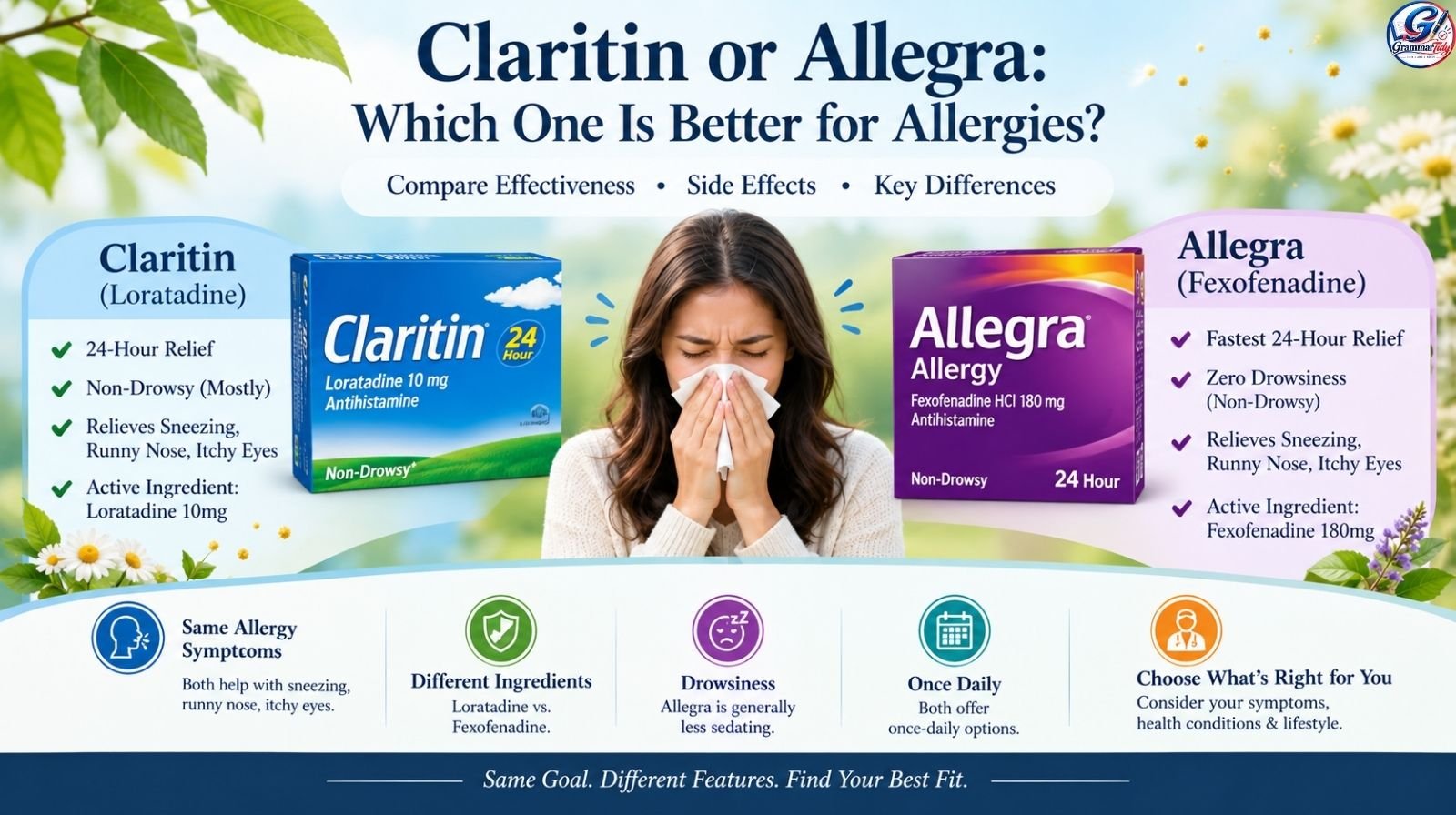
Claritin contains loratadine, while Allegra contains fexofenadine. Both are used for common upper-respiratory allergy symptoms, and current evidence does not show that one is universally best for everyone.
However, differences in sedation, symptom response, drug interactions, and personal tolerance can make one a better fit for a particular person.
This guide compares Claritin vs. Allegra in simple terms so you can understand how they work, which symptoms they may help most, their side effects, and when talking with a healthcare professional is especially important.
Medical note: This article is for general education, not a personal diagnosis or prescription. Always follow the product label or advice from your doctor or pharmacist, especially for children, pregnancy, kidney/liver disease, or medication interactions.
Also Read: Commit vs Comit: Correct Spelling And Usage
Claritin vs Allegra: Quick Answer

If you want the short version, neither Claritin nor Allegra is automatically better for everyone.
Claritin (loratadine) may be a reasonable choice if you want a once-daily second-generation antihistamine and particularly want relief from allergy-related eye symptoms.
A 2026 network meta-analysis found loratadine among the more effective oral antihistamines for ocular symptoms, although the researchers emphasized that differences between many second-generation antihistamines were small and uncertain.
Allegra (fexofenadine) can be especially attractive when minimizing sedation is a priority. Fexofenadine is generally considered one of the less-sedating options, and current evidence continues to support a relatively low sedative effect.
The better option depends on your symptoms, other medicines, health conditions, and how your body responds.
Claritin vs Allegra at a Glance
| Feature | Claritin | Allegra |
|---|---|---|
| Active ingredient | Loratadine | Fexofenadine |
| Drug class | Second-generation antihistamine | Second-generation antihistamine |
| Common allergy uses | Sneezing, runny nose, itchy/watery eyes, itchy nose/throat | Sneezing, runny nose, itchy/watery eyes, itchy nose/throat |
| Typical adult OTC tablet | 10 mg once daily in U.S. labeling | 180 mg once daily for the U.S. 24-hour product |
| Drowsiness | Usually low, but possible | Generally very low |
| Important interaction issue | Liver/kidney disease may require medical advice | Fruit juice and aluminum/magnesium antacids can interfere |
| Best-known practical advantage | Convenient once-daily option; useful for ocular symptoms | Very low sedation and convenient once-daily option |
| Universal winner? | No | No |
U.S. OTC labels vary by product and formulation, so always check the package you have.
What Are Claritin and Allegra, and How Do They Work?
Both medications are antihistamines. They work primarily by blocking histamine, a chemical involved in many allergy symptoms.
Claritin Contains Loratadine
Claritin’s active ingredient is loratadine. U.S. OTC labeling for loratadine 10 mg tablets lists temporary relief of symptoms such as runny nose, sneezing, itchy or watery eyes, and itching of the nose or throat.
For example, someone who starts sneezing and develops watery eyes every time they clean a dusty room may use a loratadine product according to its label.
Allegra Contains Fexofenadine
Allegra Allergy contains fexofenadine hydrochloride. The current U.S. label for the 180 mg product lists relief of runny nose, sneezing, itchy/watery eyes, and itching of the nose or throat associated with hay fever or other upper-respiratory allergies.
Both medications therefore target many of the same symptoms.
Also Read: Excited vs Exited: Learn The Difference And Usage
Why Are They Called Second-Generation Antihistamines?
Second-generation antihistamines were developed to provide allergy relief with less sedation than many older first-generation antihistamines.
Guidelines distinguish these less-sedating oral antihistamines from older antihistamines that are more likely to cross the blood-brain barrier and cause sedation.
That does not mean everyone will feel exactly the same after taking them. Individual responses can differ.
Claritin or Allegra: Which Is Better for Different Allergy Symptoms?

The most useful way to compare these medications is to consider what you actually want to control.
For Sneezing and Runny Nose
Both Claritin and Allegra are labeled for common hay-fever symptoms such as sneezing and a runny nose.
Neither should be viewed as a guaranteed winner.
For example, if your main problem is repeated sneezing every morning during pollen season, either may be an appropriate second-generation antihistamine option depending on your circumstances.
For Itchy or Watery Eyes
This is one area where the comparison becomes more interesting.
A 2026 network meta-analysis of oral antihistamines found that loratadine was among the more efficacious antihistamines for ocular symptoms. However, the researchers also found that differences between many second-generation antihistamines were small or uncertain.
So Claritin may be worth considering when itchy, watery eyes are a particularly troublesome part of your allergy symptoms.
For Daytime Alertness
If you need to stay alert for work, studying, driving, or other activities, sedation can be an important consideration.
Fexofenadine is generally considered one of the less-sedating antihistamines. The 2026 AAAAI summary of the latest evidence specifically notes that some antihistamines, including fexofenadine, display lower sedative effects.
Loratadine is also considered a less-sedating antihistamine, but drowsiness can still occur, particularly if you take more than directed.
Current loratadine labeling specifically warns that taking more than directed may cause drowsiness.
Also Read: Dysregulated vs Disregulated: Correct Usage Explained
Claritin vs Allegra: Effectiveness, Drowsiness, and Safety
This is where marketing claims can sometimes make the choice seem simpler than it really is.
Which One Is More Effective?
There is no strong evidence that Allegra universally beats Claritin or vice versa for all allergy sufferers.
A major 2026 network meta-analysis included 74 randomized controlled trials, including 21 studies involving perennial allergic rhinitis and 53 involving seasonal allergic rhinitis.
It found that some oral antihistamines performed better for particular outcomes, but most differences between individual second-generation antihistamines were small or trivial.
That is an important point: the “best” allergy medicine on paper may not be the best one for your body.
Which One Causes Less Drowsiness?
Fexofenadine has a particularly strong reputation for low sedation.
The latest 2026 evidence summary identified fexofenadine among antihistamines with lower sedative effects. However, “non-drowsy” does not mean that absolutely nobody will become sleepy.
Loratadine also has a relatively low sedation profile compared with older antihistamines, but its label warns that excessive dosing can cause drowsiness.
What About Safety?
Both belong to the second-generation antihistamine group and have generally favorable safety profiles when used as directed.
The 2026 network meta-analysis found similar frequencies of adverse events among different second-generation oral antihistamines, with serious adverse events being rare. However, the certainty of evidence for many individual comparisons was low or very low.
2025–2026 Evidence: What Does the Latest Research Say?
If you are searching for a 2026 answer to “Claritin or Allegra?”, the newest evidence is more nuanced than a simple winner-takes-all comparison.
The 2026 Network Meta-Analysis
A 2026 systematic review and network meta-analysis evaluated 74 randomized controlled trials of oral antihistamines for allergic rhinitis.
Researchers compared medications across nasal symptoms, ocular symptoms, quality of life, adverse effects, and serious adverse effects.
The findings included:
- 74 randomized controlled trials were included.
- 53 trials involved seasonal allergic rhinitis.
- 21 trials involved perennial allergic rhinitis.
- Different antihistamines appeared stronger for different outcomes.
- Loratadine was among the more effective medications for ocular symptoms.
- Fexofenadine was recognized for a relatively low sedative effect.
- Serious adverse events were rare.
- Most differences between individual second-generation antihistamines were small or trivial.
Also Read: Naive vs Nieve: Which Spelling Is Correct And How To Use It?
What This Means for You
The data do not support saying that everyone should switch from Claritin to Allegra or from Allegra to Claritin.
Instead, they support a more practical approach:
Choose based on the symptoms you need to control, sedation concerns, medical conditions, interactions, cost, availability, and your individual response.
This approach is also consistent with updated ARIA-EAACI guidance, which emphasizes individualized treatment decisions and recommends intranasal corticosteroids over oral antihistamines for allergic rhinitis overall when appropriate.
Case Study: Choosing Between Claritin and Allegra in Real Life
Imagine a 32-year-old office worker who develops seasonal allergies every spring. Her symptoms include frequent sneezing, a runny nose, itchy eyes, and an itchy throat. She needs to commute to work every morning and spends most of the day working at a computer.
She sees advertisements for both Claritin and Allegra and wonders which one is stronger.
Instead of assuming that one brand is automatically superior, she considers the factors that actually matter. Both loratadine and fexofenadine are second-generation antihistamines used for common upper-respiratory allergy symptoms.
Therefore, either could potentially address her sneezing, runny nose, and itchy eyes when used according to the appropriate label.
Because staying alert during the workday is especially important to her, the relatively low sedative effect associated with fexofenadine may make Allegra an attractive option.
Also Read: Really vs Realy: Which Is Correct? And Proper Usage
On the other hand, if ocular symptoms are her dominant complaint, the 2026 evidence showing loratadine among the more effective oral antihistamines for ocular symptoms could make Claritin worth considering.
If her symptoms remain poorly controlled, she should not simply keep increasing the dose. Current allergy guidance recognizes that intranasal corticosteroids can be more effective for allergic rhinitis, particularly when nasal symptoms are significant.
The lesson is simple: the best choice is not necessarily the brand with the biggest marketing claim it is the option that provides useful symptom control with an acceptable safety and convenience profile for that individual.
How to Choose: Claritin or Allegra?

Rather than memorizing a winner, use this simple decision guide.
Step 1: Identify Your Main Symptoms
Ask yourself what bothers you most:
- Sneezing?
- Runny nose?
- Itchy nose or throat?
- Watery or itchy eyes?
- Nasal congestion?
Both medications are labeled for several common allergy symptoms, but severe congestion may require a different treatment strategy.
Step 2: Consider Drowsiness
If staying alert is your biggest concern, fexofenadine may have an advantage because of its particularly low sedative profile.
Still, pay attention to how you personally respond.
Step 3: Check Your Other Medicines and Health Conditions
This step is easy to overlook.
For example, current U.S. fexofenadine labeling warns against taking it at the same time as aluminum- or magnesium-containing antacids and says not to take it with fruit juices.
It also advises people with kidney disease to ask a doctor because a different dose may be needed.
Loratadine labeling similarly advises people with liver or kidney disease to ask a doctor because a different dose may be necessary.
Step 4: Follow the Exact Product Label
Do not assume every Claritin or Allegra product has the same strength or dosing instructions.
For example, the current U.S. Allegra Allergy 180 mg label directs adults and children 12 years and older to take one 180 mg tablet with water once daily, while a U.S. loratadine 10 mg label directs adults and children 6 years and older to take one tablet daily. Different formulations and countries can have different instructions.
Also Read: Transferred vs Transfered: Which Is Correct?
Claritin vs Allegra: Which One Should You Pick?
Here is the practical takeaway:
| If your priority is… | Option worth considering |
|---|---|
| Very low sedation | Allegra / fexofenadine |
| Itchy or watery eyes | Claritin / loratadine may be useful |
| Once-daily convenience | Both have once-daily products |
| Sneezing and runny nose | Either may help |
| Strong nasal congestion | Ask about other allergy treatments |
| Kidney disease | Ask a healthcare professional before choosing |
| Liver disease | Ask a healthcare professional before choosing loratadine |
| Medication interactions | Check with a pharmacist/doctor |
This is not a prescription or a guarantee of individual effectiveness. The latest evidence supports the idea that differences among second-generation antihistamines are often relatively small, so personal response matters.
Important Things to Know Before Taking Claritin or Allegra

Do Not Assume “Non-Drowsy” Means Zero Risk of Sleepiness
Even less-sedating antihistamines can affect some people differently.
If you feel sleepy or impaired after taking an allergy medicine, avoid driving or operating machinery until you know how the medicine affects you.
Do Not Take More Than the Recommended Amount
More medication does not automatically mean more allergy relief.
Current loratadine and fexofenadine labels both instruct consumers not to exceed the recommended amount.
Check Combination Products Carefully
Some allergy products contain multiple active ingredients. Always read the Drug Facts label so you do not accidentally duplicate an ingredient.
Severe Allergic Reactions Are Different
Claritin and Allegra are intended for allergy symptoms such as those associated with hay fever. They are not a substitute for emergency treatment of anaphylaxis.
If someone develops severe trouble breathing, swelling of the tongue or throat, fainting, or other signs of a serious allergic reaction, seek emergency medical care immediately.
Mini Quiz: Claritin or Allegra
1. What is the active ingredient in Claritin?
Answer: Loratadine.
2. What is the active ingredient in Allegra?
Answer: Fexofenadine.
3. Are Claritin and Allegra second-generation antihistamines?
Answer: Yes.
4. Which one is generally associated with especially low sedation?
Answer: Allegra (fexofenadine).
5. Which allergy symptom may make loratadine an interesting option?
Answer: Itchy or watery eyes.
6. Is there one universal winner between Claritin and Allegra?
Answer: No.
7. What chemical do antihistamines primarily block?
Answer: Histamine.
8. What should you consider before choosing Claritin or Allegra?
Answer: Your symptoms, other medicines, health conditions, and personal response.
9. What can you consider if nasal congestion remains a major problem?
Answer: Other allergy treatments, such as an appropriate intranasal corticosteroid, with professional guidance.
10. Can fruit juice interfere with fexofenadine?
Answer: Yes.
11. How often is Allegra 180 mg typically labeled for adults and children 12+?
Answer: Once daily.
12. What does recent evidence say about differences between many second-generation antihistamines?
Answer: Many differences are relatively small or trivial.
13. Which two medicines does this article compare?
Answer: Claritin and Allegra.
14. What is one important safety rule when using either medicine?
Answer: Follow the product label.
15. What is the biggest takeaway from the comparison?
Answer: The better choice depends on the individual and their allergy symptoms.
FAQs
1. Is Allegra stronger than Claritin?
Not necessarily. Current evidence does not establish a universal winner. A 2026 network meta-analysis found that differences between many second-generation antihistamines were generally small or trivial, although individual medications performed differently for particular outcomes.
2. Is Claritin or Allegra better for itchy eyes?
Claritin’s active ingredient, loratadine, may be a reasonable option when eye symptoms are prominent. The 2026 evidence review found loratadine among the more efficacious oral antihistamines for ocular symptoms, although this does not mean it will work better for every person.
3. Which causes less drowsiness: Claritin or Allegra?
Allegra’s active ingredient, fexofenadine, is generally considered particularly low-sedating. Claritin is also a less-sedating second-generation antihistamine, but individual reactions vary.
4. Can you take Claritin and Allegra together?
Do not combine antihistamines unless a doctor or pharmacist specifically recommends it. Taking multiple medicines from the same class can increase the risk of unwanted effects without necessarily providing better relief.
5. Can you take Allegra with orange or apple juice?
The current U.S. Allegra Allergy label says not to take the product with fruit juices. It also warns against taking it at the same time as aluminum- or magnesium-containing antacids.
6. Is Claritin or Allegra better for nasal congestion?
Neither should automatically be considered the best treatment for significant congestion. Guidelines generally favor intranasal corticosteroids for allergic rhinitis, particularly when nasal symptoms affect quality of life.
7. When should I see a doctor about allergies?
Consider medical evaluation if your symptoms are severe, persistent, difficult to diagnose, interfering with sleep or daily life, or not improving with appropriate treatment. Allergy testing may also be useful when the diagnosis is uncertain or treatment is not working adequately.
Final Verdict:
So, Claritin or Allegra which one is better for allergies?
The most accurate answer is: it depends on the person and the symptoms.
Allegra (fexofenadine) may be the more appealing choice when minimizing drowsiness is a top priority. Claritin (loratadine) is another well-established second-generation antihistamine and may be particularly useful when eye symptoms are a major concern.
However, the latest 2026 evidence does not support treating either one as a universal winner.
If your main allergy problem is mild sneezing, itching, runny nose, or watery eyes, either may be reasonable when used according to its label.
If congestion is your biggest problem or symptoms continue despite treatment, an oral antihistamine may not be enough, and an intranasal corticosteroid or professional evaluation may be more appropriate.
Bottom line: choose based on symptom pattern, sedation concerns, health conditions, interactions, and how you respond not simply on which brand sounds stronger.
Discover More Article
- Lead or Led? The Mistake Even Editors Make
- Pre vs Post: What’s The Real Difference? (With 100+ Examples)
- 31st or 31th: Which Is Correct? Meaning, Rules & Examples
- Zyrtec or Benadryl: Which One Should You Actually Take?
Keep learning with more easy grammar lessons on GrammarTidy.com

Hi, I’m Noor Fatima, the author and creator of Grammar Tidy. I’m passionate about grammar, writing, and making language learning simple and enjoyable. Through Grammar Tidy, I share helpful tips, clear explanations, and practical guidance to help readers improve their writing, avoid common mistakes, and communicate with confidence. My goal is to make better grammar easy, useful, and accessible for everyone.