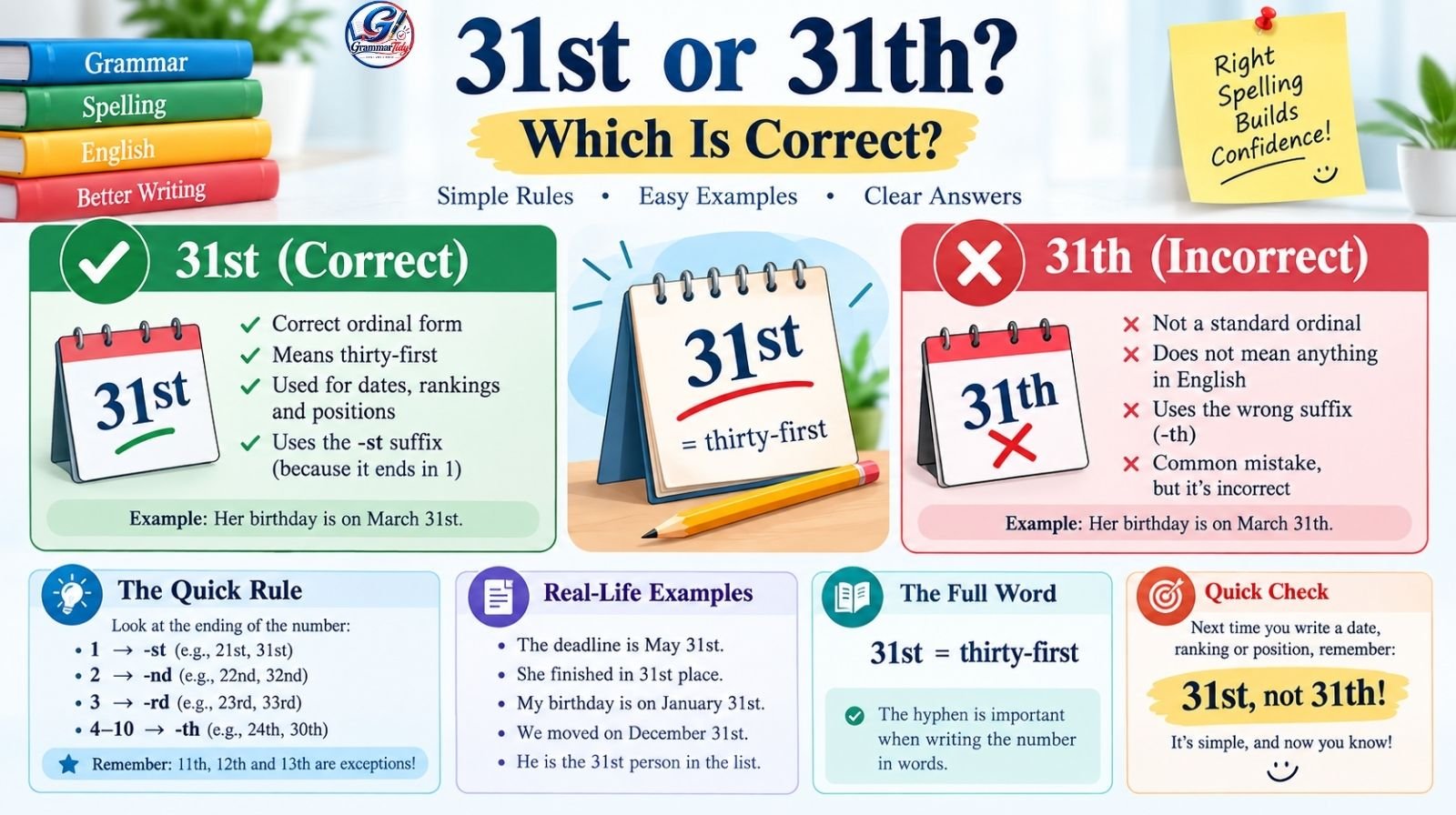
Have you ever stopped while writing a date or ranking and wondered whether it should be 31st or 31th? It is an easy mistake to make because many English ordinal numbers use -th. However, 31st is the correct form, while 31th is incorrect in standard English.
The reason is simple: 31 ends in 1, so its ordinal form uses -st. The complete word is thirty-first. Cambridge defines an ordinal number as a number that shows position in a sequence, such as 1st, 2nd, or 3rd.
In this guide, you will learn exactly why 31st is correct, when to use it, common mistakes, date examples, and a simple trick for remembering the rule.
Also Read: Soder or Solder? Easy Guide with Simple Words And Clear Examples
31st or 31th: Which Is Correct?
The correct form is 31st.
31st = thirty-first
31th = incorrect
The suffix -st represents the ending in first. Because 31 is written as thirty-one, its ordinal form becomes thirty-first, abbreviated as 31st.
Why 31st Is Correct
English ordinal numbers indicate position or order. For example:
- 1st = first
- 2nd = second
- 3rd = third
- 4th = fourth
- 21st = twenty-first
- 31st = thirty-first
The pattern is especially useful for numbers ending in 1, 2, or 3, although 11, 12, and 13 are important exceptions.
Why 31th Is Incorrect
31th incorrectly combines the number 31 with the general -th ending.
For example:
❌ I finished in 31th place.
✅ I finished in 31st place.
The correct word is thirty-first, not “thirty-oneth” or a form corresponding to “31th.”
What Does 31st Mean?
31st is the ordinal form of the cardinal number 31. It tells us that something is in the thirty-first position.
31st as an Ordinal Number
Cardinal numbers tell us how many:
There are 31 students in the class.
Ordinal numbers tell us which position:
Sarah is the 31st student on the list.
Cambridge explains that ordinal numbers are used to show position in a sequence.
31st Written in Words
The full spelling is:
31st → thirty-first
Notice the hyphen in thirty-first. Ordinal numbers formed from numbers such as 21, 31, 41, and 51 are written as compound words when spelled out.
Examples:
- 21st → twenty-first
- 31st → thirty-first
- 41st → forty-first
- 51st → fifty-first
- 61st → sixty-first
Also Read: Zyrtec or Benadryl: Which One Should You Actually Take?
The Easy Rule for 31st and Other Ordinal Numbers
The easiest way to choose the correct suffix is to look at the ending of the number.
The 1st, 2nd, 3rd, 4th Rule
Generally:
| Number Ending | Suffix | Example |
|---|---|---|
| 1 | -st | 21st, 31st |
| 2 | -nd | 22nd, 32nd |
| 3 | -rd | 23rd, 33rd |
| Other endings | -th | 24th, 25th, 30th |
So:
31 → ends in 1 → 31st
This same pattern appears in standard ordinal-number charts: 21st, 22nd, 23rd, 30th, 31st, 32nd, and 33rd.
Remember the 11, 12, and 13 Exception
There is one important catch.
Numbers ending in 11, 12, or 13 always use -th:
- 11th = eleventh
- 12th = twelfth
- 13th = thirteenth
- 111th
- 112th
- 113th
Therefore:
31 → 31st
32 → 32nd
33 → 33rd
But:
11 → 11th, not 11st
12 → 12th, not 12nd
13 → 13th, not 13rd
This exception is why simply looking at the final digit is not always enough.
31st in Dates: How Should You Use It?
One of the most common places you’ll see 31st is in dates.
Correct Date Examples
Here are natural examples:
- My birthday is on March 31st.
- The deadline is December 31st.
- The meeting is scheduled for the 31st of October.
- She moved to the city on January 31st.
- The competition ends on May 31st.
However, date style varies between formal and informal writing. Some style systems prefer writing dates with cardinal numerals, such as March 31, 2026, rather than March 31st, 2026.
Grammarly notes that formal date writing can use cardinal numbers, while ordinal forms are appropriate in constructions such as “the 10th of June.”
Also Read: Lead or Led? The Mistake Even Editors Make
31st vs. 31 in Dates
Both can appear depending on the style:
Informal/common style:
The event is on March 31st.
Formal date style:
The event is on March 31, 2026.
The important point is that if you choose the ordinal form, it is 31st, never 31th.
31st vs 31th: Quick Comparison

| Feature | 31st | 31th |
|---|---|---|
| Correct English? | ✅ Yes | ❌ No |
| Ordinal number | ✅ Yes | ❌ No |
| Full form | Thirty-first | Incorrect |
| Correct suffix | -st | -th |
| Used for position? | ✅ Yes | ❌ No |
| Used in ordinal dates? | ✅ Yes | ❌ No |
| Example | 31st place | 31th place |
Correct vs. Incorrect Examples
Correct:
She finished in 31st place.
Incorrect:
She finished in 31th place.
Correct:
The deadline is 31st May.
Incorrect:
The deadline is 31th May.
Correct:
This is my 31st birthday.
Incorrect:
This is my 31th birthday.
Common Mistakes With 31st
Understanding the rule is easy, but several related mistakes appear in everyday writing.
Writing 31th Instead of 31st
This is the main mistake:
❌ 31th
✅ 31st
The reason is usually that writers remember that many ordinal numbers end in -th and apply that ending too broadly.
Also Read: Caraway vs GreenPan: A Complete Cookware Comparison Guide
Confusing 31st With 30th
Remember:
30 → thirtieth → 30th
31 → thirty-first → 31st
32 → thirty-second → 32nd
The suffix changes because the final part of the number changes.
Forgetting the Hyphen in Thirty-First
When writing the number completely in words, use:
✅ thirty-first
Not:
❌ thirty first
For compound ordinal numbers such as twenty-first and thirty-first, the hyphen helps connect the two parts.
A Real-Life Case Study: The 31th Mistake in a Business Schedule
Imagine a small business preparing an email about an important monthly deadline. An employee writes:
“Please submit all documents by the 31th of December.”
At first glance, the message is perfectly understandable. The recipient will probably know that the writer means December 31.
However, the incorrect ordinal form can make the email look less polished, especially when it is being sent to a client, manager, university, or business partner.
The employee checks the wording and changes it to:
“Please submit all documents by the 31st of December.”
That small correction makes the sentence grammatically standard.
The lesson is useful beyond this single date. When writing an ordinal number, don’t automatically add -th. First check the ending. Since 31 ends in 1 and is pronounced thirty-first, the abbreviated form is 31st.
The same check can prevent similar mistakes with 21st, 41st, 51st, and 61st. At the same time, remember the special teen endings: 11th, 12th, and 13th.
This quick two-step check is particularly useful when writing dates, rankings, schedules, reports, and formal emails.
Also Read: Pre vs Post: What’s The Real Difference? (With 100+ Examples)
What Does Current Usage Tell Us?
There is no meaningful grammar debate in current standard English over whether 31st or 31th is correct: 31st is the established ordinal form.
Current educational references continue to list 31st = thirty-first and distinguish it from numbers such as 30th and 32nd.
2025–2026 Writing and Style Context
Modern writing tools and style guidance continue to emphasize consistency when handling numbers, dates, and ordinal forms.
Grammarly notes that different style guides may have different preferences for writing numbers, but consistency within a document is important.
For practical writing in 2025–2026, the takeaway is straightforward:
31st is the standard ordinal abbreviation.
If you are writing a formal document, follow the style guide required by your organization or publication. But when you need the ordinal form of 31, use 31st, not 31th.
How to Remember 31st Easily
You don’t need to memorize dozens of ordinal numbers.
Use the “First” Trick
Think of the complete word:
31 = thirty-one
Change one → first:
thirty-one → thirty-first
Then shorten it:
thirty-first → 31st
That’s it.
Use This Mini Pattern
Memorize this sequence:
21st → 22nd → 23rd → 24th
Then:
31st → 32nd → 33rd → 34th
The endings follow the same pattern.
1 = st
2 = nd
3 = rd
4–10 = th
Just remember the 11–13 exception.
Also Read: Eaten or Aten? The Correct Spelling Explained Simply
Mini Quiz: 31st or 31th
1. Quick Check: Which One Is Correct?
31st or 31th?
Answer: 31st ✅
2. What Is the Full Form of 31st?
Can you spell it out?
Answer: Thirty-first ✅
3. Pick the Correct Birthday!
Which sentence is right?
A. She celebrated her 31th birthday.
B. She celebrated her 31st birthday.
Answer: B 31st birthday ✅
4. What Comes After 30th?
30th → ? → 32nd
Answer: 31st ✅
5. Fill in the Date!
“The event will take place on March ___.”
Answer: 31st ✅
6. Which Suffix Belongs to 31?
Should 31 take -st or -th?
Answer: -st → 31st ✅
7. Spot the Mistake!
“John finished in 31th place.”
What needs fixing?
Answer: 31th → 31st ✅
8. What Does 31st Mean?
Does 31st show a quantity or a position?
Answer: A position or order thirty-first ✅
9. Complete the Pattern!
21st → 22nd → 23rd → ___
Answer: 24th ✅
10. Which One Sounds Right?
A. Thirty-oneth
B. Thirty-first
Answer: B thirty-first ✅
11. Date Challenge!
Which is the correct ordinal form?
31 May → 31st May or 31th May?
Answer: 31st May ✅
12. Watch the Teen Exception!
Which is correct?
A. 11st
B. 11th
Answer: B 11th ✅
13. What About 32?
Which form is correct?
A. 32st
B. 32nd
C. 32th
Answer: B 32nd ✅
14. Complete This Sentence!
“She came in ___ place in the competition.”
Choose: 31st or 31th.
Answer: 31st place ✅
15. Final Boss: Remember the Rule!
Which statement is correct?
A. 31 ends in 1, so it normally uses -st.
B. Every number ending in 1 uses -th.
Answer: A 31st is correct because it means thirty-first. ✅
FAQs
1. Is 31st correct or 31th?
31st is correct. It is the abbreviated ordinal form of thirty-first. 31th is incorrect in standard English.
2. Why is 31st not 31th?
Because 31 is thirty-first. Ordinal numbers ending in 1 generally take -st, except numbers ending in 11, which use -th.
3. Is it 31st birthday or 31th birthday?
The correct expression is 31st birthday.
She celebrated her 31st birthday.
4. Is January 31st correct?
Yes, January 31st is grammatically acceptable in styles that use ordinal dates. In some formal styles, January 31 may be preferred.
5. How do you spell 31st in words?
31st is spelled thirty-first.
6. What is the rule for 31st, 32nd, and 33rd?
The endings are based on the final number:
- 31st = thirty-first
- 32nd = thirty-second
- 33rd = thirty-third
But remember that 11th, 12th, and 13th are exceptions.
Final Answer:
If you’re wondering “31st or 31th: which is correct?”, the answer is simple: 31st is correct, and 31th is incorrect.
The full ordinal form is thirty-first, so the abbreviation is 31st. The easiest rule is to use -st for numbers ending in 1, -nd for 2, and -rd for 3 while remembering the special 11th, 12th, and 13th exception.
So the next time you write a date, ranking, birthday, deadline, or position, choose 31st confidently.
Remember: 31 → thirty-first → 31st.
Discover More Article
- Honour or Honor: Which Spelling Should You Use?
- Where to Watch Deal or No Deal Island: Streaming Guide
- Yuwen Win or Lose: Does Yuwen Win or Lose?
- Worse or Worst: What Is The Difference?
Keep learning with more easy grammar lessons on GrammarTidy.com

Hi, I’m Noor Fatima, the author and creator of Grammar Tidy. I’m passionate about grammar, writing, and making language learning simple and enjoyable. Through Grammar Tidy, I share helpful tips, clear explanations, and practical guidance to help readers improve their writing, avoid common mistakes, and communicate with confidence. My goal is to make better grammar easy, useful, and accessible for everyone.