
Have you ever typed “comit” and wondered whether it should actually be “commit”? You’re not alone. This is a common spelling mistake, especially because the pronunciation does not clearly reveal the double t.
The correct spelling is commit. Comit is not the standard English spelling of this word. In this guide, we’ll explain the difference between commit vs comit, show you how to use commit correctly, and cover the verb’s most common forms so you can avoid similar spelling errors.
Commit vs Comit: Which Spelling Is Correct?
The correct spelling is commit, with two t’s.
Comit is an incorrect spelling when you mean the English verb commit. Major English dictionaries list commit as the standard form, with meanings including doing something wrong or illegal, promising or dedicating yourself to something, and giving time or resources to a purpose.
Commit Is the Correct Word
Use commit when you want to describe making a firm decision, dedicating yourself to something, or carrying out an action.
Examples:
- I decided to commit to my new study schedule.
- She wants to commit more time to the project.
- He refused to commit to a specific deadline.
- The suspect was accused of committing a crime.
Also Read: Dysregulated vs Disregulated: Correct Usage Explained
Comit Is a Spelling Mistake
In standard English, comit is not the correct spelling of the verb.
For example:
❌ I need to comit to this plan.
The correct version is:
✅ I need to commit to this plan.
If you’re writing an email, essay, report, résumé, or professional document, always use commit.
What Does Commit Mean?
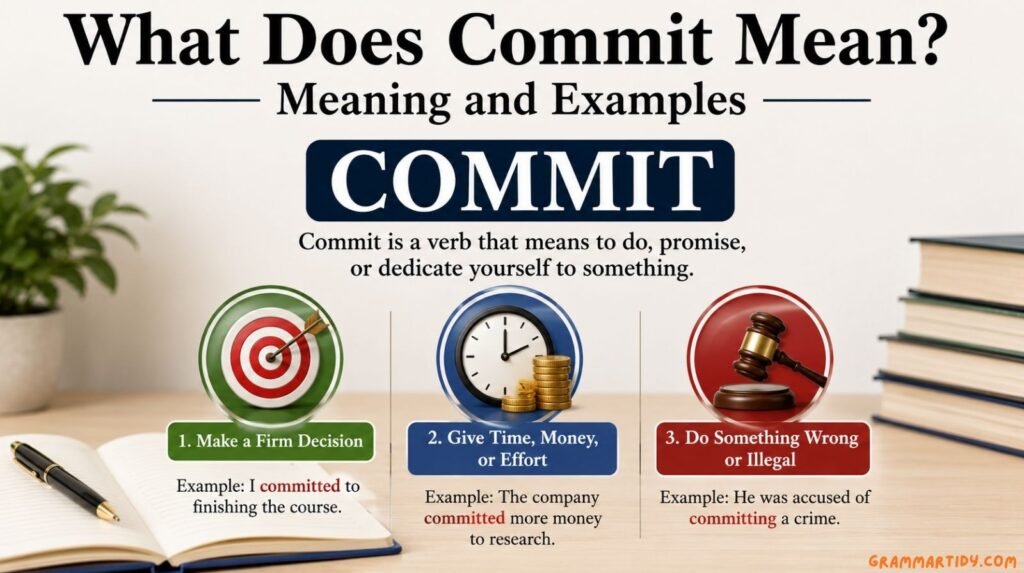
The word commit is a verb with several related meanings. Its exact meaning depends on the context.
Commit Meaning: Make a Firm Decision
One common meaning is to promise or decide firmly to do something.
For example:
- She committed to finishing the course.
- They committed themselves to improving customer service.
- I can’t commit to working every weekend.
In this sense, commit often appears with to.
Commit Meaning: Give Time, Money, or Effort
You can also use commit when dedicating resources to something.
For example:
- The company committed more money to research.
- He committed several hours to studying.
- The team committed additional resources to the project.
Cambridge Dictionary similarly defines commit in contexts involving dedicating money, time, or other resources to a particular purpose.
Commit Meaning: Do Something Wrong
Another important meaning is to carry out an illegal or seriously wrong action.
For example:
- The criminal committed a serious offence.
- She was accused of committing fraud.
- He did not commit the crime.
This is why expressions such as commit a crime, commit fraud, and commit an offence are common in English.
Commit vs Comit: Common Spelling Forms
Understanding the different forms of commit makes the spelling easier to remember.
The Correct Forms of Commit
Here is a quick reference:
| Form | Correct Spelling | Example |
|---|---|---|
| Base form | commit | I will commit to the plan. |
| Third-person singular | commits | She commits to her goals. |
| Past tense | committed | He committed to the project. |
| Past participle | committed | They have committed to the change. |
| Present participle | committing | She is committing more time to it. |
Notice that the double t remains important when the ending changes.
Cambridge’s grammar guidance specifically notes that the past and past participle forms are committed, not comited, while the -ing form is committing.
Also Read: Naive vs Nieve: Which Spelling Is Correct And How To Use It?
Why Does Commit Double the T?
The spelling follows a familiar English pattern in which certain short stressed verbs double their final consonant before endings such as -ed and -ing.
Compare:
- commit → committed
- commit → committing
- admit → admitted
- admit → admitting
- permit → permitted
- permit → permitting
Therefore, writing comited or comiting is incorrect when you mean the forms of commit.
Commit vs Comit: Examples in Real Sentences
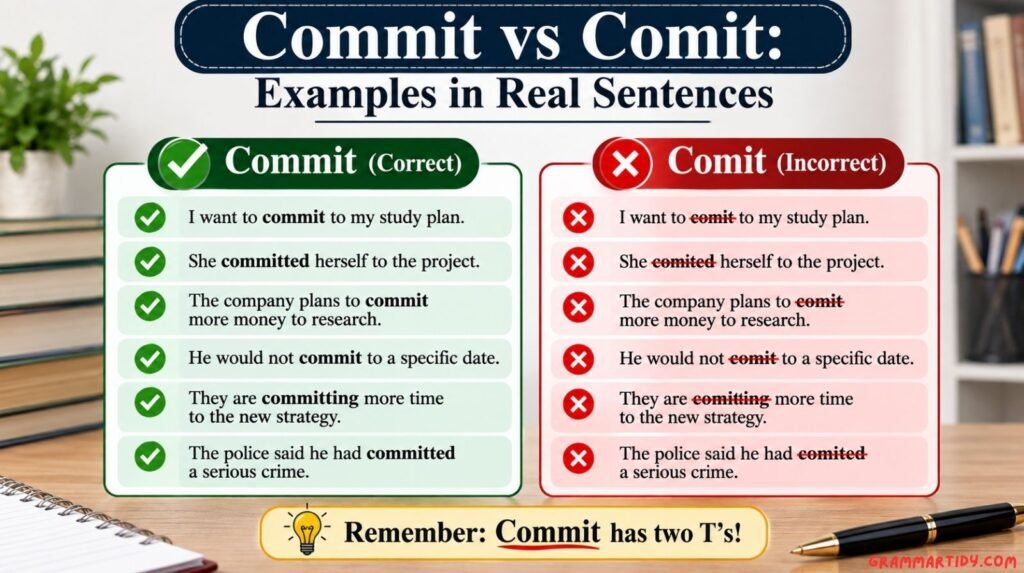
Seeing the word in context is one of the easiest ways to remember the correct spelling.
Examples With Commit
Here are several natural examples:
- I want to commit to exercising three times a week.
- She committed herself to completing the assignment.
- The company plans to commit more money to development.
- He would not commit to a specific date.
- The investigation found evidence that he had committed the offence.
These examples show that commit can be used in personal, professional, financial, and legal contexts.
Examples With Committed
The past tense and past participle require the double t:
- We committed to the new strategy last month.
- She committed herself to learning Spanish.
- The organization has committed significant resources to the program.
Not:
❌ We comited to the new strategy.
Instead:
✅ We committed to the new strategy.
Examples With Committing
The same spelling principle applies to the -ing form:
- They are committing more resources to the project.
- He is committing himself to a difficult goal.
- The company is committing to better environmental practices.
Not:
❌ The company is comiting to the plan.
Correct:
✅ The company is committing to the plan.
A Real-Life Example of the Commit Spelling Mistake
Imagine a university student named Daniel preparing an important application for an internship. He writes a paragraph explaining his dedication to professional development:
“I am ready to comit my time and energy to learning new skills.”
The sentence communicates the right idea, but comit is misspelled. Because the application is formal, the error could make the writing look less polished.
Daniel checks the spelling and changes the sentence to:
“I am ready to commit my time and energy to learning new skills.”
Also Read: Really vs Realy: Which Is Correct? And Proper Usage
He then notices another useful pattern. If he talks about a decision he has already made, he needs the past form:
“I committed my time to learning new skills.”
And if he describes something happening now:
“I am committing more time to professional development.”
This small example demonstrates why learning only the base spelling isn’t always enough. The entire word family follows a consistent pattern: commit → committed → committing.
In professional writing, these details matter because readers expect familiar words to follow standard spelling conventions. A spell-checker may catch comit, but understanding the pattern yourself is more useful because it also helps prevent related mistakes such as comited and comiting.
What Current Language and Search Guidance Tells Us
There isn’t a meaningful 2025–2026 statistical dataset showing how many people misspell commit as comit. Search-volume estimates for a very specific spelling error can also vary considerably by country, search engine, and keyword database. It would therefore be misleading to invent a percentage or claim that a particular number of people make this mistake.
2025–2026 Data and Guidance
What we can verify is that current authoritative language resources continue to recognize commit as the standard spelling. Cambridge’s current dictionary entry gives commit as the verb and shows its pronunciation and grammatical forms, including committed and committing.
Google’s current Search guidance, updated in December 2025, also emphasizes helpful, reliable, people-first content and specifically advises creators to avoid spelling and stylistic errors.
Google further explains that its helpful-content system became part of its core ranking systems in March 2024.
So, for a spelling article such as this one, the most useful evidence is authoritative dictionary information rather than an unsupported estimate of how frequently people type comit.
Also Read: Transferred vs Transfered: Which Is Correct?
How to Remember the Correct Spelling of Commit

A simple memory trick can help you avoid the comit mistake.
Think: Commit Has Two T’s
Break the word visually into:
com + mit
Then remember:
commit = double T
You can also connect it with its related forms:
commit → committed → committing
The double t is easy to spot when you write the complete word family together.
Use This Quick Checklist
Before submitting an important piece of writing, check:
- ✅ commit
- ❌ comit
- ✅ committed
- ❌ comited
- ✅ committing
- ❌ comiting
This is especially useful when proofreading essays, emails, business documents, and applications.
1. Quick Spell Check: Which One Is Correct?
A) Comit
B) Commit
C) Committ
D) Comitt
Answer: B) Commit
“Commit” is the correct spelling. “Comit” is a common spelling mistake.
2. Fill in the Gap
“I decided to ___ to my study plan.”
A) comit
B) commit
C) committ
D) comittt
Answer: B) commit
The correct verb is commit, with two t’s.
3. Spot the Mistake
Which sentence is written correctly?
A) I will comit to the project.
B) I will commit to the project.
C) I will comitt to the project.
D) I will comitted to the project.
Answer: B) I will commit to the project.
“Commit” is the correct base form.
4. Double-T Challenge
How many t’s are in the correct spelling of “commit”?
A) One
B) Two
C) Three
D) Four
Answer: B) Two
Remember: commit = two t’s.
5. Choose the Correct Past Form
“She ___ herself to the new project.”
A) comited
B) commit
C) committed
D) commiting
Answer: C) committed
The correct past form is committed, with double t.
6. Which -ing Form Is Right?
“They are ___ more time to the project.”
A) comiting
B) committing
C) commiting
D) comitted
Answer: B) committing
The correct -ing form is committing.
7. Meaning Match
What does “commit to a goal” usually mean?
A) Forget the goal
B) Avoid the goal
C) Dedicate yourself to the goal
D) Change the goal
Answer: C) Dedicate yourself to the goal
To commit to something means to make a firm decision or dedication.
8. Which Sentence Sounds Natural?
A) She committed to learning English.
B) She comited to learning English.
C) She commited to learning English.
D) She comit to learning English.
Answer: A) She committed to learning English.
“Committed to” is the correct past-tense construction.
9. Crime Context Check
Which sentence uses “commit” correctly?
A) He committed a crime.
B) He comited a crime.
C) He commited a crime.
D) He comiting a crime.
Answer: A) He committed a crime.
“Commit” can mean to carry out an illegal or wrongful action.
Also Read: Symptomatology vs Symptomology: Differences, Meaning, And Usage
10. Complete the Word Family
Which group contains only correct forms?
A) commit, commited, comiting
B) comit, committed, committing
C) commit, committed, committing
D) comitt, comitted, commiting
Answer: C) commit, committed, committing
These are the standard forms of the word.
11. Find the Correct Sentence
Which sentence should you use in a professional email?
A) I am ready to comit my time.
B) I am ready to commit my time.
C) I am ready to committ my time.
D) I am ready to comitted my time.
Answer: B) I am ready to commit my time.
Professional writing should use the standard spelling commit.
12. Past or Present?
Which sentence is grammatically correct?
A) I committed to the plan yesterday.
B) I committted to the plan yesterday.
C) I comited to the plan yesterday.
D) I comit to the plan yesterday.
Answer: A) I committed to the plan yesterday.
“Yesterday” calls for the past form committed.
13. The Tricky One
Which spelling is correct?
A) Comiting
B) Committed
C) Comited
D) Comit
Answer: B) Committed
“Committed” correctly keeps the double t.
14. One-Second Grammar Test
Choose the correct sentence:
A) They are committing to the plan.
B) They are comiting to the plan.
C) They are commiting to the plan.
D) They are comitted to the plan.
Answer: A) They are committing to the plan.
The present participle of commit is committing.
15. Final Challenge: Remember This Rule
Which statement is correct?
A) Comit is the standard spelling.
B) Commit is correct, but committed has one t.
C) Commit, committed, and committing use the double-t pattern.
D) Commit is only used for crimes.
Answer: C) Commit, committed, and committing use the double-t pattern.
That simple pattern helps you avoid the most common spelling mistakes with commit.
FAQs
Q1. Is “comit” a correct spelling?
A: No. If you mean the English verb meaning to dedicate yourself to something or carry out an action, the correct spelling is commit.
Q2. Is it commit or comit?
A: It is commit, with two t’s. Comit is a misspelling.
Q3. Why does commit have two T’s?
A: The standard spelling of the verb is commit, and the double t is retained in forms such as committed and committing. Cambridge specifically identifies these as the correct forms.
Committed is correct, with two t’s. For example: “She committed to the project.”
Q4. Is “comiting” correct?
A: No. The correct -ing form is committing, with two t’s.
Q5. What is the difference between commit and committed?
A: Commit is the base form, while committed is its past tense and past participle.
For example:
- Present: “I commit to this goal.”
- Past: “I committed to this goal.”
Conclusion:
When comparing commit vs comit, the answer is straightforward: commit is the correct spelling, while comit is a spelling mistake in standard English.
Remember the main forms:
- commit
- commits
- committed
- committing
The double t is the key detail. Whether you’re talking about committing to a goal, committing resources to a project, or committing an offence, commit is the spelling you should use.
For polished writing, take a moment to check these forms before publishing or submitting your work. If you remember one thing from this guide, remember this: commit has two T’s.
Quick tip: Save this page for future reference whenever you’re unsure about commit vs comit, and check the related forms before you hit publish.
Keep learning with more easy grammar lessons on GrammarTidy.com

Hi, I’m Noor Fatima, the author and creator of Grammar Tidy. I’m passionate about grammar, writing, and making language learning simple and enjoyable. Through Grammar Tidy, I share helpful tips, clear explanations, and practical guidance to help readers improve their writing, avoid common mistakes, and communicate with confidence. My goal is to make better grammar easy, useful, and accessible for everyone.