If you have ever wondered about symptomatology vs symptomology, you are not alone. The two terms look almost identical, sound similar, and are sometimes used interchangeably. However, there is an important distinction in standardness and usage, particularly in medical and academic writing.
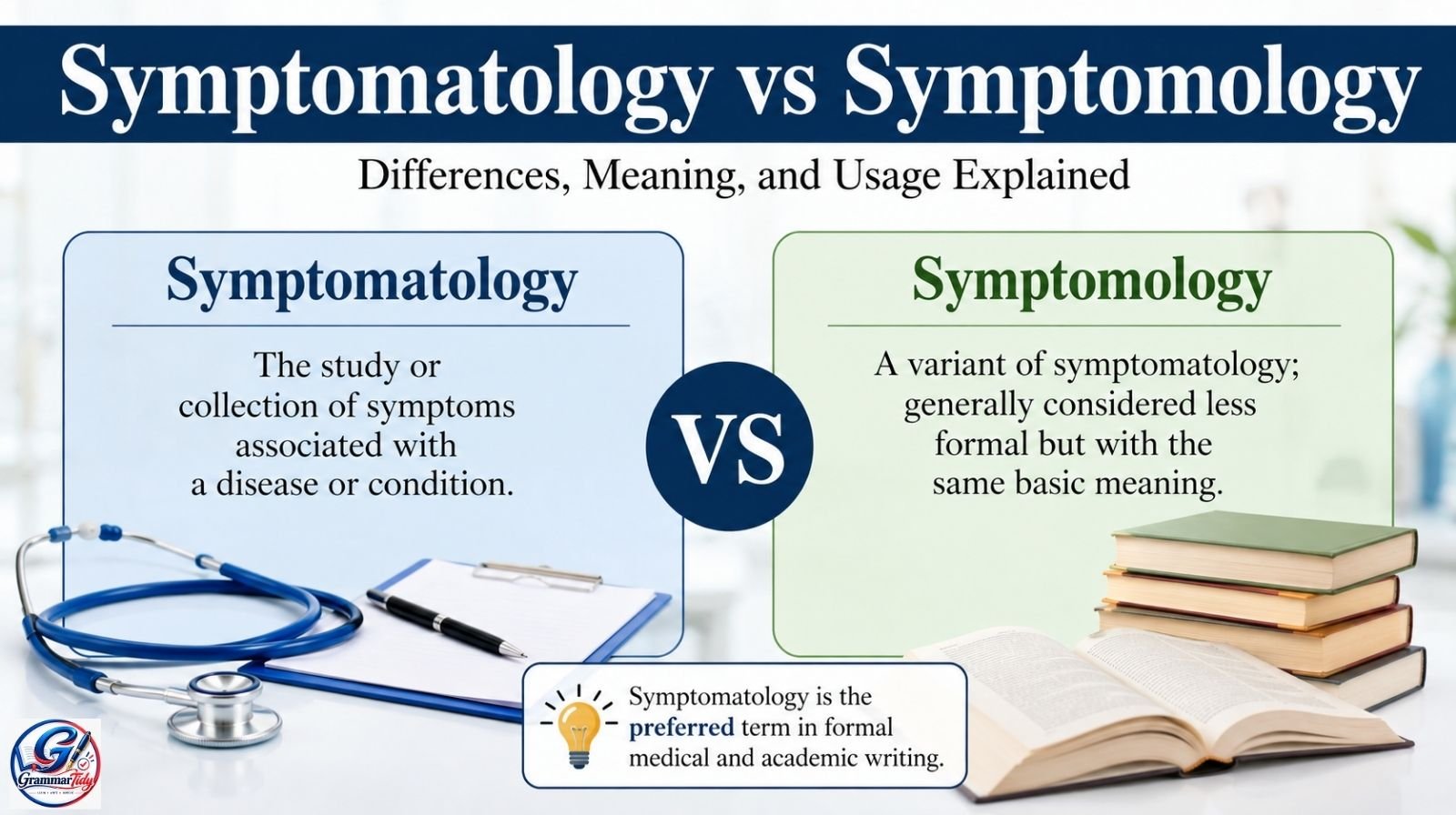
Symptomatology is the established medical term. It can refer to the study of symptoms or, depending on context, the collection or pattern of symptoms associated with a disease. Symptomology, meanwhile, is generally treated as an informal variant of symptomatology. Collins lists symptomology as a British English variant, while other reference sources characterize it as informal.
This guide explains the difference between symptomatology and symptomology, shows how each word is used, and gives practical examples so you can choose the right term confidently.
What Is the Difference Between Symptomatology and Symptomology?
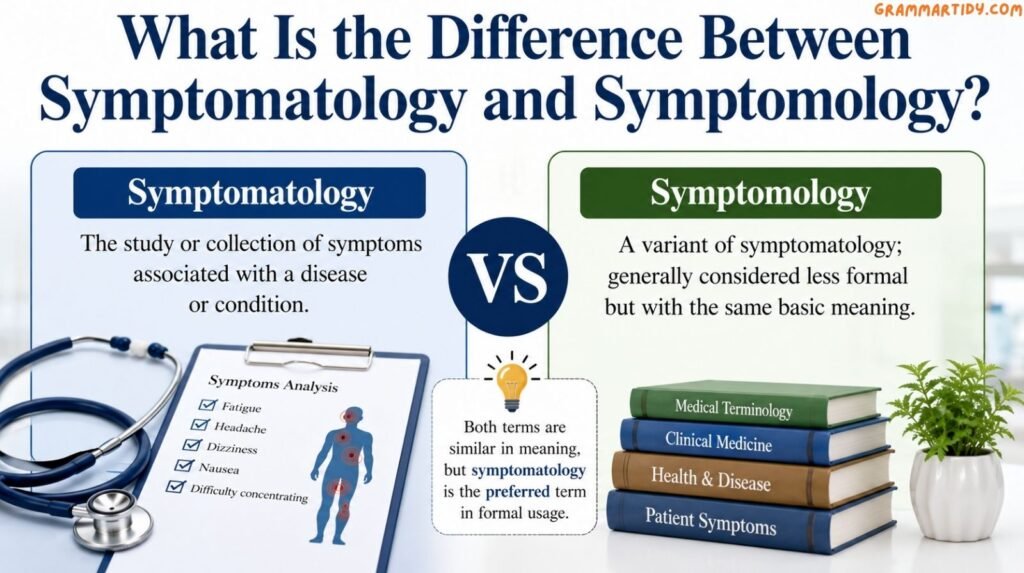
The simplest answer is that symptomatology is the more established and preferred term in formal medical and scientific writing, while symptomology is a less formal variant.
Symptomatology meaning
Symptomatology has two closely related meanings:
- The study or classification of symptoms associated with disease.
- The collective pattern or complex of symptoms experienced with a particular disease or condition.
Merriam-Webster defines symptomatology as both the “symptom complex of a disease” and a branch of medical science concerned with symptoms of disease.
For example:
The patient’s symptomatology was consistent with a neurological disorder.
Here, symptomatology refers to the overall pattern of symptoms rather than one individual symptom.
Symptomology meaning
Symptomology is generally used as a shortened or informal form of symptomatology. Its meaning is essentially the same.
For example:
The clinician reviewed the patient’s symptomology before considering possible diagnoses.
The sentence is understandable, but in a formal clinical report, academic paper, or scientific publication, symptomatology is usually the safer choice.
Wiktionary explicitly labels symptomology as an informal synonym of symptomatology, while Collins recognizes it as a British English variant.
Quick comparison
| Feature | Symptomatology | Symptomology |
|---|---|---|
| Basic meaning | Study or collective pattern of symptoms | Same basic concept |
| Formal medical usage | Preferred | Less formal |
| Academic writing | Recommended | Usually avoid if precision matters |
| General writing | Appropriate | Can be used |
| Dictionary recognition | Well established | Recognized as a variant |
| Best choice for professional writing | Yes | Usually no |
Bottom line: If you need one word for professional, medical, or academic writing, choose symptomatology.
Symptomatology vs Symptomology: Why Does the Difference Matter?
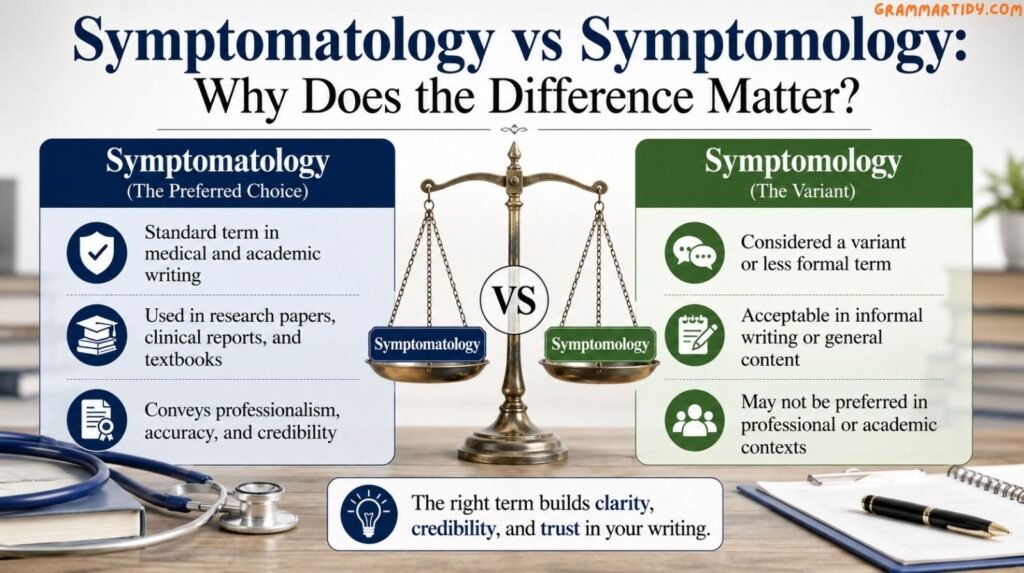
The difference matters less because of meaning and more because of register, convention, and audience expectations.
Symptomatology is the standard professional choice
Medical terminology often favors established technical vocabulary. Symptomatology has a long history in medical language and remains the term used by major dictionaries and specialist references.
Cambridge Dictionary describes symptomatology as a specialized medical noun referring to all the symptoms associated with a particular disease.
For example:
- “The study examined the clinical symptomatology of depression.”
- “Changes in symptomatology were recorded over six months.”
- “The patient’s symptomatology changed following treatment.”
These constructions sound natural in clinical and academic contexts.
Also Read: Naive vs Nieve: Which Spelling Is Correct And How To Use It?
Symptomology is understandable but less formal
Symptomology is not simply meaningless or automatically “wrong.” It is a recognized English word. Its problem is that its status and usage are less consistent.
Collins, for example, lists symptomology alongside symptomatology in British English.
That means calling it an absolute spelling error would be misleading.
Instead, think of the distinction this way:
Symptomatology = established, formal, preferred medical terminology
Symptomology = recognized but generally more informal or variant terminology
When precision matters
Choose symptomatology when writing:
- Medical research papers
- Clinical documentation
- Healthcare websites
- Academic assignments
- Medical textbooks
- Scientific reports
- Professional presentations
For casual communication, symptomology may be understood without difficulty.
How to Use Symptomatology Correctly
Understanding the definition is only half the challenge. The next step is knowing how symptomatology works naturally in a sentence.
Common symptomatology examples
Here are several examples:
Medical research:
Researchers examined the symptomatology associated with long-term neurological disease.
Clinical context:
The patient’s symptomatology included persistent fatigue, dizziness, and difficulty concentrating.
Psychology:
The researchers measured depressive symptomatology using standardized assessment tools.
Disease description:
The symptomatology of the condition can vary considerably between patients.
Cambridge provides similar medical usage, including examples involving depressive symptomatology and changes in a patient’s symptoms before surgery.
Symptomatology does not mean one symptom
One common mistake is using symptomatology when you simply mean symptom.
For example:
❌ The patient’s symptomatology was a headache.
A better sentence would be:
✅ The patient’s primary symptom was a headache.
However:
✅ The patient’s symptomatology included headaches, dizziness, fatigue, and visual disturbances.
The second sentence describes a pattern or collection of symptoms, which is where symptomatology becomes useful.
Symptomatology vs symptoms
A useful way to remember the distinction is:
Symptom = an individual experience or indication
Symptoms = multiple individual experiences or indications
Symptomatology = the overall pattern, complex, or study of those symptoms
Merriam-Webster defines a symptom as subjective evidence of disease or physical disturbance observed by the patient.
Also Read: Really vs Realy: Which Is Correct? And Proper Usage
Real-Life Example: How the Two Terms Work in Practice
Imagine a patient visits a clinic because of several weeks of fatigue, headaches, difficulty sleeping, and problems concentrating.
During the consultation, the doctor records each individual complaint. Fatigue is a symptom. Headaches are symptoms. Sleep disturbance and difficulty concentrating are also symptoms.
The doctor then considers how these complaints occur together, when they started, whether they are getting worse, and whether they correspond to a recognizable clinical pattern. That broader pattern can be described as the patient’s symptomatology.
Now imagine that a healthcare blogger writes, “The patient’s symptomology included fatigue and headaches.” Most readers will understand the intended meaning. The sentence is not incomprehensible simply because the writer chose symptomology. However, if the same sentence appears in a peer-reviewed medical paper, symptomatology would generally be the more conventional choice.
This illustrates the central point: the two words overlap heavily in meaning, but their level of formality and acceptance can differ depending on the context. Collins recognizes symptomology as a variant, while Wiktionary specifically labels it informal.
For healthcare professionals, researchers, editors, and students, the practical lesson is straightforward: when there is no reason to choose the variant, use symptomatology. It communicates the intended meaning while fitting established medical terminology.
Symptomatology vs Symptomology: History and Usage Data
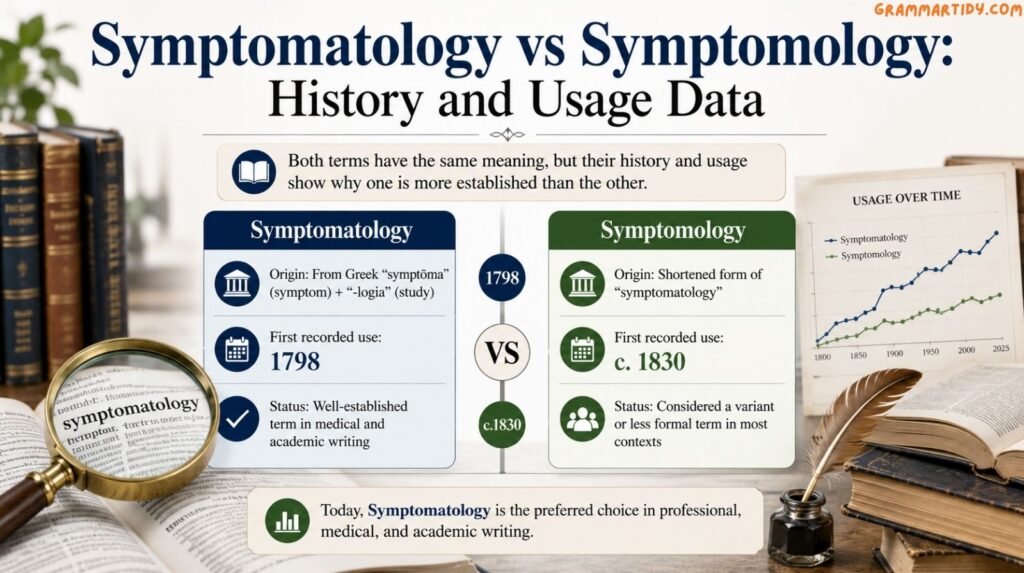
The history of these words helps explain why they look so similar.
Where did symptomatology come from?
The word symptomatology has deep roots in medical terminology. Etymological references trace it to medical Latin symptomatologia, ultimately connected with Greek symptōma (“symptom”) and -logia, meaning study or discourse.
Merriam-Webster records the first known use of symptomatology in 1798.
When did symptomology appear?
The shorter form symptomology emerged later. Etymonline dates its use to approximately 1830, describing it as a shortening of symptomatology.
That gives us a useful historical snapshot:
| Usage data | Symptomatology | Symptomology |
|---|---|---|
| First recorded use cited by major reference source | 1798 | c. 1830 |
| Approximate historical gap | — | 32+ years later |
| Core meaning | Symptoms/study of symptoms | Variant of symptomatology |
| Current formal preference | Strong | Weaker |
These dates are historical usage data, not modern search-volume statistics. There is no reliable universal statistic showing that one form represents a specific percentage of modern medical writing. Therefore, claims such as “90% of doctors use symptomatology” should not be presented as fact without a properly defined corpus or study.
The modern reference landscape nevertheless provides a clear qualitative signal: Merriam-Webster and Cambridge define symptomatology directly, while Collins also identifies symptomology as a variant.
What this tells modern writers
The historical data supports a practical rule:
Use symptomatology when you want the established, formal medical term; recognize symptomology as a variant rather than assuming it represents a completely different concept.
Which Word Should You Use?
If you are deciding between the two terms, your audience and context should determine your choice.
For medical and academic writing
Use symptomatology.
Examples:
- “Clinical symptomatology was assessed at baseline.”
- “The researchers compared symptomatology between the two groups.”
- “The patient’s symptomatology changed following treatment.”
This is the clearest choice when precision and professional convention matter.
Also Read: Excited vs Exited: Learn The Difference And Usage
For general or informal writing
Symptomology may be understandable and acceptable depending on the publication’s style guide.
For example:
“The article explains the symptomology commonly associated with the condition.”
There is no major ambiguity for the reader. However, an editor may still prefer symptomatology.
A simple decision rule
Use this three-step test:
- Is this medical, scientific, or academic writing?
→ Use symptomatology. - Is the audience general and the writing informal?
→ Symptomology may be understood, but symptomatology remains safe. - Are you following a specific organization’s style guide?
→ Follow that guide consistently.
Consistency is especially important when writing healthcare content because terminology contributes to perceived expertise and clarity.
1. Which Term Is More Formal?
Question: Which word is generally preferred in formal medical writing?
A) Symptomology
B) Symptomatology
C) Symptomize
D) Symptomatic
Answer: B) Symptomatology
2. What Does Symptomatology Mean?
Question: What can symptomatology refer to?
A) A single symptom only
B) A medicine
C) The study or overall pattern of symptoms
D) A laboratory test
Answer: C) The study or overall pattern of symptoms
3. Is Symptomology a Real Word?
Question: Is symptomology a recognized English word?
A) Yes
B) No
C) Only as a verb
D) Only in scientific formulas
Answer: A) Yes
4. Which One Is Safer for Academic Writing?
Question: Which term is usually the better choice for an academic paper?
A) Symptomology
B) Symptomatology
C) Symptomize
D) Symptomical
Answer: B) Symptomatology
5. Spot the Correct Sentence
Question: Which sentence uses symptomatology naturally?
A) The patient’s symptomatology included fatigue and headaches.
B) The patient’s symptomatology was one headache.
C) The doctor symptomatology the patient.
D) Symptomatology is a type of medicine.
Answer: A) The patient’s symptomatology included fatigue and headaches.
6. Symptom vs. Symptomatology
Question: Which word describes one individual indication of a condition?
A) Symptomology
B) Symptomatology
C) Symptom
D) Symptomatological
Answer: C) Symptom
7. Which Word Sounds More Professional?
Question: In a clinical report, which term generally sounds more standard?
A) Symptomology
B) Symptomatology
C) Symptomize
D) Symptomful
Answer: B) Symptomatology
8. Are They Completely Different?
Question: Do symptomatology and symptomology usually have completely different meanings?
A) Yes
B) No
C) Only in medicine
D) Only in British English
Answer: B) No
9. Fill in the Blank
Question: “The researchers examined the clinical ______ of the patients.”
A) symptomology
B) symptomatology
C) symptomatic
D) symptom
Answer: B) symptomatology
10. What Is the Main Difference?
Question: What is the main difference between the two terms?
A) Their basic meaning
B) Their spelling and usage preference
C) Their medical treatment
D) Their pronunciation only
Answer: B) Their spelling and usage preference
11. Which Is Better for a Medical Paper?
Question: You are writing a medical research paper. Which should you normally choose?
A) Symptomatology
B) Symptomology
C) Symptomize
D) Symptomical
Answer: A) Symptomatology
Also Read: Transferred vs Transfered: Which Is Correct?
12. What Can Symptomatology Describe?
Question: Symptomatology can describe a collection or pattern of what?
A) Treatments
B) Symptoms
C) Medicines
D) Doctors
Answer: B) Symptoms
13. Quick Spelling Check
Question: Which spelling is the established formal term?
A) Symptomatology
B) Symptomotology
C) Symptamatology
D) Symptomatolagy
Answer: A) Symptomatology
14. Which Sounds Less Formal?
Question: Which term is generally considered less formal or a variant?
A) Symptom
B) Symptomatic
C) Symptomology
D) Symptomatology
Answer: C) Symptomology
15. Final Quick Challenge
Question: If you’re unsure which term to use in professional writing, which is the safest choice?
A) Symptomology
B) Symptomatology
C) Symptomical
D) Symptomize
Answer: B) Symptomatology
FAQs
Q1. Is symptomology a real word?
A: Yes. Symptomology is a recognized English word, although it is generally treated as a variant or informal form of symptomatology. Collins lists it as a British English variant, while Wiktionary labels it informal.
Q2. Is symptomatology the correct term?
A: Yes. Symptomatology is the established term and is the better choice for formal medical, scientific, and academic writing. It can describe the study of symptoms or the collective pattern of symptoms associated with a disease.
Q3. Are symptomatology and symptomology synonyms?
A: They are generally treated as synonyms or near-synonyms. The main difference is usage and register, rather than a fundamentally different meaning.
Q4. What is an example of symptomatology?
A: A sentence such as “The patient’s symptomatology included fatigue, headaches, and sleep disturbance” uses the term correctly because it describes a collection or pattern of symptoms.
Q5. What is the difference between symptom and symptomatology?
A: A symptom is an individual indication or experience, such as nausea or pain. Symptomatology refers to the broader collection, pattern, or study of symptoms.
Q6. Is symptomatology used in psychology?
A: Yes. It is commonly used to describe patterns of psychological or psychiatric symptoms. For example, researchers may discuss depressive symptomatology when referring to a group or pattern of depressive symptoms. Cambridge includes depressive symptomatology among its usage examples.
Q7. Should I use symptomology in an academic paper?
A: Usually, no. Unless your institution, journal, or subject-specific style guide specifically uses symptomology, symptomatology is the safer and more established choice for academic writing.
Conclusion:
The difference between symptomatology vs symptomology is primarily about standard usage, formality, and context, not about two completely different medical concepts.
Symptomatology is the established professional term. It can refer to the study of symptoms or the overall pattern and collection of symptoms associated with a disease. Symptomology conveys essentially the same idea but is generally regarded as a less formal variant.
If you are writing a medical article, research paper, clinical report, academic assignment, or professional healthcare content, symptomatology is the best default choice.
When in doubt, remember the simplest rule: individual clues are symptoms; the broader pattern or study of those clues is symptomatology.
For accurate medical and academic writing, choose established terminology, check your publication’s style guide, and keep your wording consistent throughout the document.
Keep learning with more easy grammar lessons on GrammarTidy.com

Hi, I’m Noor Fatima, the author and creator of Grammar Tidy. I’m passionate about grammar, writing, and making language learning simple and enjoyable. Through Grammar Tidy, I share helpful tips, clear explanations, and practical guidance to help readers improve their writing, avoid common mistakes, and communicate with confidence. My goal is to make better grammar easy, useful, and accessible for everyone.