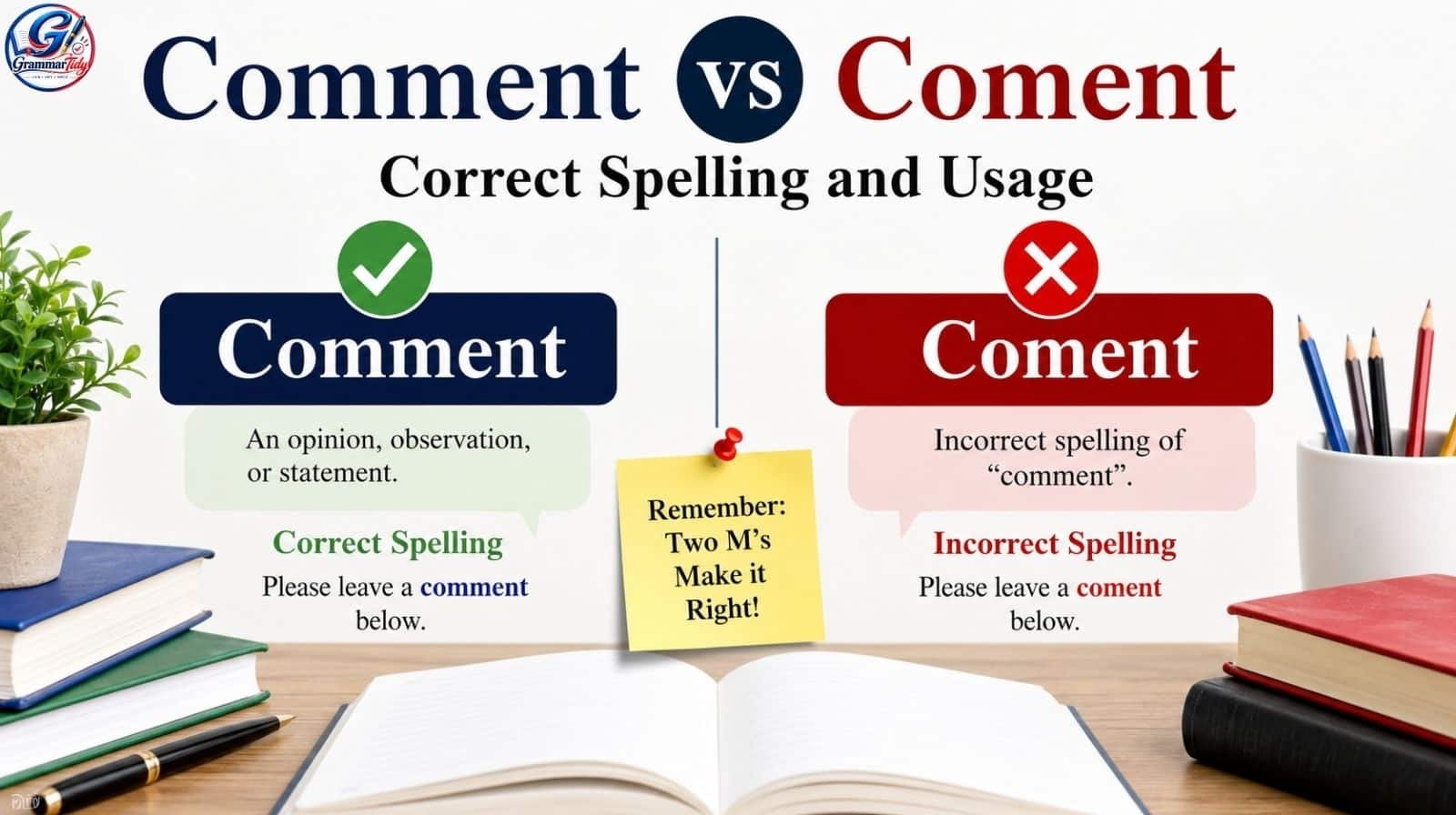
Have you ever typed “coment” and wondered whether it is actually a word? You are not alone. When comparing Comment vs Coment, the correct English spelling is comment. “Coment” is a misspelling and should generally be avoided in standard English writing.
The word comment can be used as a noun or a verb. It refers to an opinion, observation, or statement about something, or the act of expressing such an opinion. It is common in everyday conversations, academic writing, business communication, social media, and online discussions.
In this guide, you will learn the difference between comment and coment, their meanings, correct usage, pronunciation, common mistakes, and simple ways to remember the correct spelling.
Also Read: Accross vs Across: Which Is The Correct Spelling?
What Is the Correct Spelling: Comment or Coment?
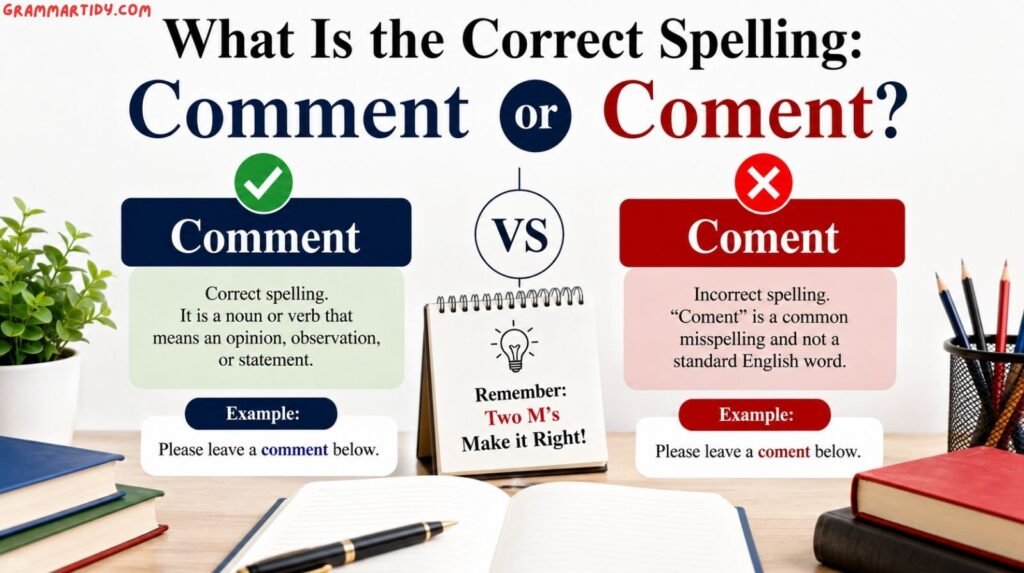
The correct spelling is comment.
Comment is the standard English spelling. Coment is not the standard spelling of the English word.
| Word | Correct? | Meaning |
|---|---|---|
| Comment | ✅ Yes | An opinion, observation, or statement |
| Coment | ❌ No | Common misspelling of “comment” |
For example:
Correct: Please leave a comment below.
Incorrect: Please leave a coment below.
The easiest thing to remember is that comment has two m’s.
Major English dictionaries recognize comment as the standard word, while “coment” is not the normal English spelling.
Why Is “Comment” Spelled With Two Ms?
The double m is part of the established spelling of comment.
Because the word is pronounced relatively quickly in everyday speech, some writers may hear only one strong /m/ sound and accidentally type coment.
However, pronunciation should not be used as the only guide to spelling. When writing the word, remember:
com + ment = comment
Comment vs Coment: Meaning and Usage
Understanding the meaning of comment makes it easier to use the word correctly.
What Does Comment Mean?
As a noun, comment means an opinion, observation, or statement about a particular subject.
Examples:
- Her comment made everyone laugh.
- I read your comment on the article.
- The teacher wrote a helpful comment on my assignment.
- His comment was surprisingly thoughtful.
As a verb, comment means to express an opinion or observation.
Examples:
- She commented on the new design.
- The manager commented on the team’s performance.
- He refused to comment on the situation.
- The author commented that the results were unexpected.
Therefore, comment works naturally in many different sentence structures.
Comment as a Noun
When comment is a noun, it often refers to something someone says or writes.
Example:
Her comment about the project was helpful.
Here, comment means an observation or opinion.
Another example:
I received several positive comments on my article.
In this sentence, comments means opinions or responses from readers.
Comment as a Verb
When comment functions as a verb, it describes the act of expressing an opinion.
Example:
The professor commented on the student’s research.
Here, commented describes what the professor did.
Common Examples of Comment in Real Sentences
One of the best ways to understand comment vs coment is to see the correct spelling in different situations.
Comment in Everyday English
1. I have a comment about your idea.
2. She made a funny comment during dinner.
3. Please don’t comment until you have read the entire article.
Comment in Academic Writing
1. The professor left a detailed comment on my essay.
2. Students were asked to comment on the results.
3. His comments helped improve the research paper.
Comment in Business Communication
1. The client provided several comments about the proposal.
2. Please comment on the attached document.
3. The manager declined to comment on the issue.
Comment on Social Media
1. Thanks for your comment!
2. I saw your comment on my post.
3. Many users commented on the announcement.
These examples show why learning the correct spelling matters. Comment appears in many forms of modern written communication.
Comment vs Coment: A Practical Comparison
If you frequently confuse these spellings, the comparison below gives you the answer at a glance.
Quick Comparison Guide
| Feature | Comment | Coment |
|---|---|---|
| Standard English spelling | ✅ Yes | ❌ No |
| Dictionary word | ✅ Yes | ❌ Generally not |
| Can be a noun | ✅ Yes | ❌ No |
| Can be a verb | ✅ Yes | ❌ No |
| Used for opinions or observations | ✅ Yes | ❌ No |
| Suitable for formal writing | ✅ Yes | ❌ No |
| Common spelling mistake | No | ✅ Yes |
The important distinction is simple:
Comment = correct
Coment = incorrect
Examples Side by Side
Correct:
Please leave a comment below.
Incorrect:
Please leave a coment below.
Correct:
The manager commented on the proposal.
Incorrect:
Notice that the double m remains when the verb changes to commented.
The manager comented on the proposal.
Why Do People Confuse Comment and Coment?
Spelling mistakes often happen when pronunciation, memory, and typing habits work against one another.
The Double-M Problem
The biggest reason is simple: people forget the second m.
When saying comment, the word may sound as though it has only one clearly noticeable m. This can cause learners to write:
com + ent → coment
instead of:
com + ment → comment
Also Read: Quantify vs Qualify: Differences And Correct Usage
Fast Typing Can Cause the Mistake
Online communication has made typing extremely fast and informal. When people type quickly, they may accidentally omit repeated letters.
For example:
- comment → coment
- committee → comittee
- accommodate → accomodate
Not every spelling error has a complicated linguistic explanation. Sometimes, it is simply a typing or memory error.
Autocorrect Does Not Always Solve Everything
Spell-checking tools can catch many obvious errors, but users should still know the correct spelling themselves. Google recommends creating content primarily for people and emphasizes helpful, reliable, people-first information rather than content created merely to manipulate rankings.
That same principle applies to everyday writing: automated tools can assist, but understanding the word remains valuable.
How to Remember the Correct Spelling of Comment
A small memory trick can make comment much easier to remember.
Use the “Two Ms” Trick
Think:
COMMENT = TWO Ms
Break the word into:
COM + MENT
The first part ends with m, and the second part begins with m:
com + ment → comment
Whenever you hesitate between comment and coment, ask yourself:
“Does this word need two Ms?”
Yes.
Connect Comment With “Commenting”
Another useful trick is to remember related forms:
- comment
- comments
- commented
- commenting
- commenter
All of these forms preserve the basic comm- spelling.
For example:
She is commenting on the post.
Seeing the related forms repeatedly reinforces the correct spelling.
Write It in a Short Sentence
Practice the word in a sentence:
I left a comment.
Repeat it a few times. Short, meaningful examples are often easier to remember than isolated spelling rules.
A Real-Life Example: Comment in Online Communication
Imagine that a student publishes an article about climate change on a school website. After reading it, another student writes:
“Your explanation of renewable energy was very clear. I especially liked the examples.”
The website records this response as a comment.
Later, the student writes a message to a teacher:
“Thank you for your comment on my article. I will revise the introduction.”
In both situations, comment refers to an opinion, observation, or response.
Now imagine that the student types:
“Thank you for your coment.”
The meaning is still understandable, but the spelling is incorrect. The reader can easily recognize what the writer intended, yet the error can make the writing appear less polished.
This matters even more in professional settings. Suppose an employee writes a report for a manager and says, “Please review my document and add any coments.” The intended meaning is obvious, but comments is the correct spelling. A careful writer would use the standard form because workplace communication often needs to be clear and professional.
Also Read: Courtesy vs Curtesy: Meaning, Usage And Common Mistakes
The lesson is straightforward: “coment” may communicate the intended idea, but “comment” is the correct English spelling. Once you associate the word with its double m, the mistake becomes much easier to avoid.
Comment Usage and Modern Digital Communication

The word comment has become especially common in digital communication.
People comment on:
- social-media posts
- blogs
- videos
- news articles
- discussion forums
- online documents
- educational platforms
- business documents
For example:
Readers can comment on the article.
She left a comment under the video.
The editor added comments to the document.
The word also appears in official communication. For example, government agencies may invite members of the public to submit comments about proposed policies or legislation. The Washington State Legislature, for instance, provides a formal process for people to write and submit comments on bills.
Why Correct Spelling Still Matters Online
Digital communication is informal, but that does not mean spelling is irrelevant.
A correctly spelled word:
- looks more professional,
- improves readability,
- builds reader confidence,
- reduces ambiguity, and
- helps maintain credibility.
Therefore, even a small spelling distinction such as comment vs coment is worth learning.
2025–2026 Data and Writing Context
There is an important limitation when discussing statistics about spelling mistakes: major language organizations do not publish a reliable annual global count of how many people misspell comment specifically. Claims such as “X% of people spell comment incorrectly” should therefore not be presented as established fact without a credible dataset.
However, current digital-writing guidance shows why spelling and clear communication remain relevant. Google’s current Search documentation emphasizes helpful, reliable, people-first content and asks creators to provide original, substantial value rather than simply rewriting existing material.
At the same time, modern online communication provides countless opportunities to encounter and use words such as comment from social posts and blogs to collaborative documents and public consultation systems. Official online services continue to use comment as a standard term; for example, the U.S. Federal Energy Regulatory Commission describes its online eComment system and allows users to submit written comments electronically.
Key takeaway: there is no trustworthy 2025–2026 statistic showing a specific percentage of people who misspell comment as coment. What can be established is that comment remains the standard English spelling and is widely used in contemporary digital and formal communication.
Common Mistakes With Comment
Knowing the most frequent mistakes can help you avoid them.
Mistake 1: Writing “Coment”
❌ I left a coment on your post.
✅ I left a comment on your post.
The second m is required.
Mistake 2: Forgetting the Double M in “Commented”
❌ She comented on the issue.
✅ She commented on the issue.
Adding -ed does not remove either of the original Ms.
Mistake 3: Confusing Comment With Other Words
Do not confuse comment with:
- commend
- commentary
- compliment
- complaint
These words can appear in similar contexts, but they have different meanings.
For example:
She commented on my work.
is different from:
She complimented my work.
A comment can be positive, negative, neutral, or simply informative. A compliment, by contrast, is specifically an expression of praise.
Comment vs Commentary vs Compliment
These words are sometimes confused because they relate to speaking or writing about something.
Comment
An opinion, observation, or statement.
He made a comment about the movie.
Commentary
A discussion or explanation of something, often more extended.
The documentary included commentary from several experts.
Compliment
An expression of praise or admiration.
She gave me a compliment about my presentation.
So, if you simply want to refer to an opinion or observation, comment is usually the word you need.
A Simple Step-by-Step Way to Choose the Correct Spelling
When you are unsure, use this quick process.
Step 1: Identify the Word
Ask yourself whether you mean an opinion, observation, or response.
If yes, you probably mean comment.
Step 2: Check the Double M
Write:
COM + MENT
That gives you:
COMMENT
Step 3: Check the Sentence
For example:
Please leave a ______ below.
The correct answer is:
Please leave a comment below.
Step 4: Check Related Forms
If you need a different grammatical form, remember:
- comment
- comments
- commented
- commenting
The double m stays.
Quick Checklist: Comment or Coment?
Before publishing your sentence, check:
- Use comment, not coment.
- Remember the two Ms.
- Use comment as a noun for an opinion or observation.
- Use comment as a verb for expressing an opinion.
- Keep the double m in commented and commenting.
- Proofread important academic and professional writing.
Mini Quiz Comment vs Coment
Quiz 1: Which Spelling Is Correct?
Which word is correctly spelled?
A) Coment
B) Comment
C) Commant
D) Comement
Answer: B) Comment
Quiz 2: Fill in the Blank
Please leave a □ below this article.
A) coment
B) comment
C) commant
D) commente
Answer: B) comment
Quiz 3: Double-M Check
Which spelling contains the correct double m?
A) coment
B) comment
C) comement
D) commment
Answer: B) comment
Quiz 4: Pick the Correct Sentence
A) I left a coment on her post.
B) I left a comment on her post.
C) I left a commant on her post.
D) I left a commente on her post.
Answer: B) I left a comment on her post.
Quiz 5: What Does “Comment” Mean?
What can a comment be?
A) An opinion or observation
B) A type of food
C) A measurement
D) A place
Answer: A) An opinion or observation
Quiz 6: Noun or Verb?
In “She made a comment,” how is comment used?
A) Verb
B) Adjective
C) Noun
D) Adverb
Answer: C) Noun
Quiz 7: Spot the Mistake
Which sentence contains the spelling mistake?
A) He made a comment.
B) Please comment below.
C) She left a coment.
D) I read your comment.
Answer: C) She left a coment.
Quiz 8: Remember the Pattern
Which memory trick helps you spell comment?
A) COM + MENT
B) CO + MENT
C) COM + ENT
D) COMM + ANT
Answer: A) COM + MENT
Quiz 9: Verb Form
Choose the correctly spelled past-tense form.
A) comented
B) commanted
C) commented
D) commentted
Answer: C) commented
Quiz 10: Social Media Check
Which sentence is correct?
A) Thanks for your coment!
B) Thanks for your comment!
C) Thanks for your commant!
D) Thanks for your commente!
Answer: B) Thanks for your comment!
Quiz 11: Complete the Sentence
The teacher left a helpful □ on my essay.
A) coment
B) comment
C) commant
D) commente
Answer: B) comment
Quiz 12: Quick Spelling Test
How many m’s are in the correct spelling of comment?
A) One
B) Two
C) Three
D) Four
Answer: B) Two
Quiz 13: Choose the Correct Verb
Which sentence is correctly written?
A) She comented on the news.
B) She commented on the news.
C) She commanted on the news.
D) She commentted on the news.
Answer: B) She commented on the news.
Quiz 14: Comment vs Coment
Which statement is true?
A) Both spellings are standard English.
B) Coment is more formal.
C) Comment is the standard spelling.
D) Coment is the British spelling.
Answer: C) Comment is the standard spelling.
Quiz 15: Final Challenge
What is the easiest way to remember comment?
A) It has one m.
B) It has two m’s.
C) It ends with “ant.”
D) It starts with “comen.”
Answer: B) It has two m’s.
FAQs
Q. Is “coment” a correct English word?
A: No. Coment is generally a misspelling of comment in standard English. The correct spelling is comment.
Q. Which is correct: comment or coment?
A: Comment is correct. It is spelled with two Ms.
Q. What does comment mean?
A: A comment is an opinion, observation, or statement about something. It can also be used as a verb meaning to express an opinion or observation.
Q. How do you spell comment correctly?
A: Spell it C-O-M-M-E-N-T.
A useful memory trick is COM + MENT = COMMENT.
Q. Can comment be a verb?
A: Yes. For example:
The teacher commented on my essay.
Here, commented is the past tense of the verb comment.
Q. What is the difference between a comment and a compliment?
A: A comment is an observation or statement and can be positive, negative, or neutral. A compliment is specifically an expression of praise.
Q. Why do people spell comment as “coment”?
A: The most common reason is probably that the second m is easy to overlook when spelling from memory or typing quickly. The pronunciation can also make the double letter less obvious to learners.
Final Takeaway:
When it comes to Comment vs Coment, there is a clear winner: comment is the correct English spelling.
Coment is a common spelling mistake caused mainly by forgetting the second m. The correct form is:
COMMENT
Remember the simple pattern:
COM + MENT = COMMENT
Whether you are writing a social-media response, an academic paper, a business email, or a blog post, using comment will keep your writing accurate and professional.
If you found this comment vs coment guide helpful, save it for future reference and share it with anyone who often forgets the second m in comment.
Keep learning with more easy grammar lessons on GrammarTidy.com

Hi, I’m Noor Fatima, the author and creator of Grammar Tidy. I’m passionate about grammar, writing, and making language learning simple and enjoyable. Through Grammar Tidy, I share helpful tips, clear explanations, and practical guidance to help readers improve their writing, avoid common mistakes, and communicate with confidence. My goal is to make better grammar easy, useful, and accessible for everyone.