Have you ever stopped while writing Bachelor vs Batchelor and wondered which spelling is correct? This small spelling difference can create confusion, especially when you are writing a university application, résumé, academic document, or professional profile.
The quick answer is simple: bachelor is the correct standard English spelling. Batchelor is generally not used as a standard English vocabulary word, although it can appear as a proper surname.
In this guide, you will learn the complete Bachelor vs Batchelor difference, understand the meaning of bachelor, see real examples, discover why people make this spelling mistake, and learn easy ways to remember the correct spelling.
Bachelor vs Batchelor: What Is The Difference?
The main difference between Bachelor vs Batchelor is straightforward:
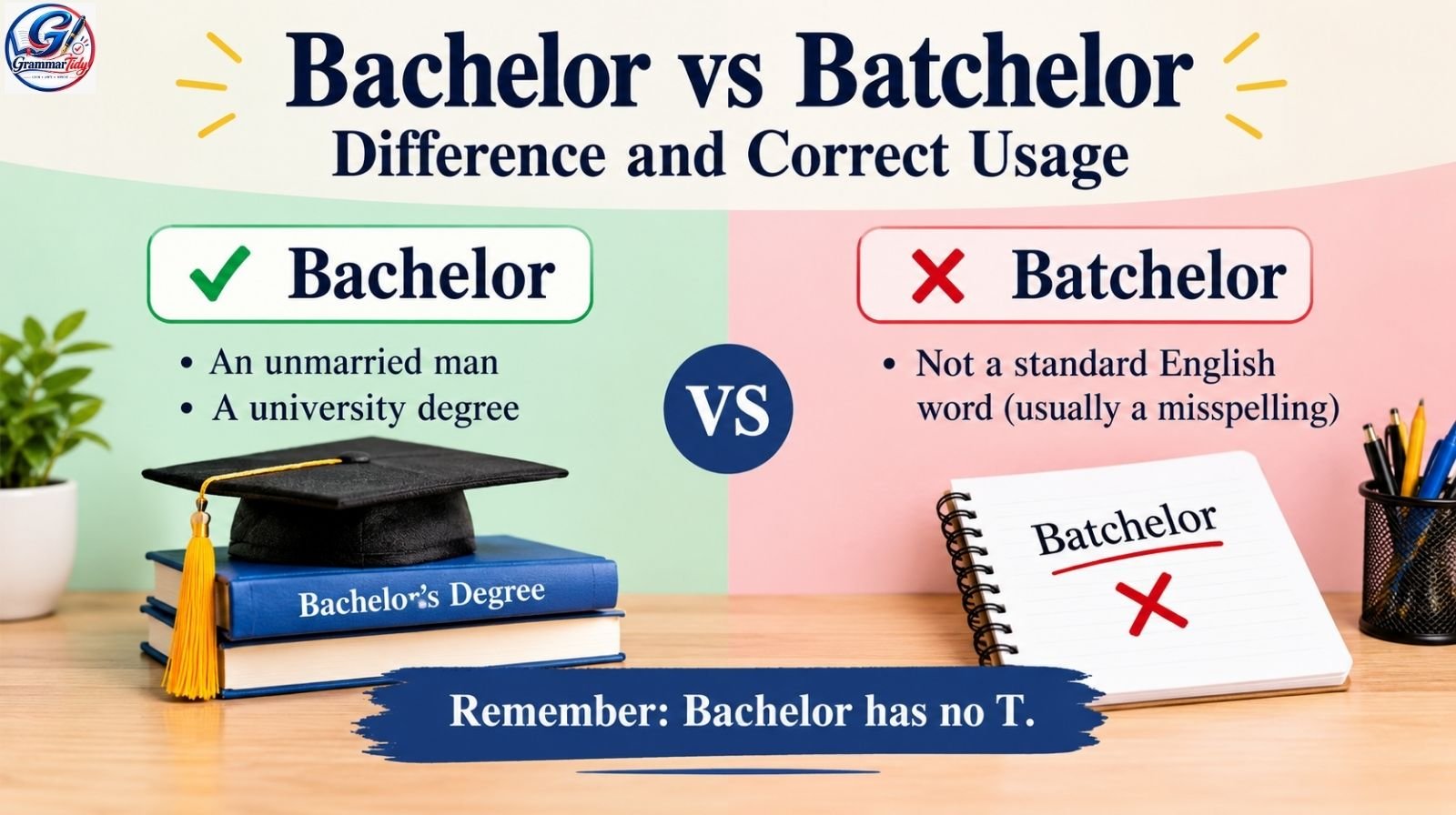
- Bachelor is the correct standard English word.
- Batchelor is generally a misspelling when someone intends to write bachelor.
According to major dictionaries, bachelor can refer to an unmarried man or a person who has received a bachelor’s degree.
Quick Comparison Table
| Word | Correct? | Meaning | Example |
|---|---|---|---|
| Bachelor | ✅ Yes | An unmarried man or an academic degree holder | He earned a bachelor’s degree. |
| Batchelor | ❌ Not standard vocabulary | Usually a misspelling of bachelor | Incorrect: She completed her Batchelor degree. |
The Correct Spelling
The correct spelling is:
B-A-C-H-E-L-O-R
There is no letter “T” in bachelor.
For example:
- ✅ He is studying for a bachelor’s degree.
- ❌ He is studying for a batchelor’s degree.
Featured Snippet Answer
Bachelor is the correct spelling in standard English. It can refer to an unmarried man or a university degree. Batchelor is generally a misspelling when used as a common English word, although it may exist as a surname.
What Does Bachelor Mean?
The word bachelor has more than one meaning. Understanding the context makes correct usage much easier.
Bachelor Meaning: An Unmarried Man
One common meaning of bachelor is a man who is not married.
Examples:
- James remained a bachelor for many years.
- My uncle is a lifelong bachelor.
- The novel tells the story of a wealthy bachelor.
Cambridge Dictionary defines bachelor as a man who has never married.
Bachelor Meaning: An Academic Degree
The word is also closely connected with higher education.
A bachelor’s degree is typically an undergraduate degree awarded by a college or university.
Examples:
- She earned a Bachelor of Arts in English.
- Ahmed completed his bachelor’s degree in computer science.
- He is applying for jobs after finishing his undergraduate degree.
Also Read: Quantify vs Qualify: Differences And Correct Usage
Bachelor in Other Expressions
You may also see the word in common phrases such as:
- Bachelor apartment
- Bachelor party
- Bachelor’s degree
- Bachelor of Science (BS/BSc)
- Bachelor of Arts (BA)
Therefore, learning the correct bachelor spelling is useful in both everyday and academic writing.
Why Do People Confuse Bachelor and Batchelor?
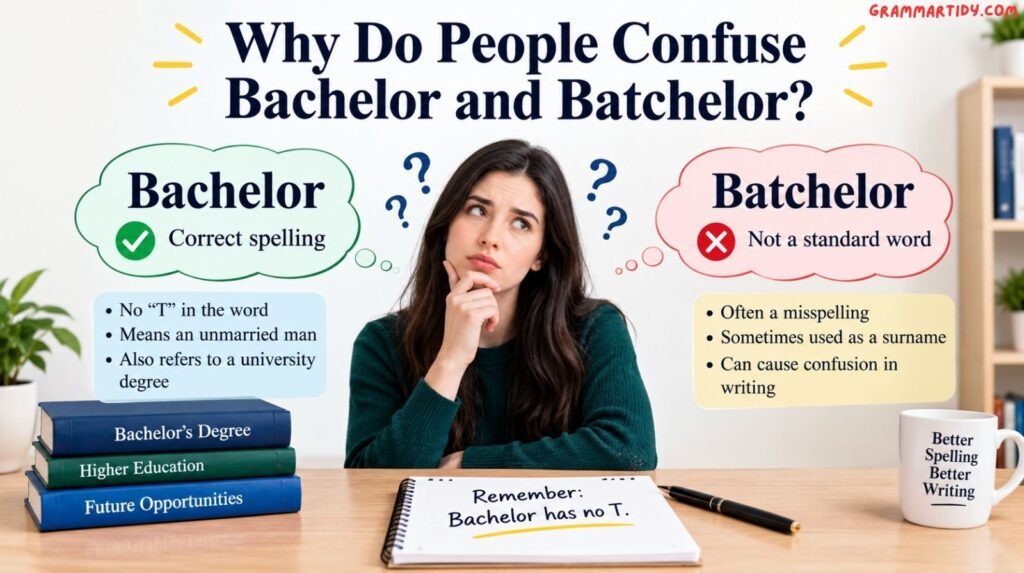
The confusion between Bachelor vs Batchelor usually happens because English pronunciation does not always match spelling perfectly.
The Extra “T” Sounds Natural to Some Writers
When people say bachelor, the pronunciation can make some writers think a T belongs in the word.
As a result, they may incorrectly write:
❌ Batchelor
Instead of:
✅ Bachelor
This is an example of a phonetic spelling mistake, where someone writes a word according to how they believe it sounds.
English Contains Many Non-Phonetic Spellings
English spelling has developed through influences from different languages and historical changes. Therefore, relying only on pronunciation can sometimes cause errors.
For example, writers often confuse words such as:
- Definitely vs Definately
- Separate vs Seperate
- Bachelor vs Batchelor
The safest approach is to learn the correct spelling pattern.
Academic Context Makes the Mistake More Noticeable
The spelling mistake becomes especially important when writing:
- University applications
- CVs and résumés
- LinkedIn profiles
- Academic essays
- Certificates
- Job applications
Writing Batchelor’s degree instead of Bachelor’s degree can make an otherwise professional document look less polished.
How to Use Bachelor Correctly in a Sentence
The easiest way to master Bachelor vs Batchelor correct usage is to see the correct word in real sentences.
Examples Related to Education
Here are some common examples:
- Maria earned a bachelor’s degree in psychology.
- He completed his Bachelor of Science last year.
- A bachelor’s degree can open opportunities in many careers.
- She is currently working toward her bachelor’s degree.
Notice that bachelor’s degree usually includes an apostrophe.
Examples Related to an Unmarried Man
The word can also describe a person’s marital status.
- He was a bachelor when he bought his first home.
- The famous bachelor lived alone in the city.
- He enjoyed his life as a bachelor.
Common Incorrect and Correct Examples
| Incorrect | Correct |
|---|---|
| He earned a Batchelor degree. | He earned a bachelor’s degree. |
| She completed her Batchelor of Arts. | She completed her Bachelor of Arts. |
| My brother is a Batchelor. | My brother is a bachelor. |
The rule is simple: when referring to the standard English word, use bachelor, not batchelor.
Bachelor vs Batchelor in Academic and Professional Writing
The Bachelor vs Batchelor difference matters most when accuracy and professionalism are important.
Writing a Bachelor’s Degree Correctly
A common phrase is:
Bachelor’s degree
Examples include:
- bachelor’s degree in business
- bachelor’s degree in engineering
- bachelor’s degree in education
Cambridge Dictionary describes a bachelor’s degree as a first degree earned at a college or university.
Capitalization Rules
Capitalization depends on how the phrase is used.
General use:
- She earned a bachelor’s degree in biology.
Official degree title:
- He earned a Bachelor of Science in Computer Science.
In general writing, use lowercase for a general degree description. Use capital letters when writing the official name of a degree.
Why Correct Spelling Matters on a CV
Imagine a recruiter reading these two lines:
❌ Batchelor of Business Administration
✅ Bachelor of Business Administration
The second version immediately looks more professional and accurate.
A small spelling error may not always change the meaning, but professional documents benefit from careful proofreading.
A Real-Life Writing Case Study: The University Application Mistake
Consider a realistic situation involving a student named Daniel.
Daniel was preparing an application for a graduate program. He had carefully listed his education, work experience, skills, and achievements. However, in the education section, he repeatedly wrote:
Batchelor of Science in Information Technology
Because the application contained several references to his undergraduate qualification, the same spelling mistake appeared multiple times.
During proofreading, Daniel’s friend noticed the extra “T” in Batchelor. Daniel had assumed the spelling was correct because the word sounded similar to the version he had written.
The corrected version became:
Bachelor of Science in Information Technology
This example shows why spelling accuracy matters. The mistake did not change Daniel’s actual qualification, but it affected the presentation of an important professional document. University applications, CVs, résumés, and professional profiles often create a first impression before someone meets you personally.
The lesson is simple: when a word appears repeatedly in an important document, verify the spelling once using a trusted dictionary and then check that the same correct form is used everywhere. For Bachelor vs Batchelor, remember that standard English uses Bachelor without a T.
Bachelor vs Batchelor: Language and Writing Accuracy in 2025–2026
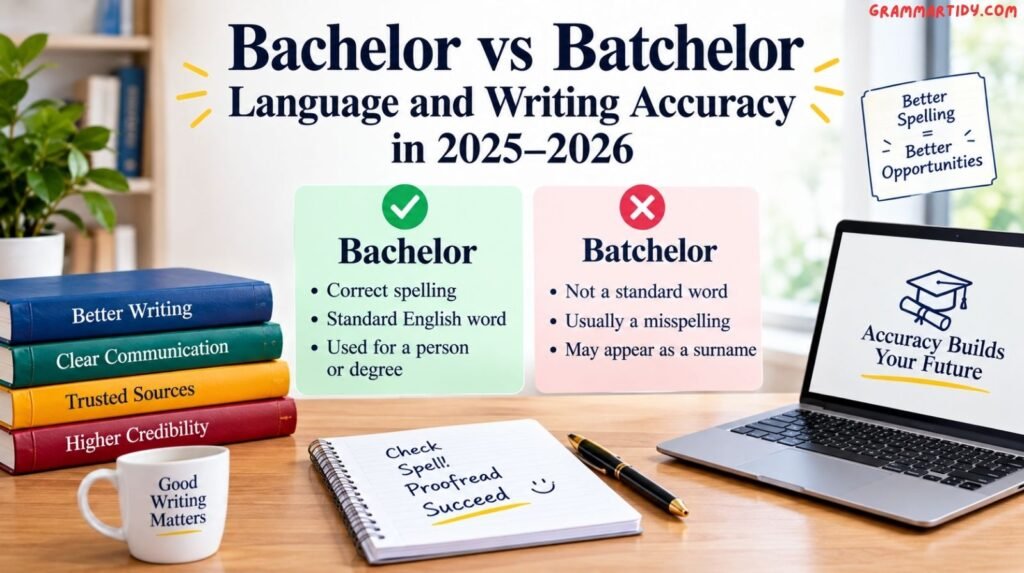
Accurate spelling remains an important part of creating trustworthy, useful content in 2025–2026.
Google’s current guidance emphasizes helpful, reliable, people-first content and specifically includes avoiding spelling and stylistic problems as part of producing high-quality pages. Google’s documentation was updated in December 2025.
What Current Guidance Tells Writers
The practical lesson for writers is clear:
- Use standard dictionary spellings.
- Proofread important documents carefully.
- Use words naturally and clearly.
- Prioritize reader understanding over unnecessary complexity.
For a spelling-focused topic like Bachelor vs Batchelor, authoritative dictionary sources provide the strongest evidence. Merriam-Webster continues to list bachelor as the standard form and recognizes its meanings relating to academic degrees and unmarried men.
Why This Matters for Online Content
A spelling mistake in a casual message may be harmless. However, repeated mistakes on:
- Educational websites
- Career pages
- Business websites
- Professional biographies
- Academic resources
can reduce clarity and reader confidence.
Therefore, correct spelling is not just about grammar it also supports credibility and trust.
How to Remember the Correct Spelling of Bachelor
Fortunately, remembering the correct spelling is easier than it first appears.
Memory Trick: Remember “No T”
The most important rule is:
Bachelor has no T.
Write it mentally as:
B-A-C-H-E-L-O-R
If you remember that there is no T, you can avoid the most common mistake immediately.
Connect It With Common Degree Names
You have probably seen these phrases many times:
- Bachelor of Arts
- Bachelor of Science
- Bachelor’s degree
Each one uses Bachelor, never Batchelor.
Repeated exposure to these common academic phrases can help reinforce the correct spelling.
Use a Quick Proofreading Checklist
Before submitting an important document, check:
- Did I write Bachelor, not Batchelor?
- Did I remove the extra T?
- Is bachelor’s degree written correctly where appropriate?
- Are official degree titles capitalized consistently?
- Have I checked the spelling throughout the document?
This simple checklist can prevent a common English spelling mistake.
Bachelor vs Batchelor: Common Mistakes to Avoid
Understanding common mistakes can help you write with more confidence.
Mistake 1: Adding an Extra “T”
❌ Batchelor
✅ Bachelor
This is the most common error.
Mistake 2: Writing “Batchelor’s Degree”
❌ I completed my Batchelor’s degree.
✅ I completed my bachelor’s degree.
The correct spelling is essential in academic writing.
Mistake 3: Confusing General and Official Degree Names
Compare:
- She has a bachelor’s degree in economics.
- She earned a Bachelor of Arts in Economics.
Both can be correct depending on whether you are using a general description or the official degree title.
Mistake 4: Relying Only on Pronunciation
English spelling cannot always be predicted perfectly from sound.
Therefore, when writing an important word such as bachelor, use a trusted dictionary if you are unsure.
Mini Quiz: Bachelor vs Batchelor
Quiz 1: Which spelling is correct? ok
Bachelor or Batchelor?
Answer: ✅ Bachelor
Quiz 2: Does “Bachelor” contain the letter T? ok
Yes or No?
Answer: ❌ No, Bachelor has no “T.”
Quiz 3: Which phrase is correct? ok
Bachelor’s degree or Batchelor’s degree?
Answer: ✅ Bachelor’s degree
Quiz 4: What does “Bachelor” commonly describe? ok
An unmarried man or a married man?
Answer: ✅ An unmarried man
Quiz 5: Complete the spelling! ok
B-A-C-H-E-L-O-?
Answer: ✅ R
Quiz 6: Find the incorrect spelling! ok
Bachelor or Batchelor?
Answer: ❌ Batchelor
Quiz 7: Which degree name is correct? ok
Bachelor of Science or Batchelor of Science?
Answer: ✅ Bachelor of Science
Quiz 8: Quick spelling check! ok
Which word has an extra incorrect letter?
Answer: ❌ Batchelor the extra letter is T.
Quiz 9: Fill in the blank! ok
She earned a ______ degree in English.
Answer: ✅ Bachelor’s
Quiz 10: Is this sentence correct? ok
“He completed his Batchelor’s degree.”
Answer: ❌ No. The correct word is Bachelor’s.
Also Read: Emersion vs Immersion: Differences And Correct Usage
Quiz 11: Choose the right word! ok
My brother is a ______.
Answer: ✅ Bachelor
Quiz 12: What is the easiest spelling rule? ok
Bachelor has a T or no T?
Answer: ✅ No T
Quiz 13: Spot the correct sentence! ok
Which one is right?
A. She earned a Batchelor degree.
B. She earned a Bachelor’s degree.
Answer: ✅ B. She earned a Bachelor’s degree.
Quiz 14: Can “Bachelor” relate to education? ok
Yes or No?
Answer: ✅ Yes! It can refer to a bachelor’s degree.
Quiz 15: Final spelling challenge! ok
Which spelling should you always use in standard English?
Bachelor or Batchelor?
Answer: 🎯 Bachelor always remember: NO T!
FAQs
Q. Is Bachelor or Batchelor correct?
A: Bachelor is the correct standard English spelling. Batchelor is generally a misspelling when referring to an unmarried man or an academic degree.
Q. How do you spell bachelor’s degree correctly?
A: The standard spelling is bachelor’s degree.
Example:
She earned a bachelor’s degree in English.
Q. Does Bachelor have a T in it?
A: No. Bachelor does not contain the letter T.
The correct spelling is:
B-A-C-H-E-L-O-R
Q. What does bachelor mean?
A: Bachelor commonly means either an unmarried man or a person who has earned a bachelor’s-level academic degree.
Q. Is Batchelor ever correct?
A: Batchelor can appear as a proper surname or family name. However, it is not the standard spelling when you mean an unmarried man or an academic qualification.
Q. Should I write bachelor degree or bachelor’s degree?
A: In standard English, bachelor’s degree is the commonly accepted form.
Example:
✅ She earned a bachelor’s degree.
Q. Should Bachelor be capitalized?
A: Use lowercase for general references, such as bachelor’s degree. Capitalize it when it is part of an official degree title, such as Bachelor of Science.
Conclusion:
The Bachelor vs Batchelor difference is easy to remember once you know the rule: Bachelor is the correct standard English spelling, and it does not contain a “T.”
Whether you are talking about an unmarried man, a Bachelor of Arts, a Bachelor of Science, or a bachelor’s degree, the correct word is always bachelor in standard English.
Batchelor should not be used as a replacement for bachelor in normal academic, professional, or everyday writing.
The next time you write about your education or qualifications, remember this simple rule: Bachelor = correct spelling, no T. Double-checking small details like this can make your writing clearer, more accurate, and more professional.
Keep learning with more easy grammar lessons on GrammarTidy.com

Hi, I’m Noor Fatima, the author and creator of Grammar Tidy. I’m passionate about grammar, writing, and making language learning simple and enjoyable. Through Grammar Tidy, I share helpful tips, clear explanations, and practical guidance to help readers improve their writing, avoid common mistakes, and communicate with confidence. My goal is to make better grammar easy, useful, and accessible for everyone.