Have you ever wondered whether to write anticlockwise or counterclockwise? Both words describe the same movement, but choosing the right one depends on your audience and the type of English you are using.
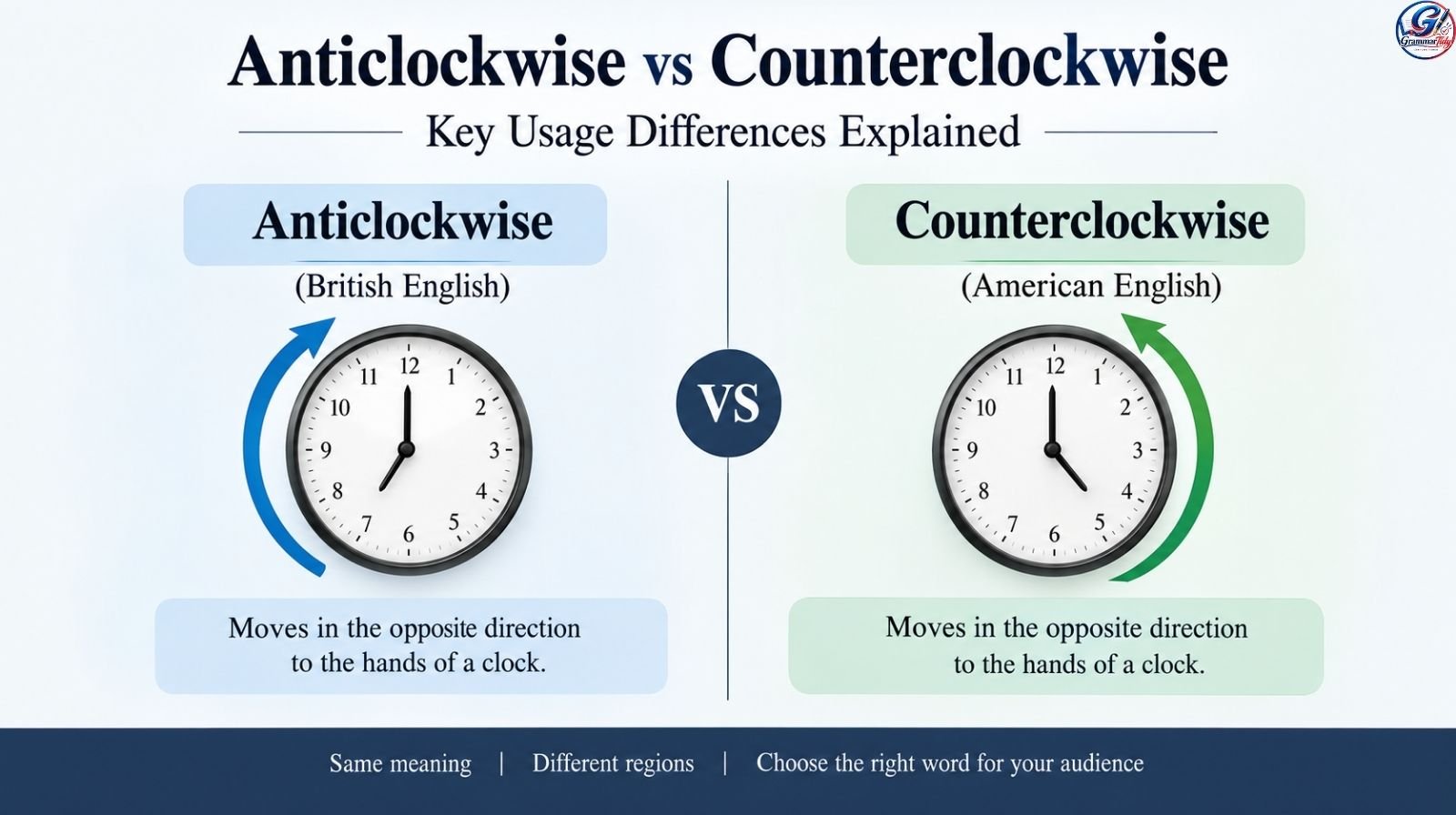
The main difference between anticlockwise vs counterclockwise is regional preference. Anticlockwise is commonly used in British English, while counterclockwise is the standard choice in American English.
Neither spelling is incorrect, and both communicate the same direction.
In this guide, you will learn what each word means, how to use it in a sentence, which spelling is appropriate for different audiences, and how to avoid common mistakes.
What Is the Difference Between Anticlockwise and Counterclockwise?
The difference between anticlockwise and counterclockwise is primarily regional, not grammatical. Both words describe movement in the opposite direction to the hands of a clock.
For example, imagine looking directly at a traditional wall clock. If you move your finger from the 12 toward the 11, 10, and 9, you are moving anticlockwise or counterclockwise.
Also Read: Lead or Led? The Mistake Even Editors Make
What Does Anticlockwise Mean?
Anticlockwise is an adverb or adjective commonly associated with British English. It describes movement in the direction opposite to the usual movement of clock hands.
Examples:
- Turn the bottle cap anticlockwise to open it.
- The wheel rotates anticlockwise.
- Walk anticlockwise around the circular garden.
- Rotate the dial in an anticlockwise direction.
In each example, the word explains the direction of movement.
What Does Counterclockwise Mean?
Counterclockwise is the standard American English equivalent of anticlockwise. It has the same meaning and can also function as an adjective or adverb.
Examples:
- Turn the bottle cap counterclockwise to open it.
- The wheel rotates counterclockwise.
- Walk counterclockwise around the circular garden.
- Rotate the dial in a counterclockwise direction.
These sentences communicate exactly the same information as their British English counterparts.
Are Both Words Correct?
Yes, both are correct English words. The best choice depends on your intended audience and the style of English you follow.
The simplest rule is to use anticlockwise for British English and counterclockwise for American English. Neither term is universally better, and both are easily understood by English speakers.
Anticlockwise vs Counterclockwise in British and American English
Regional English differences influence vocabulary, spelling, and everyday expressions. These two words are a clear example of how different varieties of English can express the same idea.
British English: Use Anticlockwise
In British English, anticlockwise is generally the preferred term for describing movement opposite to the hands of a clock.
You may encounter it in everyday instructions, school mathematics, technical manuals, and descriptions of circular movement.
Examples:
- Turn the handle anticlockwise.
- The dancers moved anticlockwise around the hall.
- Rotate the shape 90 degrees anticlockwise.
- The object travelled around the circular path in an anticlockwise direction.
For example, a UK instruction manual might say, “Turn the valve anticlockwise to release the pressure.”
This wording is natural for a British audience.
Also Read: Zyrtec or Benadryl: Which One Should You Actually Take?
American English: Use Counterclockwise
In American English, counterclockwise is the more familiar and standard choice.
It commonly appears in instructions, educational materials, mathematics problems, and technical explanations.
Examples:
- Turn the knob counterclockwise.
- The wheel spins counterclockwise.
- Rotate the image 90 degrees counterclockwise.
- The machine moves counterclockwise during operation.
For instance, an American product manual might instruct the reader to “Turn the valve counterclockwise to release the pressure.”
The instruction has the same meaning as the British version.
Which Word Should International Writers Choose?
If you are writing for readers from several countries, consistency is more important than treating one word as universally correct.
Use this practical guide:
| Audience | Recommended word |
|---|---|
| United Kingdom | Anticlockwise |
| United States | Counterclockwise |
| International audience | Choose one based on your style guide |
| British English educational content | Anticlockwise |
| American English technical instructions | Counterclockwise |
Other English-speaking countries may use either term depending on local conventions and the publication’s style. When preparing content for a particular market, follow the language conventions preferred by that audience.
Also Read: Pre vs Post: What’s The Real Difference? (With 100+ Examples)
How to Use Anticlockwise and Counterclockwise in Sentences
Both words can describe actions, directions, and movements. Understanding their grammatical functions helps you use them naturally in everyday writing.
Using the Words as Adverbs
An adverb describes how an action happens. When anticlockwise or counterclockwise describes how something moves or turns, it functions as an adverb.
Examples:
- She turned the key anticlockwise.
- He rotated the wheel counterclockwise.
- The dancer moved anticlockwise around the stage.
- The technician turned the dial counterclockwise.
In these sentences, each word explains how the action is performed.
Using the Words as Adjectives
An adjective describes a noun. Both words can appear before nouns to describe a direction, rotation, or movement.
Examples:
- The anticlockwise movement was easy to follow.
- The counterclockwise rotation changed the object’s position.
- We observed an anticlockwise turn.
- The diagram shows a counterclockwise motion.
Both forms are grammatically acceptable. The choice between them still depends mainly on regional preference.
Also Read: Soder or Solder? Easy Guide with Simple Words And Clear Examples
Using the Words in Instructions
Clear directional language is particularly important when writing instructions for tools, machines, or everyday tasks.
Compare these examples:
| British English | American English |
|---|---|
| Turn the lid anticlockwise. | Turn the lid counterclockwise. |
| Rotate the dial anticlockwise. | Rotate the dial counterclockwise. |
| Move the wheel anticlockwise. | Move the wheel counterclockwise. |
| Turn the screw anticlockwise to loosen it. | Turn the screw counterclockwise to loosen it. |
The meaning remains unchanged in every pair.
One important point: these terms describe direction, not necessarily the result of an action. Whether turning a screw loosens or tightens it depends on the screw’s design and threading. Always follow the manufacturer’s instructions when working with equipment.
Anticlockwise vs Counterclockwise: Examples and Real-Life Case Study
The best way to understand the difference is to see how the words work in realistic situations.
Everyday Examples
Here are ten examples showing how both terms can be used correctly.
- Opening a jar: Turn the lid anticlockwise in British English or counterclockwise in American English.
- Operating a dial: Rotate the dial anticlockwise to select the desired setting.
- Drawing a circle: Move your pencil counterclockwise around the starting point.
- Using a steering mechanism: Follow the specified direction when rotating the control.
- Teaching geometry: Rotate the triangle 90 degrees anticlockwise.
- Describing a wheel: The wheel moved counterclockwise after the mechanism started.
- Following a walking route: Walk anticlockwise around the circular path.
- Explaining a diagram: The arrow indicates counterclockwise rotation.
- Writing a science report: The object rotated anticlockwise around its centre.
- Preparing product instructions: Use the direction word consistently throughout the document.
These examples demonstrate that the two terms are interchangeable in meaning, even when their regional preferences differ.
Real-Life Case Study: Writing Instructions for a Global Audience
Imagine a company that manufactures kitchen appliances and sells them in both the United Kingdom and the United States. Its product includes a removable lid that must be turned in a specified direction before it can be opened.
The company’s original instruction reads, “Turn the lid anticlockwise to unlock it.”
For British customers, this instruction is natural and easy to understand. However, the American marketing team wants the wording to match the vocabulary commonly used in its local product manuals.
It therefore changes the sentence to “Turn the lid counterclockwise to unlock it.”
The company has not changed the physical instructions or the meaning of the sentence. It has simply adapted the vocabulary for its target audience.
Next, the company prepares a shared online help centre for customers in both countries. The writing team considers using both terms throughout every article. However, repeatedly writing “anticlockwise or counterclockwise” makes the instructions longer and less readable.
Instead, the team chooses a consistent approach: British product pages use anticlockwise, and American product pages use counterclockwise.
For shared pages, the company follows its established international style guide and uses one term consistently, while providing a regional alternative where clarity requires it.
The team also checks that illustrations, arrows, and written instructions agree with each other.
What does this case study teach us? Neither word is inherently better. Effective writing considers the reader, maintains consistency, and communicates the intended direction clearly.
This approach is useful for bloggers, teachers, translators, technical writers, and businesses publishing content for international audiences.
Also Read: Honour or Honor: Which Spelling Should You Use?
Anticlockwise vs Counterclockwise: 2025–2026 Data and Statistics
When comparing words, it is important to distinguish documented linguistic facts from unsupported popularity claims. Dictionary definitions and established language conventions provide a reliable starting point for understanding the relationship between anticlockwise and counterclockwise.
What Current Reference Data Tells Us
The following table summarizes the established usage distinctions between the two words.
| Comparison point | Finding |
|---|---|
| British English preference | Anticlockwise |
| American English preference | Counterclockwise |
| Grammatical function | Both can be adjectives and adverbs |
| Core meaning | Movement opposite to a clock’s hands |
| Difference in meaning | No general difference |
| Correct spelling | Both are correct |
These distinctions reflect standard British and American English usage.
Also Read: Where to Watch Deal or No Deal Island: Streaming Guide
Are There Exact Usage Statistics for 2025–2026?
There is no verified, directly comparable 2025–2026 statistic established here that measures the worldwide use of both terms across all English speakers.
Regional usage labels explain which word is preferred in different varieties of English, but they do not provide a complete count of how frequently people use each word in conversation, books, websites, or searches.
Therefore, it would be misleading to claim that one term is a specific percentage more popular than the other without a reliable, comparable dataset.
A rigorous comparison of usage frequency would require a defined source, such as a dated text corpus, with separate British and American samples and a consistent counting method.
Search interest could also be studied using a search-trend tool, but search interest would not represent total word usage.
For content creators in 2025–2026, the most useful conclusion remains straightforward: match the word to your audience rather than choosing it based on an unsupported popularity statistic.
Also Read: Yuwen Win or Lose: Does Yuwen Win or Lose?
Frequently Asked Questions
1. Is Anticlockwise or Counterclockwise Correct?
Both are correct. Anticlockwise is commonly used in British English, while counterclockwise is standard in American English. Choose the term that matches your audience.
2. Is Anticlockwise British or American English?
Anticlockwise is primarily associated with British English. It describes movement in the direction opposite to a clock’s hands.
3. Is Counterclockwise American English?
Yes. Counterclockwise is the standard American English term for movement opposite to the hands of a clock.
4. Do Anticlockwise and Counterclockwise Mean the Same Thing?
Yes. Both words describe the same direction of rotation. The main distinction is regional usage rather than meaning or grammar.
5. Is Anticlockwise One Word or Two?
Anticlockwise is normally written as one word. For standard British English writing, use this closed form rather than separating it into two words.
6. Should I Use Anticlockwise or Counterclockwise in SEO Content?
Choose the term that best matches your target readers. Use anticlockwise when writing primarily for a British audience and counterclockwise for an American audience. You can mention the alternative naturally when it helps readers understand the regional difference.
Avoid repeating both keywords unnecessarily. Helpful explanations, clear examples, and consistent terminology are more valuable than keyword stuffing.
Conclusion:
The difference between anticlockwise vs counterclockwise is simple: both words describe movement opposite to the direction of a clock’s hands, but they are associated with different varieties of English.
Use anticlockwise when writing for a British audience and counterclockwise when writing for an American audience. Both words are grammatically correct, and neither changes the direction being described.
Remember these three key points:
- Anticlockwise: Commonly preferred in British English.
- Counterclockwise: Standard in American English.
- Meaning: Identical in ordinary usage.
The next time you write an instruction, explain a rotation, or prepare an educational article, consider who will read your content and choose the term that feels most natural to that audience.
Found this guide helpful? Explore more spelling and grammar comparisons on your website to improve your English, write with confidence, and make every word count.
Discover More Article
- When Does Trick-or-Treating Start? Halloween Hours Guide
- GitLab or GitHub: Which One Should You Choose?
- Win or Lose Episodes: Complete Episode Guide (2026)
- Layed or Laid (2026): Easy Guide To Understand The Difference
Keep learning with more easy grammar lessons on GrammarTidy.com

Hi, I’m Noor Fatima, the author and creator of Grammar Tidy. I’m passionate about grammar, writing, and making language learning simple and enjoyable. Through Grammar Tidy, I share helpful tips, clear explanations, and practical guidance to help readers improve their writing, avoid common mistakes, and communicate with confidence. My goal is to make better grammar easy, useful, and accessible for everyone.