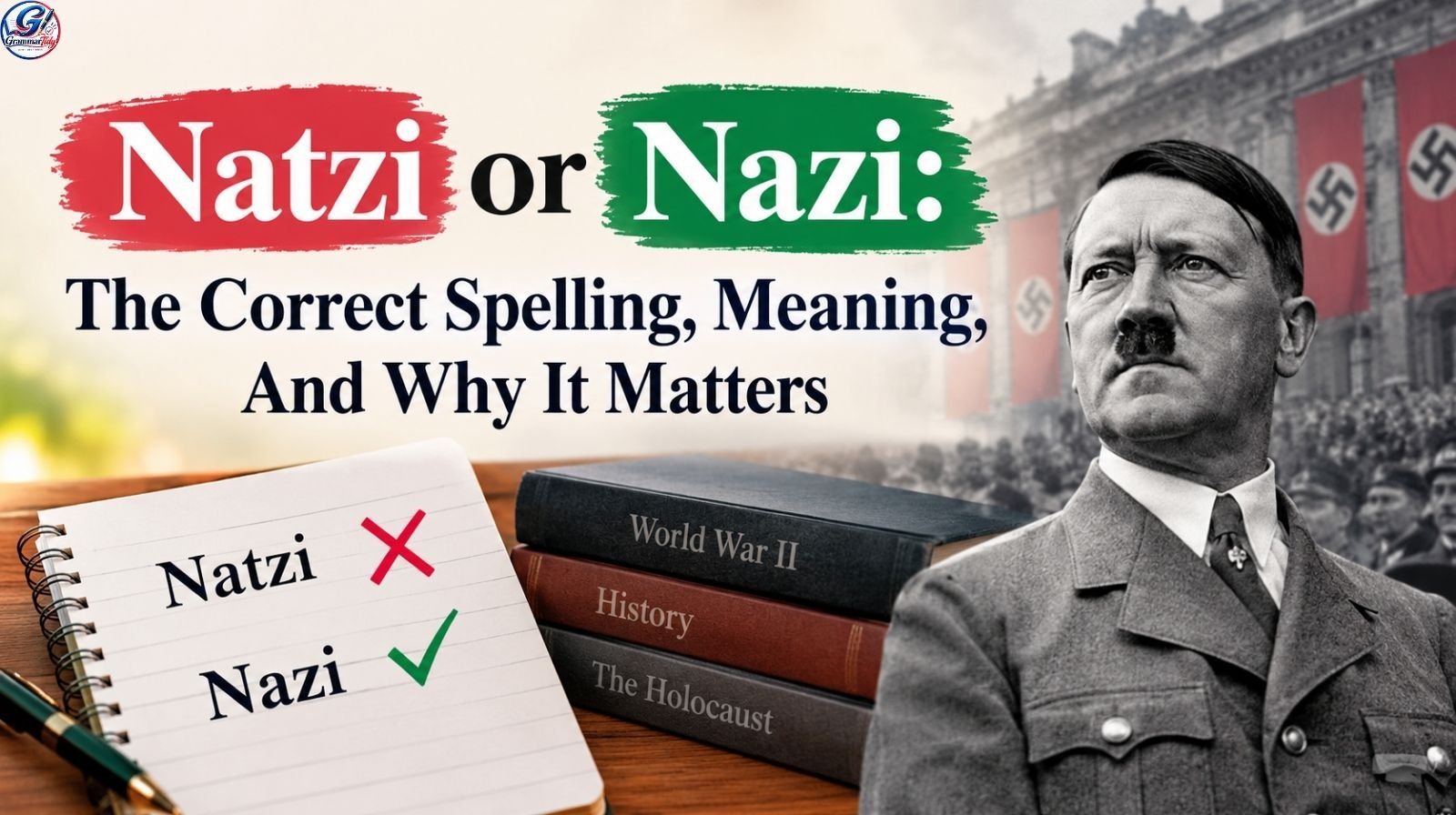
Have you ever wondered whether the correct spelling is Natzi or Nazi? Although both spellings may appear in online searches, historical discussions, and everyday writing, only one is the standard English spelling.
The correct spelling is Nazi, not Natzi. The word refers to a member or supporter of the National Socialist German Workers’ Party, led by Adolf Hitler.
The party established a dictatorship in Germany and carried out the Holocaust, one of the darkest chapters in modern history.
Understanding the difference between Nazi and Natzi is more than a spelling exercise. Because this word is associated with genocide, antisemitism, and extremist ideology, using it accurately helps readers understand the subject without confusion.
In this guide, you’ll learn the correct spelling, its meaning and origins, examples of proper usage, common mistakes, and why the word remains important in 2026.
Also Read: Lieing or Lying: Correct Spelling Guide 2026
What Is the Correct Spelling: Natzi or Nazi?
The correct spelling is Nazi. The alternative spelling Natzi is a misspelling in standard English when referring to the German political movement or its members.
The word is commonly used in discussions of World War II, Nazi Germany, the Holocaust, and extremist movements associated with Nazi ideology.
Why Is Nazi Correct?
The spelling Nazi comes from the German name of the National Socialist German Workers’ Party, known in German as Nationalsozialistische Deutsche Arbeiterpartei, abbreviated NSDAP. The informal name Nazi developed from Nationalsozialist, the German word for a National Socialist.
The standard spelling does not include a t. Therefore, writing Natzi adds a letter that does not belong in the word.
Examples:
- Correct: “The Nazi regime ruled Germany from 1933 to 1945.”
- Incorrect: “The Natzi regime ruled Germany from 1933 to 1945.”
Why Do People Confuse Nazi and Natzi?
People may add a t because they are unfamiliar with the word’s German origin or because they are spelling it from memory. The sound of a word does not always reveal its correct spelling.
Other possible reasons include typing errors, autocorrect mistakes, and confusion when reading unfamiliar historical terms.
For example, someone writing quickly might type “Natzi Germany” instead of “Nazi Germany.” The intended meaning may still be understandable, but the spelling should be corrected in formal writing.
Quick Comparison: Nazi vs. Natzi
| Feature | Nazi | Natzi |
|---|---|---|
| Standard English spelling | Correct | Incorrect |
| Historical usage | Established | Nonstandard misspelling |
| Refers to Nazi ideology or its members | Yes | Only if intended as a misspelling |
| Suitable for academic writing | Yes, when appropriate | No |
Easy rule to remember: Write Nazi without a t.
What Does Nazi Mean?
The word Nazi originally referred to a member or supporter of the Nazi Party in Germany. Today, it is primarily used in historical contexts or to describe people, groups, and ideologies associated with Nazism.
Because the word carries a serious historical meaning, writers should distinguish between its literal historical use and casual or exaggerated expressions.
The Historical Meaning of Nazi
The Nazi Party rose to power under Adolf Hitler. Hitler became Germany’s chancellor in 1933, and the Nazis established a dictatorship that destroyed democratic institutions, persecuted opponents, and promoted racist and antisemitic policies.
During World War II, the Nazi regime and its collaborators carried out the Holocaust, the systematic persecution and murder of six million Jews.
They also persecuted and murdered millions of other people, including Roma, disabled people, Polish civilians, Soviet prisoners of war, and others targeted by Nazi policies.
Example:
“The Nazi government used propaganda and state violence to maintain its dictatorship.”
In this sentence, Nazi describes a specific historical regime.
Also Read: Continuous vs Continous: What’s The Difference? 2026
What Is Nazism?
Nazism is the ideology associated with Hitler and the Nazi Party. It included extreme nationalism, racial hierarchy, antisemitism, authoritarian rule, and the suppression of political opposition.
The terms are related, but they are not interchangeable in every sentence.
- Nazi: A member or supporter of the movement, or an adjective describing something associated with it.
- Nazism: The political ideology and system of beliefs associated with the movement.
- Neo-Nazi: A person or group that revives or promotes Nazi ideology after the original Nazi regime.
Example: “The historian studied the origins of Nazism in Germany.”
How Is Nazi Used in Modern English?
In modern writing, Nazi appears in historical research, news reporting, educational materials, and discussions of contemporary extremist movements.
However, people sometimes use the word casually to describe someone they believe is excessively strict or controlling. Such usage can trivialize the historical crimes associated with Nazism, especially when it is used as a casual insult.
For clear communication, use the word in its historical or ideological sense whenever that is what you mean.
Natzi or Nazi: A Real-Life Case Study
Imagine a university student preparing a history assignment about World War II. The student writes the sentence, “The Natzi Party came to power in Germany in 1933,” and submits the document without checking the spelling.
The teacher understands the intended meaning but marks the word as incorrect. The student then searches online for “Natzi or Nazi” and discovers that Nazi is the established spelling.
The student also learns that the word refers to the National Socialist German Workers’ Party, which Adolf Hitler led to power. The Nazi regime ruled Germany as a dictatorship from 1933 until its defeat in 1945. Its policies led to widespread persecution, aggressive war, and the Holocaust.
After reviewing reliable historical sources, the student corrects the sentence to: “The Nazi Party came to power in Germany in 1933.”
The student then checks the rest of the assignment for other spelling mistakes and verifies important historical facts using reputable historical publications.
This example illustrates why proofreading matters, especially when writing about history. A misspelling may not prevent readers from understanding a sentence, but it can make academic work appear less careful. More importantly, historical accuracy requires using appropriate terminology and representing events responsibly.
The lesson: Check unfamiliar words, verify historical claims, and consult reputable sources before publishing or submitting educational content.
Also Read: Discard or Disgard: Which Spelling Is Correct?
Why the Word Nazi Matters in 2026
The word Nazi remains important because it refers to a real historical movement whose ideology caused enormous human suffering. It also appears in modern discussions of antisemitism, white supremacy, extremism, and Holocaust education.
Correct spelling helps readers find trustworthy information and distinguish historical facts from misinformation.
What Recent Statistics Tell Us
The following figures provide context for understanding why accurate language about antisemitism and Nazi ideology still matters in 2026.
1. Reported antisemitic incidents in 2025
The Anti-Defamation League reported 6,274 antisemitic incidents in the United States in 2025. These included harassment, vandalism, and assault. The organization published its annual audit in May 2026.
2. A decrease from 2024
The reported total was approximately 33% lower than the 9,354 incidents recorded in 2024. However, the 2025 figure remained among the highest annual totals recorded since the organization began tracking incidents in 1979.
3. Six million Jewish victims of the Holocaust
Approximately six million Jewish people were murdered during the Holocaust by Nazi Germany and its collaborators. Millions of other people were also persecuted and killed under Nazi policies.
These figures measure different things. The incident statistics concern reported antisemitism in the United States, while the Holocaust figure describes historical victims across Nazi-occupied Europe and other affected areas. They should not be treated as directly comparable measurements.
These statistics also do not measure how frequently people misspell Nazi as Natzi. No verified statistic on that specific spelling error is provided here.
Why Historical Accuracy Is Important
Historical terms can shape how readers understand people, ideologies, and events. Incorrect spelling can make information harder to find, while inaccurate descriptions can distort the historical record.
For students, writers, journalists, and educators, the best approach is to use the standard spelling and consult credible historical publications when researching complex subjects.
Also Read: Brite vs Bright: 7 Easy Ways To Know The Difference
How to Use Nazi Correctly in a Sentence
Using Nazi correctly means understanding both its spelling and its context. It can function as a noun or an adjective, depending on the sentence.
Examples of Nazi in Real Sentences
Here are several examples showing how the word is used in standard English.
- Historical noun: “The Nazi was a member of the German political movement.”
- Plural noun: “The Nazis established a dictatorship in Germany.”
- Adjective: “The Nazi regime persecuted Jewish people and other targeted groups.”
- Historical research: “The documentary examines Nazi propaganda during World War II.”
- Ideology: “The book explains how Nazi ideology promoted racism and antisemitism.”
- Modern extremism: “The report discusses the activities of a neo-Nazi organization.”
These examples demonstrate that the word’s grammatical role changes according to the sentence, but its spelling remains the same.
Common Mistakes to Avoid
Use this checklist when proofreading an article, essay, or historical report.
- Write Nazi, not Natzi.
- Write Nazis when referring to multiple members of the movement.
- Use Nazism when referring to the ideology.
- Use neo-Nazi for a modern adherent or movement that revives Nazi ideology.
- Avoid using the term casually when a more precise description would communicate your meaning.
- Verify historical claims against reputable sources.
A Simple Memory Trick
Remember the spelling by focusing on the word itself: N-A-Z-I.
There is no t between the a and z. If you are writing about Nazi Germany, the Nazi Party, or Nazism, keep the standard spelling consistent.
Also Read: Writing or Writting: Which Spelling Is Actually Correct? (2026 Guide)
Mini Quizzes: Natzi or Nazi
Quiz 1: Which Spelling Is Correct?
Which word is correctly spelled in standard English?
A) Natzi B) Nazi C) Nazy D) Natsi
Answer: B) Nazi
Quiz 2: What Does Nazi Originally Refer To?
A) A German political movement B) A type of German food C) A European language D) A historical building
Answer: A) A German political movement
Quiz 3: Fill in the Blank
“The _____ regime ruled Germany under Adolf Hitler.”
A) Natzi B) Natsi C) Nazi D) Nazy
Answer: C) Nazi
Quiz 4: Is “Natzi” the Standard Spelling?
A) Yes B) No
Answer: B) No
Explanation: The standard spelling is Nazi, without a “t.”
Quiz 5: Who Led the Nazi Party?
A) Winston Churchill B) Adolf Hitler C) Franklin D. Roosevelt D) Joseph Stalin
Answer: B) Adolf Hitler
Quiz 6: What Does Nazism Mean?
A) A German writing style B) A type of literature C) An ideology associated with the Nazi movement D) A European holiday
Answer: C) An ideology associated with the Nazi movement
Quiz 7: Which Sentence Is Correct?
A) The Natzi Party ruled Germany. B) The Nazi Party ruled Germany. C) The Natsi Party ruled Germany. D) The Nazy Party ruled Germany.
Answer: B) The Nazi Party ruled Germany.
Quiz 8: When Did Hitler Become Germany’s Chancellor?
A) 1918 B) 1925 C) 1933 D) 1945
Answer: C) 1933
Quiz 9: What Is a Neo-Nazi?
A) Someone who studies German grammar B) Someone who promotes or revives Nazi ideology C) Someone who studies ancient buildings D) Someone who translates historical books
Answer: B) Someone who promotes or revives Nazi ideology
Quiz 10: Which Word Refers to the Ideology?
A) Nazi B) Natzi C) Nazism D) Natsi
Answer: C) Nazism
Quiz 11: True or False?
The correct spelling of Nazi includes the letter “t.”
Answer: False
Explanation: The correct spelling is N-A-Z-I.
Quiz 12: What Was the Holocaust?
A) A political election B) A European peace agreement C) The systematic persecution and murder of six million Jews by Nazi Germany and its collaborators D) A German cultural festival
Answer: C) The systematic persecution and murder of six million Jews by Nazi Germany and its collaborators.
Quiz 13: Choose the Correct Plural
What is the correct plural of Nazi?
A) Natzi’s B) Nazies C) Nazis D) Natzis
Answer: C) Nazis
Quiz 14: Why Does Correct Spelling Matter?
A) It makes every sentence longer. B) It improves clarity and historical accuracy. C) It changes the history of an event. D) It removes the need for proofreading.
Answer: B) It improves clarity and historical accuracy.
Quiz 15: Quick Final Challenge
Which sentence uses the word correctly?
A) Nazism was an ideology associated with the Nazi movement. B) Natzi was the standard spelling of the word. C) Nazism was the name of a German holiday. D) Nazi and Natzi are both standard spellings.
Answer: A) Nazism was an ideology associated with the Nazi movement.
Also Read: Genious or Genius: Which Word Is Correct? Common Mistakes Explained (2026)
Frequently Asked Questions
1. Is it Natzi or Nazi?
Nazi is correct. Natzi is a misspelling when referring to the German political movement or its members.
2. What does the word Nazi mean?
It originally referred to a member or supporter of Hitler’s National Socialist German Workers’ Party. Today, it is also used as an adjective associated with Nazi Germany and its ideology.
3. Why is Natzi incorrect?
The established English spelling is Nazi, derived from the German term Nationalsozialist. Adding a t creates a nonstandard spelling.
4. Is Nazi a noun or an adjective?
It can be both. In “The Nazi spoke at the meeting,” it functions as a noun. In “the Nazi regime,” it functions as an adjective.
5. What is the difference between Nazi and Nazism?
Nazi refers to a person associated with the movement or describes something connected with it. Nazism refers to the ideology itself.
6. Is neo-Nazi the same as Nazi?
Not exactly. A Nazi generally refers to someone associated with the original Nazi movement, while a neo-Nazi supports or revives Nazi ideology in a later period.
7. Why does correct spelling matter when discussing Nazi history?
Correct spelling improves clarity, supports accurate historical research, and helps readers locate reliable information. Careful terminology is particularly important when discussing genocide, antisemitism, and extremist ideologies.
Conclusion:
The correct spelling is Nazi, not Natzi. The word has a specific historical meaning connected to Adolf Hitler, the Nazi Party, and the ideology responsible for the Holocaust.
Remember these three key points:
- Nazi is the correct spelling.
- Nazism refers to the ideology associated with the Nazi movement.
- Neo-Nazi describes a later person or group that promotes Nazi ideology.
Although the spelling difference is only one letter, using the correct word helps maintain clarity and historical accuracy. When writing about this subject, check your spelling, use terms in the right context, and rely on credible historical information.
Want to improve your English spelling and word usage? Explore more spelling guides, compare commonly confused words, and check unfamiliar terms before using them in your writing.
Discover More Article
- Claritin or Allegra: Which One Is Better For Allergies?
- Worse or Worst: What Is The Difference?
- Nosey or Nosy: Which Spelling Is Correct?
- Nosey or Nosy: Which Spelling Is Correct?
Keep learning with more easy grammar lessons on GrammarTidy.com

Hi, I’m Noor Fatima, the author and creator of Grammar Tidy. I’m passionate about grammar, writing, and making language learning simple and enjoyable. Through Grammar Tidy, I share helpful tips, clear explanations, and practical guidance to help readers improve their writing, avoid common mistakes, and communicate with confidence. My goal is to make better grammar easy, useful, and accessible for everyone.