Confused about pre vs post? You are not alone. These short terms appear everywhere in English, from pre-test and post-test to pre-event and post-event.
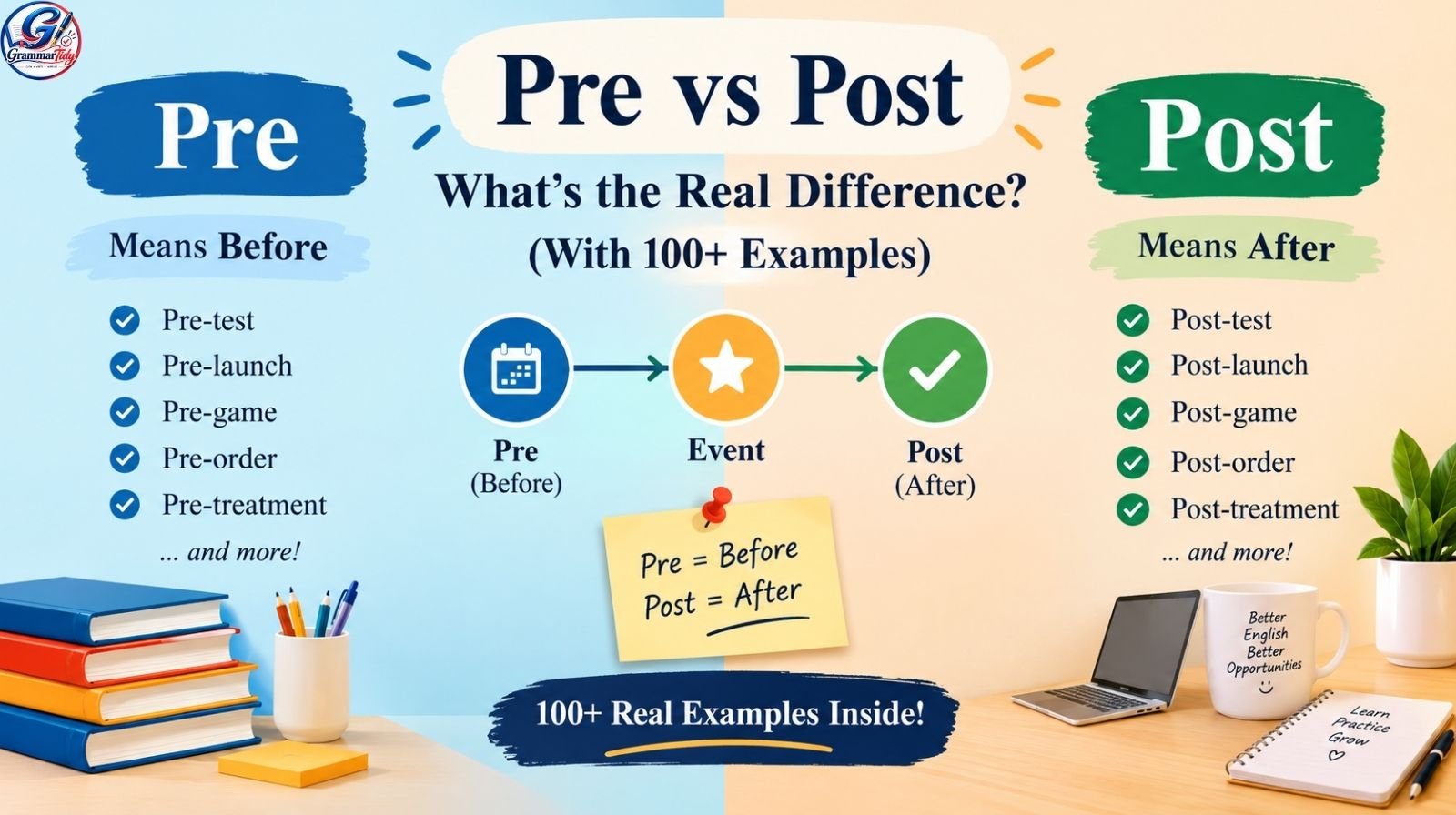
The good news is that the basic difference is simple: pre generally means “before,” while post generally means “after.”
Cambridge Dictionary identifies pre- as a prefix meaning before a time or event and post- as a prefix meaning after.
In this guide, you’ll learn exactly what pre and post mean, when to use each one, how they work as prefixes, how hyphens affect writing, and more than 100 practical examples.
Also Read: Continuous vs Continous: What’s The Difference? 2026
What Does Pre Mean?
Pre usually means before, earlier than, or in preparation for something.
It can appear as a prefix attached to another word or be used informally as a shortened form of a word or phrase.
For example:
- Pre-test = a test taken before something
- Pre-event = something happening before an event
- Pre-order = ordering something before it becomes available
- Pre-game = occurring before a game
- Prepaid = paid before receiving a service or product
Cambridge lists examples such as pre-flight, pre-lunch, and pre-industrial, all expressing the idea of something occurring before a particular time, activity, or period.
Pre vs Post: The Basic Rule
The easiest way to remember the difference is:
| Term | Basic meaning | Easy memory trick |
|---|---|---|
| Pre | Before | Pre = Prior |
| Post | After | Post = Following |
So:
Pre = before it happens.
Post = after it happens.
Examples of Pre in Sentences
- We completed a pre-test before starting the lesson.
- The doctor gave me pre-operative instructions.
- Please complete the pre-registration form.
- The team held a pre-game meeting.
- She watched a pre-recorded presentation.
Also Read: Tapping vs Taping: Difference And Correct Usage Explained
What Does Post Mean?
Post usually means after, following, or occurring later than something when it functions as the prefix post-.
For example:
- Post-test = a test taken after something
- Post-event = something happening after an event
- Post-game = occurring after a game
- Postgraduate = education after an undergraduate degree
- Postwar = relating to the period after a war
Cambridge Grammar specifically gives post- the meaning “after,” with examples such as post-war and postgraduate.
Pre vs Post in Simple English
Think of an event as a point on a timeline:
PRE → EVENT → POST
For example:
Pre-game → Game → Post-game
Or:
Pre-test → Test → Post-test
This simple timeline can help you understand most uses immediately.
Examples of Post in Sentences
- Students took a post-test after completing the course.
- We conducted a post-event survey.
- The players attended a post-game interview.
- She is pursuing postgraduate studies.
- The company conducted a post-project review.
Pre vs Post: What’s the Real Difference?
The core difference between pre vs post is their relationship to time.
Pre points toward something that happens before an event, while post points toward something that happens after it.
Pre Means Before
Examples:
- pre-launch = before launch
- pre-meeting = before a meeting
- pre-treatment = before treatment
- pre-season = before the main season
- pre-production = before production
Post Means After
Examples:
- post-launch = after launch
- post-meeting = after a meeting
- post-treatment = after treatment
- post-season = after the main season
- post-production = after production
See Also: Prooving vs Proving Difference: Which Spelling Is Correct?
Pre vs Post Examples Side by Side
| Pre | Meaning | Post | Meaning |
|---|---|---|---|
| pre-test | before test | post-test | after test |
| pre-game | before game | post-game | after game |
| pre-event | before event | post-event | after event |
| pre-launch | before launch | post-launch | after launch |
| pre-treatment | before treatment | post-treatment | after treatment |
| pre-war | before war | post-war | after war |
| pre-election | before election | post-election | after election |
| pre-production | before production | post-production | after production |
| pre-season | before season | post-season | after season |
| pre-project | before project | post-project | after project |
The meanings are often almost mirror images of each other.
100+ Pre and Post Examples You Can Use
One of the easiest ways to master pre vs post is to see the terms in context. Here are more than 100 examples divided into pre and post categories.
50+ Examples With Pre
- Pre-test — a test before instruction
- Pre-event — before an event
- Pre-game — before a game
- Pre-match — before a match
- Pre-season — before a season
- Pre-launch — before a launch
- Pre-order — order before availability
- Pre-registration — registration before an event or service
- Pre-production — preparation before production
- Pre-planning — planning beforehand
- Pre-payment — payment made beforehand
- Prepaid — paid in advance
- Pre-booking — booking beforehand
- Pre-sale — sale before general availability
- Pre-screening — screening before a main process
- Pre-treatment — treatment before another treatment
- Pre-operative — before an operation
- Pre-surgery — before surgery
- Pre-flight — before a flight
- Pre-school — education before formal school
- Pre-college — before college
- Pre-university — before university
- Pre-employment — before employment
- Pre-interview — before an interview
- Pre-meeting — before a meeting
- Pre-conference — before a conference
- Pre-concert — before a concert
- Pre-show — before a show
- Pre-recorded — recorded beforehand
- Pre-existing — existing beforehand
- Pre-approved — approved beforehand
- Pre-selected — selected beforehand
- Pre-arranged — arranged beforehand
- Pre-determined — determined beforehand
- Pre-installed — installed beforehand
- Pre-heated — heated beforehand
- Pre-cooked — cooked beforehand
- Pre-washed — washed beforehand
- Pre-cut — cut beforehand
- Pre-packed — packed beforehand
- Pre-war — before a war
- Pre-election — before an election
- Pre-tax — before tax is deducted
- Pre-crisis — before a crisis
- Pre-digital — before the digital era
- Pre-modern — before the modern period
- Pre-industrial — before industrialization
- Prehistoric — before recorded history
- Pre-existing — already existing before
- Prearranged — arranged in advance
- Precondition — a condition required beforehand
- Preliminary — coming before the main stage
- Preview — a view before the main event
- Preheat — heat before cooking
- Prepare — make ready beforehand
See Also: Nominator vs Nominee: Differences, Definitions, And Correct Usage
50+ Examples With Post
- Post-test — a test after instruction
- Post-event — after an event
- Post-game — after a game
- Post-match — after a match
- Post-season — after a season
- Post-launch — after a launch
- Post-production — after production
- Post-project — after a project
- Post-meeting — after a meeting
- Post-conference — after a conference
- Post-concert — after a concert
- Post-show — after a show
- Post-treatment — after treatment
- Post-operative — after an operation
- Post-surgery — after surgery
- Postgraduate — after undergraduate study
- Post-school — after school
- Post-college — after college
- Post-university — after university
- Post-employment — after employment
- Post-interview — after an interview
- Post-screening — after screening
- Post-sale — after a sale
- Post-payment — after payment
- Post-processing — processing after the initial process
- Post-production — work after production
- Post-recording — after recording
- Post-review — review after an activity
- Post-analysis — analysis afterward
- Post-assessment — assessment afterward
- Post-operative care — care after an operation
- Post-war — after a war
- Post-election — after an election
- Post-crisis — after a crisis
- Post-digital — relating to a period after digital development
- Post-modern — relating to postmodernism
- Post-industrial — relating to a period after industrialization
- Post-pandemic — after a pandemic period
- Post-match interview — interview after a match
- Post-event survey — survey after an event
- Post-project review — review after a project
- Post-launch analysis — analysis after launch
- Post-test score — score obtained after testing
- Post-treatment monitoring — monitoring afterward
- Post-production editing — editing after production
- Postgraduate course — course after undergraduate study
- Postscript — additional text written after the main message
- Postdate — assign a date later than the actual date
- Postpone — delay until a later time
- Posterior — relating to a position behind or later in sequence
These examples demonstrate the central idea: pre relates to what comes before, while post relates to what comes after.
See Also: Triple vs Tripple: Which Is The Correct One To Use?
How to Use Pre and Post Correctly in Writing
Knowing the definitions is easy. The trickier part is using these forms naturally and choosing the correct spelling or hyphenation.
Pre vs Post as Prefixes
A prefix is added to the beginning of a word to create another word or modify its meaning. Cambridge explains that prefixes can express relationships involving time, place, manner, and other meanings.
For pre- and post-, the time relationship is especially important:
- pre-war → before the war
- post-war → after the war
- pre-launch → before launch
- post-launch → after launch
Pre vs Post Hyphenation
There is no single universal rule saying every word beginning with pre- or post- must have a hyphen.
Cambridge notes that English prefix spelling varies: some prefixed forms are written together, while others use a hyphen. A dictionary is often the safest way to check a specific word.
Compare:
- pre-order
- prepaid
- preheat
- post-war
- postgraduate
- postproduction
Therefore, don’t automatically insert or remove a hyphen just because you see pre or post.
Pre vs Post in Professional Writing
In business, education, marketing, technology, and research, these terms are especially useful because they quickly identify when something happens.
For example:
Pre-launch: The marketing team prepared the campaign before the product launch.
Post-launch: The team analyzed customer feedback after the product launch.
This makes technical and professional writing more concise.
See Also: Icycle vs Icicle: Differences And Correct Usage
Pre vs Post in Real-Life Situations
The difference becomes even clearer when you connect these words to familiar activities.
Education
Pre-test: Students take it before learning.
Post-test: Students take it after learning.
Example:
The teacher gave students a pre-test on Monday and a post-test on Friday.
Sports
Pre-game: Activities before the game.
Post-game: Activities after the game.
Example:
The coach held a pre-game meeting and later attended a post-game press conference.
Business
Pre-launch: Activities before a product launch.
Post-launch: Activities after the product launch.
Example:
The company conducted pre-launch research and used post-launch feedback to improve the product.
Events
Pre-event: Preparation before an event.
Post-event: Follow-up after an event.
Example:
Our pre-event checklist covered everything from seating to registration, while the post-event survey collected attendee feedback.
Healthcare and Clinical Contexts
You’ll also encounter these terms in healthcare-related writing, although the exact terminology depends on the context:
- pre-operative
- pre-treatment
- post-operative
- post-treatment
- pre-surgery
- post-surgery
The basic time relationship remains the same: pre = before; post = after.
A Simple Case Study: Pre-Launch vs Post-Launch

Imagine a small software company preparing to release a new productivity app.
Six weeks before release, the company begins its pre-launch activities. The team researches potential customers, tests the interface, prepares promotional materials, trains its support staff, and creates a launch-day checklist. These activities happen before the public release, so pre-launch is the appropriate term.
On launch day, the app becomes available to customers. The company then enters a different stage. During the following weeks, the team examines downloads, customer comments, support requests, technical issues, and user behavior. These activities are part of its post-launch work because they happen after the product has been released.
The company might also conduct a post-launch survey to ask users about their experience. Meanwhile, a new feature scheduled for the next release could go through another pre-launch testing phase.
Notice how the two terms create a clear timeline rather than describing two unrelated concepts:
Pre-launch → Product Launch → Post-launch
This same pattern works in education, sports, events, research, marketing, and many other fields. Once you identify the central event, simply ask:
Does this happen before it or after it? If it happens before, pre is usually the right direction. If it happens after, post is usually the right direction.
See Also: Repore or Rapport: Which Spelling Is Correct? Meaning, Examples & Grammar Guide (2026)
2025–2026 Data: Why Clear English Usage Still Matters Online
There is no authoritative 2025–2026 statistic that measures exactly how many times English writers use the prefixes pre- and post- online. It would therefore be misleading to present a made-up “pre vs post usage rate.”
However, current web-language data shows why understanding English word formation remains relevant for online writing.
W3Techs reported on 29 September 2026 that English was the content language of 49.5% of websites whose content language could be identified. It also reported English on 47.3% of the top 1 million websites in its ranking breakdown.
Its historical data shows English at 49.3% in 2025 and 49.5% in September 2026, illustrating its continuing large presence across web content.
These figures are not statistics about pre/post words themselves. Instead, they provide current context for why precise English usage matters for bloggers, students, marketers, editors, and website owners.
Common Mistakes With Pre vs Post
Even though the basic distinction is simple, several mistakes appear frequently.
Mistake 1: Reversing the Meanings
Incorrect thinking:
Post-test = test before learning
Correct:
Pre-test = before learning
Post-test = after learning
Remember:
PRE → BEFORE
POST → AFTER
See Also: Tying vs Tieing: Correct Spelling & Easy Rule To Remember
Mistake 2: Assuming Every Word Needs a Hyphen
Not every word containing pre or post follows the same spelling pattern.
For example:
- pre-order
- prepaid
- preheat
- post-war
- postgraduate
Always check established dictionary usage when you are uncertain. Cambridge specifically notes that there are no absolute rules covering every prefix-hyphen situation.
Mistake 3: Confusing Prefixes With Other Meanings
Post can also be a completely different word.
For example:
She sent the letter by post.
Here, post means the postal system or mail, not necessarily “after.”
Similarly:
He applied for a post at the university.
Here, post means a position or job.
So context matters.
Easy Trick to Remember Pre vs Post
If you keep forgetting the difference, use this simple memory trick:
Pre = Prior
Pre sounds like prior.
Prior means something that comes earlier.
So:
Pre = before
Post = After
Think of post-event or post-game.
The event or game happens first, and the post-event activity happens afterward.
So:
Post = after
The 3-Word Formula
Remember:
PRE → BEFORE → EVENT
POST → AFTER → EVENT
Once you identify the main event, choosing the right term becomes much easier.
See Also: Acception vs Exception: Which One Is Actually Correct? (2026)
Pre vs Post Quick Comparison Checklist
Use this checklist whenever you are unsure:
- Is it happening before an event? → Use pre
- Is it happening after an event? → Use post
- Are you describing preparation? → Pre is often appropriate
- Are you describing follow-up? → Post is often appropriate
- Are you unsure about spelling? → Check a reliable dictionary
- Are you unsure about a hyphen? → Check the established form of that particular word
- Is post being used as an ordinary noun? → Its meaning may be completely different
- Is pre part of a longer established word? → Don’t assume it always needs a hyphen
Mini Quiz: Pre vs Post
1. Quick Check: What Does “Pre” Mean?
Question: Does pre mean before or after?
Answer: Before.
“Pre” usually refers to something that happens before an event.
2. What About “Post”?
Question: If something is post-game, when does it happen?
Answer: After the game.
3. Pick the Right Word
Question: Which one means a test taken before instruction: pre-test or post-test?
Answer: Pre-test.
4. Spot the Difference
Question: A company studies customer feedback after launching a product. Is this pre-launch or post-launch?
Answer: Post-launch.
5. Memory Trick Time!
Question: Which word can you connect with “prior”: pre or post?
Answer: Pre.
Think: Pre = Prior = Before.
6. Before the Big Game
Question: The coach gives players instructions before a match. Is this a pre-game or post-game activity?
Answer: Pre-game.
7. After the Event
Question: You send attendees a feedback form after an event. What is it called?
Answer: A post-event survey.
8. Fill in the Blank
Question: “The team held a ______-meeting to prepare for tomorrow.”
Answer: Pre-meeting.
9. Launch Time!
Question: Which term describes activities that happen before a product release?
Answer: Pre-launch.
10. After Learning
Question: Students take a test after completing a course. Is it a pre-test or post-test?
Answer: Post-test.
11. True or False?
Question: Post generally means “after” when used as a time-related prefix.
Answer: True.
12. Hyphen Challenge
Question: Should you automatically add a hyphen to every word beginning with pre- or post-?
Answer: No.
Hyphenation varies by word, so check the established spelling when unsure.
13. Timeline Test
Question: Which order is correct?
A. Post → Event → Pre
B. Event → Pre → Post
C. Pre → Event → Post
D. Post → Pre → Event
Answer: C. Pre → Event → Post.
14. Real-Life Writing Challenge
Question: A company prepares promotional materials before releasing a product. Which phrase fits best?
Answer: Pre-launch preparation.
15. The Ultimate Memory Test
Question: Complete this formula:
Pre = ______
Post = ______
Answer: Pre = Before; Post = After.
See Also: Oversite vs Oversight: What’s The Difference And Which Word Should You Use?
FAQs
1. Is pre before or after?
Pre means before. It commonly refers to something that happens before a particular event, time, or process, such as a pre-test or pre-launch activity.
2. Is post before or after?
Post means after when it is used as the prefix post-. For example, post-test means a test that occurs after instruction.
3. What is the difference between pre-test and post-test?
A pre-test is taken before instruction, training, or an intervention. A post-test is taken afterward, often to measure what changed or was learned.
4. Does pre always mean before?
When pre- is used as the relevant time-related prefix, it generally means before. However, individual words can have established meanings that should be checked in context.
5. Does post always mean after?
When post- functions as a prefix expressing time, it generally means after. But post can also be an independent word with other meanings, such as mail, a position, or a support structure.
6. Should pre and post be hyphenated?
Not always. English spelling varies by word. Some forms are hyphenated, while others are written as one word. Cambridge recommends checking a good learner’s dictionary when you are uncertain.
7. What is the easiest way to remember pre vs post?
Remember:
Pre = before
Post = after
Or use:
Pre → Prior → Before
Post → Following → After
Conclusion:
The difference between pre vs post is much easier once you connect both terms to a central event.
Pre generally means before, while post generally means after. That gives you a simple timeline:
PRE → EVENT → POST
So, a pre-test happens before testing or instruction, while a post-test happens afterward. A pre-launch campaign comes before a launch, while post-launch analysis comes after it.
The biggest thing to remember is that spelling and hyphenation can vary from word to word, so check a reliable dictionary when you’re unsure. Cambridge’s grammar resources confirm that both pre- and post- are productive prefixes with time-related meanings.
Save this guide, use the 100+ examples above, and the next time you see “pre” or “post,” simply ask: Did it happen before or after the main event? That one question will usually give you the answer.
Discover More Article
- Offerred or Offered: Which Spelling Is Correct & Why In 2026?
- Fiend or Feen: Which Spelling Is Correct & Why In 2026?
- Transferring or Transfering: Correct Usage In Business, Technology & Everyday English In 2026
- Amount or Ammount: Which Word Is Correct? (2026)
Keep learning with more easy grammar lessons on GrammarTidy.com

Hi, I’m Noor Fatima, the author and creator of Grammar Tidy. I’m passionate about grammar, writing, and making language learning simple and enjoyable. Through Grammar Tidy, I share helpful tips, clear explanations, and practical guidance to help readers improve their writing, avoid common mistakes, and communicate with confidence. My goal is to make better grammar easy, useful, and accessible for everyone.