Have you ever typed “curtesy” when you meant “courtesy” and wondered whether both spellings were correct? The confusion is understandable because the two words look and sound similar. However, courtesy vs curtesy is not simply a matter of choosing between two spellings.
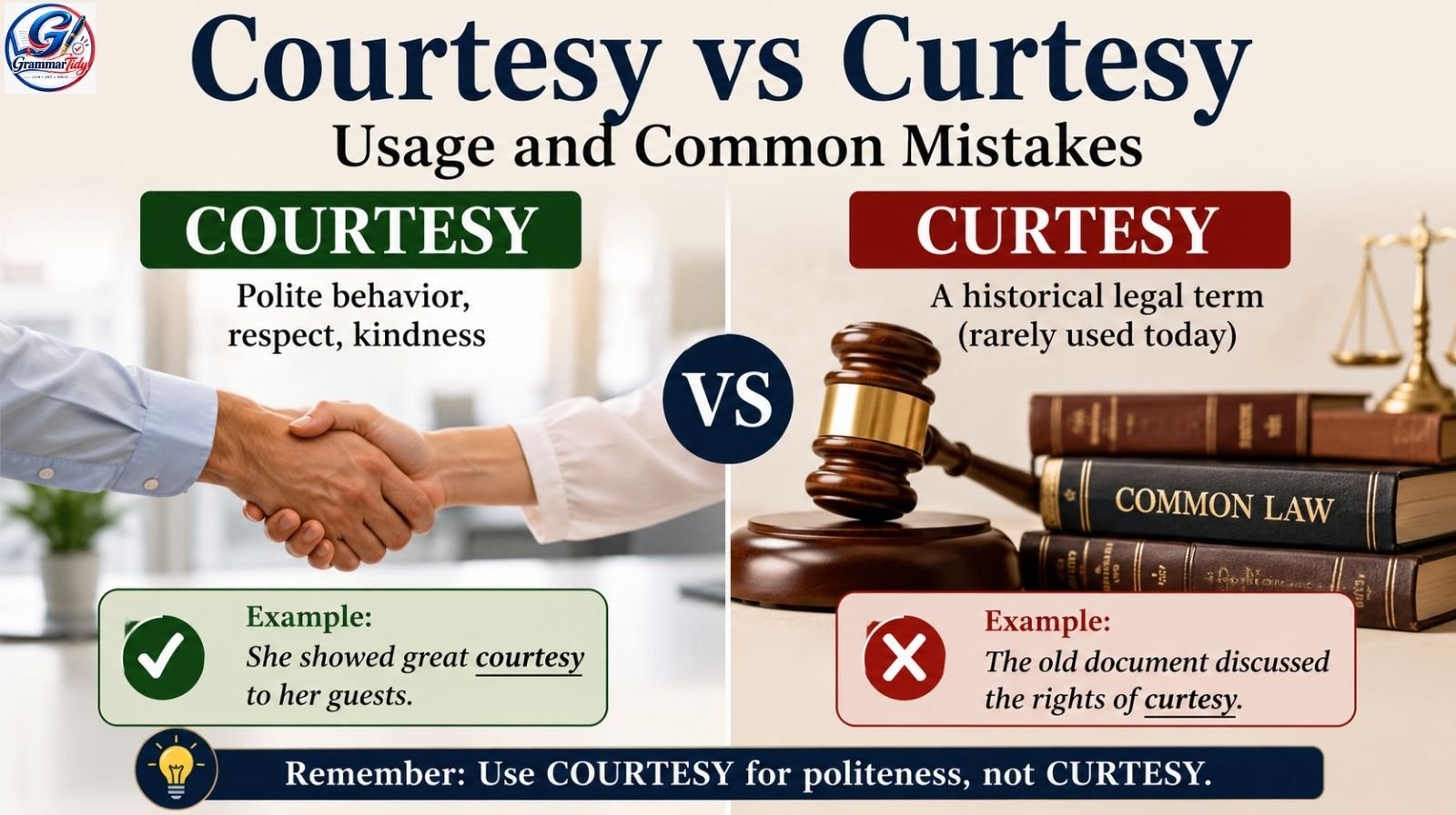
Courtesy is a common modern English word connected with politeness, respect, and considerate behavior. Curtesy, on the other hand, is a rare historical legal term with a completely different meaning.
This guide explains what each word means, why people confuse them, how to use them correctly, and how to avoid one of the most common spelling mistakes involving courtesy vs curtesy.
Also Read: Quantify vs Qualify: Differences And Correct Usage
What Is the Difference Between Courtesy and Curtesy?
The simplest answer is this:
| Word | Meaning | Common Today? | Example |
|---|---|---|---|
| Courtesy | Polite behavior, respect, or a considerate act | Yes | She thanked him for his courtesy. |
| Curtesy | A historical legal interest of a husband in his deceased wife’s property | Rare | The old legal text discussed curtesy rights. |
In everyday English, courtesy is almost always the word you need. Cambridge defines it as polite behavior or a polite action or remark, while Merriam-Webster identifies curtesy as a distinct historical legal term.
What Does Courtesy Mean?
Courtesy refers to polite, respectful, and considerate behavior. It can also describe a kind action, a privilege, or something provided free of charge.
Courtesy as Polite Behavior
This is the most common meaning.
Examples:
- She treated every customer with courtesy.
- Please show some courtesy to other passengers.
- Holding the door open is a simple act of courtesy.
Courtesy as a Considerate Action
Sometimes the word refers to a specific polite act.
For example:
- He had the courtesy to call before arriving.
- As a courtesy, the company extended the deadline.
Courtesy in Common Expressions
You will also see courtesy in several common phrases:
- Courtesy of – provided by someone
- As a courtesy – as a polite or helpful gesture
- Courtesy call – a polite or formal visit or call
- Courtesy car – a temporary vehicle provided to a customer
These are all modern, standard uses of the word courtesy.
What Does Curtesy Mean?
Curtesy is a real English word, but it has a very different meaning from courtesy.
Historically, curtesy referred to a husband’s legal interest in certain real property owned or inherited by his wife after her death, subject to conditions under common law.
Curtesy Is Mainly a Historical Legal Term
You are unlikely to use curtesy in ordinary emails, articles, school assignments, or business writing.
Example:
The legal historian explained the traditional doctrine of curtesy in common law.
Therefore, if you want to describe politeness, respect, kindness, or good manners, curtesy is incorrect. Use courtesy instead.
Is Curtesy a Misspelling?
Not exactly.
Curtesy is a legitimate word, but it is frequently an accidental substitution for courtesy. The important distinction is meaning:
- Want to say politeness? → Courtesy
- Discussing an old legal property right? → Curtesy
Courtesy vs Curtesy: Common Spelling Mistakes
The main reason people confuse these words is their similar pronunciation. However, the missing “ou” changes the word entirely.
Mistake #1: Writing “Curtesy” for Politeness
❌ Thank you for your curtesy.
✅ Thank you for your courtesy.
In this sentence, the writer is expressing appreciation for someone’s politeness or kindness. Therefore, courtesy is correct.
Mistake #2: Assuming Curtesy Is an Alternative Spelling
Unlike words that have accepted British and American spelling variations, curtesy is not simply another spelling of courtesy.
They are separate words with separate meanings.
Mistake #3: Relying Only on Sound
Both words can sound very similar in natural speech. As a result, writers may spell the word based on pronunciation.
A simple solution is to remember that courtesy is connected to courteous.
If you can replace the word with politeness or respect, choose courtesy.
Courtesy vs Curtesy: How to Remember the Correct Word
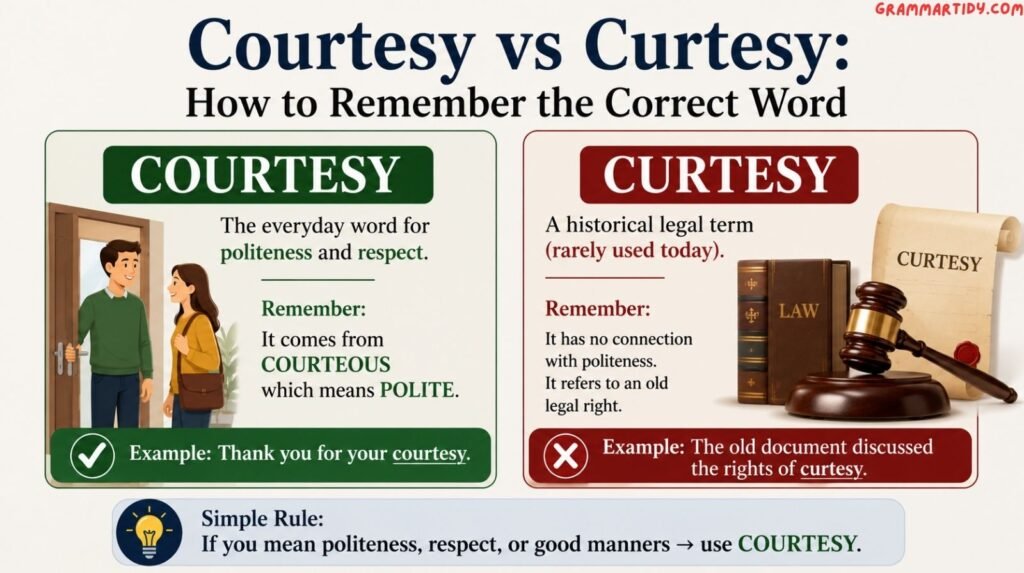
Here is a simple step-by-step method.
Step 1: Think About the Meaning
Ask yourself:
Am I talking about politeness, respect, kindness, or good manners?
If yes, use courtesy.
Step 2: Remember “Courteous”
The adjective courteous means polite.
Therefore:
Courteous → Courtesy
This connection makes the spelling easier to remember.
Step 3: Watch for the Missing “OU”
Compare:
- Courtesy → everyday politeness
- Curtesy → historical legal term
The letters “ou” can serve as a quick visual reminder that courtesy is the standard modern word for polite behavior.
A Real-Life Writing Example: How One Small Letter Changes the Meaning
Imagine a customer service manager preparing a response to an unhappy customer. The manager writes:
“We apologize for the inconvenience and thank you for your patience and curtesy.”
At first glance, the sentence may appear understandable. However, curtesy is not the word the manager intends to use. The message is thanking the customer for patience and polite understanding, so courtesy is the correct choice.
The corrected sentence is:
“We apologize for the inconvenience and thank you for your patience and courtesy.”
This small correction matters because professional writing depends on clarity and credibility. A spelling that accidentally produces another legitimate word can be harder to notice than an obvious typo. The writer may assume that because curtesy is recognized as a word, it must fit the sentence. However, meaning not just dictionary recognition determines whether a word is correct.
This example also applies to emails, blog posts, customer support messages, academic writing, and social media content. When proofreading, do not simply ask, “Is this a real word?” Instead, ask, “Is this the word that expresses my intended meaning?”
Also Read: Accross vs Across: Which Is The Correct Spelling?
Why Spelling and Word-Choice Errors Still Matter in 2025–2026
Modern spelling and grammar tools can help writers identify possible errors, but automated suggestions should still be checked against context.
For example, a 2024 study examining automated writing assessment found that many flagged spelling and word issues were not genuine errors; among the issues analyzed, the study reported a substantial number of false positives and context-dependent cases. This highlights an important lesson for writers in 2025–2026: writing tools are useful assistants, but they do not replace understanding the meaning of the words you choose.
For courtesy vs curtesy, this distinction is especially useful because both are real words. A spellchecker may not always catch a mistake if the incorrectly chosen word is still recognized.
Best Practice for Writers
Before publishing or sending important content:
- Check the spelling.
- Check the word’s definition.
- Read the entire sentence for context.
- Use a reliable dictionary when two words look or sound similar.
- Proofread manually instead of relying entirely on automated tools.
Courtesy vs Curtesy: Quick Usage Checklist
Use this checklist whenever you are unsure:
- Talking about politeness? → Use courtesy
- Talking about respect or good manners? → Use courtesy
- Writing “thank you for your…”? → Usually courtesy
- Using “courtesy of”? → Use courtesy
- Discussing an old common-law property right? → Use curtesy
In nearly all everyday writing situations, courtesy is the correct choice.
Mini Quizzes
Quiz 1: Pick the Right Word
Which word means polite or considerate behavior?
A) Curtesy
B) Courtesy
C) Courtsy
D) Curtsey
Answer: B) Courtesy
Quiz 2: Quick Spelling Check
Which sentence is correct?
A) Thank you for your curtesy.
B) Thank you for your courtesey.
C) Thank you for your courtesy.
D) Thank you for your curtisy.
Answer: C) Thank you for your courtesy.
Quiz 3: Know the Difference
What is curtesy mainly associated with?
A) Modern manners
B) Historical law
C) Customer service
D) Friendly greetings
Answer: B) Historical law
Quiz 4: Fill the Gap
“Please show some ______ to your neighbors.”
A) curtesy
B) courtesy
C) courtesey
D) curtisy
Answer: B) courtesy
Quiz 5: Everyday English
Which word should you use when talking about good manners?
A) Courtesy
B) Curtesy
C) Curtsey
D) Courtsy
Answer: A) Courtesy
Quiz 6: Spot the Correct Sentence
Which sentence uses courtesy correctly?
A) His courtesy made everyone feel welcome.
B) His curtesy made everyone feel welcome.
C) His courtesey made everyone feel welcome.
D) His curtisy made everyone feel welcome.
Answer: A) His courtesy made everyone feel welcome.
Quiz 7: Memory Trick
Which adjective can help you remember the spelling of courtesy?
A) Courteous
B) Curt
C) Courted
D) Courtesyful
Answer: A) Courteous
Quiz 8: Meaning Match
“Courtesy of the museum” most nearly means:
A) Against the museum
B) Provided by the museum
C) Hidden by the museum
D) Purchased from the museum
Answer: B) Provided by the museum
Quiz 9: Common Mistake
Someone writes, “Thank you for your curtesy.” What should they normally write?
A) Thank you for your courtesy.
B) Thank you for your courty.
C) Thank you for your curtesy.
D) Thank you for your courteous.
Answer: A) Thank you for your courtesy.
Quiz 10: Word Recognition
Which of these is a real word with a historical legal meaning?
A) Curtesy
B) Courtesey
C) Courtsy
D) Curtisy
Answer: A) Curtesy
Quiz 11: Choose Carefully
“She treated the guests with great ______.”
A) curtesy
B) courtesy
C) courtesey
D) curtsey
Answer: B) courtesy
Quiz 12: One-Letter Trap
Why do writers often confuse courtesy and curtesy?
A) They have identical meanings.
B) They look and sound similar.
C) They are always interchangeable.
D) They are both modern spelling variants.
Answer: B) They look and sound similar.
Quiz 13: Professional Writing
Which word is appropriate in this sentence?
“Thank you for your patience and ______.”
A) curtesy
B) courtesy
C) courtesey
D) curtisy
Answer: B) courtesy
Quiz 14: Final Meaning Test
If you can replace a word with “politeness,” which word is most likely correct?
A) Curtesy
B) Courtesy
C) Curtsey
D) Courted
Answer: B) Courtesy
Quiz 15: The Ultimate Check
Which statement is correct?
A) Courtesy is only a historical legal term.
B) Curtesy is the usual word for good manners.
C) Courtesy commonly means politeness, while curtesy is a rare historical legal term.
D) Courtesy and curtesy always have the same meaning.
Answer: C) Courtesy commonly means politeness, while curtesy is a rare historical legal term.
FAQs
Q1. Is it courtesy or curtesy?
A: If you mean politeness, respect, or a considerate action, the correct word is courtesy. Curtesy is a separate and rare historical legal term.
Q2. Is curtesy a real word?
A: Yes. Curtesy is a real word, but it refers to a historical legal interest related to a husband’s rights in certain property after his wife’s death.
Q3. How do you use courtesy in a sentence?
A: For example:
She showed great courtesy to every guest.
Here, courtesy means polite and respectful behavior.
Q4. What does “courtesy of” mean?
A: Courtesy of can mean provided by, supplied by, or made possible by someone or something.
For example:
The photograph appears courtesy of the museum.
Cambridge also recognizes this established usage.
Q5. Is curtesy a correct spelling of courtesy?
A: No. Curtesy is not an alternative spelling of courtesy. They are different words with different meanings.
Q6. How can I remember how to spell courtesy?
A: Connect courtesy with courteous:
Courteous behavior = Courtesy
That connection makes it easier to remember the correct spelling.
Conclusion:
The difference between courtesy vs curtesy comes down to meaning. Courtesy is the common modern word for politeness, respect, and considerate behavior. Curtesy, however, is a rare historical legal term and should not be used as a replacement for courtesy.
The easiest rule to remember is simple: if you are talking about good manners, kindness, respect, or polite behavior, choose courtesy.
Before publishing your next email, article, assignment, or professional message, take a moment to check similar-looking words. One small spelling difference can completely change the meaning and choosing the right word helps your writing stay clear, professional, and trustworthy.
Authoritative References
Keep learning with more easy grammar lessons on GrammarTidy.com

Hi, I’m Noor Fatima, the author and creator of Grammar Tidy. I’m passionate about grammar, writing, and making language learning simple and enjoyable. Through Grammar Tidy, I share helpful tips, clear explanations, and practical guidance to help readers improve their writing, avoid common mistakes, and communicate with confidence. My goal is to make better grammar easy, useful, and accessible for everyone.