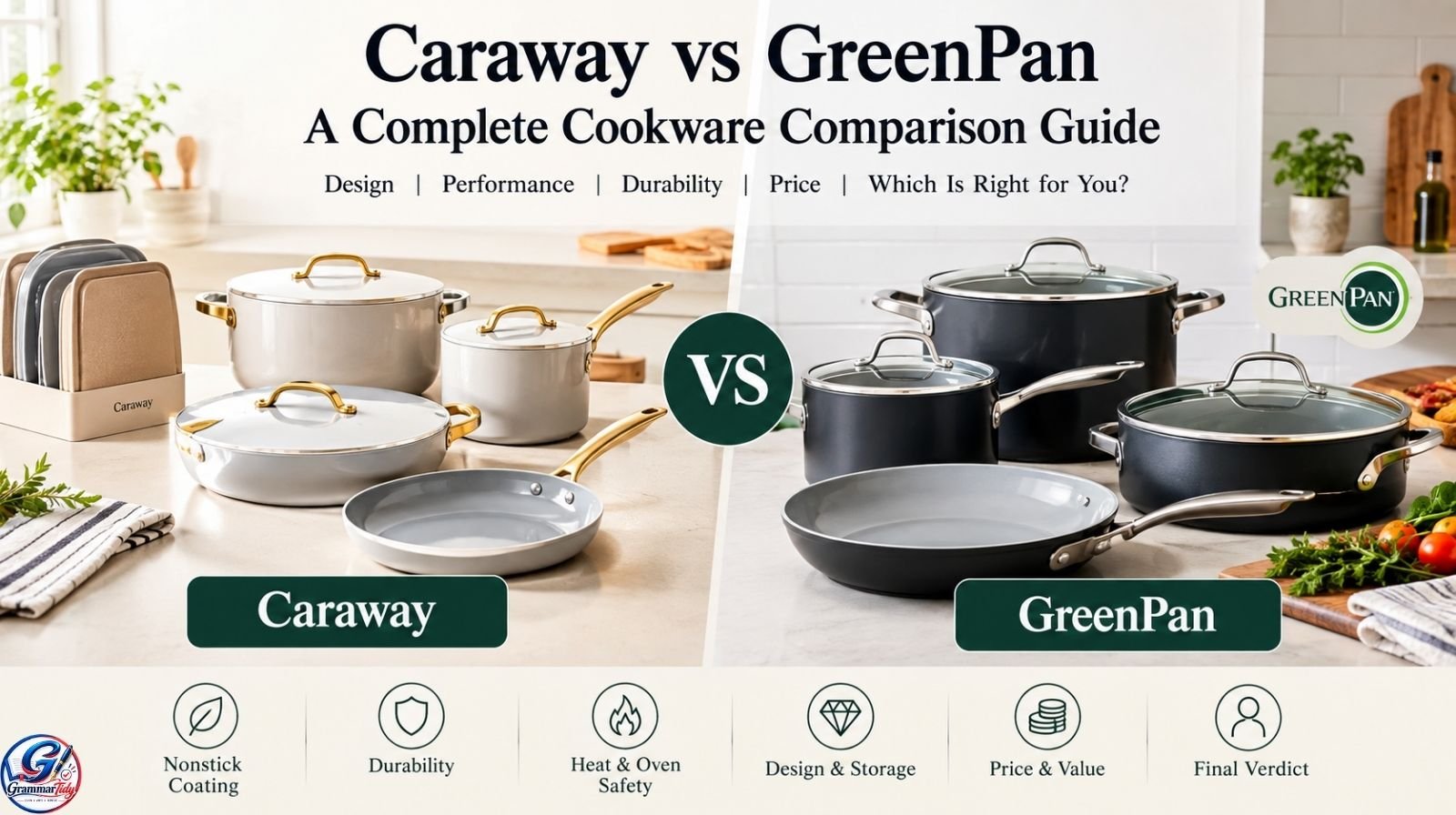
Choosing between Caraway vs GreenPan can feel surprisingly difficult. Both brands are well known for stylish ceramic nonstick cookware, both offer PFAS-free options, and both promise easy food release and cleanup.
But they are not exactly the same.
Caraway focuses heavily on minimalist design, coordinated colors, storage solutions, and an all-in-one cookware-set experience. GreenPan, meanwhile, offers a much broader cookware range, including numerous ceramic collections with different constructions, price points, and performance features.
So, which should you choose?
The answer depends on what matters most in your kitchen: design, cooking performance, durability, induction compatibility, oven use, cleaning, storage, or overall flexibility.
This Caraway vs GreenPan comparison breaks down the important differences so you can make a more informed cookware decision.
Also Read: Oversite vs Oversight: What’s The Difference And Which Word Should You Use?
Caraway vs GreenPan: Quick Comparison
Before looking at each category in detail, here’s the basic picture.
| Feature | Caraway | GreenPan |
|---|---|---|
| Main material | Ceramic-coated cookware | Ceramic-coated cookware across multiple collections |
| Nonstick technology | Proprietary ceramic coating | Thermolon ceramic technology and other proprietary ceramic coatings |
| PFAS positioning | Made without intentionally added PFAS | Many ceramic collections are marketed as PFAS-free |
| Induction | Yes | Many collections, including Valencia Pro |
| Oven temperature | Up to 550°F for the standard cookware set | Up to 600°F for Valencia Pro |
| Dishwasher | Handwashing recommended | Some collections are dishwasher-safe |
| Design focus | Minimalist, coordinated aesthetic | Wide variety of styles and collections |
| Storage | Storage organizers included with some sets | Pan protectors included with some sets |
| Product variety | More focused cookware lineup | Very broad cookware lineup |
| Best-known strength | Design + organized kitchen setup | Variety + ceramic cookware performance |
The table is a useful starting point, but cookware performance can vary significantly between collections. A direct comparison of a specific Caraway set with a specific GreenPan collection is therefore more meaningful than comparing the brands as if every pan were identical.
What Is the Difference Between Caraway and GreenPan?
The biggest difference is not simply “ceramic versus ceramic.” Both brands use ceramic nonstick technology, but their cookware collections differ in construction, design, features, and care requirements.
Caraway’s Approach to Cookware
Caraway’s cookware is built around a coordinated kitchen experience. Its standard cookware set includes essential pieces such as a fry pan, saucepan, sauté pan, and Dutch oven, along with storage accessories.
The brand emphasizes a minimalist appearance, ergonomic handles, coordinated colors, and storage organization.
That makes Caraway particularly appealing if you want your cookware to look intentional rather than like a collection of unrelated pans.
For example, someone moving into a new apartment might appreciate buying one coordinated set instead of choosing individual pots and pans.
Also Read: Acception vs Exception: Which One Is Actually Correct? (2026)
GreenPan Offers More Collections
GreenPan takes a broader approach.
Instead of concentrating on one recognizable cookware style, the company offers multiple ceramic collections. These can differ in construction, weight, appearance, price, oven capabilities, and cooking features.
The Valencia Pro collection, for example, uses hard-anodized aluminum bodies and a Magneto induction base. GreenPan lists it as compatible with induction, gas, electric, halogen, and ceramic stovetops.
This variety means shoppers have more opportunity to choose cookware according to their cooking style rather than simply choosing one brand-wide design.
Ceramic Nonstick Does Not Mean Maintenance-Free
This is an important point when comparing Caraway and GreenPan.
Ceramic nonstick cookware can make eggs, pancakes, fish, vegetables, and other delicate foods easier to release. However, ceramic coatings still need proper care.
High heat, abrasive cleaning, cooking sprays, and rough utensils can shorten the useful life of a nonstick surface.
Therefore, buying ceramic cookware should not be treated as buying completely maintenance-free cookware.
Caraway vs GreenPan: Nonstick Performance and Cooking
For many shoppers, nonstick performance is the most important part of the decision.
How Caraway Performs
Caraway’s ceramic-coated pans are designed for easy food release and simple cleanup.
In Good Housekeeping’s recent testing, the Caraway set performed well across foods including eggs, pancakes, frittatas, sauces, chicken, fried rice, and tacos. The tester also reported that the fry pan was easy to clean after cooking scrambled eggs.
However, the same testing found that the nonstick coating did not maintain its performance indefinitely, which is a consideration with ceramic cookware generally.
How GreenPan Performs
GreenPan has a particularly strong presence in the ceramic nonstick category.
In Good Housekeeping’s 2026 testing, the Valencia Pro skillet showed even heat distribution, while fried eggs released easily. The testers also found that the collection performed well when searing steak and simmering tomato sauce.
Other GreenPan collections produced different results because the construction varies from one line to another.
That distinction matters.
A GreenPan Valencia Pro pan is not necessarily representative of every GreenPan pan.
Also Read: Filipino or Philipino? Meaning, Pronunciation, Spelling & Usage Explained In 2026
Which Cooking Tasks Suit Ceramic Nonstick?
Both brands can work especially well for:
- Eggs and omelets
- Pancakes
- Fish
- Vegetables
- Frittatas
- Sauces
- Everyday sautéing
- Low-to-medium-heat cooking
For example, if breakfast usually means eggs and pancakes, a good ceramic nonstick skillet can make flipping and cleanup easier.
For very high-heat searing, however, shoppers should pay close attention to the specific cookware’s instructions rather than assuming ceramic nonstick should be treated like cast iron or bare stainless steel.
Caraway vs GreenPan: Durability, Heat, and Oven Safety
Durability is where the details become particularly important.
Caraway Heat and Oven Limits
Caraway’s standard ceramic cookware is listed as oven-safe up to 550°F. The company recommends low-to-medium stovetop heat and handwashing.
That means Caraway can handle many common oven recipes, including baked pasta, frittatas, roasted vegetables, and stovetop-to-oven dishes.
However, its care guidance specifically emphasizes avoiding excessive heat because overheating can negatively affect ceramic nonstick performance and longevity.
GreenPan Heat and Oven Limits
GreenPan’s Valencia Pro collection is listed as oven-safe up to 600°F, with lids rated to 425°F.
That gives the collection a higher published oven limit than the standard Caraway cookware set.
GreenPan also recommends low-to-medium heat for routine stovetop cooking because ceramic cookware can heat efficiently.
Why the Difference Matters
A 50°F difference may not matter for someone who mostly cooks eggs, vegetables, pasta, and soups.
It becomes more relevant if you frequently use:
- High-temperature oven recipes
- Stovetop-to-oven techniques
- Broiling or intense finishing heat
- Recipes that require higher oven temperatures
Always check the instructions for the exact model because oven and broiler ratings can differ between collections.
Also Read: Plandid or Candid: Which Is Correct? Meaning, Examples & Usage Guide (2026)
Design, Storage, and Everyday Convenience
Cookware is not only about cooking performance. You also have to live with it in your kitchen.
Caraway’s Design Advantage
Caraway puts considerable emphasis on visual design.
Its cookware comes in coordinated colors, and the standard set includes storage organizers intended to keep lids and pans arranged neatly.
This can be useful in smaller kitchens where cookware storage becomes a daily problem.
A person with limited cabinet space may value the included storage system almost as much as the cookware itself.
GreenPan’s Variety
GreenPan offers more visual and structural variety.
Depending on the collection, shoppers can find different colors, handle styles, materials, and construction types.
This is helpful if you prefer selecting cookware piece by piece instead of committing to one complete design.
Which Is More Convenient?
It depends on your kitchen.
If you want a coordinated set with an intentional visual style and storage accessories, Caraway’s approach may fit your needs.
If you want to mix and match cookware or choose among multiple construction types, GreenPan gives you more options.
Caraway vs GreenPan: Price and Value
Price should be evaluated alongside what you actually receive.
Caraway Pricing
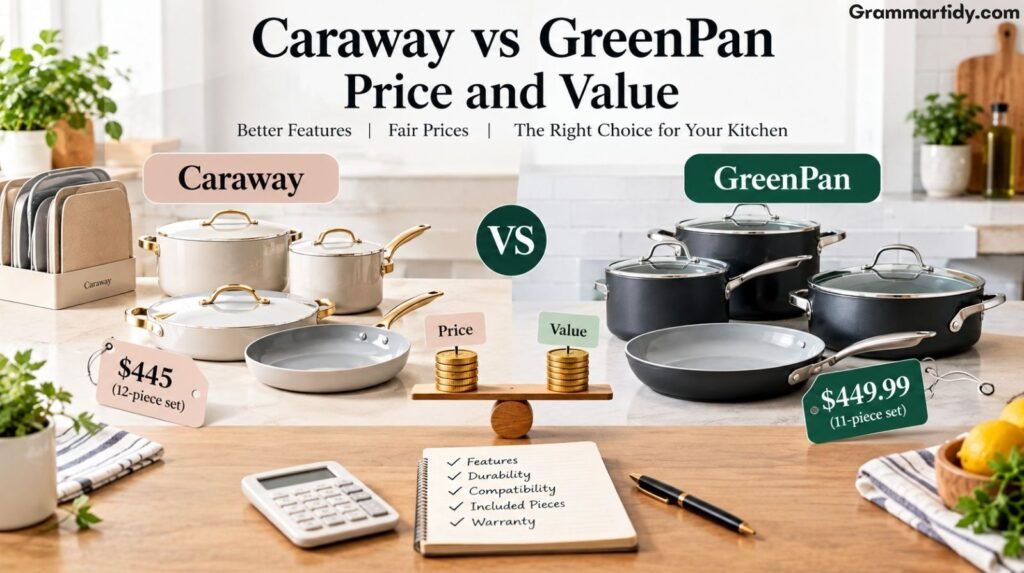
Caraway’s current standard 12-piece cookware set is listed at a regular price of $675 and a sale price of $445 at the time of this comparison.
The package includes cookware plus storage accessories, so the value calculation should include those extras rather than comparing only the number of pots and pans.
GreenPan Pricing
GreenPan’s Valencia Pro 11-piece set is currently listed at $449.99 on GreenPan’s U.S. website, although prices and promotions can change.
GreenPan also offers less expensive ceramic collections. Its current ceramic cookware lineup includes collections at substantially different price points.
That gives shoppers more room to adjust the budget.
Also Read: Fiend or Feen: Which Spelling Is Correct & Why In 2026?
Think Beyond the Sticker Price
A cookware set can appear inexpensive until you realize that you still need a separate skillet, stockpot, or storage solution.
When comparing value, ask:
- How many useful pieces are included?
- Do I need every piece?
- Is storage included?
- Does the set work with my stovetop?
- How much care will the coating require?
- What is the warranty?
- Would buying individual pieces make more sense?
This approach is more useful than simply choosing the set with the lower advertised price.
2025–2026 Data: What the Cookware Market Tells Us
The wider cookware market also helps explain why ceramic nonstick cookware has become such a visible category.
One current industry estimate places the global nonstick cookware market at $20.6 billion in 2025, with a projected value of $21.8 billion in 2026 and a projected 5.9% CAGR from 2026 to 2033.
These figures cover the broader nonstick cookware market rather than Caraway or GreenPan specifically, so they should not be interpreted as sales figures for either brand.
Still, they illustrate the scale of consumer interest in nonstick cookware.
At the product-testing level, Good Housekeeping reports that its Kitchen & Cooking Lab has tested more than 200 cookware sets since 2015, including around 100 nonstick sets. Its 2026 testing selected GreenPan Valencia Pro as its overall ceramic cookware pick and Caraway as its most stylish ceramic cookware pick.
The takeaway is simple: ceramic cookware is no longer a niche kitchen category. Consumers have a wide range of ceramic products to choose from, which makes construction, care instructions, and intended use increasingly important when comparing brands.
Real-Life Example: What Testing Reveals About Caraway vs GreenPan

A useful real-world example comes from Good Housekeeping’s recent cookware testing rather than from a manufacturer’s marketing claims.
For its Caraway evaluation, the Kitchen Lab tested the cookware using foods such as steak, eggs, sauces, pancakes, frittatas, soups, pasta, fried rice, chicken, and tacos. A tester also used the cookware at home for about two months, allowing the evaluation to include ordinary daily cooking rather than relying only on laboratory tests.
The Caraway cookware received positive feedback for easy cleanup and even heating overall. However, the testing also identified practical limitations: the cookware can stain on the exterior, the set is relatively heavy compared with some nonstick options, and the ceramic nonstick performance can decline over time.
The storage system was appreciated but considered bulky by some testers.
GreenPan’s recent testing produced a somewhat different picture. The Valencia Pro skillet showed good heat distribution, fried eggs released easily, and steak browned evenly.
A long-term home tester reported using the cookware heavily for two to three years while keeping it in good condition. At the same time, Good Housekeeping notes that ceramic coatings require care and generally do not last as long as traditional nonstick coatings.
Also Read: Transferring or Transfering: Correct Usage In Business, Technology & Everyday English In 2026
This comparison demonstrates why “Which brand is better?” is too broad a question. The actual collection, cooking habits, temperature, utensils, cleaning method, and expectations about coating longevity can all influence the experience.
Which Cookware Should You Choose?
Instead of treating one brand as universally better, match the cookware to your priorities.
Choose Caraway If Design and Organization Matter Most
Caraway may make sense if you want:
- A coordinated kitchen aesthetic
- Attractive cookware that can be displayed
- Included storage organization
- A straightforward starter cookware set
- Ceramic nonstick cooking
- Compatibility with gas, electric, and induction cooktops
For someone furnishing a first kitchen, the combination of cookware and storage can be particularly appealing.
Consider GreenPan If Variety and Cooking Flexibility Matter Most
GreenPan may be a better fit if you want:
- A larger selection of cookware collections
- Different price levels
- Ceramic nonstick options with different constructions
- Strong induction compatibility in collections such as Valencia Pro
- A higher published oven limit in certain collections
- The ability to buy individual pieces
The broad product lineup also makes GreenPan interesting for experienced home cooks who already know which cookware pieces they need.
Don’t Ignore Your Cooking Habits
Your cooking style should influence the decision more than brand popularity.
If you mostly cook delicate foods on low-to-medium heat, ceramic nonstick features may be highly useful.
If you regularly cook at very high temperatures, heavily use metal utensils, or want cookware that can tolerate years of aggressive cooking, you should examine the specific construction and coating rather than assuming either ceramic brand will meet those needs.
Also Read: Amount or Ammount: Which Word Is Correct? (2026)
How to Make the Right Caraway vs GreenPan Decision
Use this simple checklist before purchasing.
Step 1: Check Your Stovetop
If you have induction, confirm that the exact cookware collection is induction-compatible.
Step 2: Check Your Cooking Temperature
Look at the manufacturer’s maximum stovetop and oven temperatures.
Don’t choose cookware based only on appearance.
Step 3: Decide How Much Storage You Need
If cabinet organization is a major issue, consider whether the included storage system is genuinely useful for your kitchen.
Step 4: Consider Your Cleaning Habits
If you strongly prefer putting cookware in the dishwasher, check the specific model’s instructions. Dishwasher-safe does not necessarily mean dishwasher use is ideal for long-term coating performance.
Step 5: Think About Longevity
Ceramic nonstick cookware requires reasonable care. Low-to-medium heat, appropriate utensils, and gentle cleaning can help preserve the cooking surface.
Step 6: Compare Individual Pieces
Don’t automatically buy a large set.
If you only need a skillet and saucepan, purchasing individual pieces may give you better value and prevent unused cookware from filling your cabinets.
Also Read: Genious or Genius: Which Word Is Correct? Common Mistakes Explained (2026)
Mini Quiz: Caraway vs GreenPan
1. Caraway vs GreenPan: Both Use What Type of Nonstick Coating?
A) Ceramic
B) Copper
C) Cast iron
D) Glass
Answer: A) Ceramic
2. Which Brand Is Especially Known for Coordinated Kitchen Design?
A) GreenPan
B) Caraway
C) Lodge
D) All-Clad
Answer: B) Caraway
3. What Is GreenPan Known for Offering?
A) Only one cookware set
B) A wide range of cookware collections
C) Only stainless steel pans
D) Only cast iron cookware
Answer: B) A wide range of cookware collections
4. What Should You Check Before Buying an Induction Pan?
A) Handle color
B) Pan height
C) Induction compatibility
D) Packaging design
Answer: C) Induction compatibility
5. Which Caraway Cookware Feature Can Help Organize Your Kitchen?
A) Storage organizers
B) Glass shelves
C) Magnetic knives
D) Cutting boards
Answer: A) Storage organizers
6. Which Food Is Especially Suitable for Ceramic Nonstick Cookware?
A) Eggs
B) Ice
C) Raw rice
D) Bread dough
Answer: A) Eggs
7. True or False: Ceramic Nonstick Cookware Requires Proper Care.
Answer: True
8. Which GreenPan Collection Is Mentioned in the Comparison?
A) Valencia Pro
B) Classic Stone
C) Kitchen Pro Max
D) Chef Elite
Answer: A) Valencia Pro
9. What Temperature Is Caraway’s Standard Cookware Set Listed as Oven-Safe Up To?
A) 350°F
B) 450°F
C) 550°F
D) 700°F
Answer: C) 550°F
10. What Is the Listed Maximum Oven Temperature for GreenPan Valencia Pro?
A) 400°F
B) 500°F
C) 550°F
D) 600°F
Answer: D) 600°F
11. Which Heat Level Is Generally Recommended for Routine Ceramic Nonstick Cooking?
A) Low to medium
B) Maximum heat
C) Broiler heat
D) Extreme heat
Answer: A) Low to medium
12. What Can Help Extend the Life of Ceramic Nonstick Cookware?
A) Gentle cleaning and proper utensils
B) Constant high heat
C) Abrasive scrubbers
D) Leaving food burned on the surface
Answer: A) Gentle cleaning and proper utensils
13. Which Brand Offers Multiple Cookware Collections at Different Price Points?
A) GreenPan
B) Caraway
C) Neither
D) Both only offer one collection
Answer: A) GreenPan
14. What Should You Compare Instead of Looking Only at the Brand Name?
A) The exact cookware collection
B) The box design
C) The logo size
D) The color alone
Answer: A) The exact cookware collection
15. The Final Question: What Matters Most When Choosing Between Caraway and GreenPan?
A) Your cooking habits and needs
B) The most popular color
C) The largest box
D) The heaviest pan
Answer: A) Your cooking habits and needs
Also Read: Tying vs Tieing: Correct Spelling & Easy Rule To Remember
FAQs
1. Is Caraway better than GreenPan?
Neither brand is universally better for every cook. Caraway emphasizes coordinated design and storage, while GreenPan offers a wider range of cookware collections and construction options. The better fit depends on your cooking style, budget, storage needs, and desired features.
2. Is Caraway cookware really ceramic?
Yes. Caraway’s cookware uses a ceramic nonstick coating over the cookware body. The company markets its cookware as being made without PTFE, PFOA, and PFAS.
3. Is GreenPan cookware really PFAS-free?
GreenPan markets its ceramic nonstick cookware as PFAS-free, and specific collections identify their coating as made without intentionally added PFAS. Because GreenPan sells multiple cookware lines, always check the specifications for the exact product you are buying.
4. Which is more durable, Caraway or GreenPan?
Durability depends heavily on the specific collection and how the cookware is used. Both brands’ ceramic coatings require appropriate care. Good Housekeeping’s testing also notes that ceramic nonstick coatings generally do not last as long as traditional nonstick coatings.
5. Can Caraway and GreenPan go in the oven?
Yes, but the maximum temperature varies. Caraway’s standard cookware set is listed as oven-safe up to 550°F, while GreenPan Valencia Pro is listed as oven-safe up to 600°F. Always check the instructions for your exact model.
6. Can you use metal utensils with GreenPan?
Some GreenPan collections are marketed as metal-utensil-safe, including Valencia Pro. However, GreenPan still recommends silicone and wooden utensils to help extend coating life.
7. Can you use high heat with Caraway or GreenPan?
Both brands recommend low-to-medium heat for routine ceramic nonstick cooking. High heat can negatively affect ceramic coating performance and longevity, so following the manufacturer’s care instructions is important.
Final Verdict:
The Caraway vs GreenPan comparison is really a choice between two different approaches to ceramic cookware.
Caraway emphasizes coordinated design, convenient storage, and a streamlined cookware-set experience. GreenPan offers a much broader selection, allowing shoppers to choose among multiple ceramic collections and constructions.
For a shopper who values kitchen aesthetics and organization, Caraway’s design-focused approach may be attractive. For someone who wants more cookware variety, different price points, or specific performance features, GreenPan’s broader lineup provides more choices.
The most important step is to compare the specific Caraway set and GreenPan collection you are considering not just the two brand names.
Before buying, check the coating, stovetop compatibility, oven rating, cleaning instructions, included pieces, storage requirements, price, and warranty. That simple checklist will help you choose cookware that fits your actual kitchen rather than simply choosing the brand that looks best online.
Ready to compare? Start with the exact Caraway and GreenPan sets you’re considering, then match their features against your cooking habits and budget before making your purchase.
Discover More Article
- Brite vs Bright: 7 Easy Ways To Know The Difference
- In Process vs In Progress: The Real Difference With 20+ Examples
- Eaten or Aten? The Correct Spelling Explained Simply
- Pre vs Post: What’s The Real Difference? (With 100+ Examples)
Keep learning with more easy grammar lessons on GrammarTidy.com

Hi, I’m Noor Fatima, the author and creator of Grammar Tidy. I’m passionate about grammar, writing, and making language learning simple and enjoyable. Through Grammar Tidy, I share helpful tips, clear explanations, and practical guidance to help readers improve their writing, avoid common mistakes, and communicate with confidence. My goal is to make better grammar easy, useful, and accessible for everyone.