Have you ever typed messege or message and wondered which spelling is correct? You are not alone. English spelling can be confusing, especially when a word sounds different from how its letters might suggest it should be written.
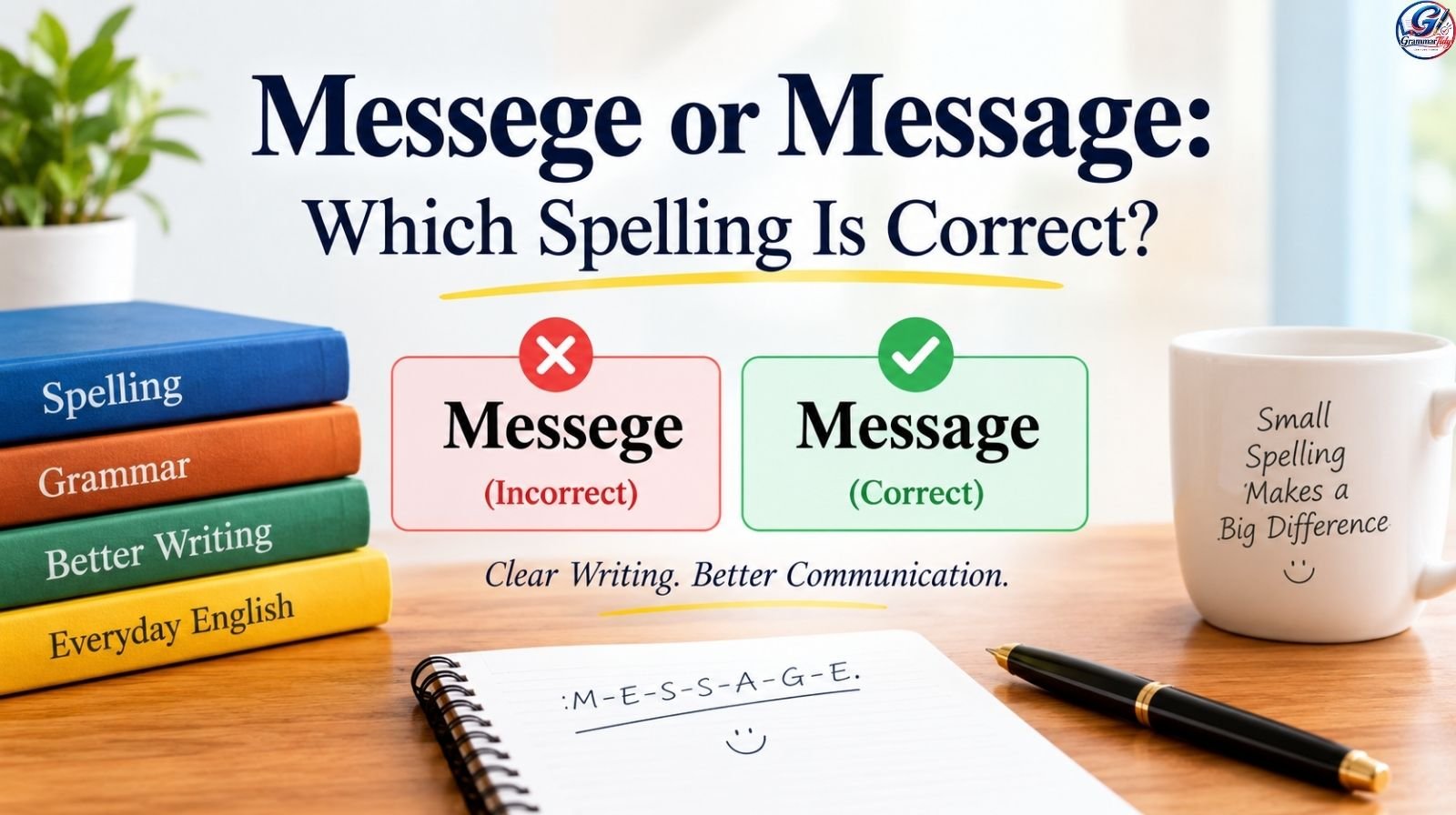
The correct spelling is message, while messege is a misspelling in standard English. Whether you are writing a text, sending an email, completing a school assignment, or preparing a professional document, using the correct spelling helps your writing look clear and polished.
In this guide, you will learn the meaning of message, understand why people misspell it, explore practical examples, and discover a simple trick to remember the correct spelling.
Also Read: Goodmorning or Good Morning: The Correct Usage (And Why It Actually Matters)
What Is the Correct Spelling: Messege or Message?
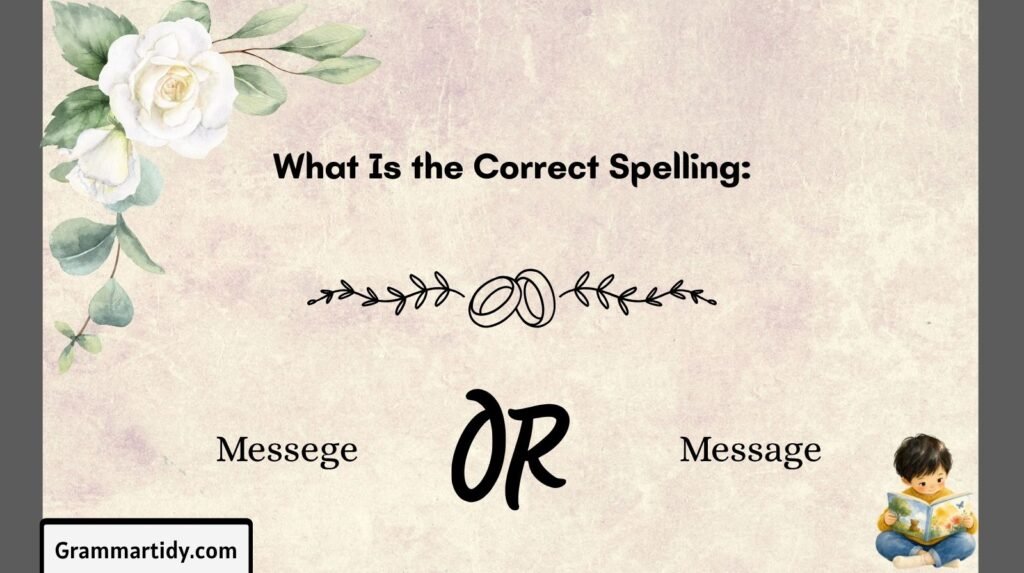
The correct spelling is message. The spelling messege is incorrect in standard English and should be avoided in formal and informal writing.
A message is information communicated from one person or source to another. It can be written, spoken, or delivered electronically through a phone, email, or messaging application.
Correct Spelling: Message
The word message is a standard English word used as both a noun and a verb.
Examples:
- I received your message this morning.
- Please send me a message when you arrive.
- She left a voice message for her colleague.
- I will message you after the meeting.
In each example, message refers to information being communicated or the act of communicating that information.
Incorrect Spelling: Messege
Messege is a common spelling error, usually caused by confusion over the vowel in the middle of the word.
Consider these examples:
- Incorrect: I sent you a messege yesterday.
- Correct: I sent you a message yesterday.
- Incorrect: Please check your messege.
- Correct: Please check your message.
The important difference is the letter a in message. Remember the spelling as M-E-S-S-A-G-E.
Also Read: Bougie vs Boujee: The Real Difference Most People Miss
What Does Message Mean?
The word message generally means information, an idea, or a communication conveyed to someone. Its precise meaning depends on how it is used in a sentence.
Message as a Noun
As a noun, message refers to information communicated through speech, writing, or electronic media.
Examples:
- The teacher wrote a message on the board.
- I received a message from my friend.
- The manager left an important message for the team.
In each sentence, message identifies the information being communicated.
Message as a Verb
Message can also function as a verb, meaning to send someone information, usually electronically.
Examples:
- Please message me when you get home.
- I messaged my friend about the event.
- She messages her team every morning.
Its common forms include message, messages, messaged, and messaging.
Message in Everyday Communication
Messages are part of everyday life. People send them through text messaging, email, workplace communication tools, and social media.
For example, if you write, “I will message you tonight,” you are using the word as a verb. If you write, “I received your message,” you are using it as a noun.
In both cases, the spelling remains message, never messege.
Why Do People Confuse Messege and Message?
The confusion usually occurs because English pronunciation does not always make spelling obvious. People may hear a word correctly but struggle to remember which vowel belongs in its written form.
The Vowel Confusion
The middle vowel in message can be easy to overlook when speaking quickly. As a result, some writers replace the letter a with e and produce the incorrect spelling messege.
Also Read: Cancellation vs Cancelation: Which Spelling Is Correct?
Compare the two forms:
| Word | Spelling status | Explanation |
|---|---|---|
| Message | Correct | Standard English spelling |
| Messege | Incorrect | Misspelling of message |
The best solution is to learn the word visually rather than relying only on its pronunciation.
Typing Quickly on Phones and Computers
Fast typing is another reason spelling mistakes occur. When writing a quick text or replying to a notification, you may type the word as it sounds without checking each letter.
For example:
- Incorrect: Thanks for the messege!
- Correct: Thanks for the message!
Spell-check tools can help identify mistakes, but they are not perfect. Reviewing your writing before sending it remains a useful habit.
An Easy Trick to Remember the Correct Spelling
Use this simple memory trick:
Remember the “A” in message.
Break the word into its letters:
M-E-S-S-A-G-E
Focus on the sequence S-S-A-G-E. When you remember that message contains an a before the g, it becomes easier to avoid writing messege.
Practice with a sentence such as:
“I received a message and replied immediately.”
Repeating the correct spelling in meaningful sentences can help reinforce it.
Also Read: Unenroll vs Disenroll: Which One Is Correct?
Message vs. Messege: Examples and Practical Usage
Understanding the difference becomes easier when you see how the word appears in everyday situations.
Correct and Incorrect Sentence Examples
| Incorrect sentence | Correct sentence |
|---|---|
| I got your messege. | I got your message. |
| Please send me a messege. | Please send me a message. |
| She left a messege for me. | She left a message for me. |
| Did you read my messege? | Did you read my message? |
| I will messege you later. | I will message you later. |
These examples show that the correction is straightforward: replace messege with message.
A Real-Life Example: Correcting a Workplace Email
Imagine that a new employee is preparing an email to a manager about an upcoming meeting.
The employee writes:
“Hello, I wanted to check whether you received my messege about tomorrow’s meeting. Please let me know if you need any additional information.”
The meaning is understandable, but the misspelled word may make the email appear less carefully prepared. In professional communication, small errors can distract readers from the main point.
After proofreading, the employee changes the sentence to:
“Hello, I wanted to check whether you received my message about tomorrow’s meeting. Please let me know if you need any additional information.”
The revised version communicates exactly the same information, but the spelling is correct and the message looks more polished.
Now consider a second situation. A student writes, “My teacher sent me a messege about the assignment.” A spelling checker flags the word, and the student corrects it to message before submitting the assignment.
In both situations, the problem is not the meaning of the sentence. The problem is the spelling. Recognizing the correct form helps writers communicate confidently across emails, schoolwork, workplace documents, and casual conversations.
Also Read: Potatoes or Potatos: Which Spelling Is Correct? (2026)
A Quick Checklist Before You Send
Use this checklist whenever you are unsure about the spelling.
- Check that the word is spelled message.
- Confirm that the middle vowel is a, not e.
- Read the full sentence to make sure the word fits.
- Use a spelling checker when available.
- Proofread important emails and documents before sending them.
Message Spelling: What Do Dictionaries and Current Guidance Tell Us?
For a spelling question like messege or message, dictionaries are the most useful sources because they establish standard word forms and definitions.
What Dictionaries Establish
The correct spelling is message. It is an established English word used for information communicated between people or systems. Messege is not the standard spelling.
For verification, consult these authoritative resources:
- Merriam-Webster Dictionary definition and usage of message.
- Cambridge Dictionary meaning, pronunciation, and examples.
- Google Search Central guidance on creating helpful, accurate, people-first content.
Spelling Facts for 2025–2026
There is no reliable, widely recognized public statistic establishing an exact percentage of English writers who misspell message as messege in 2025 or 2026. It would be misleading to invent a figure.
However, the following facts are useful for understanding the spelling question:
| Fact | Explanation |
|---|---|
| Standard spelling | Message |
| Common incorrect form | Messege |
| Part of speech | Noun and verb |
| Main meaning | Information communicated to someone |
| British or American English | Message is standard in both |
| Best verification method | Check a reputable dictionary |
The central takeaway has not changed: message is the standard spelling in modern English. There is no separate British or American spelling variation that makes messege correct.
Google’s published content guidance also emphasizes accuracy, usefulness, and writing that meets readers’ needs.
For an educational spelling article, that means giving readers the correct answer, clear examples, and reliable ways to verify it rather than unsupported statistics.
Also Read: Labelling or Labeling: What’s The Correct Spelling? (2026)
Frequently Asked Questions
1. Is It Messege or Message?
Message is correct. Messege is a misspelling and should not be used in standard English writing.
Example: “I received your message.”
2. How Do You Spell Message Correctly?
The correct spelling is M-E-S-S-A-G-E.
A helpful reminder is to remember the letter a before the g.
3. What Does Message Mean?
A message is information or an idea communicated from one person or source to another. It may be written, spoken, or sent electronically.
Example: “She sent me a message about the appointment.”
4. Is Message Correct in British and American English?
Yes. Message is the standard spelling in both British and American English. Neither variety uses messege as the correct form.
5. Can Message Be Used as a Verb?
Yes. Message can mean to send someone information, particularly through a digital communication service.
Example: “I will message you after work.”
6. Why Do People Spell Message as Messege?
People may confuse the vowels because of pronunciation, fast typing, or unfamiliarity with the written word. Remembering the correct sequence, M-E-S-S-A-G-E, helps prevent this error.
Conclusion:
When choosing between messege or message, the answer is simple: message is the correct spelling, and messege is a spelling mistake.
Use message when referring to written communication, a text, an email, or the act of sending someone information. The word works as both a noun and a verb, and its standard spelling is the same in British and American English.
To remember it, focus on the a in M-E-S-S-A-G-E. Check your spelling before sending important emails, submitting assignments, or publishing content.
Discover More Article
- Anticlockwise vs Counterclockwise: Key Usage Differences Explained
- Genuinity or Genuity: The Hidden Truth Behind This Confusing Word
- Aide vs Aid: The Person Who Helps And The Help Itself
- Skiis or Skis: Which Spelling Is Correct?
Keep learning with more easy grammar lessons on GrammarTidy.com

Hi, I’m Noor Fatima, the author and creator of Grammar Tidy. I’m passionate about grammar, writing, and making language learning simple and enjoyable. Through Grammar Tidy, I share helpful tips, clear explanations, and practical guidance to help readers improve their writing, avoid common mistakes, and communicate with confidence. My goal is to make better grammar easy, useful, and accessible for everyone.