Have you ever stopped while writing and wondered whether to use began or begun? You are not alone. These two words look similar, share the same basic meaning, and often confuse English learners, students, and even experienced writers.
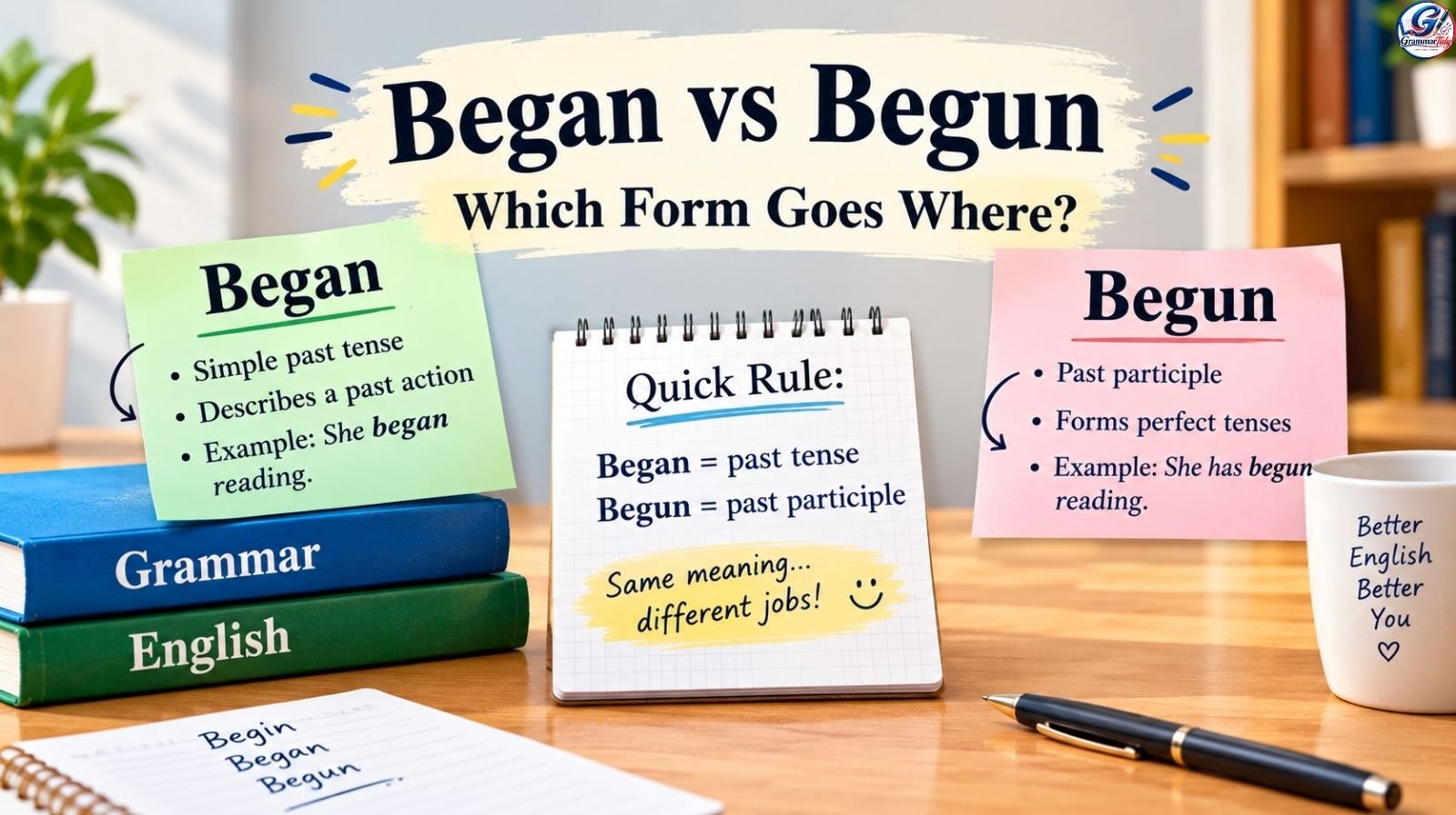
Understanding began vs begun becomes much easier when you learn one simple rule: began is the simple past tense of begin, while begun is the past participle. The correct choice depends on how the verb functions in your sentence.
In this guide, you will learn the difference between began and begun, explore practical examples, discover common mistakes, and find an easy way to choose the correct form every time.
Also Read: Who Won The Vietnam War: U.S. Or Vietnam?
What Is the Difference Between Began and Begun?
The main difference between began and begun is their grammatical function. Both come from the irregular verb begin, which means to start something or to start doing something.
Use began when describing an action that started in the past. Use begun when the sentence requires a past participle, most commonly after has, have, or had.
For example:
- Correct: The meeting began at nine o’clock.
- Correct: The meeting has begun.
- Incorrect: The meeting has began.
- Incorrect in standard English: The meeting begun at nine o’clock.
The important point is that neither word is universally better than the other. Both are correct when used in the appropriate grammatical structure.
Began vs Begun at a Glance
| Feature | Began | Begun |
|---|---|---|
| Verb form | Simple past | Past participle |
| Main use | Describes a past action | Forms perfect tenses |
| Common pattern | Subject + began | Subject + has/have/had + begun |
| Example | She began reading. | She has begun reading. |
| Can it stand alone as a simple past verb? | Yes | No, not in standard English |
What Are the Three Forms of Begin?
The verb begin has three main forms:
| Form | Example |
|---|---|
| Base form | I begin work at eight. |
| Simple past | I began work at eight. |
| Past participle | I have begun work. |
Unlike regular verbs such as walk and talk, which usually form the past tense by adding -ed, begin changes its spelling.
That is why begined is incorrect in standard English. You must learn the forms begin, began, and begun.
Also Read: GitLab or GitHub: Which One Should You Choose?
When Should You Use Began?
Use began when you want to describe something that started or happened in the past. It is the simple past tense of begin and usually does not need a helping verb.
For example, if you are describing what happened yesterday, last week, or at a particular moment in the past, began is often the correct choice.
Examples of Began in Sentences
Here are some natural examples:
- The movie began at seven o’clock.
- She began learning English last year.
- We began our journey early in the morning.
- The rain began suddenly.
- He began writing his assignment after dinner.
- The meeting began later than expected.
- They began building their house in March.
Each sentence describes an action that started in the past.
Notice that none of these sentences requires has, have, or had before the main verb.
Can Began Be Used With a Time Expression?
Yes. Began commonly appears with expressions that identify when something happened.
For example:
- The concert began at 8 p.m.
- My classes began last Monday.
- The discussion began two hours ago.
- Construction began in January.
- The new chapter began when she changed schools.
However, a specific time expression is not required. You can also write, “Suddenly, the baby began to cry.”
The key is the sentence structure, not simply whether a time expression appears.
Began With Infinitives and -Ing Forms
After began, you can use either an infinitive with to or a verb ending in -ing.
Both constructions are generally correct when they describe starting an activity.
Examples:
- She began to laugh.
- She began laughing.
- They began to prepare for the exam.
- They began preparing for the exam.
The meaning is usually very similar in these examples. Choose the construction that sounds natural in your sentence.
Also Read: Win or Lose Episodes: Complete Episode Guide (2026)
When Should You Use Begun?
Use begun when the sentence requires the past participle of begin. This happens most commonly in perfect tenses, which use a helping verb such as has, have, or had.
For example:
- I have begun my homework.
- She has begun a new job.
- They had begun the meeting before we arrived.
In these sentences, the helping verb works with begun to express the relationship between the beginning of an action and another time or event.
Begun With Has, Have, and Had
The easiest way to remember when to use begun is to learn these common patterns.
1. Has begun
Use this structure with a singular third-person subject, such as he, she, or it, and with singular nouns.
Examples:
- She has begun her presentation.
- The school year has begun.
- He has begun exercising regularly.
2. Have begun
Use this structure with I, you, we, they, and plural nouns.
Examples:
- I have begun reading the book.
- We have begun our research.
- The students have begun their assignments.
3. Had begun
Use this structure when describing an action that had already started before another past event.
Examples:
- The movie had begun before we reached the cinema.
- She had begun cooking when the guests arrived.
- They had begun the project before the deadline changed.
Remember that has, have, and had can be used in different grammatical constructions. In the perfect tenses shown here, they are followed by the past participle begun, not began.
Also Read: Nosey or Nosy: Which Spelling Is Correct?
Can Begun Be Used in Passive Sentences?
Yes. Begun can also appear in passive constructions when the sentence calls for a past participle.
For example:
- The project was begun last year.
- The investigation was begun by the committee.
- Several initiatives were begun during the first phase.
These sentences are grammatically possible, although active alternatives may sound more natural in everyday writing.
For example, “The committee began the investigation last year” is often clearer than “The investigation was begun by the committee.”
Began vs Begun: Common Mistakes and How to Fix Them

Many mistakes happen because writers recognize that both words refer to starting something but overlook the grammatical structure of the sentence.
The solution is to check the helping verb and identify the tense before choosing the form.
Common Incorrect and Correct Sentences
| Incorrect | Correct | Reason |
|---|---|---|
| I begun my homework yesterday. | I began my homework yesterday. | Simple past requires began. |
| She has began working. | She has begun working. | Has requires the past participle. |
| They had began the meeting. | They had begun the meeting. | Had requires the past participle. |
| The show begun at eight. | The show began at eight. | A simple past verb is needed. |
| He has began a new course. | He has begun a new course. | Has begun is the correct pattern. |
What About Sentences With Did?
This is another common source of confusion. After did or did not, use the base form begin, not began or begun.
Correct examples:
- Did the class begin on time?
- The class did not begin on time.
- When did the concert begin?
Incorrect examples:
- Did the class began on time?
- The class did not begun on time.
Why? Because did already carries the past-tense meaning. The main verb stays in its base form.
This same rule applies to many other verbs:
- Did she go? Not Did she went?
- Did he see it? Not Did he saw it?
- Did they begin? Not Did they began?
A Simple Trick to Remember the Difference
Use this three-step check:
- Is the sentence describing a past action without a perfect-tense helping verb? Use began.
- Does the sentence use has, have, or had to form a perfect tense? Use begun.
- Does the sentence use did or did not? Use begin.
For example:
- The class began at ten.
- The class has begun.
- Did the class begin at ten?
Once you recognize these patterns, choosing the right form becomes much easier.
Also Read: Natzi or Nazi: The Correct Spelling, Meaning, And Why It Matters
A Real-Life Example: Choosing Began or Begun in an Essay
Imagine a student named Emma is writing an essay about how she improved her English over the past year. She wants her writing to sound natural, but she repeatedly confuses began and begun.
Her first draft says:
“I begun learning English last January. By March, I had began reading short stories. Recently, I have began writing longer essays, and my confidence has begun to improve.”
Although the reader can understand the message, three verb forms need attention.
First, “I begun learning English last January” should be “I began learning English last January.” The sentence describes a past action, so the simple past form is appropriate.
Second, “I had began reading short stories” should be “I had begun reading short stories.” The word had signals the past perfect construction, which requires the past participle.
Third, “I have began writing longer essays” should be “I have begun writing longer essays.” The present perfect construction uses have followed by begun.
Her corrected paragraph reads:
“I began learning English last January. By March, I had begun reading short stories. Recently, I have begun writing longer essays, and my confidence has begun to improve.”
The revised paragraph is grammatically correct and preserves Emma’s original meaning. More importantly, the corrections follow a consistent rule rather than relying on guesswork.
This example demonstrates a useful editing habit: look at the entire verb phrase, not just the word you are unsure about. Identifying the helping verb often reveals which form belongs in the sentence.
Began vs Begun: Grammar Facts and 2025–2026 Data
Understanding the difference between began and begun does not require memorizing complicated terminology. A few core grammar facts explain almost every everyday use.
Key Grammar Facts
- Begin is an irregular English verb.
- Began is its simple past form.
- Begun is its past participle.
- Perfect-tense constructions use has begun, have begun, or had begun.
- Questions and negatives using did take the base form begin.
These are established grammar rules, not recent changes.
What Do the 2025–2026 Figures Tell Us?
There is no verified statistic presented in this article that establishes how many people confuse began and begun or what percentage of writers make this mistake during 2025–2026.
It would be misleading to invent a percentage or claim that one form has become more popular without reliable evidence.
Instead, the most useful evidence is the consistent grammatical distinction between the three forms of the verb. The rule remains the same: begin is the base form, began is the simple past, and begun is the past participle.
For readers, the practical takeaway is straightforward: learn the verb forms, recognize the helping verbs, and check the complete sentence before choosing began or begun.
Also Read: Goodmorning or Good Morning: The Correct Usage (And Why It Actually Matters)
Frequently Asked Questions
1. Is It Began or Begun?
Both words are correct, but they are used differently. Use began for the simple past tense and begun as the past participle, usually after has, have, or had.
Examples:
- The meeting began at noon.
- The meeting has begun.
2. Is Began the Past Tense of Begin?
Yes. Began is the simple past tense of begin.
For example: “I began studying English last year.”
3. Is Begun a Past Tense Word?
Begun is the past participle, not the simple past form. It is commonly used in perfect tenses, such as “She has begun her work.”
4. Is “I Have Began” Correct?
No. In standard English, the correct phrase is “I have begun.”
The helping verb have requires the past participle in this construction.
5. Is It “Had Began” or “Had Begun”?
The correct form is had begun.
For example: “The meeting had begun before I arrived.”
The past perfect tense follows the pattern had + past participle.
6. Can I Say “The Movie Begun”?
Not in standard English when you mean that the movie started in the past. Say “The movie began” or “The movie has begun,” depending on your intended meaning.
7. What Is the Easiest Way to Remember Began vs Begun?
Remember this simple pattern:
- Begin: Base form “We begin now.”
- Began: Simple past “We began yesterday.”
- Begun: Past participle “We have begun.”
Checking the helping verb is usually the fastest way to choose correctly.
Conclusion:
The difference between began vs begun comes down to grammar, not meaning. Both words come from begin, but each has a different role in a sentence.
Use began when describing a past action: “She began writing yesterday.”
Use begun when a past participle is required: “She has begun writing.”
And remember that after did or did not, you should use the base form begin.
With these three forms in mind begin, began, and begun you can avoid common mistakes and write with greater confidence.
Ready to improve your English grammar? Save this guide for future reference, practise identifying helping verbs in your sentences, and apply these simple rules whenever you write. A little attention to verb forms can make your everyday writing clearer and more accurate.
Discover More Article
- Cancellation vs Cancelation: Which Spelling Is Correct?
- Bougie vs Boujee: The Real Difference Most People Miss
- Anticlockwise vs Counterclockwise: Key Usage Differences Explained
- Aide vs Aid: The Person Who Helps And The Help Itself
Keep learning with more easy grammar lessons on GrammarTidy.com

Hi, I’m Noor Fatima, the author and creator of Grammar Tidy. I’m passionate about grammar, writing, and making language learning simple and enjoyable. Through Grammar Tidy, I share helpful tips, clear explanations, and practical guidance to help readers improve their writing, avoid common mistakes, and communicate with confidence. My goal is to make better grammar easy, useful, and accessible for everyone.