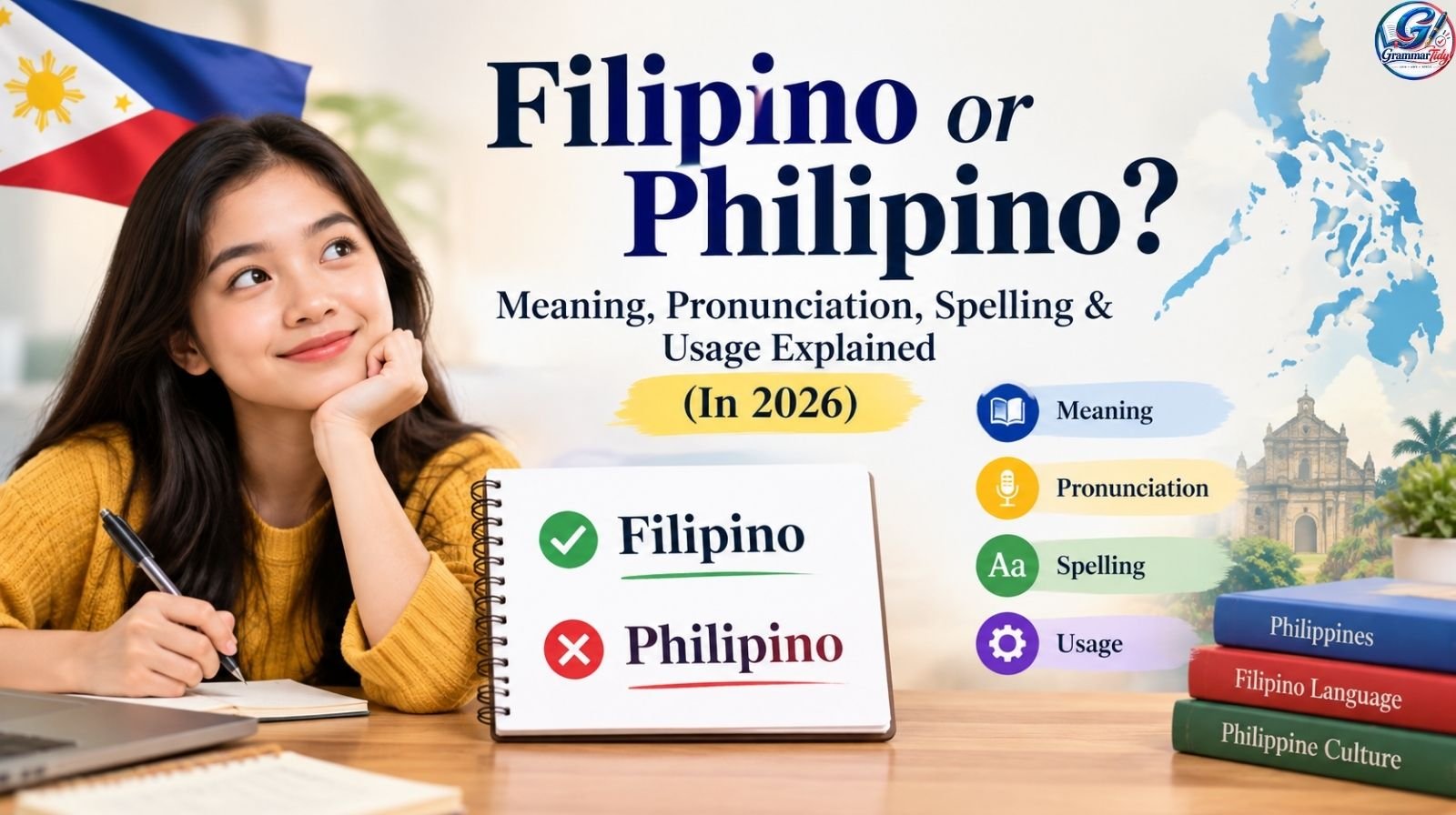
Have you ever typed “Philipino” when you meant “Filipino”? You are not alone. The two spellings look extremely similar, and the spelling Philipino can seem logical because the country is called the Philippines.
However, when referring to a person from the Philippines or the national language, the standard English spelling is Filipino. Cambridge Dictionary defines Filipino as both a person from the Philippines and an official language of the Philippines.
So, Filipino or Philipino? In standard English usage, Filipino is the correct spelling. Philipino is generally treated as a misspelling.
In this guide, you will learn the difference, meaning, pronunciation, correct usage, common mistakes, and an easy way to remember the spelling.
Also Read: Unaffected vs Uneffected: Which Word To Use Correctly?
Filipino vs. Philipino: Which Spelling Is Correct?
The key difference is simple: Filipino contains “Fil-”, while the incorrect form Philipino begins with “Phil-.”
| Spelling | Standard English usage | Meaning |
|---|---|---|
| Filipino | Correct | A person from the Philippines or the Filipino language |
| Philipino | Misspelling | Usually intended to mean Filipino |
Why Is Filipino the Correct Spelling?
Filipino is the established English spelling used for the demonym and the language. Major dictionaries recognize it as Filipino, not Philipino. Cambridge lists the pronunciation and defines the noun as a person from the Philippines and as an official language of the Philippines.
The spelling can feel surprising because Philippines contains “Phil.” This is one reason people may accidentally insert the extra h into Filipino.
For example:
- Correct: She is Filipino.
- Correct: He speaks Filipino.
- Incorrect: She is Philipino.
- Incorrect: He speaks Philipino.
Is “Philipino” a Word?
You may encounter Philipino online, but its presence does not make it the standard spelling. A current Wiktionary entry identifies Philipino as a misspelling of Filipino and notes that the spelling is generally considered a misspelling in the Philippines.
Therefore, for formal writing, schoolwork, professional communication, and published content, use Filipino.
What Does Filipino Mean?
The word Filipino has more than one closely related use.
Filipino as a Demonym
A Filipino is a person from the Philippines.
For example:
Maria is Filipino.
Many Filipinos work and study around the world.
The plural form is Filipinos.
Filipino as a Language
Filipino is also the name of a national language of the Philippines. Cambridge Dictionary lists it as an official language of the Philippines.
For example:
I am learning Filipino.
The course introduces students to Filipino language and culture.
This distinction matters because Filipino can refer to either a person or a language depending on context.
Filipino as an Adjective
The word can also describe something associated with the Philippines or its people.
Examples include:
- Filipino food
- Filipino culture
- Filipino literature
- Filipino history
- Filipino traditions
- Filipino communities
The surrounding noun usually makes the intended meaning clear.
Also Read: Repore or Rapport: Which Spelling Is Correct? Meaning, Examples & Grammar Guide (2026)
How to Pronounce Filipino Correctly
Pronunciation is another reason people sometimes become unsure about the word.
Cambridge gives the English pronunciation as /ˌfɪl.ɪˈpiː.noʊ/ in US English and /ˌfɪl.ɪˈpiː.nəʊ/ in UK English.
Where Is the Stress?
The main stress falls on the third syllable, the “pee” sound.
When saying the word naturally, avoid making it sound as though the “Phil” spelling of Philippines must be copied into Filipino.
Filipino vs. Philippines
These two words are related, but they are not interchangeable:
- Philippines = the country
- Filipino = a person, language, or adjective associated with the Philippines
For example:
I traveled to the Philippines.
My colleague is Filipino.
She is studying Filipino.
Common Mistakes With Filipino and Philipino
The most common mistake is adding “ph” to the beginning of Filipino because of the spelling of Philippines.
Mistake 1: Writing “Philipino”
Incorrect: He is Philipino.
Correct: He is Filipino.
Mistake 2: Writing “Philipino Language”
Incorrect: She is studying the Philipino language.
Correct: She is studying the Filipino language.
Mistake 3: Confusing Filipino With Philippine
Both Filipino and Philippine are used in English, but they have different grammatical roles.
For example:
Filipino people have diverse cultural traditions.
The Philippine government issued a statement.
A useful general distinction is:
Filipino commonly refers to people, the language, or things associated with Filipino identity, while Philippine is commonly used as an adjective before nouns relating to the country or its institutions.
A Quick Memory Trick
Think:
Philippines → Filipino
Do not automatically copy the “ph” from Philippines into Filipino.
A simple spelling pattern to remember is:
F I L I P I N O
Once you remember the first F, the rest becomes much easier.
Also Read: Tying vs Tieing: Correct Spelling & Easy Rule To Remember
Filipino in Real-Life Writing: A Practical Case Study

Imagine an international company preparing an employee newsletter about its teams around the world.
One section introduces an employee named Ana:
“Ana is Philipino and works with our Manila team.”
At first glance, the sentence may look perfectly understandable. Readers can probably determine what the writer means. However, the spelling is not standard. In a professional publication, the sentence should read:
“Ana is Filipino and works with our Manila team.”
Now suppose the newsletter discusses language:
“The company provides Filipino-language training for employees working with customers in the Philippines.”
Here, Filipino is again the appropriate spelling.
This small distinction illustrates why spelling accuracy matters. A typo may not prevent readers from understanding a sentence, but it can make professional content look less carefully edited. It can also be especially noticeable when writing about a person’s nationality, language, or cultural identity.
The same issue can occur in resumes, academic assignments, travel websites, customer-support documentation, and social-media posts. A writer may know the country is spelled Philippines and unconsciously transfer the “ph” into the related word.
The easiest solution is to remember that the standard form is Filipino, even though the country name is Philippines.
Filipino in 2025–2026: Why the Word Still Matters
The relevance of Filipino extends beyond spelling. Recent Philippine government activity shows continued attention to the language in education, public communication, research, and technology.
2026 Language and Technology Data
The Philippine government’s 2026 budget documentation for the Commission on the Filipino Language includes targets for preserving, enriching, and promoting Filipino and other Philippine languages.
The program lists a baseline of 26% of 40 endangered languages documented, translated, and validated, with a 30% target for 2025 and 2026 planning. It also sets targets related to government agencies adopting Filipino in official correspondence.
In July 2026, the Philippine Information Agency reported that the Commission on the Filipino Language described the country as having more than 135 indigenous languages and discussed using AI for translation, research, and language preservation.
The same report described a collaboration involving a “Pinoy AI” project intended to strengthen Filipino’s digital presence.
Also Read: Acception vs Exception: Which One Is Actually Correct? (2026)
More recently, the Philippine Supreme Court reported that the Commission on the Filipino Language recognized the Court’s efforts to use Filipino in legal and public-information materials in 2026. The Court also noted that two 2026 decisions were written in Filipino.
These figures and developments do not measure how frequently people misspell Filipino as Philipino. Instead, they show the continuing institutional and digital relevance of the Filipino language in 2025–2026.
Filipino vs. Philipino: Easy Comparison Checklist
Use this quick checklist whenever you are unsure.
Step 1: Are You Referring to a Person?
Use Filipino.
He is Filipino.
Step 2: Are You Referring to the Language?
Use Filipino.
She is learning Filipino.
Step 3: Are You Describing Culture or People?
Use Filipino where appropriate.
Filipino culture is diverse.
Step 4: Did You Write “Philipino”?
Check the spelling again.
❌ Philipino
✅ Filipino
Step 5: Are You Referring to the Country?
Use Philippines.
She lives in the Philippines.
This five-step check can prevent the most common spelling mistake.
Filipino or Philipino: Example Sentences
Seeing the word in context makes the difference easier to remember.
Correct Examples
1. My friend is Filipino.
2. She is studying Filipino.
3. Filipino food is popular around the world.
4. The university offers a Filipino language course.
5. Many Filipinos live and work overseas.
6. He enjoys learning about Filipino history.
Incorrect Examples
1. My friend is Philipino.
2. She is studying Philipino.
3. They discussed Philipino culture.
In each example, replace Philipino with Filipino.
Also Read: Oversite vs Oversight: What’s The Difference And Which Word Should You Use?
Mini Quiz: Filipino or Philipino?
1. Quick Spelling Check: Which One Is Correct?
A) Philipino
B) Filipino
C) Phillipino
D) Filipeno
Answer: B) Filipino
2. What Does “Filipino” Commonly Refer To?
A) A person from the Philippines
B) A city in Asia
C) A type of currency
D) A continent
Answer: A) A person from the Philippines
3. Which Spelling Is Generally a Misspelling?
A) Filipino
B) Philippines
C) Philipino
D) Philippine
Answer: C) Philipino
4. Fill in the Blank: She Is ______.
A) Philipino
B) Filipino
C) Phillipino
D) Filipinao
Answer: B) Filipino
5. Which Word Names the Country?
A) Filipino
B) Philippine
C) Philippines
D) Philipino
Answer: C) Philippines
6. Which Sentence Uses “Filipino” Correctly?
A) He is Philipino.
B) She is Filipino.
C) He is Phillipino.
D) She is Filipeno.
Answer: B) She is Filipino.
7. Can “Filipino” Refer to a Language?
A) Yes
B) No
C) Only in informal writing
D) Only when capitalized twice
Answer: A) Yes
Also Read: Offerred or Offered: Which Spelling Is Correct & Why In 2026?
8. Which Phrase Is Spelled Correctly?
A) Philipino culture
B) Filipino culture
C) Phillipino culture
D) Filipeno culture
Answer: B) Filipino culture
9. Why Do People Sometimes Write “Philipino”?
A) It is the official spelling
B) It comes from another country
C) They may be influenced by the spelling “Philippines”
D) It is an alternative English alphabet
Answer: C) They may be influenced by the spelling “Philippines”
10. Which Word Fits Best?
“Maria is ______ and lives in Manila.”
A) Philipino
B) Filipino
C) Philippines
D) Philippine
Answer: B) Filipino
11. Which One Refers to the Country?
A) Filipino
B) Filipino language
C) Philippines
D) Filipinos
Answer: C) Philippines
12. Which Sentence Is Correct?
A) I am learning Philipino.
B) I am learning Filipino.
C) I am learning Phillipino.
D) I am learning Filipeno.
Answer: B) I am learning Filipino.
13. What Is the Plural of “Filipino” When Referring to People?
A) Filipinos
B) Filipinoes
C) Philipinos
D) Filipinees
Answer: A) Filipinos
14. Which Spelling Should You Use in Formal Writing?
A) Philipino
B) Phillipino
C) Filipino
D) Filipeno
Answer: C) Filipino
15. Final Challenge: Complete the Rule
“Philippines” is the country, while ______ can refer to its people or language.
A) Philipino
B) Filipino
C) Philippine
D) Philipines
Answer: B) Filipino
FAQs
1. Is Filipino or Philipino correct?
Filipino is the standard English spelling. Philipino is generally considered a misspelling.
2. Why do people spell Filipino as Philipino?
The mistake is understandable because the country is spelled Philippines, with “ph.” Writers may incorrectly transfer that spelling pattern into Filipino.
3. What does Filipino mean?
Filipino can refer to a person from the Philippines, the Filipino language, or something associated with Filipino people or culture, depending on context.
4. How do you pronounce Filipino?
Cambridge lists US English pronunciation as /ˌfɪl.ɪˈpiː.noʊ/ and UK English as /ˌfɪl.ɪˈpiː.nəʊ/.
5. Is Philipino an accepted spelling?
It may appear in informal writing or online content, but it is not the standard spelling used for the demonym or language. For formal English, use Filipino.
6. Is Filipino the language of the Philippines?
Filipino is an official language of the Philippines and is also described by Cambridge Dictionary as an official language of the country.
7. What is the difference between Filipino and Philippine?
Filipino can refer to a person, language, or cultural identity, while Philippine is commonly used as an adjective in expressions such as “Philippine government” or “Philippine history.”
Conclusion:
When choosing between Filipino or Philipino, use Filipino in standard English writing.
Remember:
- ✅ Filipino = correct standard spelling
- ❌ Philipino = common misspelling
- Filipino can mean a person from the Philippines
- Filipino can also refer to the language
- Philippines is the name of the country
- Philippine is commonly used as an adjective before country-related nouns
The easiest way to remember the spelling is to separate Philippines from Filipino. Although the country has “ph,” the standard demonym and language name is spelled Filipino.
If you are writing an article, email, assignment, resume, or professional document, choose Filipino whenever that is the word you mean.
Discover More Article
- Nominator vs Nominee: Differences, Definitions, And Correct Usage
- Plandid or Candid: Which Is Correct? Meaning, Examples & Usage Guide (2026)
- Fiend or Feen: Which Spelling Is Correct & Why In 2026?
Keep learning with more easy grammar lessons on GrammarTidy.com

Hi, I’m Noor Fatima, the author and creator of Grammar Tidy. I’m passionate about grammar, writing, and making language learning simple and enjoyable. Through Grammar Tidy, I share helpful tips, clear explanations, and practical guidance to help readers improve their writing, avoid common mistakes, and communicate with confidence. My goal is to make better grammar easy, useful, and accessible for everyone.