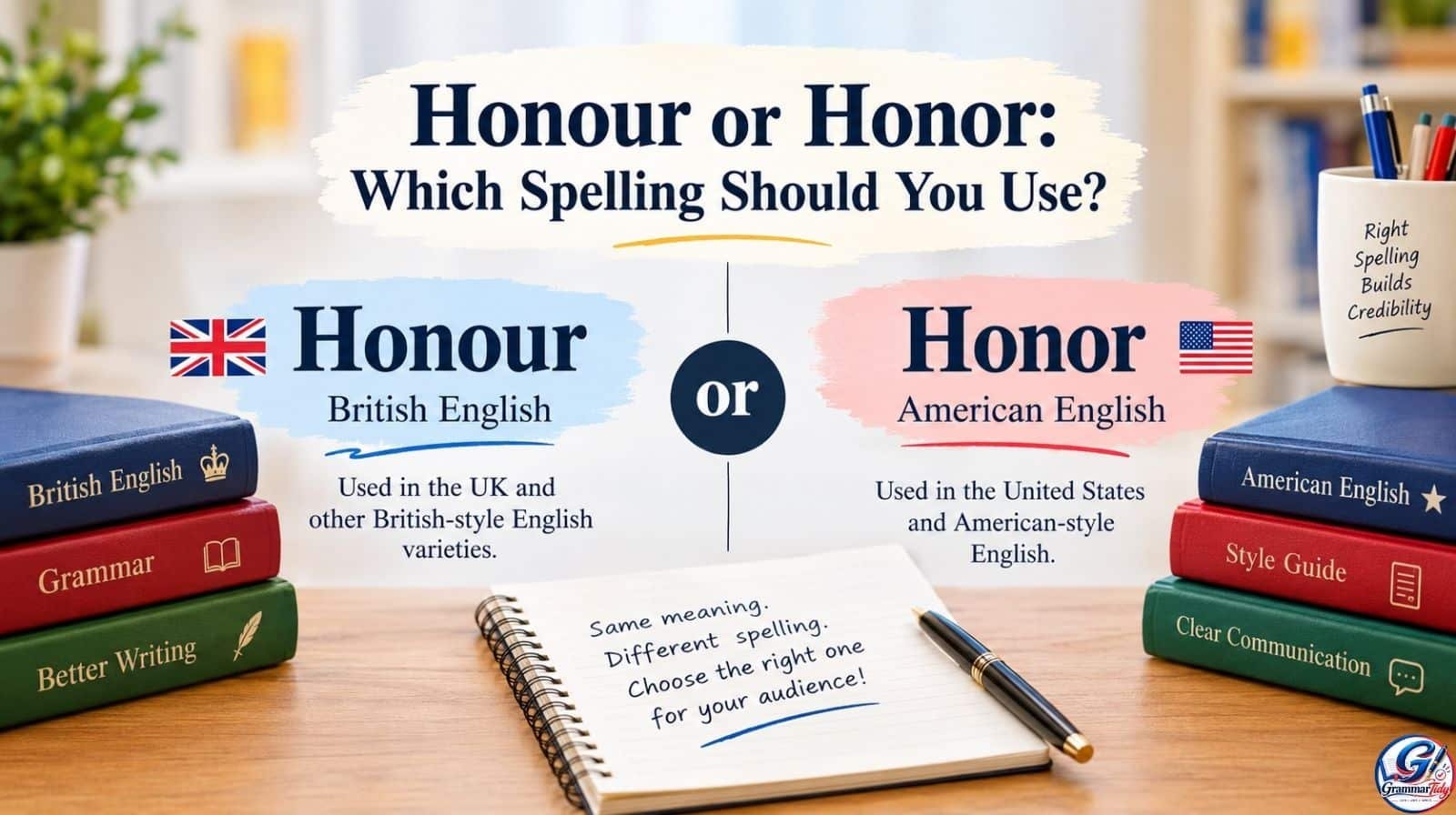
Honour or honor can both be correct. The difference is mainly based on the variety of English you are using. Honour is the standard spelling in British English, while honor is the standard American English spelling.
Cambridge Dictionary confirms that honor is the US spelling of honour, while honour is the UK spelling of honor.
So, which spelling should you use? The answer depends on your audience, country, publication style, or academic requirements. This guide explains the difference, meanings, examples, related forms, and a simple way to remember which version to choose.
Also Read: Transferring or Transfering: Correct Usage In Business, Technology & Everyday English In 2026
Honour or Honor: What Is the Difference?
The main difference between honour and honor is regional spelling, not meaning.
Honour Is British English
Honour is commonly used in British English and is also used in several other varieties that generally follow British spelling conventions.
Examples:
- It was an honour to meet the professor.
- She received a national honour for her service.
- We held a ceremony in honour of the volunteers.
- He promised to honour the agreement.
Cambridge lists honour as the UK spelling of honor.
Honor Is American English
Honor is the standard American English spelling.
Examples:
- It was an honor to meet the professor.
- She received a national honor for her service.
- We held a ceremony in honor of the volunteers.
- He promised to honor the agreement.
The meaning remains the same; only the spelling changes.
Quick Comparison
| Feature | Honour | Honor |
|---|---|---|
| Main variety | British English | American English |
| Meaning | Respect, dignity, recognition | Respect, dignity, recognition |
| Example | It is an honour. | It is an honor. |
| Verb | honour | honor |
| Related adjective | honourable | honorable |
| Common regional style | UK and related varieties | US |
Simple rule: If you are writing for a British-English audience, use honour. If you are writing for an American-English audience, use honor.
Also Read: In Process vs In Progress: The Real Difference With 20+ Examples
What Does Honour or Honor Mean?
Both spellings can function as a noun or verb. The word generally relates to respect, dignity, recognition, or fulfilling an obligation.
Honour or Honor as a Noun
As a noun, the word can describe respect, a distinction, or something that gives a person pride.
For example:
- It was an honour to receive the award.
- It was an honor to receive the award.
- She defended her family’s honour.
- He defended his family’s honor.
Cambridge defines the noun in terms including great respect, good character, and a public reward or distinction.
Honour or Honor as a Verb
As a verb, it can mean to show respect, recognize someone, or fulfill a promise, agreement, or obligation.
British English:
The company agreed to honour the contract.
American English:
The company agreed to honor the contract.
Both sentences communicate the same idea.
Common Expressions
You may see either spelling in expressions such as:
- in honour of / in honor of
- a matter of honour / a matter of honor
- code of honour / code of honor
- honour bound / honor bound
- badge of honour / badge of honor
- do someone the honour / do someone the honor
The spelling should remain consistent with the variety of English being used.
Honour or Honor: Which Spelling Should You Use?
The best choice depends on where your readers are and which English style your publication follows.
Use Honour in British English
Choose honour when writing in British English.
This is especially appropriate for:
- UK audiences
- British schools and universities
- UK-focused websites
- British publications
- Documents following British spelling conventions
For example:
British:
It is a great honour to receive this award.
Also Read: Brite vs Bright: 7 Easy Ways To Know The Difference
Use Honor in American English
Choose honor when writing in American English.
This is appropriate for:
- US audiences
- American schools and universities
- US publications
- American business communication
- Content following American spelling conventions
For example:
American:
It is a great honor to receive this award.
What About Australian English?
Australian English generally follows British spelling conventions, although Australian English has its own rules and accepted variations. The Australian Government Style Manual recommends choosing an appropriate Australian dictionary and using spelling consistently.
Therefore, Australian writers should follow their organization’s preferred Australian style rather than automatically switching between American and British spellings.
Honour vs Honor: Examples in Real Sentences
Seeing the two forms side by side makes the distinction much easier.
Formal Writing Examples
British English:
It was an honour to represent our university.
American English:
It was an honor to represent our university.
British English:
The ceremony was held in honour of the retiring teacher.
American English:The ceremony was held in honor of the retiring teacher.
Business Examples
British:
We will honour the terms of the agreement.
American:
We will honor the terms of the agreement.
Everyday Examples
British:
I would be honoured to join you.
American:
I would be honored to join you.
British:
She acted with honour and courage.
American:
She acted with honor and courage.
Also Read: Discard or Disgard: Which Spelling Is Correct?
Academic Examples
British:
He graduated with an honours degree.
American:
He graduated with honors.
The exact educational terminology can vary by country, so academic writers should follow the institution’s own style.
Honour or Honor: Related Words You Should Know
One useful way to avoid spelling mistakes is to remember that the same regional pattern often appears in related words.
Honourable vs Honorable
British English:
- honourable
- honourably
American English:
- honorable
- honorably
Examples:
She was known as an honourable person.
She was known as an honorable person.
Honoured vs Honored
British English:
The scientist was honoured for her research.
American English:
The scientist was honored for her research.
Honouring vs Honoring
British English:
The organization is honouring its founder.
American English:
The organization is honoring its founder.
This happens because British English generally retains the u in these forms, while American English removes it.
2025–2026 Data: What Current Language Sources Tell Us
When discussing spelling differences in 2025–2026, it is important not to confuse search popularity with correctness.
Cambridge’s current dictionary entries continue to identify honour as the UK spelling and honor as the US spelling.
Google Trends also explains that its data measures relative search interest, not absolute search volume. Its scores are normalized on a scale from 0 to 100, meaning a higher value represents greater relative interest within the selected comparison rather than a fixed number of searches.
That distinction matters for an article like this. A spelling appearing more frequently in online searches does not make it universally more correct. Regional usage determines which spelling is appropriate.
Also Read: Continuous vs Continous: What’s The Difference? 2026
The Australian Government’s current Style Manual likewise emphasizes consistency: writers should choose an appropriate dictionary and use its spelling consistently.
Bottom line for 2025–2026: there has been no need to replace one spelling with the other. Honour remains appropriate for British-style English, while honor remains appropriate for American English.
Case Study: Choosing the Right Spelling for a Global Website
Imagine a company based in London preparing a website announcing an annual employee recognition ceremony.
The original headline says:
“It is an honor to celebrate our outstanding employees.”
The sentence is grammatically understandable, but the company’s website otherwise uses British spellings such as organisation, recognised, and programme.
An editor notices the inconsistency and changes the sentence to:
“It is an honour to celebrate our outstanding employees.”
The change does not alter the meaning. Instead, it makes the page consistent with the company’s established British-English style.
Now imagine the same announcement is published by an American company. Its website uses organization, recognized, and other American spellings. In that situation, honor is the natural choice:
“It is an honor to celebrate our outstanding employees.”
This example shows why there is no universal winner between honour and honor. The better spelling is the one that matches the audience and the style used throughout the document.
For professional writers, consistency is often more important than simply choosing one spelling because it “looks right.” A consistent style makes content easier to read and helps establish a clear editorial voice.
A Simple Checklist for Choosing Honour or Honor
Use this quick checklist whenever you are unsure.
Step 1: Identify Your Audience
Ask:
Are my readers mainly in the UK or countries using British-style English?
If yes, choose honour.
Are my readers mainly in the United States?
If yes, choose honor.
Also Read: Genious or Genius: Which Word Is Correct? Common Mistakes Explained (2026)
Step 2: Check Your Existing Spelling
Look at nearby words.
If your document uses:
- colour
- organisation
- realise
- travelled
then honour will usually fit the same British style.
If it uses:
- color
- organization
- realize
- traveled
then honor will usually fit the American style.
Step 3: Follow the Required Style Guide
For academic, legal, government, or professional writing, check the organization’s style guide first.
Quick Decision Table
| If you are writing for… | Use |
|---|---|
| United Kingdom | honour |
| United States | honor |
| British-style publication | honour |
| American-style publication | honor |
| Australian organization | Follow its Australian style guide |
| International website | Choose one style and stay consistent |
Common Mistakes With Honour and Honor
Mistake 1: Treating One Form as Incorrect
Neither spelling is automatically wrong.
Wrong assumption: “Honor is a misspelling.”
Better understanding: Honor is standard American English.
Likewise, honour is not a mistake simply because an American reader is more accustomed to honor.
Mistake 2: Mixing Both Forms
Avoid switching styles randomly.
For example:
The honour was awarded by the American organization, and the winner was honored at the ceremony.
This could be perfectly acceptable if honour refers to a British context and honored to an American quoted source, but unexplained mixing within your own writing can look inconsistent.
Also Read: Amount or Ammount: Which Word Is Correct? (2026)
Mistake 3: Forgetting Related Words
If you choose honour, remember related forms such as:
- honoured
- honouring
- honourable
If you choose honor, use:
- honored
- honoring
- honorable
Consistency is the key.
Mini Quiz: Honour or Honor
1. Quick Pick: Which Spelling Is British?
A) Honor
B) Honour
C) Honner
D) Honnour
Answer: B) Honour
2. Which Spelling Is American English?
A) Honour
B) Honoure
C) Honor
D) Honner
Answer: C) Honor
3. Fill the Gap: “It was an ___ to meet her.”
A) honor
B) honour
C) Both A and B
Answer: C) Both A and B Both are correct; the choice depends on the English variety.
4. True or False: Honour and Honor Have the Same Basic Meaning.
A) True
B) False
Answer: A) True
5. Which One Fits British English?
A) She was honored for her work.
B) She was honoured for her work.
C) She was honourd for her work.
Answer: B) She was honoured for her work.
6. Which One Fits American English?
A) He was honoured at the ceremony.
B) He was honord at the ceremony.
C) He was honored at the ceremony.
Answer: C) He was honored at the ceremony.
7. Spot the American Spelling!
Which word belongs to American English?
A) Honour
B) Honored
C) Honourable
D) Honouring
Answer: B) Honored
8. What Does “In Honour of” Mean?
A) To ignore someone
B) To show respect or recognition
C) To criticize someone
D) To forget an event
Answer: B) To show respect or recognition
9. British or American? “Honourable”
A) American
B) British
C) Neither
Answer: B) British
10. What Is the American Version of “Honourable”?
A) Honorible
B) Honorable
C) Honnerable
D) Honourable
Answer: B) Honorable
11. Which Pair Is Correct?
A) Honour British / Honor American
B) Honour American / Honor British
C) Both are only British
D) Both are only American
Answer: A) Honour British / Honor American
12. Can “Honor” Be Used in Formal Writing?
A) Yes
B) No
Answer: A) Yes Honor is the standard American English spelling and can be used in both formal and informal writing.
13. Which Sentence Uses British English?
A) It was a great honor.
B) It was a great honour.
C) It was a great honer.
D) It was a great honoure.
Answer: B) It was a great honour.
14. Which Sentence Uses American English?
A) We will honour the agreement.
B) We will honoure the agreement.
C) We will honor the agreement.
D) We will honner the agreement.
Answer: C) We will honor the agreement.
15. The Golden Rule: What Should You Do?
A) Always use honor
B) Always use honour
C) Choose the spelling that matches your English style and stay consistent
D) Mix both spellings freely
Answer: C) Choose the spelling that matches your English style and stay consistent.
FAQs
1. Is “honour” or “honor” correct?
Both are correct. Honour is the standard British English spelling, while honor is the standard American English spelling.
2. Is “honor” American or British?
Honor is the American English spelling. British English generally uses honour.
3. Why does British English have a “u” in honour?
The u is part of the traditional British spelling. American English uses the shorter form honor for the same word.
4. Does Canada use honour or honor?
Canadian English commonly uses honour, although Canadian spelling has its own conventions and can differ from both British and American English in some cases.
5. Is “honour” more formal than “honor”?
No. The difference is primarily regional spelling, not formality. Both can be used in formal and informal contexts.
6. Should I use honour or honor in academic writing?
Use whichever spelling is required by your university, publisher, instructor, or chosen English style. The most important rule is to remain consistent.
7. Which spelling is better for SEO?
Neither spelling is universally better. Choose the version that matches your target audience and search intent. For a US audience, honor is more appropriate; for a UK-focused audience, honour is the natural choice.
Conclusion:
So, honour or honor which spelling should you use?
The answer is simple: use honour in British English and honor in American English. Both words have the same basic meanings, including respect, dignity, recognition, and fulfilling an obligation. Cambridge confirms the regional distinction between the two spellings.
If you are writing for a UK audience, choose honour. If your readers are primarily American, choose honor. For Australian or other English varieties, follow the appropriate local style guide.
Most importantly, stay consistent. Once you choose a spelling system, apply it to related forms such as honoured/honored, honouring/honoring, and honourable/honorable.
When in doubt, check your audience, check your style guide, and then stick with the appropriate form.
Discover More Article
- Caraway vs GreenPan: A Complete Cookware Comparison Guide
- Lead or Led? The Mistake Even Editors Make
- Zyrtec or Benadryl: Which One Should You Actually Take?
- Soder or Solder? Easy Guide with Simple Words And Clear Examples
Keep learning with more easy grammar lessons on GrammarTidy.com

Hi, I’m Noor Fatima, the author and creator of Grammar Tidy. I’m passionate about grammar, writing, and making language learning simple and enjoyable. Through Grammar Tidy, I share helpful tips, clear explanations, and practical guidance to help readers improve their writing, avoid common mistakes, and communicate with confidence. My goal is to make better grammar easy, useful, and accessible for everyone.