If you have ever wondered whether to write vender or vendor, you are not alone. These two spellings look almost identical, and both are associated with selling.
However, choosing the right word can make a difference in business emails, professional documents, website content, and everyday writing.
So, in the vender vs vendor debate, which spelling should you use in 2026?
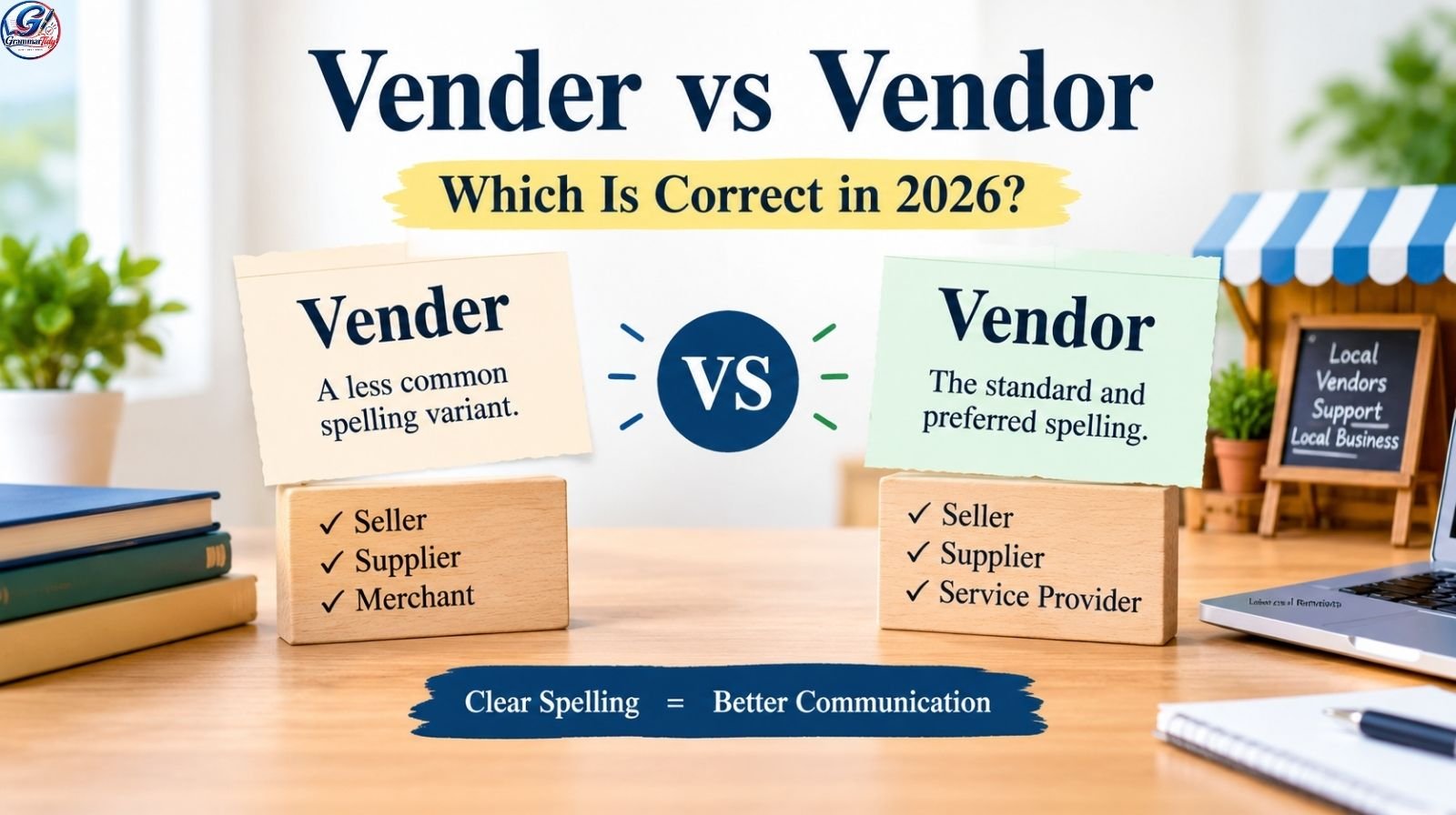
Vendor is the standard and generally preferred spelling in modern English. It refers to a person or business that sells goods or provides services.
Vender is also recorded as an English spelling variant, but it is much less common. For most professional and general writing, vendor is the safer choice.
In this guide, you will learn what both words mean, how they differ, when to use each spelling, and how to avoid common mistakes.
Also Read: GitLab or GitHub: Which One Should You Choose?
Is Vender or Vendor Correct?
The main difference between vender and vendor is their spelling and frequency of use. Although both forms appear in English, vendor is the conventional spelling used for a seller or supplier.
What Does Vendor Mean?
A vendor is a person, company, or organization that sells products or services to customers or other businesses.
For example:
- The company selected a new software vendor.
- A food vendor sold sandwiches outside the station.
- We contacted the vendor about our delayed order.
- The event organizers hired several local vendors.
The word is widely used in retail, technology, procurement, events, and business communication.
Is Vender a Real Word?
Yes, vender is recorded as a variant spelling of vendor. However, it is considerably less common in contemporary English.
You might encounter it in older writing, regional usage, or certain texts. That does not mean it is the best choice for every situation.
For example:
- Less common: The vender supplied office furniture.
- Preferred: The vendor supplied office furniture.
Both sentences communicate the same basic idea, but the second follows the more familiar spelling convention.
Which Spelling Should You Remember?
Use this simple rule:
Choose “vendor” whenever you mean a person or business that sells goods or services. Use vender only when a particular source, historical text, or established naming convention specifically requires it.
This rule is especially useful for students, content writers, and professionals who want their writing to sound natural and polished.
Also Read: Win or Lose Episodes: Complete Episode Guide (2026)
Vender vs Vendor: Meaning and Usage Differences
Although the two spellings can refer to the same thing, their practical usage is not equal. Understanding their relationship helps you make the right choice without overthinking it.
Vendor Meaning and Examples
The noun vendor describes someone who sells products or provides services. It can refer to an individual seller, a small business, or a large organization.
Examples include:
- Online vendor: A business that sells products through an online store.
- Software vendor: A company that develops or supplies software.
- Street vendor: A person who sells goods in a public place.
- Service vendor: A company that provides services to another organization.
Example sentence: “Our company is reviewing each vendor before renewing its annual contracts.”
Here, vendor clearly identifies the businesses supplying products or services.
Vender Meaning and Examples
Vender can carry the same basic meaning as vendor when used as an English spelling variant. Its main limitation is that readers are much more accustomed to seeing vendor.
For example:
- Less common: The vender offered fresh fruit.
- More familiar: The vendor offered fresh fruit.
The meaning remains understandable, but the standard spelling is more appropriate for most modern writing.
One additional point matters for language learners: in Spanish, “vender” means “to sell.” That Spanish verb is a different grammatical form from the English noun vendor. Do not confuse the two simply because their spellings are similar.
Vender vs Vendor at a Glance
| Feature | Vendor | Vender |
|---|---|---|
| English usage | Standard and widely preferred | Less common variant |
| Meaning | Seller or supplier | Can mean seller or supplier |
| Business writing | Recommended | Usually avoid |
| Academic writing | Preferred | Use only when justified |
| General readability | Familiar to most readers | May look unusual |
| Best choice in 2026 | Yes | Generally no |
The practical takeaway is straightforward: both spellings may be encountered, but vendor is the better default for clear, professional English.
Why Is Vendor Preferred in Modern English?
The spelling vendor is preferred because it is widely recognized in business communication, dictionaries, and professional writing. Using the familiar form helps readers understand your message without being distracted by an unusual spelling.
Also Read: Nosey or Nosy: Which Spelling Is Correct?
Vendor in Business and Professional Writing
Businesses regularly use the word vendor when discussing suppliers, purchasing agreements, software subscriptions, and service contracts.
Consider these examples:
- “Please send the payment details to our vendor.”
- “We need to evaluate the vendor’s performance.”
- “The vendor agreement expires next month.”
- “Our IT department approved a new cloud service vendor.”
In each sentence, vendor is the natural choice. Replacing it with vender would not normally improve clarity or accuracy.
Vendor in Academic and Online Content
Students and online writers should also prefer vendor. The spelling is familiar to readers and fits naturally into essays, reports, product descriptions, and informational articles.
For example:
- Correct: The vendor provided a detailed invoice.
- Less common: The vender provided a detailed invoice.
If you are writing an article targeting searches such as vendor meaning or vender vs vendor, explain both spellings accurately while consistently using vendor in your own examples.
How to Avoid Spelling Mistakes
Use these practical tips to remember the preferred spelling:
- Associate vendor with supplier and business.
- Use vendor in emails, reports, contracts, and website content.
- Check the spelling of unusual variants before using them in formal documents.
- Keep your spelling consistent throughout a document.
These small habits can help you avoid unnecessary corrections and make your writing more professional.
Vender vs Vendor: 2025–2026 Usage Trends and Data

When deciding between two spellings, it helps to distinguish documented language facts from assumptions about popularity. Although current digital writing makes spelling variations easier to encounter, that does not automatically make them equally accepted.
What Do the 2025–2026 Trends Tell Us?
The practical guidance for 2025–2026 remains the same: vendor is the standard spelling to use in contemporary English when referring to a seller or supplier.
However, there is an important limitation regarding statistics. No verified, comprehensive 2025–2026 usage percentage is provided here to quantify how often vendor appears compared with vender. Giving an exact percentage without a reliable, defined dataset would be misleading.
Here is a useful summary of the available spelling guidance:
| Measure | Finding |
|---|---|
| Standard English spelling | Vendor |
| Accepted spelling variant | Vender |
| Preferred form in professional writing | Vendor |
| Verified 2025–2026 percentage comparison | Not established here |
| Recommended approach | Use vendor consistently |
Also Read: Natzi or Nazi: The Correct Spelling, Meaning, And Why It Matters
How Can You Evaluate Spelling Popularity?
If you want to compare these spellings using actual data, consider three types of evidence:
- Dictionary entries: Determine whether a spelling is recognized and how it is classified.
- Corpus data: Compare occurrences in large collections of published English text.
- Search-interest data: Examine how frequently people search for each spelling over a defined period.
These sources measure different things. Search interest, for example, does not necessarily indicate which spelling people use most often in formal writing.
For an article published in 2026, the most responsible conclusion is that vendor is the recommended standard spelling. Avoid presenting unsupported percentages or claiming that a spelling has recently become incorrect when the evidence does not establish that.
Real-Life Case Study: Choosing Vendor in a Business Email
Imagine that a small online retailer is preparing an email to a company that supplies its packaging materials. The retailer wants to confirm an order, request an updated invoice, and ask when the shipment will arrive.
The original draft reads:
“Dear Team, we would like to confirm our order with your company. Please ask the vender to send the updated invoice and delivery schedule.”
The message is understandable, but the word vender may look unfamiliar in a professional business email. The writer decides to revise it:
“Dear Team, we would like to confirm our order with your company. Please ask the vendor to send the updated invoice and delivery schedule.”
The revised version uses the more familiar spelling without changing the meaning of the message.
Now imagine the retailer sends similar emails to several suppliers. By consistently using vendor in its correspondence, order records, and purchasing documents, the company creates a more consistent writing style. Employees can also use the same spelling in internal reports and supplier databases.
Also Read: Goodmorning or Good Morning: The Correct Usage (And Why It Actually Matters)
This example illustrates an important lesson: spelling choices are not always about whether a reader can understand a word. They are also about clarity, consistency, and professional expectations.
The lesson: When a standard, widely recognized spelling is available, choosing it is usually the simplest way to keep business communication clear. In this situation, vendor is the appropriate choice.
Quick Guide: How to Choose Between Vender and Vendor
If you are unsure which spelling belongs in your sentence, follow this simple decision-making guide.
Step-by-Step Spelling Checklist
Step 1: Identify the meaning
Are you referring to a person or business that sells goods or services?
Step 2: Choose the standard spelling
Write vendor in ordinary English, professional communication, and academic work.
Step 3: Check the context
If you are quoting an older text or reproducing an official name, preserve the original spelling when appropriate.
Step 4: Review your writing
Make sure you have used the same spelling consistently throughout your document.
Examples of Correct Usage
| Sentence | Correct choice |
|---|---|
| We selected a new software ___ for our company. | Vendor |
| The street ___ sold fresh vegetables. | Vendor |
| Please contact the ___ about the missing order. | Vendor |
| Our business works with several local ___. | Vendors |
| The ___ provided a quote for the service. | Vendor |
In all these examples, vendor is the recommended spelling.
Also Read: Bougie vs Boujee: The Real Difference Most People Miss
Frequently Asked Questions
1. Is vender or vendor correct?
Vendor is the standard and preferred spelling in modern English. Vender is a less common spelling variant, but vendor is the better choice for most writing.
2. Is vender a real English word?
Yes. Vender is recorded as an English variant of vendor. However, it is much less common and is generally avoided in contemporary professional writing.
3. What does vendor mean?
A vendor is a person, business, or organization that sells goods or provides services. Examples include an online seller, a food stall operator, or a software supplier.
4. Why do people confuse vender and vendor?
The spellings differ by only one letter, and both are associated with selling. Because vender is a recognized variant, people may also encounter it in some texts and assume the two forms are equally common.
5. Should I use vender or vendor in a business email?
Use vendor. It is the more familiar spelling and is appropriate when discussing suppliers, invoices, contracts, purchases, or business services.
6. What is the plural of vendor?
The plural is vendors. For example: “The company works with five vendors to supply its office equipment.”
7. Is vendor still the correct spelling in 2026?
Yes. Vendor remains the recommended standard spelling for a seller or supplier in modern English. There is no need to switch to vender for ordinary writing in 2026.
Conclusion:
When comparing vender vs vendor, the answer is simple: vendor is the preferred spelling in modern English. It refers to a person or business that sells products or provides services and is widely used in business, academic, and everyday communication.
Although vender exists as a less common spelling variant, it is usually unnecessary in contemporary writing. Choosing vendor helps you communicate clearly, maintain consistency, and meet readers’ expectations.
Remember the simple rule: when writing about a seller, supplier, or service provider, choose vendor.
Discover More Article
- Layed or Laid (2026): Easy Guide To Understand The Difference
- Genuinity or Genuity: The Hidden Truth Behind This Confusing Word
- Messege or Message: Which Spelling Is Correct?
- Modelling or Modeling: Which Spelling Is Correct?
Keep learning with more easy grammar lessons on GrammarTidy.com

Hi, I’m Noor Fatima, the author and creator of Grammar Tidy. I’m passionate about grammar, writing, and making language learning simple and enjoyable. Through Grammar Tidy, I share helpful tips, clear explanations, and practical guidance to help readers improve their writing, avoid common mistakes, and communicate with confidence. My goal is to make better grammar easy, useful, and accessible for everyone.