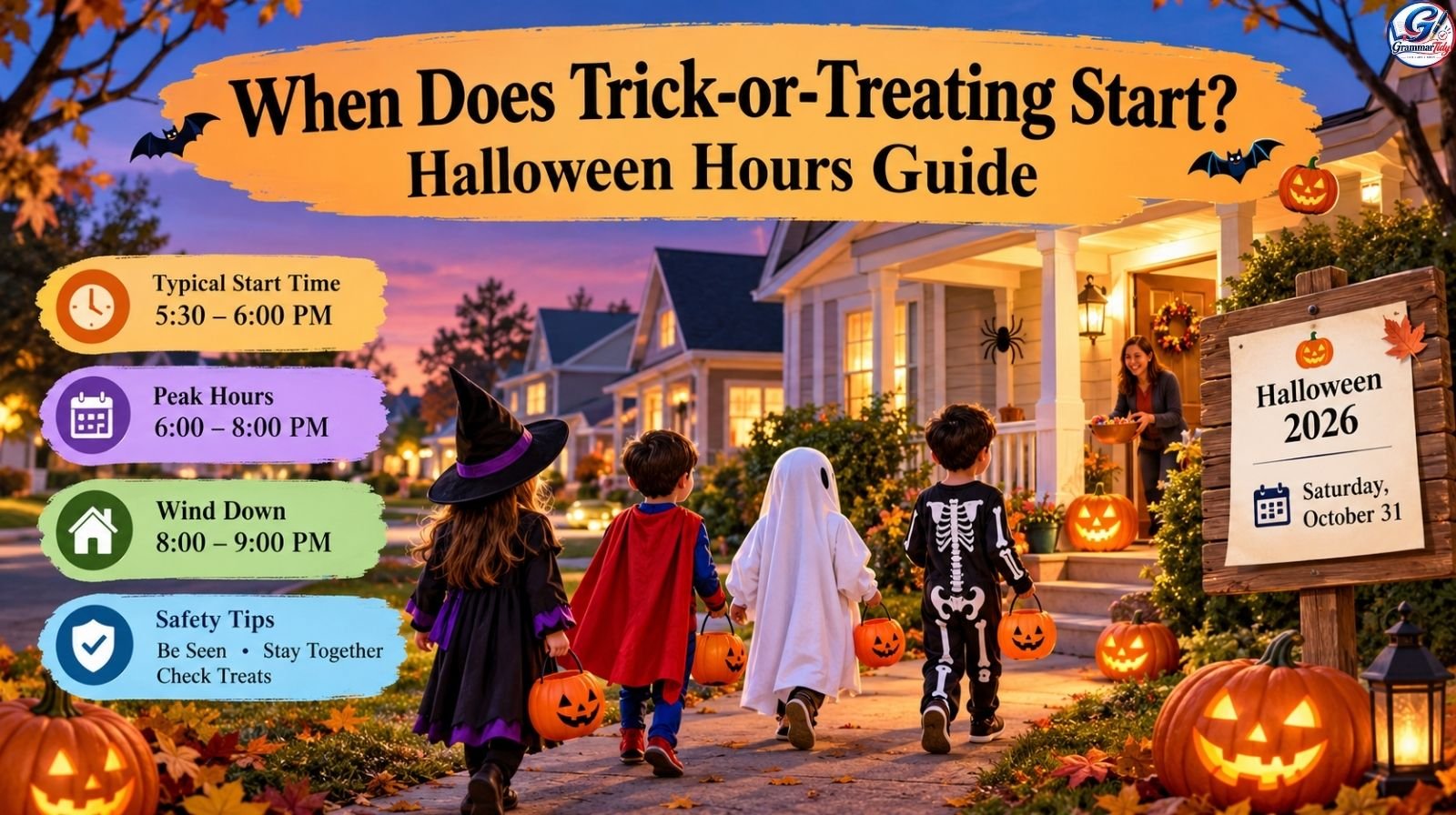
Wondering when does trick-or-treating start on Halloween? For most U.S. neighborhoods, children typically begin going door to door in the early evening, often around 5:30 or 6:00 p.m.,
with many families finishing by about 8:00 or 9:00 p.m. However, there is no single nationwide trick-or-treating schedule.
Local traditions, sunset, weather, children’s ages, and community rules can all affect the timing. Safe Kids Worldwide notes that popular trick-or-treating hours are generally 5:30 p.m. to 9:30 p.m., while some cities and neighborhoods establish narrower hours.
This guide explains the best time to start trick-or-treating, when Halloween hours usually end, how to find your local schedule, and how parents can make the evening safer and more enjoyable.
Also Read: Eaten or Aten? The Correct Spelling Explained Simply
When Does Trick-or-Treating Start?
The short answer is: usually between 5:30 and 6:30 p.m. local time.
There is no official U.S.-wide start time. Each city, neighborhood, homeowners’ association, or local event may follow its own tradition. Some communities organize formal trick-or-treating hours, while others simply leave the timing to individual families.
What Time Should You Start Trick-or-Treating?
For many families, around 6:00 p.m. is a practical starting point.
This timing works well because:
- Younger children can begin before it gets completely dark.
- Parents have time to finish dinner and costumes.
- More homes are likely to be ready for trick-or-treaters.
- Families can enjoy the evening without staying out too late.
- Visibility is generally better at the beginning of the evening.
Safe Kids Worldwide identifies 5:30 p.m. to 9:30 p.m. as popular trick-or-treating hours and recommends that younger children be accompanied by an adult.
When Does Trick-or-Treating Start for Younger Kids?
Families with toddlers and preschoolers often start earlier, sometimes around 4:30–5:30 p.m.
An early start can be useful when:
- Your child gets tired quickly.
- Sunset comes early in your area.
- The weather is cold.
- You want to avoid the busiest period.
- Your child is uncomfortable walking in complete darkness.
For example, a family with a 4-year-old might visit a few nearby houses at 5:15 p.m., return home by 6:30 p.m., and still enjoy Halloween without a late night.
What Are the Typical Trick-or-Treating Hours?
Although schedules vary, a common Halloween evening follows a pattern similar to this:
| Time | What Usually Happens |
|---|---|
| 4:30–5:30 p.m. | Early trick-or-treating for very young children |
| 5:30–6:30 p.m. | Trick-or-treating becomes more active |
| 6:30–8:00 p.m. | Peak neighborhood activity |
| 8:00–9:00 p.m. | Activity begins slowing down |
| 9:00–9:30 p.m. | Mostly older kids or late visitors |
| After 9:30 p.m. | Many households consider trick-or-treating finished |
These are typical ranges, not universal rules. Some communities may finish considerably earlier.
When Does Trick-or-Treating End?
For many neighborhoods, trick-or-treating winds down between 8:00 and 9:00 p.m.
Safe Kids Worldwide lists popular hours through approximately 9:30 p.m., but that does not mean every neighborhood stays active that late.
A good rule is to follow the behavior of your neighborhood. If most porch lights are off and very few homes are answering the door, the evening is probably ending.
Why Do Trick-or-Treating Hours Vary?
Several factors influence Halloween hours:
- Local rules – Some communities publish official hours.
- Sunset – Earlier darkness can affect younger children’s schedules.
- Weather – Rain, cold, or strong winds can shorten the evening.
- Age of children – Younger children generally go earlier.
- Neighborhood traditions – Some areas start and finish earlier than others.
- Community events – Trunk-or-treats and Halloween parties can change normal routines.
Also Read: Pre vs Post: What’s The Real Difference? (With 100+ Examples)
What Time Is Trick-or-Treating in 2026?
In 2026, Halloween falls on Saturday, October 31. That weekend timing may make it easier for some families to start earlier or stay out longer than they would on a school night.
Still, the safest approach is to check your local community’s schedule rather than assume Saturday night means unlimited trick-or-treating.
Halloween 2026 Trick-or-Treating Schedule
A reasonable planning window for many U.S. neighborhoods is:
Start: Around 5:30–6:00 p.m.
Peak: Around 6:00–8:00 p.m.
Wind-down: Around 8:00–9:00 p.m.
Late window: Up to about 9:30 p.m. in some areas
These times are planning estimates rather than official nationwide hours.
How to Find Your Local Halloween Hours
Before Halloween night, check:
- Your city or town website
- Local police or fire department announcements
- School or PTA communications
- Neighborhood association pages
- Local community social-media announcements
- Your city’s official event calendar
Some cities do not designate official trick-or-treat hours at all. For example, Paducah, Kentucky, stated in its 2025 Halloween guidance that the city did not set official hours, although it expected the highest number of trick-or-treaters between 5 and 8 p.m.
That is why searching for your specific city is more reliable than relying on a national timetable.
What Is the Best Time to Go Trick-or-Treating?
For most families, around 5:30–6:30 p.m. is an excellent starting window.
The best time depends on your child’s age and your neighborhood.
Best Time for Toddlers and Young Children
For toddlers, preschoolers, and very young elementary-school children, consider starting around 5:00–5:30 p.m.
This gives them the opportunity to:
- See where they are walking
- Avoid the busiest crowds
- Finish before they become overtired
- Return home before it gets very late
Parents should stay with young children throughout the outing.
Safe Kids Worldwide recommends joining children under age 12 for trick-or-treating and advises older children who are ready to go independently to stay in familiar, well-lit areas and travel in groups.
Best Time for Older Kids
Older children may prefer 6:00–8:00 p.m., when more houses are participating and the neighborhood is busier.
However, older does not automatically mean safer. Children still need to follow pedestrian-safety rules and remain aware of vehicles.
Also Read: Brite vs Bright: 7 Easy Ways To Know The Difference
Is It Better to Trick-or-Treat Before or After Dark?
Starting around dusk can offer a useful balance.
Going too early may mean some families have not finished preparing. Going very late means darker streets, fewer participating homes, and potentially more tired children.
Therefore, early evening is usually the most practical window.
Halloween Safety Tips for Trick-or-Treating
Knowing when does trick-or-treating start is only part of planning Halloween. Visibility and pedestrian safety become especially important as daylight fades.
Safe Kids Worldwide recommends using sidewalks or paths, crossing at corners and crosswalks, avoiding distractions, and watching carefully for vehicles. It also recommends flashlights or glow sticks and reflective materials to help children be seen.
Make Costumes Easy to See
A great Halloween costume should not make it difficult for a child to walk or see.
Choose clothing that:
- Fits properly
- Does not drag on the ground
- Allows clear vision
- Does not block movement
- Can be seen by drivers
Reflective tape, reflective stickers, flashlights, or glow sticks can add visibility after sunset.
The U.S. Consumer Product Safety Commission also recommends well-fitting costumes and increased visibility during darker conditions.
Choose Safe Routes
Before leaving home, decide where the children will go.
A good route should prioritize:
- Sidewalks
- Familiar streets
- Well-lit homes
- Fewer road crossings
- Areas with slower traffic
Children should avoid running between parked cars or suddenly entering the street.
Check Treats Before Eating Them
Parents should examine treats before younger children begin eating them.
Also pay attention to age-appropriate treats and toys. The CPSC advises carefully checking novelty items given to children under 3 because small components can present choking hazards.
Also Read: Lieing or Lying: Correct Spelling Guide 2026
2025–2026 Halloween Data and Trends
Halloween continues to be a major seasonal event in the United States, and recent data shows just how large the celebration has become.
Halloween 2025 Statistics
The National Retail Federation reported that Americans were expected to spend a record $13.1 billion on Halloween in 2025, with average spending reaching $114.45 per person. Nearly half of consumers 49% said they began shopping for Halloween in September or earlier.
This suggests that Halloween planning increasingly starts well before October 31.
Halloween 2026 Statistics
The trend continued in 2026. The NRF’s 2026 survey projected:
- $13.5 billion in total Halloween spending
- 74% of consumers planning to celebrate
- 61% planning to hand out candy
- 50% planning to dress in costume
- 49% starting Halloween shopping in September or earlier
The survey included 7,889 consumers and was conducted September 1–9, 2026.
These figures do not establish a specific trick-or-treating start time, but they show that Halloween has increasingly become a full-season celebration rather than a single evening.
Case Study: Why Local Trick-or-Treating Hours Matter
Consider a family living in a suburban neighborhood with two children, ages 5 and 9.
The parents initially plan to leave at 7:30 p.m. because they assume that is when trick-or-treating will be busiest. However, they check their local community announcement and discover that nearby residents generally expect children between approximately 5:30 and 8:00 p.m.
Instead of waiting until 7:30, the family leaves at 5:45 p.m.
The younger child can see the sidewalks clearly while there is still some daylight. The family visits several nearby homes before the streets become crowded. By 7:15 p.m., they have already collected plenty of candy, and the 5-year-old is beginning to get tired.
They return home before 8:00 p.m., check the treats, and spend the rest of the evening watching a Halloween movie.
This example illustrates an important point: the best trick-or-treating time is not necessarily the latest or busiest time.
Checking local expectations beforehand allows families to choose a schedule that matches their children’s ages, neighborhood traffic, and safety needs.
A Simple Trick-or-Treating Checklist
Use this checklist before leaving home:
Before You Go
- Check your local trick-or-treating hours.
- Check the weather.
- Make sure costumes fit properly.
- Pack a flashlight or glow sticks.
- Add reflective material when appropriate.
- Choose a familiar route.
- Wear comfortable, sturdy shoes.
- Bring a phone for emergencies.
- Make sure younger children have adult supervision.
While Trick-or-Treating
- Walk instead of running.
- Use sidewalks whenever possible.
- Cross at appropriate crossings.
- Watch for turning and backing vehicles.
- Stay with your group.
- Visit homes with welcoming porch lights.
- Avoid entering unfamiliar homes or vehicles.
When You Get Home
- Check treats before eating them.
- Remove anything that may be unsafe or unsuitable.
- Check small toys for choking hazards.
- Drink some water and take a break.
Also Read: Writing or Writting: Which Spelling Is Actually Correct? (2026 Guide)
Mini Quiz: When Does Trick-or-Treating Start?
1. What time does trick-or-treating usually start?
A) 2:00 p.m.
B) 5:30–6:00 p.m.
C) 11:00 p.m.
D) Midnight
Answer: B) 5:30–6:00 p.m.
2. When do many neighborhoods start winding down?
A) 3:00 p.m.
B) 5:00 p.m.
C) 8:00–9:00 p.m.
D) 11:30 p.m.
Answer: C) 8:00–9:00 p.m.
3. True or False: There is one official trick-or-treating time for the entire U.S.
Answer: False. Local communities can have different schedules.
4. What is a good starting time for many families?
A) Around 6:00 p.m.
B) Around midnight
C) Around 1:00 a.m.
D) Around noon
Answer: A) Around 6:00 p.m.
5. Why might younger kids go trick-or-treating earlier?
A) They need more candy
B) They may get tired quickly
C) Stores are closed
D) Halloween starts earlier for them
Answer: B) They may get tired quickly.
6. What can help children stay visible after dark?
A) Sunglasses
B) Reflective materials
C) Dark clothing only
D) Earphones
Answer: B) Reflective materials.
7. What should children use whenever possible while walking?
A) The middle of the road
B) Driveways only
C) Sidewalks or paths
D) Parking lots
Answer: C) Sidewalks or paths.
8. True or False: Parents should check treats before young children eat them.
Answer: True.
9. What is Halloween in 2026?
A) Friday, October 30
B) Saturday, October 31
C) Sunday, November 1
D) Monday, October 31
Answer: B) Saturday, October 31.
10. Which time is often part of the busiest trick-or-treating period?
A) 7:00 p.m.
B) 3:00 a.m.
C) 10:00 a.m.
D) Noon
Answer: A) 7:00 p.m.
11. What should families check before Halloween night?
A) Local trick-or-treating hours
B) Movie reviews
C) Restaurant menus
D) School textbooks
Answer: A) Local trick-or-treating hours.
12. Which children may benefit most from an early start?
A) Toddlers and preschoolers
B) Adults only
C) College students only
D) Pets
Answer: A) Toddlers and preschoolers.
13. What should children avoid doing near streets?
A) Walking on sidewalks
B) Watching for cars
C) Running between parked cars
D) Staying with their group
Answer: C) Running between parked cars.
14. True or False: Every city has official trick-or-treating hours.
Answer: False. Some cities leave the timing to neighborhoods and families.
15. What is the smartest way to know your local Halloween schedule?
A) Guess based on another city
B) Check local community or city announcements
C) Wait until midnight
D) Ask only for candy
Answer: B) Check local community or city announcements.
FAQs
1. What time does trick-or-treating usually start?
Most trick-or-treating activity begins around 5:30–6:00 p.m., although some families with young children start earlier. Local community schedules can be different.
2. What time does trick-or-treating usually end?
Many neighborhoods wind down around 8:00–9:00 p.m. Some communities remain active until about 9:30 p.m., while others finish earlier.
3. Is 5 p.m. too early to trick-or-treat?
Not necessarily. 5 p.m. can be appropriate for toddlers and young children, especially if families in the neighborhood are already participating. However, some homes may not be ready that early.
4. Is 7 p.m. a good time to trick-or-treat?
Yes. 7 p.m. is often within the busiest part of the evening, particularly for older children. However, check local hours because some communities may end earlier.
5. Do all cities have official trick-or-treating hours?
No. Some cities publish specific times, while others leave scheduling to neighborhoods and families. For example, Paducah noted that it did not designate official trick-or-treat hours in its 2025 guidance.
6. What is the safest time for young children to trick-or-treat?
For young children, early evening roughly 5:00–6:30 p.m. can be a practical choice, particularly while there is still some daylight. Adult supervision and visibility are more important than choosing an exact time.
7. When is Halloween in 2026?
Halloween is Saturday, October 31, 2026. Because it falls on a Saturday, families may have more flexibility with their evening schedule, but local trick-or-treating rules still take priority.
Conclusion:
So, when does trick-or-treating start? For most U.S. neighborhoods, a good general expectation is around 5:30–6:00 p.m., with the busiest period often falling between 6:00 and 8:00 p.m. Many families finish around 8:00–9:00 p.m., although local schedules can vary considerably.
For Halloween 2026, the smartest approach is to check your city or neighborhood’s announcement before October 31. Then choose a start time based on your child’s age, local traffic, sunset, weather, and community traditions.
Most importantly, don’t focus only on getting the biggest candy haul. A well-planned, visible, supervised, and comfortable Halloween evening is a much better goal.
Planning Halloween this year? Check your local community schedule, prepare a safe route, grab the flashlight, and enjoy the treats!
Discover More Article
- Zyrtec or Benadryl: Which One Should You Actually Take?
- Lead or Led? The Mistake Even Editors Make
- Claritin or Allegra: Which One Is Better For Allergies?
- With or Without You Lyrics: Meaning, Song Details And More
Keep learning with more easy grammar lessons on GrammarTidy.com

Hi, I’m Noor Fatima, the author and creator of Grammar Tidy. I’m passionate about grammar, writing, and making language learning simple and enjoyable. Through Grammar Tidy, I share helpful tips, clear explanations, and practical guidance to help readers improve their writing, avoid common mistakes, and communicate with confidence. My goal is to make better grammar easy, useful, and accessible for everyone.