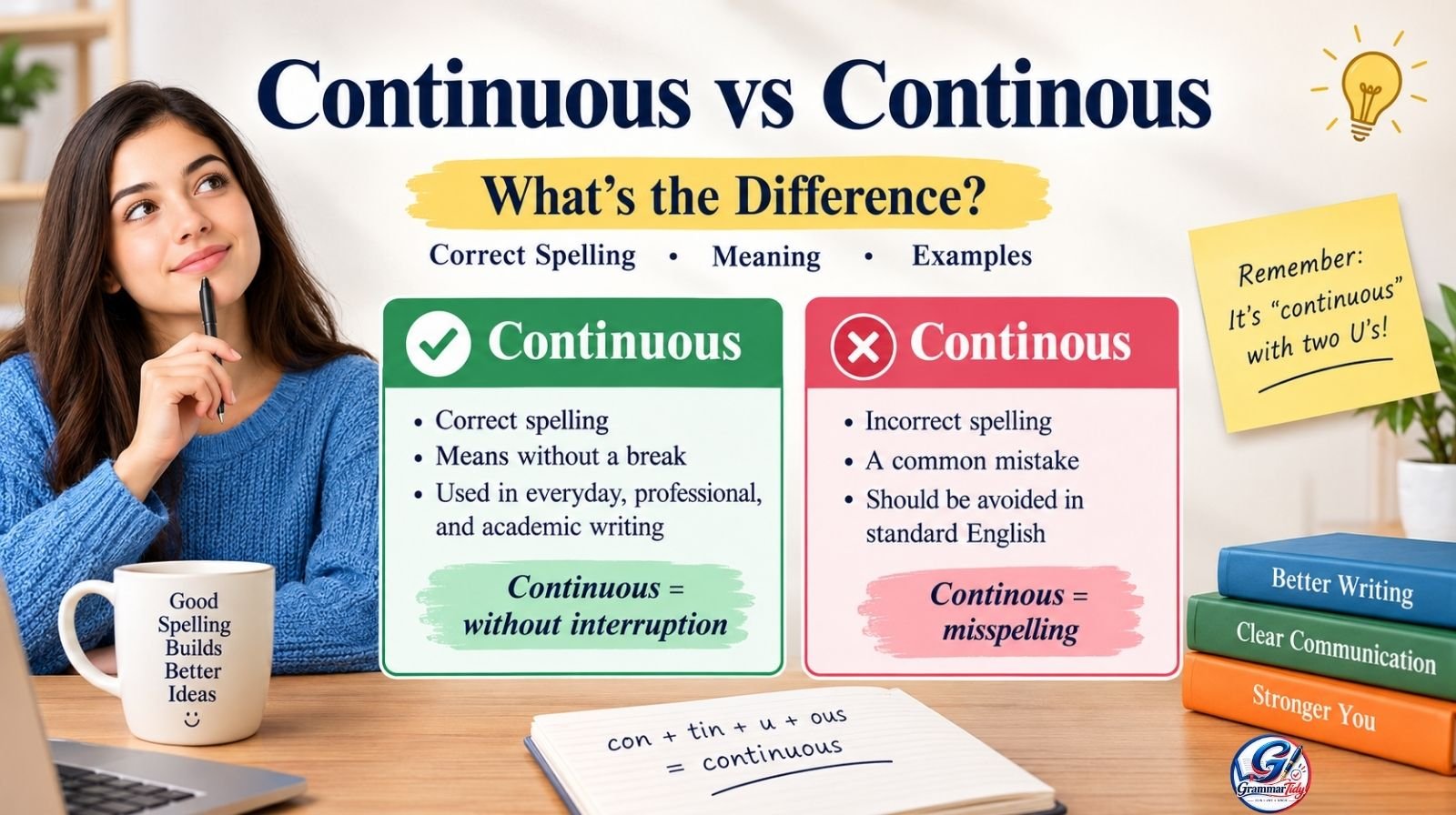
If you have ever hesitated between continuous vs continous, you are not alone. This is a common spelling mistake because the second “u” in continuous is easy to overlook when writing quickly.
The answer is simple: continuous is the correct spelling, while continous is a misspelling. Cambridge Dictionary defines continuous as something that happens or exists without stopping or interruption.
In this guide, you will learn the correct spelling, meaning, pronunciation, common mistakes, sentence examples, and an easy way to remember continuous in 2026.
Also Read: Filipino or Philipino? Meaning, Pronunciation, Spelling & Usage Explained In 2026
Continuous vs Continous: Which Spelling Is Correct?
The correct spelling is continuous.
Continous is incorrect and should not be used in standard English writing. Current dictionary evidence supports continuous as the established English word, while continous appears as a misspelling rather than a separate word. Cambridge defines continuous as “without a pause or interruption.”
| Spelling | Status | Meaning |
|---|---|---|
| Continuous | ✅ Correct | Happening without stopping or interruption |
| Continous | ❌ Incorrect | Misspelling of continuous |
What Does Continuous Mean?
Continuous is an adjective used for something that continues without a break, interruption, or gap.
For example:
- The machine requires continuous monitoring.
- We experienced continuous rain throughout the afternoon.
- The company provides continuous support to its customers.
- The road has a continuous line in the middle.
The word can describe time, movement, sound, activity, processes, or other things that remain uninterrupted.
Is Continous a Word?
No. In standard English, continous is not the correct spelling.
If you write:
❌ The system requires continous monitoring.
Change it to:
✅ The system requires continuous monitoring.
Continuous Meaning, Pronunciation, and Word Form
Understanding the word itself makes the spelling easier to remember.
How Do You Pronounce Continuous?
Continuous is pronounced approximately:
kuhn-TIN-yoo-us
The middle “u” can be easy to miss when you hear the word spoken, which helps explain why writers sometimes produce continous.
However, when spelling it, remember:
con + tin + u + ous = continuous
What Part of Speech Is Continuous?
Continuous is primarily an adjective.
It describes something that happens or exists without interruption.
Examples:
- continuous noise
- continuous service
- continuous improvement
- continuous communication
- continuous development
The word is also used in English grammar. Cambridge explains that the continuous form of a verb describes an action that is continuing and is formed using be plus the present participle.
For example:
She is studying.
Here, is studying is the present continuous form.
Continuous vs Continous: The Spelling Difference
The difference is only one letter, but it matters:
Continuous → C-O-N-T-I-N-U-O-U-S
Continous → C-O-N-T-I-N-O-U-S
The incorrect version drops the u after tin.
A useful visual reminder is:
CONTIN-U-OUS
That extra U belongs in the correct spelling.
Also Read: Fiend or Feen: Which Spelling Is Correct & Why In 2026?
Why Is Continuous Commonly Misspelled as Continous?
The mistake usually happens because the word contains several vowels close together.
The Missing “U” Problem
When people type quickly, they may remember the sound of the word rather than every letter.
Compare:
continuous
continous
The two spellings look very similar, so the missing u can easily escape notice.
Spelling-reference sources specifically identify continous as a misspelling of continuous.
The Pronunciation Can Be Misleading
When spoken naturally, the middle sounds in continuous are not always pronounced with equal emphasis.
This can make the written form less obvious, particularly for English learners.
For that reason, it helps to memorize the spelling visually rather than trying to spell the word entirely from pronunciation.
Other Common Misspellings
Besides continous, people may also write:
- ❌ continious
- ❌ continuos
- ❌ contineous
- ❌ contious
- ❌ continus
The standard spelling is:
- ✅ continuous
How to Use Continuous Correctly in a Sentence
The easiest way to understand continuous is to see it in realistic sentences.
Everyday Examples
Here are several natural examples:
- The baby cried for continuous hours.
- We heard a continuous buzzing sound.
- The river provides a continuous flow of water.
- She made continuous progress throughout the course.
- The team needs continuous communication.
- The machine operates through a continuous process.
- The road has a continuous white line.
- The company focuses on continuous improvement.
Business and Professional Writing
Continuous is especially useful in professional communication.
For example:
Our team provides continuous customer support throughout the year.
The software requires continuous monitoring to maintain reliable performance.
We are committed to continuous improvement of our services.
These examples show how the word naturally fits formal and workplace writing.
Academic and Technical Writing
The word is also common in academic contexts.
For example:
The experiment required continuous observation.
The researcher collected data through continuous monitoring.
The mathematical model assumes a continuous function.
In mathematics and science, continuous can have more specialized meanings, so context matters.
Also Read: Plandid or Candid: Which Is Correct? Meaning, Examples & Usage Guide (2026)
Continuous vs Continual: A Difference Worth Knowing
One reason this topic can become confusing is that continuous and continual are both legitimate words.
However, they are not always interchangeable.
Continuous Means Without a Break
Continuous generally describes something that happens without interruption.
The machine produced a continuous sound.
This suggests that the sound did not stop.
Continual Means Repeated Again and Again
Continual generally refers to something that happens repeatedly, often with breaks between occurrences. Cambridge gives examples involving repeated problems and interruptions.
For example:
The continual interruptions made it difficult to concentrate.
The interruptions happen repeatedly, but each interruption itself has an endpoint.
Quick Comparison
| Word | Basic idea | Example |
|---|---|---|
| Continuous | Without stopping | Continuous rainfall |
| Continual | Repeated frequently | Continual interruptions |
| Continous | ❌ Misspelling | Do not use |
A simple memory aid is:
Continuous = no break
Continual = repeated
Continuous vs Continous: A Simple Memory Trick
If you frequently forget the second u, try this method.
Remember “Continue” First
Start with the familiar word:
continue
Then connect it visually to:
continuous
You can remember the middle sequence as:
TINU
So:
con + tinu + ous = continuous
Use the “Two U” Trick
Another easy trick:
Continuous keeps going and it keeps its two U’s.
Look closely:
continUous
The important part is the U after “tin.”
Write It Slowly Once
When you are unsure, write:
C-O-N-T-I-N-U-O-U-S
After seeing the correct sequence several times, the spelling becomes much easier to recall.
Also Read: Tapping vs Taping: Difference And Correct Usage Explained
Continuous vs Continous: Real-Life Case Study
Imagine a marketing manager preparing an important email for a company’s customers.
The manager wants to announce that technical support will remain available throughout a major software update. While typing quickly, the manager writes:
“Customers will receive continous support during the update.”
The sentence is understandable, but the spelling is incorrect. The manager notices the word looks unusual but is unsure whether continous or continuous is correct.
After checking a dictionary, the manager changes the sentence to:
“Customers will receive continuous support during the update.”
This small correction matters because professional writing is often judged not only by the information it communicates but also by clarity and accuracy. A spelling mistake in a customer email may distract readers from the actual message.
The same issue can appear in reports, academic assignments, website copy, resumes, product descriptions, and internal business documents. The solution does not require memorizing a complicated grammar rule. The writer simply needs to recognize that continuous is the standard spelling and remember the u in the middle.
This is a useful example of why proofreading common words is worthwhile: even a one-letter spelling error can make otherwise polished writing look less careful.
Continuous vs Continous: 2025–2026 Data & Evidence
There is an important distinction between dictionary evidence and search-volume statistics.
As of September 2026, Cambridge Dictionary continues to list continuous as an established English adjective meaning “without a pause or interruption.” It also documents its grammatical use in continuous forms.
Recent educational and spelling-reference materials also continue to present continous as an incorrect spelling and continuous as the correct form. For example, a 2025 English-language assessment includes continous among incorrect options and continuous as the correct spelling.
However, there is no reliable public 2025–2026 authoritative dataset establishing exactly how many people misspell “continuous” as “continous.” Search results and third-party spelling pages can demonstrate that the error exists, but they should not be presented as precise global misspelling-frequency statistics.
That distinction is important for trustworthy content: the spelling can be verified confidently; an exact worldwide frequency cannot be claimed without a suitable corpus or search dataset.
A Quick Checklist for Remembering Continuous
Use this checklist whenever you are unsure:
- Am I describing something without a break?
→ Consider continuous. - Did I accidentally remove the “u” after “tin”?
→ Check continuous. - Does the sentence contain “continous”?
→ Correct it to continuous. - Am I talking about repeated events with breaks?
→ Continual may be more appropriate. - Am I discussing an ongoing grammatical form?
→ Continuous may refer to the continuous/progressive form.
Quick Example
❌ The company provides continous support.
✅ The company provides continuous support.
Also Read: Nominator vs Nominee: Differences, Definitions, And Correct Usage
Mini Quiz: Continuous vs Continous
1. Quick Spell Check: Which One Wins?
A) Continous
B) Continuous
Answer: B) Continuous ✅
2. Spot the Missing Letter!
Which spelling is incorrect?
A) Continuous
B) Continous
Answer: B) Continous ❌
3. Fill the Gap!
Complete the word: Con-tin-__-ous
A) A
B) U
C) E
Answer: B) U ✅
4. What Does “Continuous” Mean?
A) Happening without a break
B) Happening only once
C) Happening randomly
Answer: A) Happening without a break ✅
5. Pick the Correct Sentence
A) The machine needs continous monitoring.
B) The machine needs continuous monitoring.
Answer: B) The machine needs continuous monitoring. ✅
6. Which One Looks Right?
A) Continuous
B) Continous
Answer: A) Continuous ✅
7. Complete This Sentence
“The company provides ______ support.”
A) continous
B) continuous
Answer: B) continuous ✅
8. Continuous or Continual?
Which word usually means something happens without interruption?
A) Continuous
B) Continual
Answer: A) Continuous ✅
9. Find the Spelling Mistake!
Which word needs fixing?
“We experienced continous rainfall.”
A) experienced
B) continous
C) rainfall
Answer: B) continous ❌
10. Grammar Check!
Is this sentence spelled correctly?
“She made continuous progress.”
A) Yes
B) No
Answer: A) Yes ✅
11. Which Word Belongs Here?
“The system requires ______ monitoring.”
A) continuous
B) continous
Answer: A) continuous ✅
12. Remember the “U”!
Which spelling contains the important U after “tin”?
A) Continuous
B) Continous
Answer: A) Continuous ✅
13. Everyday English Challenge
Which sentence is correct?
A) We need continous communication.
B) We need continuous communication.
Answer: B) We need continuous communication. ✅
14. Continuous vs Continual
Which word is generally used for something that happens repeatedly, often with breaks?
A) Continuous
B) Continual
Answer: B) Continual ✅
15. Final Boss: Can You Get It Right?
Choose the correct sentence:
A) The road has a continous white line.
B) The road has a continuous white line.
Answer: B) The road has a continuous white line. 🎯
Also Read: Repore or Rapport: Which Spelling Is Correct? Meaning, Examples & Grammar Guide (2026)
FAQs
1. Is “continous” correct?
No. Continous is a misspelling. The correct spelling is continuous.
2. What is the correct spelling: continuous or continous?
The correct spelling is continuous, with a u after “tin.”
3. What does continuous mean?
Continuous means happening or existing without stopping, breaking, or being interrupted.
4. How do you use continuous in a sentence?
You can use it to describe an uninterrupted action, process, sound, flow, or condition.
Example:
The machine requires continuous monitoring.
5. What is the difference between continuous and continual?
Continuous generally means without interruption, while continual generally describes something that happens repeatedly, often with pauses.
6. Why do people spell continuous as continous?
The spelling is easy to misremember because the middle u can be difficult to hear clearly in normal pronunciation. Visual memorization can help.
7. Is continuous an adjective?
Yes. Continuous is commonly used as an adjective, although the term is also used in grammar to describe a continuing verb form.
Conclusion:
When choosing between continuous vs continous, remember one simple rule: continuous is correct; continous is a misspelling.
Continuous describes something that happens or exists without interruption. It can be used in everyday English, professional writing, academic work, technology, mathematics, and grammar.
The easiest way to remember the spelling is to focus on the middle:
con-tin-u-ous → continuous
Do not let the missing u turn continuous into continous. A quick spelling check can make your emails, assignments, articles, reports, and professional documents clearer and more polished.
Discover More Article
- Genious or Genius: Which Word Is Correct? Common Mistakes Explained (2026)
- Writing or Writting: Which Spelling Is Actually Correct? (2026 Guide)
- Humorous vs Humerous: Which Spelling Is Correct? 2026 Guide
- Lieing or Lying: Correct Spelling Guide 2026
Keep learning with more easy grammar lessons on GrammarTidy.com

Hi, I’m Noor Fatima, the author and creator of Grammar Tidy. I’m passionate about grammar, writing, and making language learning simple and enjoyable. Through Grammar Tidy, I share helpful tips, clear explanations, and practical guidance to help readers improve their writing, avoid common mistakes, and communicate with confidence. My goal is to make better grammar easy, useful, and accessible for everyone.