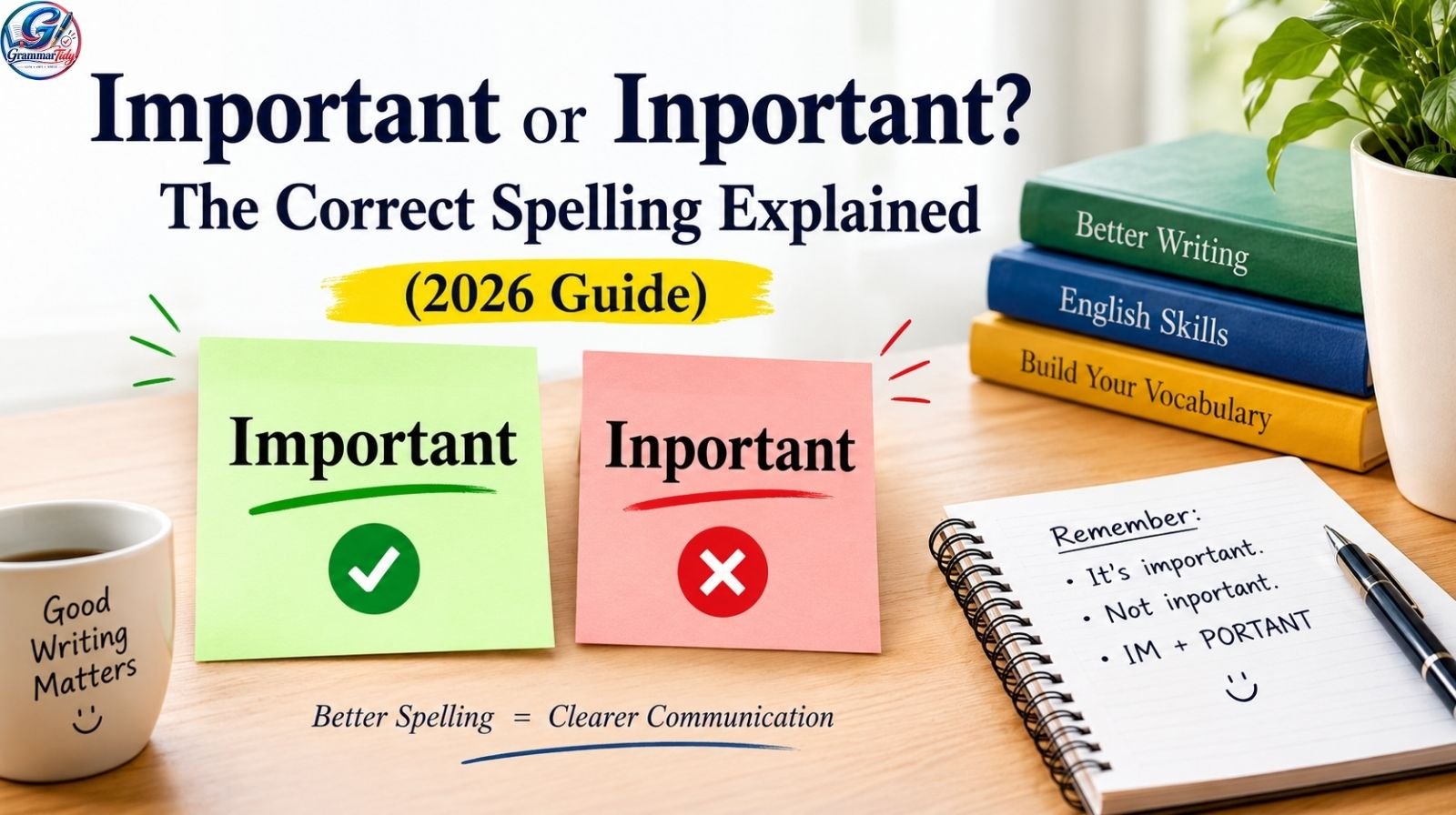
Have you ever typed “inportant” instead of “important” and wondered which spelling is correct? You’re not alone. This is a common spelling mistake because the m before p can be easy to overlook when writing quickly.
The correct spelling is important. “Inportant” is a misspelling, not the standard English form.
In this guide, we’ll explain Important or Inportant, what important means, why the spelling can be confusing, how to use it correctly in sentences, and some simple tricks for remembering it.
Also Read: Naive vs Nieve: Which Spelling Is Correct And How To Use It?
Important or Inportant: Which Spelling Is Correct?
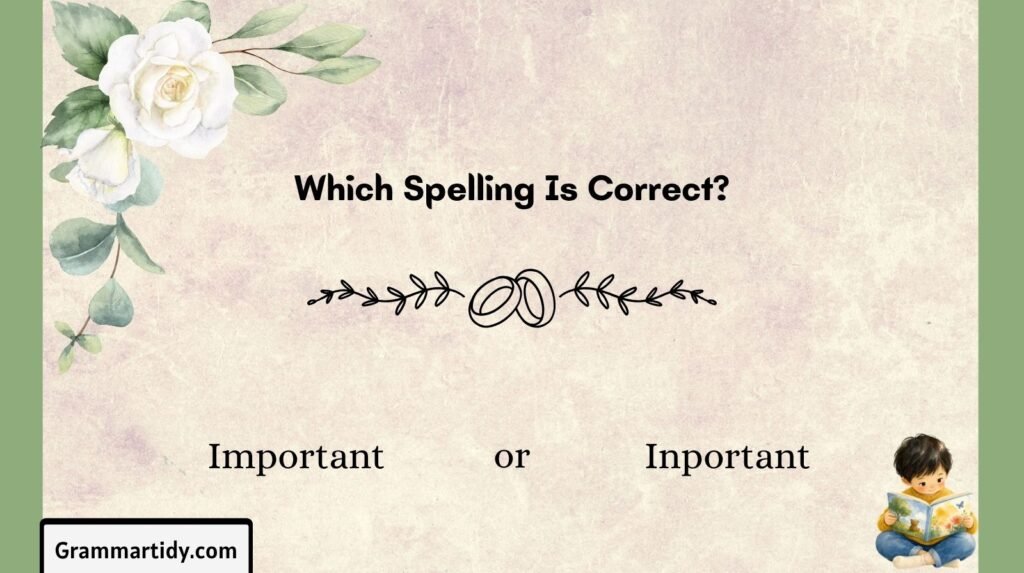
The correct spelling is important.
Inportant is incorrect in standard English. The confusion usually happens because the pronunciation of important can make the middle sound less obvious in everyday speech.
| Spelling | Correct? | Example |
|---|---|---|
| Important | ✅ Yes | Education is important. |
| Inportant | ❌ No | Education is inportant. |
The standard dictionary form is important, an adjective meaning something that is necessary, valuable, or has considerable effect or influence. Cambridge Dictionary gives these meanings for the word.
The Correct Spelling of Important
Remember this pattern:
im + portant = important
The word begins with “im”, not “in.”
For example:
- Correct: This is an important meeting.
- Incorrect: This is an inportant meeting.
Why Is “Inportant” a Common Mistake?
The letters m and n can sound similar in fast speech, particularly when followed by another consonant. As a result, someone may write the word based on how it sounds rather than how it is conventionally spelled.
However, the standard written form remains important.
What Does Important Mean?
Important is an adjective used to describe something that has great value, significance, influence, or effect.
Cambridge Dictionary defines important as something that is “necessary or of great value” and also uses the word for something having a great effect or influence.
Important Meaning in Simple English
In simple terms, important means:
Something that matters a lot or should receive attention.
For example:
- Your health is important.
- This document contains important information.
- She made an important decision.
- It is important to arrive on time.
The related noun is importance, meaning the quality or state of being important.
Important vs. Importance
These two words are related but have different grammatical roles:
- Important = adjective
- Importance = noun
Example:
Education is important.
Education has great importance in society.
So, don’t replace one with the other automatically.
Also Read: Tying vs Tieing: Correct Spelling & Easy Rule To Remember
How to Use Important Correctly in a Sentence
Knowing the spelling is only the first step. You also need to know how important works in everyday English.
Important or Inportant in Real Sentences
Here are some natural examples:
- It is important to check your work.
- She gave me an important piece of advice.
- This meeting is very important.
- Good communication is important in the workplace.
- It is important for students to practice regularly.
- He made an important contribution to the project.
Notice that important can describe people, decisions, information, events, tasks, ideas, and many other things.
Common Sentence Patterns
Some useful structures include:
important + noun
This is an important decision.
important to + person/thing
The project is important to our team.
important for + person/thing + to + verb
It is important for students to read regularly.
Cambridge’s grammar guidance also notes that important is an adjective and normally refers to a noun or pronoun rather than standing alone as a noun.
Common Mistakes to Avoid
❌ The inportant thing is practice.
✅ The important thing is practice.
❌ This is very inportant information.
✅ This is very important information.
❌ Your advice is inportant to me.
✅ Your advice is important to me.
Why Do People Spell Important as “Inportant”?
The Important or Inportant confusion is mainly a spelling issue rather than a difference in meaning.
The “M Before P” Rule
One useful spelling pattern is that m commonly appears before p in English words.
Consider:
- important
- impossible
- impatient
- imperfect
- impressive
This doesn’t mean every word containing a similar sound follows exactly the same pattern, but it gives you a useful visual reminder.
When you see p after the first part of important, remember:
im → p
not:
in → p
Pronunciation Can Cause Confusion
In natural speech, unstressed syllables can be pronounced less distinctly. This can make the spelling feel less obvious to English learners.
That’s why remembering the written structure of the word is more reliable than trying to spell it entirely from pronunciation.
A Simple Memory Trick
Use this:
I’M PORTANT I am important!
Think of “im” + “portant” when spelling the word.
It may look a little unusual, but this visual trick can help you avoid writing inportant.
Also Read: Acception vs Exception: Which One Is Actually Correct? (2026)
Important in Academic, Professional, and Everyday Writing
The word important is extremely common and works across many types of English writing.
Important in Academic Writing
Students frequently use it when discussing ideas, evidence, results, or concepts.
Examples:
It is important to consider both sides of the argument.
Reading plays an important role in language development.
The study highlights an important difference between the two groups.
For formal writing, however, repeating important too often can make your writing less precise. Depending on context, words such as significant, essential, or crucial may sometimes communicate the intended meaning more specifically.
Cambridge’s language guidance similarly identifies alternatives such as significant, essential, vital, and crucial, while noting that their meanings and emphasis differ.
Important in Professional Communication
You might see the word in:
- Business emails
- Reports
- Presentations
- Workplace notices
- Project documents
- Customer communication
For example:
Please review the important information below before Friday.
Or:
We have an important update regarding the project timeline.
Important in Everyday English
The word is also very natural in casual conversation:
That’s really important to me.
Don’t forget this it’s important.
What’s the most important thing we need to do today?
So, important isn’t restricted to formal English.
Important vs. Similar Words: Important, Significant, and Crucial
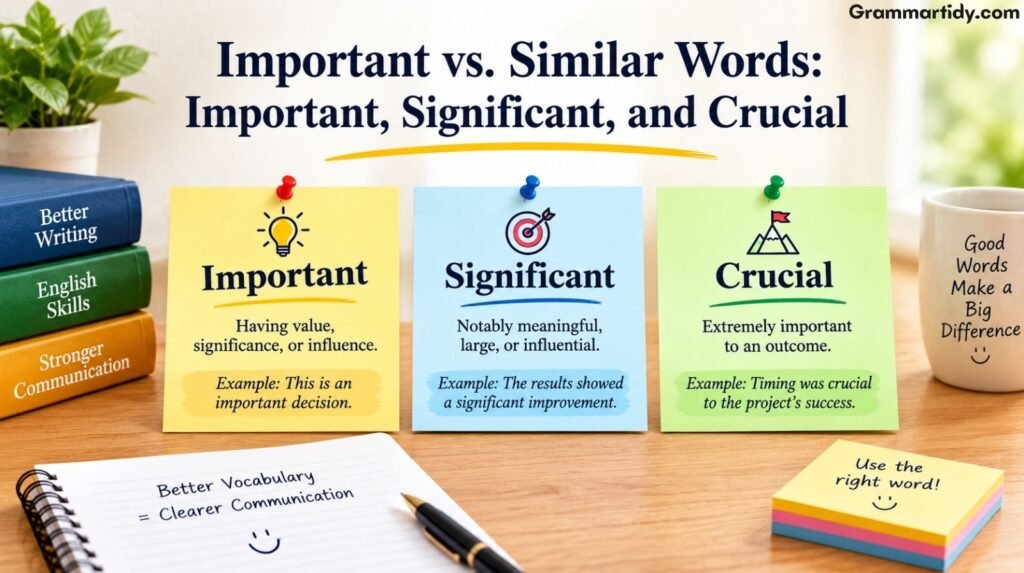
Although these words can overlap, they aren’t always interchangeable.
| Word | General Meaning | Example |
|---|---|---|
| Important | Having value, significance, or influence | This is an important decision. |
| Significant | Notably meaningful, large, or influential | The report found a significant change. |
| Crucial | Extremely important to an outcome | Timing was crucial to the project. |
| Essential | Necessary; something cannot be done without it | Water is essential for life. |
When Should You Use Important?
Use important when you simply want to say that something matters or has considerable value.
It is important to get enough sleep.
When Is Significant Better?
Significant can emphasize importance, effect, size, or meaning.
The company experienced a significant increase in sales.
When Is Crucial Better?
Crucial often suggests that something is extremely important to achieving a particular result.
Accurate data is crucial to the research.
Therefore, don’t automatically replace important with a stronger synonym. Choose the word that accurately reflects the context.
Also Read: Offerred or Offered: Which Spelling Is Correct & Why In 2026?
A Real-Life Case Study: A Small Spelling Error in a Professional Email
Imagine a project coordinator preparing an email for a client.
The coordinator wants to write:
“Please review the important information attached to this email.”
While typing quickly, they write:
“Please review the inportant information attached to this email.”
The recipient can probably understand the message. The meaning isn’t suddenly changed by the spelling error. However, the mistake may make the email look less polished, particularly because the message is professional and the word appears in a prominent sentence.
The coordinator then checks the word in a dictionary and discovers that important, not inportant, is the standard spelling. They correct the email before sending it.
This example demonstrates an important writing lesson: a spelling mistake doesn’t always prevent understanding, but accuracy still matters. In academic work, business communication, applications, and published content, small errors can affect how carefully a document is perceived.
The easiest prevention is simple: when you’re unsure, pause and check the word rather than relying entirely on pronunciation. A dictionary or reliable spellchecker can quickly confirm the standard form.
Important or Inportant: 2025–2026 Search and Writing Data
There is an important limitation when discussing the exact number of people who type “inportant” instead of “important.” Public Google sources do not provide a reliable, universal count of misspellings for this specific word.
Google Trends itself explains that low-volume searches can appear as 0, and its data should not be treated as a perfect mirror of all search activity.
Google also explains that spelling variations and misspellings can be treated differently depending on whether users explore a search term or a broader topic.
More broadly, Google’s 2025 Year in Search report found that conversational searches continued to grow: queries beginning with “How do I…” increased 25% year over year, while “Tell me about…” searches increased 70%.
What Does This Mean for “Inportant”?
It means that people increasingly use search to ask direct language questions, but there is not enough trustworthy public data to claim an exact 2025–2026 search volume for “inportant.”
Therefore, claims such as “millions of people search for inportant every month” should not be presented as fact without a verifiable data source.
For an educational spelling guide, accuracy is more valuable than an impressive but unsupported statistic.
Also Read: Fiend or Feen: Which Spelling Is Correct & Why In 2026?
How to Remember the Correct Spelling of Important
The easiest approach is to break the word into a memorable pattern.
Important Spelling Trick
Think:
IM + PORTANT = IMPORTANT
The key is the M before P.
Try writing it three times:
important
important
important
Then use it in a sentence:
It is important to check your spelling.
A Quick Visual Reminder
When you see “inportant,” ask yourself:
“Does this look right before P?”
Then remember:
M comes before P → important
This simple association can make the correct spelling easier to recall.
Quick Checklist: Important or Inportant?
Before publishing or submitting your writing, use this checklist:
- Correct spelling: important
- Incorrect spelling: inportant
- Part of speech: adjective
- Related noun: importance
- Meaning: having great value, significance, effect, or influence
- Memory tip: IM + PORTANT
- Example: This is an important decision.
If you’re proofreading a document, search for “inportant” and replace it with “important.”
Also Read: Really vs Realy: Which Is Correct? And Proper Usage
Mini Quiz: Important or Inportant?
1. Quick Spelling Check: Which One Is Correct?
A) Inportant
B) Important
Answer: B) Important ✅
2. Fill the Gap: Pick the Right Word
“Your opinion is very ______ to me.”
A) Inportant
B) Important
Answer: B) Important ✅
3. Spot the Spelling Mistake
Which sentence is correct?
A) This is an inportant meeting.
B) This is an important meeting.
Answer: B) This is an important meeting. ✅
4. What Does “Important” Mean?
A) Something that does not matter
B) Something valuable or significant
C) Something imaginary
Answer: B) Something valuable or significant ✅
5. Remember the Letters!
Which letter comes before P in “important”?
A) M
B) N
C) T
Answer: A) M ✅
6. Grammar Time: What Part of Speech Is “Important”?
A) Noun
B) Verb
C) Adjective
Answer: C) Adjective ✅
7. Choose the Correct Sentence
A) Education is inportant.
B) Education is important.
C) Education is importent.
Answer: B) Education is important. ✅
8. Can You Find the Correct Spelling?
Which spelling would you use in a professional email?
A) Inportant
B) Importent
C) Important
Answer: C) Important ✅
9. What Is the Related Noun?
What noun comes from important?
A) Importance
B) Importancy
C) Importantness
Answer: A) Importance ✅
10. Complete the Sentence
“It is ______ to check your work.”
A) important
B) inportant
C) importent
Answer: A) important ✅
11. True or False: Quick Challenge!
“Inportant” is the standard English spelling.
Answer: False ❌
The correct spelling is important.
12. Which Word Fits Best?
“Accurate information is ______ when making a decision.”
A) important
B) inportant
C) importent
Answer: A) important ✅
13. Memory Trick: Complete It!
IM + ______ = IMPORTANT
A) portants
B) portant
C) portanty
Answer: B) portant ✅
14. Important or Importance?
Which sentence uses the correct word?
A) This issue has important.
B) This issue is importance.
C) This issue is important.
Answer: C) This issue is important. ✅
15. Final Boss: Can You Get This One Right?
Which spelling should you always use in standard English?
A) Inportant
B) Important
C) Importent
Answer: B) Important 🎯
Also Read: Plandid or Candid: Which Is Correct? Meaning, Examples & Usage Guide (2026)
FAQs
1. Is “Inportant” a Correct Spelling?
No. Inportant is a misspelling. The correct standard English spelling is important.
2. How Do You Spell Important Correctly?
Spell it:
I-M-P-O-R-T-A-N-T
A useful memory trick is IM + PORTANT.
3. What Is the Meaning of Important?
Important means necessary, valuable, significant, or having considerable effect or influence.
4. Is Important an Adjective?
Yes. Important is an adjective.
For example:
She made an important decision.
5. What Is the Difference Between Important and Importance?
Important is an adjective, while importance is a noun.
This issue is important.
We understand the importance of this issue.
6. Why Do People Write “Inportant”?
The mistake can happen because the pronunciation of important may make the m sound less noticeable in fast speech. Remembering the written pattern im + portant can help.
Conclusion:
When choosing between Important or Inportant, the answer is clear: important is the correct spelling.
Inportant is a common spelling error, but it is not the standard form. Remember the simple pattern IM + PORTANT, and you’ll be much less likely to make the mistake.
The word important is an adjective used for something that has significant value, meaning, effect, or influence. It appears naturally in academic writing, professional communication, and everyday English.
For accurate writing, don’t rely only on pronunciation. When you’re uncertain about a spelling, check a reliable dictionary or proofreading tool.
Now that you know the difference, save this guide and share it with someone who often writes “inportant” instead of “important.”
Discover More Article
- Genious or Genius: Which Word Is Correct? Common Mistakes Explained (2026)
- Transferring or Transfering: Correct Usage In Business, Technology & Everyday English In 2026
- Amount or Ammount: Which Word Is Correct? (2026)
- Filipino or Philipino? Meaning, Pronunciation, Spelling & Usage Explained In 2026
Keep learning with more easy grammar lessons on GrammarTidy.com

Hi, I’m Noor Fatima, the author and creator of Grammar Tidy. I’m passionate about grammar, writing, and making language learning simple and enjoyable. Through Grammar Tidy, I share helpful tips, clear explanations, and practical guidance to help readers improve their writing, avoid common mistakes, and communicate with confidence. My goal is to make better grammar easy, useful, and accessible for everyone.