Have you ever wondered whether to write “fiend” or “feen” when describing someone who behaves cruelly or is extremely enthusiastic about something? You’re not alone. These two spellings can be confusing, especially when you’re writing quickly or relying on pronunciation.
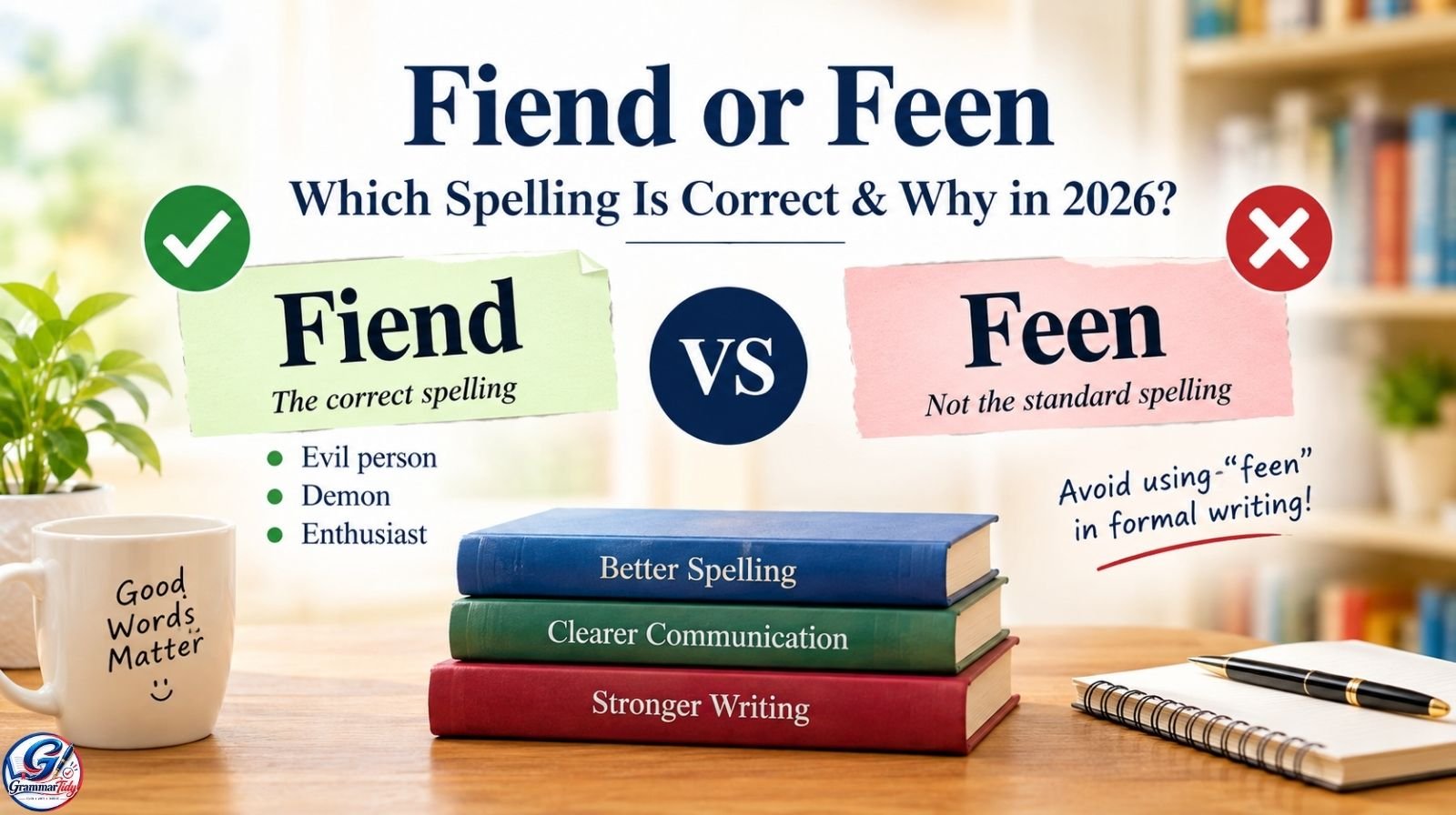
Fiend is the correct standard English spelling, while feen is generally a nonstandard spelling or a phonetic representation of how someone might pronounce the word.
The word fiend can describe an evil or cruel person, a demon, or someone who is extremely enthusiastic about something, such as a coffee fiend.
In this guide, you’ll learn the difference between fiend and feen, discover their meanings, explore real-life examples, and find out how to remember the correct spelling in 2026.
Also Read: Tapping vs Taping: Difference And Correct Usage Explained
Fiend or Feen: Which Spelling Is Correct?
The correct spelling in standard English is fiend.
It is a recognized English word used to describe a wicked or cruel person, a demon, or someone who has an intense enthusiasm for a particular activity or thing.
On the other hand, feen is not the standard spelling of this word. You may encounter it in informal writing, phonetic spellings, or particular slang contexts, but it should not replace fiend in formal or academic English.
What Does Fiend Mean?
According to standard dictionary usage, fiend is a noun with several related meanings.
It can refer to:
- An evil or cruel person.
- A demon or evil spirit.
- Someone who is extremely enthusiastic about something.
For example:
- The villain in the story was a cruel fiend.
- My brother is a coffee fiend who drinks several cups every day.
- The legend described a terrifying fiend living in the forest.
The meaning depends on the context. Calling someone a “coffee fiend” is usually playful, whereas calling someone a “cruel fiend” expresses strong disapproval.
Is Feen a Real Word?
Feen is not the standard English spelling for the meanings described above.
However, that does not mean the letter combination can never appear in writing. It may occur as a name, a phonetic spelling, or in specific slang or dialect contexts.
If you are writing a school assignment, professional email, article, or formal document, use fiend when you mean an evil person or an enthusiastic person.
Quick Comparison: Fiend vs. Feen
| Feature | Fiend | Feen |
|---|---|---|
| Standard spelling | Yes | No, for the intended meaning |
| Part of speech | Noun | Context-dependent |
| Meaning | Evil person, demon, or enthusiast | May be an informal or phonetic form |
| Formal writing | Appropriate | Avoid as a substitute |
| Example | He is a music fiend. | Nonstandard: He is a music feen. |
Quick answer: If you mean a demon, cruel person, or enthusiastic fan, write fiend.
What Does Fiend Mean in Different Contexts?
The word fiend is interesting because it can describe both something frightening and someone who simply loves a particular activity.
Understanding the context helps you use the word naturally and correctly.
Fiend as an Evil or Cruel Person
One traditional meaning of fiend is an evil or cruel person.
It is often used in fiction, storytelling, dramatic descriptions, and emotional conversations.
Examples:
- The evil fiend tried to destroy the village.
- The detective described the criminal as a ruthless fiend.
- In the fantasy novel, a powerful fiend guarded the castle.
In these examples, the word has a negative meaning and suggests cruelty or wickedness.
Fiend as a Demon or Evil Spirit
Fiend can also refer to a demon or supernatural evil being.
This usage is especially common in fantasy novels, horror stories, mythology-inspired writing, and video games.
Examples:
- A terrifying fiend appeared in the dark cave.
- The hero fought a powerful fiend in the final chapter.
- The old legend warned travelers about a fiend in the mountains.
Here, fiend refers to a supernatural creature rather than an ordinary person.
Fiend as an Enthusiastic Person
In everyday English, fiend can also describe someone who really loves something or does it frequently.
This meaning is often humorous or informal rather than insulting.
Examples:
- She is a fitness fiend who never misses a workout.
- My friend is a chocolate fiend.
- He is a technology fiend who enjoys testing new gadgets.
In these sentences, fiend communicates enthusiasm or a strong appetite for something.
Why Do People Confuse Fiend and Feen?
The main reason people confuse fiend and feen is pronunciation.
In many English accents, fiend is pronounced with a long “ee” sound, making it sound similar to “feend.” When people rely on sound alone, they may choose an incorrect spelling.
Pronunciation Makes the Spelling Confusing
The standard pronunciation of fiend is commonly represented as /fiːnd/.
It sounds roughly like “feend,” with a long vowel sound.
Because English spelling does not always match pronunciation perfectly, learners may write what they hear rather than the established spelling.
For example:
- Correct: He is a coffee fiend.
- Incorrect for standard spelling: He is a coffee feen.
The pronunciation may seem straightforward, but the spelling must still be learned.
The Silent-Looking Letter Combination
The spelling fiend contains the letters “ie,” which can confuse learners because English has many different vowel patterns.
For example:
- Field
- Friend
- Fiend
Although these words share similar letter combinations, their pronunciations and meanings differ.
Learning fiend as a complete word rather than guessing its spelling from sound can help prevent mistakes.
Informal Writing Can Reinforce Mistakes
Text messages, social media posts, and casual conversations often contain creative spellings.
A person might use “feen” because it reflects how they hear the word or because they are using a particular informal expression.
However, informal usage does not automatically make a spelling appropriate for formal English.
When writing for a general audience, using the established spelling fiend makes your meaning clearer.
Fiend vs. Feen: Real-Life Writing Case Study
Imagine a university student named Sarah who is preparing an English assignment about character descriptions in a fantasy novel.
While writing her first draft, she types:
“The main character encounters a dangerous feen who guards the ancient castle.”
Sarah knows the word sounds like “feend,” but she is unsure how to spell it. She searches for the correct spelling and discovers that fiend is the standard English word for an evil creature or demon.
Also Read: Nominator vs Nominee: Differences, Definitions, And Correct Usage
She then corrects her sentence:
“The main character encounters a dangerous fiend who guards the ancient castle.”
The correction makes the sentence consistent with standard English spelling.
Later, Sarah writes a second sentence about her classmate:
“Ali is a science fiend who enjoys learning about space.”
This time, she uses the same spelling correctly, even though the meaning is different. Instead of describing an evil creature, fiend now refers to someone who is extremely enthusiastic about science.
Sarah’s experience demonstrates an important writing lesson: a word’s meaning can change according to context, but its standard spelling remains the same.
By learning the spelling and recognizing its different meanings, Sarah can use fiend confidently in both academic and everyday writing.
Key takeaway: Whether you describe a fictional demon or a person who loves science, fiend is the standard spelling.
Fiend or Feen: 2025–2026 Spelling and Usage Facts
People searching for “fiend or feen” may want to know whether the spelling has changed or whether both forms have become acceptable.
The key distinction is between a word’s established spelling and informal variations that appear in online communication.
Has the Correct Spelling Changed in 2026?
No recognized spelling change has made feen the standard replacement for fiend.
The established spelling remains fiend in standard English.
For example, the sentence “She is a book fiend” is appropriate when describing someone who loves reading.
Writing “She is a book feen” would generally be treated as a spelling error in standard English.
What Do 2025–2026 Search Trends Tell Us?
People searching for “fiend or feen” are likely looking for clarification about spelling, pronunciation, and meaning.
However, it is important to distinguish search interest from verified language usage.
There is no verified 2025–2026 search-volume dataset provided here that establishes how often “feen” is searched or how frequently it is used instead of “fiend.”
Without a reliable dataset, it would be misleading to invent percentages, search counts, or claims that one spelling mistake has increased or decreased.
For current keyword research, tools such as Google Trends and Google Ads Keyword Planner can help investigate search interest and keyword estimates.
Also Read: Triple vs Tripple: Which Is The Correct One To Use?
How to Check Current Search Interest
If you are writing an SEO article and want to understand how people search for these words, follow these steps:
- Open Google Trends .
- Enter “fiend” and “feen” as separate search terms.
- Select the desired region and time period.
- Compare the available search-interest data.
- Use Google Ads Keyword Planner to investigate keyword estimates, if available.
Remember that Google Trends reports relative search interest rather than exact search counts. Search estimates and results may also vary by region and date.
How to Remember the Correct Spelling of Fiend
The easiest way to remember the correct spelling is to connect the word with its familiar letter pattern and meaning.
Use the “IE” Memory Trick
Remember that the correct spelling contains “ie”:
F + IE + ND = FIEND
A simple memory sentence is:
“A fiend is a friend’s opposite in a scary story.”
This is just a memory aid, not a literal definition. A fiend can also be someone who loves coffee, music, or another activity.
Practice With Simple Sentences
Reading and writing the word in context can help reinforce its spelling.
Try remembering these examples:
- The villain was a fiend.
- My sister is a chocolate fiend.
- The hero defeated the fiend.
- He is a movie fiend.
Notice that the spelling remains the same even when the meaning changes.
Fiend or Feen: A Quick Self-Check
Before submitting an assignment or publishing an article, use this checklist:
- Am I referring to a demon, evil person, or enthusiastic person?
- Have I written the word as f-i-e-n-d?
- Does the sentence make sense in context?
- Have I avoided using “feen” as a substitute in formal writing?
If your answer to these questions is yes, your spelling is likely correct.
Also Read: Unaffected vs Uneffected: Which Word To Use Correctly?
Mini Quiz: Fiend or Feen
Quiz 1: The Spelling Showdown
Which spelling is correct in standard English?
A) Feen
B) Fiend
Answer: B) Fiend
Quiz 2: Fill in the Blank
My brother is a coffee _____ who drinks it every morning.
A) Feen
B) Fiend
Answer: B) Fiend
Quiz 3: Spot the Correct Sentence
Which sentence is correct?
A) The hero defeated the fiend.
B) The hero defeated the feen.
Answer: A) The hero defeated the fiend.
Quiz 4: What Does Fiend Mean?
What can the word “fiend” describe?
A) Only a friendly person
B) An evil person or an enthusiastic person
Answer: B) An evil person or an enthusiastic person
Quiz 5: True or False?
“Feen” is the standard spelling when referring to a demon.
Answer: False. The standard spelling is “fiend.”
Quiz 6: Choose the Missing Letters
F _ _ N D
Which letters complete the correct spelling?
A) IE
B) EE
Answer: A) IE
Quiz 7: The Fantasy Challenge
The scary creature in the castle was a _____.
A) Fiend
B) Feen
Answer: A) Fiend
Also Read: Repore or Rapport: Which Spelling Is Correct? Meaning, Examples & Grammar Guide (2026)
Quiz 8: Coffee Lover Alert!
What does “coffee fiend” usually mean?
A) Someone who dislikes coffee
B) Someone who really loves coffee
Answer: B) Someone who really loves coffee
Quiz 9: Find the Spelling Mistake
Which word is incorrectly spelled for the intended standard meaning?
A) Fiend
B) Feen
Answer: B) Feen
Quiz 10: Pick the Correct Plural
What is the plural form of “fiend”?
A) Fiends
B) Feendes
Answer: A) Fiends
Quiz 11: Pronunciation Check
Which pronunciation is commonly associated with “fiend”?
A) “Feend”
B) “Fined”
Answer: A) “Feend”
Quiz 12: Complete the Sentence
The villain was described as a cruel _____.
A) Feen
B) Fiend
Answer: B) Fiend
Quiz 13: Formal Writing Test
Which spelling should you use in a school assignment when describing an evil creature?
A) Feen
B) Fiend
Answer: B) Fiend
Quiz 14: Meaning Match
“He is a music fiend.”
What does this sentence suggest?
A) He loves music very much.
B) He hates listening to music.
Answer: A) He loves music very much.
Quiz 15: The Final Spelling Champion
Complete the sentence with the correct word:
“Remember, the standard spelling is f-i-e-_____.”
A) nd
B) ne
Answer: A) nd
Also Read: Tying vs Tieing: Correct Spelling & Easy Rule To Remember
FAQs:
Q1. Is it fiend or feen?
Fiend is the correct standard spelling when referring to an evil person, demon, or extremely enthusiastic person. Feen is not the standard spelling for these meanings.
Q2. What does fiend mean in simple English?
A fiend can mean an evil or cruel person, a demon, or someone who really loves something. For example, a “coffee fiend” is someone who loves coffee.
Q3. Is feen ever correct?
It may appear as a name, phonetic spelling, or in particular informal or slang contexts. However, it is not the standard spelling of fiend.
Q4. How do you pronounce fiend?
Fiend is commonly pronounced /fiːnd/, which sounds roughly like “feend.”
Q5. What is the plural of fiend?
The plural is fiends.
Example: The heroes fought several fiends in the fantasy story.
Q6. Is fiend a bad word?
Not necessarily. It can be negative when describing an evil person, but it can also be playful when describing someone who loves something, such as a coffee fiend or music fiend.
Conclusion:
When choosing between fiend or feen, remember that fiend is the correct standard English spelling for an evil person, demon, or someone who is extremely enthusiastic about something.
Although feen may appear in informal writing or as a phonetic spelling, it should not replace fiend in academic assignments, professional communication, or standard English articles.
The easiest way to remember the correct spelling is to focus on the “ie” combination in f-i-e-n-d and practice using the word in different contexts.
Discover More Article
- Acception vs Exception: Which One Is Actually Correct? (2026)
- Oversite vs Oversight: What’s The Difference And Which Word Should You Use?
- Offerred or Offered: Which Spelling Is Correct & Why In 2026?
Keep learning with more easy grammar lessons on GrammarTidy.com

Hi, I’m Noor Fatima, the author and creator of Grammar Tidy. I’m passionate about grammar, writing, and making language learning simple and enjoyable. Through Grammar Tidy, I share helpful tips, clear explanations, and practical guidance to help readers improve their writing, avoid common mistakes, and communicate with confidence. My goal is to make better grammar easy, useful, and accessible for everyone.