Have you ever wondered whether to write says or sais? English spelling can be confusing, especially when a word sounds different from the way it is written.
If you have typed “sais” instead of “says,” you are not alone. This mistake can happen when people rely on pronunciation rather than standard spelling.
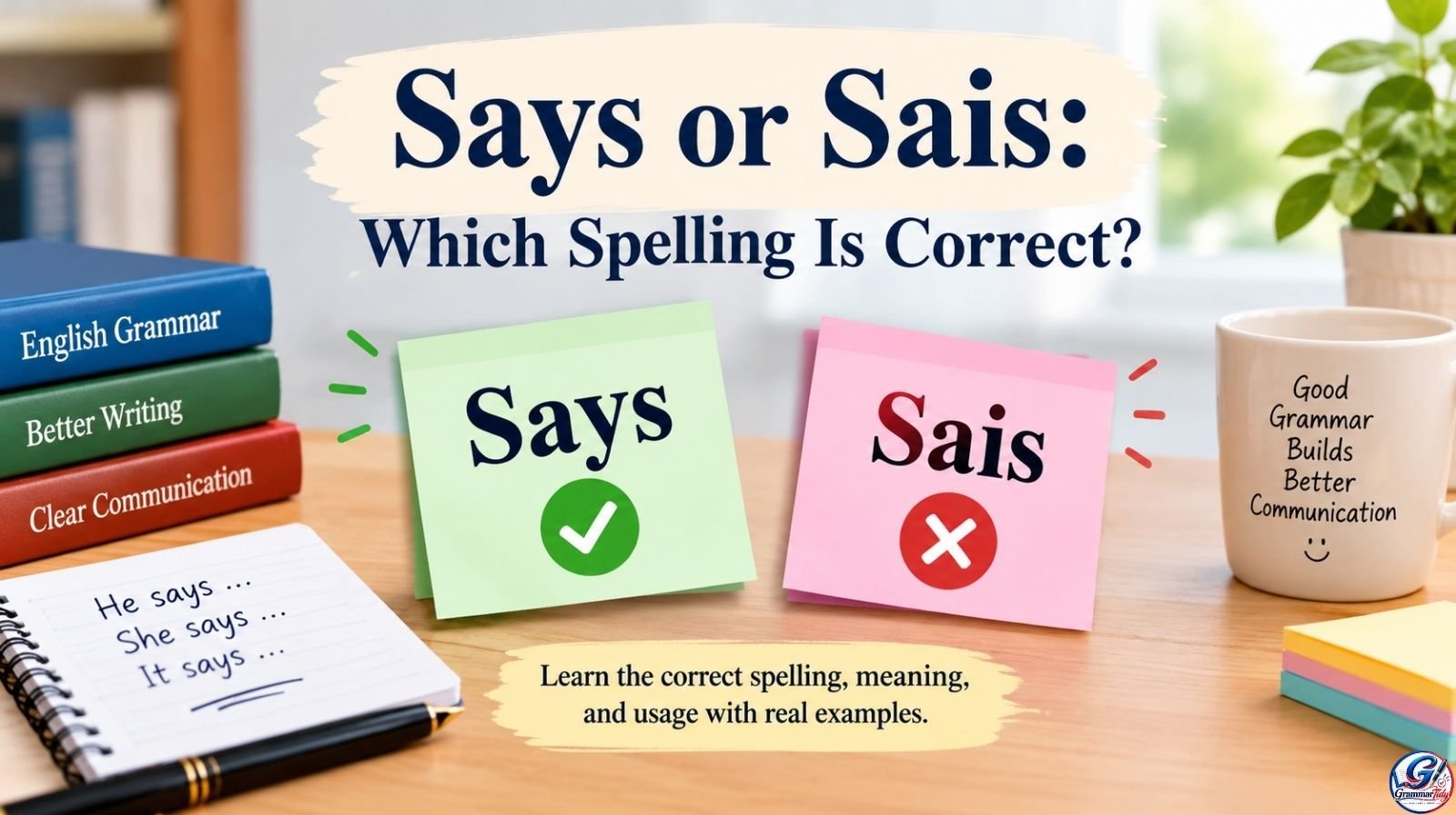
The correct spelling in modern English is says when you want to express what someone communicates or states. “Sais” is generally a misspelling of this verb in ordinary English writing.
In this guide, you will learn the difference between says and sais, understand the meaning and pronunciation of says, explore real-life examples, and discover practical ways to avoid this common spelling mistake.
Also Read: Quantify vs Qualify: Differences And Correct Usage
What Is the Difference Between Says and Sais?
The main difference between says and sais is that says is the correct standard English spelling of the verb “say” in the third-person singular present tense. Sais is not the standard spelling for this meaning.
For example, you would write, “She says hello,” rather than “She sais hello.”
What Does Says Mean?
“Says” is a form of the verb “say.” It means to express something through speech or communicate a statement.
We use it with singular third-person subjects such as he, she, and it, as well as singular names.
Examples:
- She says that the meeting starts at nine.
- He says he is feeling better.
- My teacher says practice improves writing.
- The sign says the store is closed.
In each sentence, “says” communicates what a person, object, or source states.
Is Sais a Correct English Word?
In ordinary modern English, “sais” is incorrect when you mean the verb “says.” It is usually a spelling mistake caused by the unusual pronunciation of the correct word.
If you are writing an essay, email, school assignment, article, or professional document, use says.
However, a similar-looking spelling might appear in a foreign-language expression, a name, or a specialized context. That does not make “sais” a standard alternative to “says” in English.
Also Read: Courtesy vs Curtesy: Meaning, Usage And Common Mistakes
Says vs. Sais at a Glance
| Feature | Says | Sais |
|---|---|---|
| Standard English spelling of the verb | Correct | Incorrect |
| Meaning | States or expresses something | No standard meaning as this verb |
| Example | He says the answer is correct. | He sais the answer is correct. |
| Suitable for formal writing | Yes | No, not for this meaning |
| Pronunciation | Usually /sɛz/ | Not a standard alternative pronunciation spelling |
Quick answer: If you mean “states” or “expresses,” always write “says.”
Why Do People Confuse Says and Sais?
Many spelling mistakes occur because English does not always follow predictable sound-to-letter patterns. The confusion between says and sais is a good example.
The Pronunciation of Says Is Unexpected
The word “says” is commonly pronounced like “sez,” rather than the way many learners expect it to sound based on the spelling of “say.”
Compare these forms:
- Say: Usually pronounced like “say.”
- Says: Usually pronounced like “sez.”
- Said: Usually pronounced like “sed.”
Because the vowel sound changes, English learners may try to spell “says” according to the sound they hear. This can lead to incorrect forms such as “sais.”
English Spelling Does Not Always Match Pronunciation
English has borrowed words from several languages and developed spelling conventions over many centuries. As a result, some words have pronunciations that are not immediately obvious from their written forms.
For example:
- One: Does not rhyme with “tone.”
- Said: Does not rhyme with “paid” in standard pronunciation.
- Does: Has a different vowel sound from “goes.”
- Says: Is commonly pronounced like “sez.”
These examples demonstrate why remembering the conventional spelling of a word is often more reliable than guessing from pronunciation.
Also Read: Submission vs Submittion: Learn The Difference
Typing Habits Can Cause Spelling Errors
Typing quickly, using a phone keyboard, or writing without proofreading can also lead to mistakes.
For instance, a learner might type “She sais it is easy” while concentrating on the sentence’s meaning rather than the spelling of each word.
To prevent this problem, learn the correct spelling as a complete word and review your writing before publishing or submitting it.
How to Use Says Correctly in Sentences
Understanding how to use “says” will help you avoid the says-or-sais spelling mistake in everyday writing.
Use Says With He, She, It, and Singular Nouns
In the present simple tense, use “says” with third-person singular subjects.
Examples:
- He says the train is late.
- She says she will call tomorrow.
- The teacher says the homework is important.
- My brother says he needs more time.
- The report says sales have increased.
Notice that the verb changes according to the subject. With “I,” “you,” “we,” and “they,” the correct form is generally “say,” not “says.”
For example:
- I say what I mean.
- They say the restaurant is excellent.
- She says the restaurant is excellent.
Use Says When Reporting Information
“Says” is also useful when explaining what a document, sign, website, or other source communicates.
Examples:
- The label says to keep the product refrigerated.
- The website says registration is free.
- The notice says the office opens at 8 a.m.
- The dictionary says the word has several meanings.
Also Read: Meating vs Meeting: Difference And Correct Usage
These sentences show that “says” does not have to refer only to spoken conversation. It can also describe written information.
Says vs. Say vs. Said
Understanding related verb forms makes correct spelling easier.
| Word | Usage | Example |
|---|---|---|
| Say | Present tense with I, you, we, and they | They say it is useful. |
| Says | Present tense with he, she, it, or a singular noun | She says it is useful. |
| Said | Past tense with all subjects | She said it was useful. |
Remember that “says” is the correct form for a present-tense statement involving a third-person singular subject. “Sais” does not replace any of these standard forms.
Common Mistakes to Avoid When Writing Says
Correct spelling becomes easier when you recognize the situations that commonly cause errors.
Mistake 1: Writing According to Sound
Incorrect: He sais that the answer is right.
Correct: He says that the answer is right.
Why? The standard spelling is “says,” even though its pronunciation may sound like “sez.”
Mistake 2: Using Says With the Wrong Subject
Incorrect: They says the lesson is helpful.
Correct: They say the lesson is helpful.
Why? “They” takes the base form “say” in the present simple tense.
Mistake 3: Confusing Says With Said
Incorrect: Yesterday, she says she was tired.
Correct: Yesterday, she said she was tired.
Why? When describing a completed statement in the past, “said” is normally the appropriate form.
Mistake 4: Ignoring Proofreading
A spelling checker may identify some errors, but you should not rely entirely on automated corrections. Context matters, and a word can be spelled correctly but used incorrectly.
Before publishing an article, sending an email, or submitting an assignment, review the subject, verb tense, and spelling.
Also Read: Accross vs Across: Which Is The Correct Spelling?
A Simple Checklist for Correct Spelling
Use this quick checklist whenever you are unsure whether to write says or sais:
- Am I trying to express the meaning “states” or “expresses”?
- Is the subject he, she, it, or a singular noun?
- Am I talking about the present rather than the past?
- Have I written “says” with a y, not “sais”?
- Have I read the complete sentence to check its grammar?
If the sentence describes a present-tense statement by a third-person singular subject, “says” is usually the correct choice.
Real-Life Example: Correcting Says or Sais in Everyday Writing
Imagine a student named Alex preparing an English assignment about the importance of healthy habits. Alex writes the following paragraph:
“My teacher sais that exercise is important. She sais students should sleep well and drink enough water. The school notice also sais that everyone should bring a water bottle.”
The message is understandable, but the repeated spelling error makes the assignment look less polished. Alex knows what the word sounds like but has not memorized its conventional spelling.
During proofreading, Alex checks the verb and corrects the paragraph:
“My teacher says that exercise is important. She says students should sleep well and drink enough water. The school notice also says that everyone should bring a water bottle.”
The revised paragraph uses “says” correctly in all three sentences. The word appears with both a person and a written source as its subject, demonstrating two common uses of the verb.
Alex then checks the rest of the assignment for related forms. The student changes “They says exercise is useful” to “They say exercise is useful” and changes “Yesterday, my teacher says” to “Yesterday, my teacher said,” where the context refers to a past statement.
This example illustrates an important lesson: spelling accuracy and grammar work together. Correcting “sais” to “says” fixes the spelling, while checking the subject and tense improves the entire paragraph.
By learning the pattern rather than correcting only one sentence, Alex can apply the same knowledge to future assignments, emails, reports, and online articles.
Also Read: Vinal vs Vinyl: Which Is The Correct One To Use?
Says or Sais in 2025–2026: Spelling Guidance and Language Data
The correct spelling remains says in standard modern English. There is no standard spelling reform that makes “sais” an accepted replacement for this verb in 2025 or 2026.
What Do Current Spelling Standards Tell Us?
Modern English spelling references and dictionaries preserve “says” as the standard third-person singular form of “say.” The same basic rule applies in academic writing, professional communication, and general online publishing.
For example:
- Standard: The article says that regular practice helps.
- Nonstandard: The article sais that regular practice helps.
This is a spelling distinction, not a new usage trend that changes from year to year.
Is There Reliable 2025–2026 Data About This Mistake?
There is no verified, widely recognized 2025–2026 statistic available here that measures exactly how often English writers confuse “says” with “sais.” Therefore, assigning a percentage or claiming that the error has increased in recent years would be misleading.
However, current writing practices make spelling accuracy particularly relevant for students, content creators, and professionals who publish online. Search engines and readers benefit from clear, useful, well-edited content, although a single spelling correction does not guarantee higher rankings.
For dependable guidance, consult established dictionary entries and official writing resources rather than relying on unsupported statistics.
Trusted Resources for English Spelling
The following resources can help you check spelling and improve your writing:
- Merriam-Webster Dictionary Look up standard spellings, definitions, and usage.
- Cambridge Dictionary Check meanings, pronunciation, and grammatical information.
- Google Search Central Learn about creating helpful, reliable, people-first content for online readers.
These resources support accurate writing and responsible content creation. For this particular spelling question, the essential rule is simple: use “says” for the standard English verb form.
Also Read: Commit vs Comit: Correct Spelling And Usage
Frequently Asked Questions
1. Is it says or sais?
Says is the correct spelling when you mean “states” or “expresses.” “Sais” is a misspelling when used as a substitute for this standard English verb.
2. Why is says pronounced like sez?
English spelling and pronunciation do not always match directly. The word “says” has a conventional pronunciation that differs from what some learners expect based on “say.”
3. What does says mean?
“Says” means to express something in words or communicate information. For example, “She says the meeting is tomorrow.”
4. Can I use sais in formal writing?
No, not when you intend to use the standard English verb “says.” Use the correct spelling in essays, professional emails, reports, and articles.
5. What is the difference between say and says?
“Say” is used with subjects such as I, you, we, and they in the present simple tense. “Says” is used with third-person singular subjects such as he, she, and it.
6. Is said the past tense of says?
Yes. “Said” is the past-tense form of “say.” For example, “She says hello” describes the present, while “She said hello” describes the past.
7. How can I remember the correct spelling of says?
Remember the pattern say → says → said. Although the pronunciation of “says” may sound unexpected, its standard spelling contains a y. Practicing the word in complete sentences can help you remember it.
Conclusion:
When choosing between says or sais, the correct spelling is says. It is the standard third-person singular present-tense form of “say” and is used when someone or something states, expresses, or communicates information.
Although “says” may sound different from what its spelling suggests, that pronunciation does not change the conventional spelling. Use examples such as “She says hello,” “The report says sales are growing,” and “My teacher says practice is important” to reinforce the rule.
To improve your writing, remember the difference between “say,” “says,” and “said,” and proofread your work before publishing or submitting it.
Discover More Article
- Vender vs Vendor: Which Is Correct In 2026?
- Gluing or Glueing: Which Spelling Is Correct And Why It Matters?
- Todays or Today’s: Which Spelling Is Correct?
- Vice Versa or Visa Versa: Which Is Correct?
Keep learning with more easy grammar lessons on GrammarTidy.com

Hi, I’m Noor Fatima, the author and creator of Grammar Tidy. I’m passionate about grammar, writing, and making language learning simple and enjoyable. Through Grammar Tidy, I share helpful tips, clear explanations, and practical guidance to help readers improve their writing, avoid common mistakes, and communicate with confidence. My goal is to make better grammar easy, useful, and accessible for everyone.