Have you ever wondered whether you should write emersion or immersion? Although these two words look and sound similar, they describe almost opposite directions.
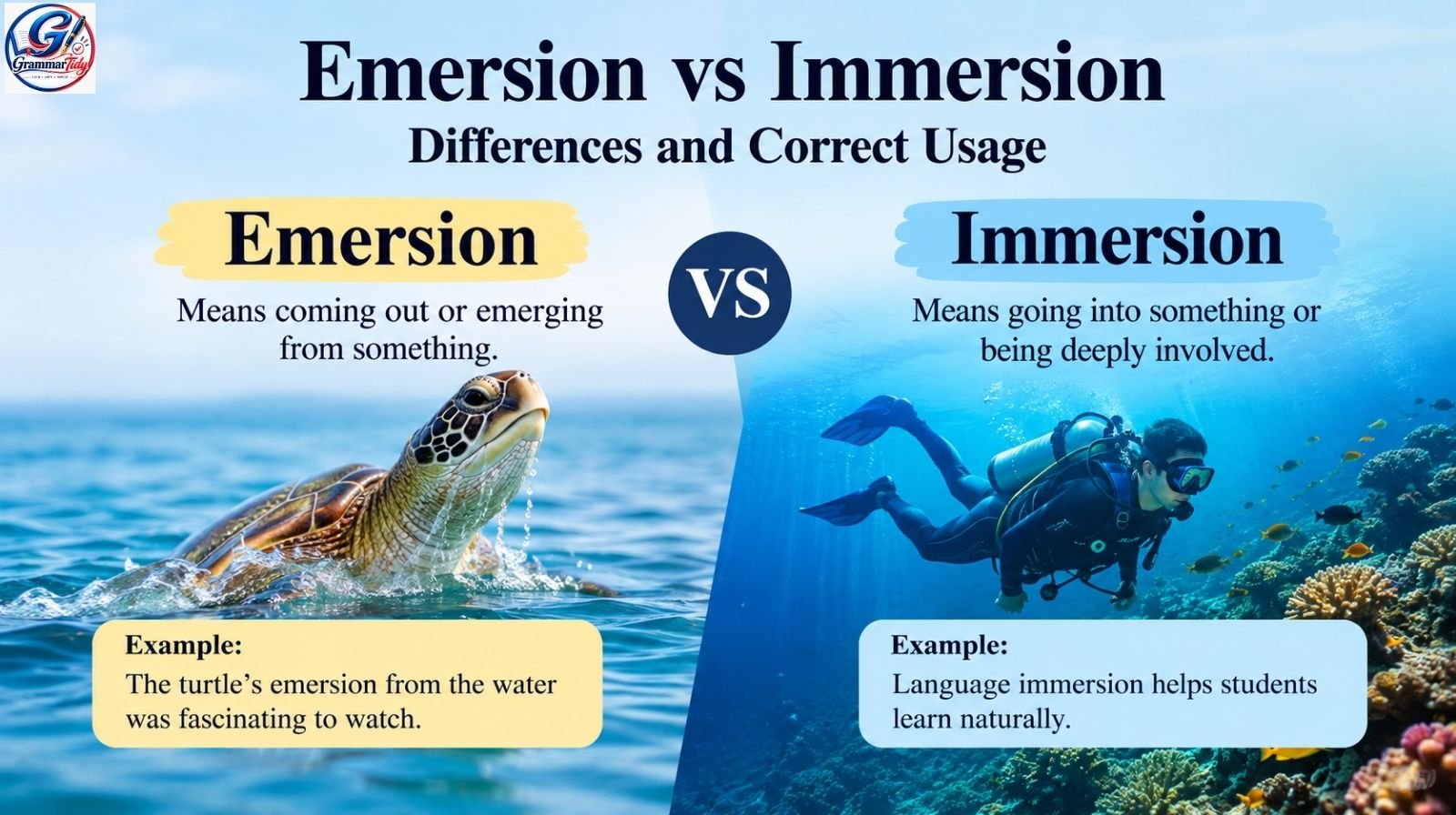
The difference is simple: emersion means coming out or emerging, while immersion means going into or being completely surrounded by something.
However, because immersion is much more common in everyday English, many writers accidentally use it when they mean emersion or assume that emersion is simply a misspelling.
This guide explains emersion vs immersion with clear definitions, real examples, a comparison table, common mistakes, and practical tips to help you choose the correct word every time.
What Is the Difference Between Emersion and Immersion?
The main difference between emersion vs immersion is the direction of movement or experience.
- Emersion means emerging, rising, or coming out of something.
- Immersion means entering into something completely or being surrounded by it.
Quick Answer
Use emersion for coming out. Use immersion for going in or being deeply involved.
For example:
- The diver’s emersion from the water was carefully recorded.
- Language immersion helps learners experience a language in real-life situations.
Merriam-Webster defines emersion as an act of emerging or emergence, while immersion can refer to being submerged or becoming deeply involved in an activity or environment.
Emersion Meaning and Correct Usage
Emersion is a relatively uncommon English noun. It refers to the act of emerging, coming out, or rising from something.
The word is often used in technical, scientific, astronomical, and descriptive contexts.
What Does Emersion Mean?
Think of emersion as movement outward.
Something was previously covered, hidden, submerged, or behind something and then it becomes visible or emerges.
Emersion Examples in Sentences
Here are some correct examples:
- The turtle’s emersion from the water was fascinating to watch.
- Scientists observed the emersion of the organism from its underwater environment.
- The astronomers recorded the emersion of the celestial object.
- The diver’s emersion marked the end of the underwater experiment.
Where Is Emersion Commonly Used?
You may encounter emersion in:
- Astronomy
- Biology
- Marine science
- Technical writing
- Scientific descriptions
Because it is less common in everyday conversation, many readers are more familiar with words such as emergence, appearance, or coming out.
Immersion Meaning and Everyday Usage

Immersion is the much more common word of the two. It generally means being completely surrounded by something or becoming deeply involved in an activity, environment, or experience.
What Does Immersion Mean?
The word immersion has both literal and figurative meanings.
Literal meaning
Something is physically placed completely into a liquid.
For example:
- The experiment required the complete immersion of the material in water.
- The ceremony involved baptism by immersion.
Figurative meaning
A person becomes deeply involved in an experience, subject, culture, or activity.
For example:
- Language immersion can help students practise naturally.
- Her immersion in the local culture changed her perspective.
- The game creates a strong sense of immersion for players.
Cambridge Dictionary also recognizes immersion as complete involvement in something and as the act of putting something completely under the surface of a liquid.
Immersion in Language Learning
One of the most familiar uses is language immersion.
For example:
Maria improved her Spanish through complete immersion in Spanish-speaking environments.
In this situation, emersion would be incorrect because Maria is becoming deeply involved in the language and culture not emerging from them.
Emersion vs Immersion: Quick Comparison
The following table makes the difference easier to remember:
| Feature | Emersion | Immersion |
|---|---|---|
| Basic meaning | Coming out or emerging | Going into or being completely involved |
| Direction | Outward | Inward |
| Commonness | Uncommon | Very common |
| Physical meaning | Emerging from something | Being submerged in something |
| Figurative use | Limited | Very common |
| Common contexts | Science, astronomy, biology | Learning, culture, gaming, water |
| Example | The object’s emersion was observed. | She experienced language immersion. |
The Easiest Memory Trick
Remember this:
E = Exit or Emerge → Emersion
I = Into → Immersion
This is not a formal grammar rule, but it is a useful memory technique.
If something is coming out, think emersion.
If something is going in or becoming completely involved, think immersion.
Why Do People Confuse Emersion and Immersion?
The confusion between emersion vs immersion usually happens because the words have very similar spelling and pronunciation patterns.
However, their prefixes create an important difference.
Similar Spelling
Compare the words:
- Emersion
- Immersion
Only a few letters separate them, which makes typing mistakes easy.
Similar Connection to “Merge”
Both words are connected historically to ideas involving movement and surrounding. However, modern usage gives them clearly different meanings.
The key distinction is:
- Emersion = emerging outward
- Immersion = entering inward or becoming surrounded
Immersion Is Far More Familiar
Another major reason for confusion is frequency.
People regularly encounter phrases such as:
- immersive experience
- language immersion
- cultural immersion
- total immersion
- virtual reality immersion
By comparison, emersion is primarily seen in specialized contexts.
Therefore, writers sometimes automatically choose immersion simply because it looks more familiar.
Emersion vs Immersion in Real Sentences
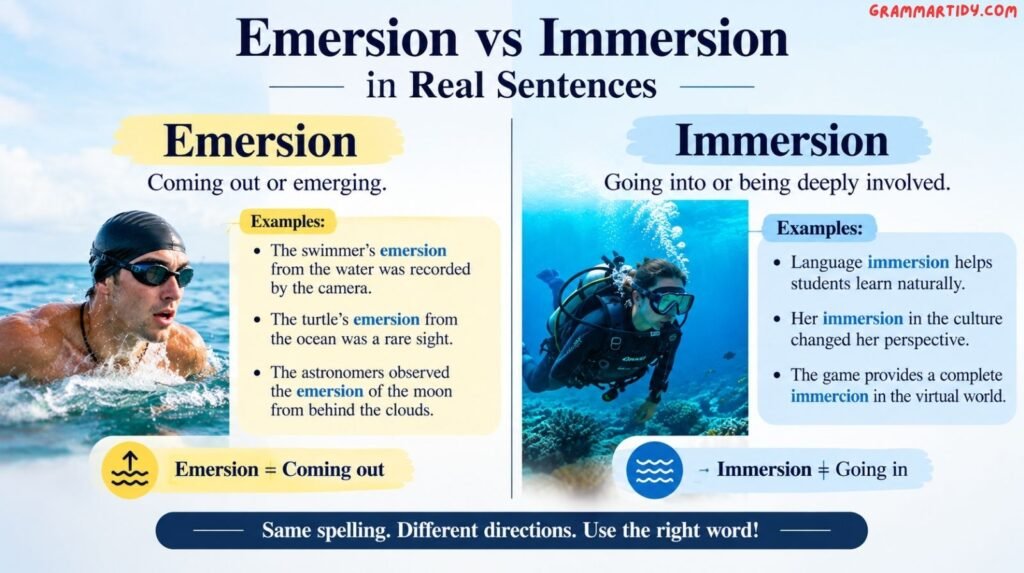
Seeing both words in context makes their difference much clearer.
Example 1: Water
❌ Incorrect: The swimmer’s immersion from the pool was recorded.
✅ Correct: The swimmer’s emersion from the pool was recorded.
Why? The swimmer is coming out of the water.
However:
✅ Correct: The swimmer’s immersion in the pool began at noon.
Here, the focus is on the swimmer being in or under the water.
Example 2: Education
❌ Incorrect: The student used Spanish emersion to learn the language.
✅ Correct: The student used Spanish immersion to learn the language.
Why? The student is becoming deeply involved in the Spanish language.
Example 3: Culture
❌ Incorrect: Cultural emersion helped him experience local traditions.
✅ Correct: Cultural immersion helped him experience local traditions.
Again, the person is entering deeply into an environment.
Real-Life Case Study: Choosing the Right Word in Content Writing
Imagine a travel blogger writing about a scuba-diving experience.
The writer creates the following sentence:
“The immersion of the divers from the ocean was an unforgettable moment.”
Although the sentence contains a familiar word, the meaning is unclear and technically incorrect if the writer is describing the moment the divers came out of the water.
The correct sentence would be:
“The emersion of the divers from the ocean was an unforgettable moment.”
However, there is another important writing lesson here. Even though emersion is technically appropriate, it may sound overly technical for a general travel audience.
A clearer version could be:
“The divers emerged from the ocean after an unforgettable underwater adventure.”
Now consider another sentence:
“The divers experienced complete immersion in the underwater world.”
This use of immersion is perfect because the sentence describes being deeply surrounded by and involved in the underwater environment.
This example shows why correct word choice is about more than dictionary definitions. Good writing also considers context, audience, readability, and natural language. A technically correct word is not always the clearest choice for every reader.
Usage Data and Language Trends in 2025–2026
Current dictionary and language-reference updates continue to show that immersion is strongly established across modern English, especially in education, culture, entertainment, technology, and physical contexts.
Recent dictionary examples from 2025 and 2026 include uses of immersion and related forms such as immersive in discussions involving language learning, culture, entertainment, and modern experiences.
Meanwhile, emersion remains a valid English word, but its use is much more specialized. Merriam-Webster defines it directly as an act of emerging or emergence and notes its historical use dating back centuries.
What This Means for Writers
For most everyday content:
- Use immersion when discussing deep involvement.
- Use emersion only when you specifically mean emerging or coming out.
- Consider simpler alternatives when writing for a broad audience.
This approach supports clear, people-first writing an important principle emphasized in Google’s guidance for helpful and reliable content.
Also Read: Courtesy vs Curtesy: Meaning, Usage And Common Mistakes
How to Choose Between Emersion and Immersion
Use this simple three-step process.
Step 1: Ask About the Direction
Is something coming out?
➡ Use emersion.
Is something going into something or becoming deeply involved?
➡ Use immersion.
Step 2: Check the Context
Technical or scientific context involving emergence?
➡ Emersion may be appropriate.
Education, culture, gaming, technology, or deep involvement?
➡ Immersion is probably correct.
Step 3: Think About Your Audience
If your readers are unfamiliar with technical vocabulary, a simpler alternative may improve readability.
For example:
Instead of:
The emersion of the animal occurred at sunrise.
You could write:
The animal emerged at sunrise.
Both can communicate the idea, but the second sentence is easier for most readers.
Common Mistakes With Emersion and Immersion
Mistake 1: Using Immersion for Coming Out
❌ The diver’s immersion from the water was observed.
✅ The diver’s emersion from the water was observed.
Mistake 2: Using Emersion for Deep Involvement
❌ Cultural emersion helped the student understand local traditions.
✅ Cultural immersion helped the student understand local traditions.
Mistake 3: Assuming Emersion Is Always a Misspelling
This is incorrect.
Emersion is a real English word, although it is much less common than immersion.
Mistake 4: Choosing a Complex Word When a Simple One Works Better
Technical vocabulary can sometimes reduce clarity.
Instead of automatically using emersion, ask whether emergence, coming out, or the verb emerged would communicate your meaning more naturally.
Emersion vs Immersion: Which Word Should You Use?
The answer depends entirely on meaning.
Use Emersion When:
- Something emerges
- Something comes out
- Something becomes visible after being hidden
- You are writing in a specialized scientific or technical context
Use Immersion When:
- Something is completely submerged
- Someone becomes deeply involved
- You are discussing language learning
- You are describing cultural experiences
- You are talking about immersive technology or entertainment
In everyday English, immersion will usually be the word you need.
Also Read: Quantify vs Qualify: Differences And Correct Usage
Mini Quiz: Emersion vs Immersion
Quiz 1: What does emersion mean?
A) Going deeper into something
B) Coming out or emerging
C) Staying underwater
D) Learning something
Answer: B) Coming out or emerging
Quiz 2: What does immersion usually mean?
A) Completely entering or being deeply involved
B) Coming out of water
C) Forgetting something
D) Moving away
Answer: A) Completely entering or being deeply involved
Quiz 3: Complete the sentence: “Language _____ helps students learn naturally.”
A) Emersion
B) Immersion
C) Emergence
D) Exit
Answer: B) Immersion
Quiz 4: A diver coming out of the water experiences:
A) Immersion
B) Emersion
C) Inclusion
D) Participation
Answer: B) Emersion
Quiz 5: Which word is more common in everyday English?
A) Emersion
B) Immersion
C) Both equally
D) Neither
Answer: B) Immersion
Quiz 6: “Cultural _____ helped her understand local traditions.”
A) Emersion
B) Immersion
C) Exit
D) Emergence
Answer: B) Immersion
Quiz 7: Which word relates to coming out?
A) Immersion
B) Emersion
C) Involvement
D) Submersion
Answer: B) Emersion
Quiz 8: Which word relates to being completely surrounded by something?
A) Emersion
B) Immersion
C) Emergence
D) Departure
Answer: B) Immersion
Quiz 9: True or False: Emersion is a real English word.
A) True
B) False
Answer: A) True
Quiz 10: Which sentence is correct?
A) Spanish emersion improved his language skills.
B) Spanish immersion improved his language skills.
Answer: B) Spanish immersion improved his language skills.
Quiz 11: Which word is often used in language learning?
A) Emersion
B) Immersion
C) Exit
D) Emergence
Answer: B) Immersion
Quiz 12: Remember the easy trick: “Into” connects best with which word?
A) Emersion
B) Immersion
C) Emergence
D) Expression
Answer: B) Immersion
Also Read: Accross vs Across: Which Is The Correct Spelling?
Quiz 13: Which context is emersion more likely to appear in?
A) Scientific writing
B) Everyday greetings
C) Shopping lists
D) Social media captions
Answer: A) Scientific writing
Quiz 14: A person deeply involved in a new culture experiences:
A) Emersion
B) Immersion
C) Departure
D) Removal
Answer: B) Immersion
Quiz 15: The easiest way to remember Emersion vs Immersion is:
A) Emersion = coming out, Immersion = going in
B) Both mean exactly the same
C) Immersion = coming out, Emersion = going in
D) Neither relates to direction
Answer: A) Emersion = coming out, Immersion = going in
FAQs
Q. Is emersion a real word?
A: Yes. Emersion is a real English word meaning the act of emerging or coming out. However, it is much less common than immersion.
Q. What is the main difference between emersion and immersion?
A: Emersion means coming out or emerging, while immersion means going into something completely or becoming deeply involved in it.
Q. Is emersion the opposite of immersion?
A: In many physical contexts, they can describe opposite directions. Immersion involves going into or being surrounded, while emersion involves coming out or emerging.
Q. Can I use emersion instead of immersion?
A: No. The two words have different meanings. Use emersion for emerging and immersion for complete involvement or submersion.
Q. What does language immersion mean?
A: Language immersion means learning a language through extensive exposure and active use, often by surrounding yourself with the language in real-life situations.
Q. Why is immersion more common than emersion?
A: Immersion has many common modern uses in education, culture, gaming, technology, and entertainment. Emersion is generally limited to more specialized contexts.
Conclusion:
Understanding emersion vs immersion becomes easy once you remember the direction of the action.
Emersion means coming out or emerging.
Immersion means going in, being surrounded, or becoming deeply involved.
Although the words look similar, they should not be used interchangeably. In most everyday situations especially when discussing language learning, culture, gaming, or deep involvement immersion is the correct choice.
Before using either word, ask yourself one simple question: Is something coming out, or is it going deeply in?
That answer will help you choose the right word every time.
Keep learning with more easy grammar lessons on GrammarTidy.com

Hi, I’m Noor Fatima, the author and creator of Grammar Tidy. I’m passionate about grammar, writing, and making language learning simple and enjoyable. Through Grammar Tidy, I share helpful tips, clear explanations, and practical guidance to help readers improve their writing, avoid common mistakes, and communicate with confidence. My goal is to make better grammar easy, useful, and accessible for everyone.